
Military Psychology: Why Armies Break and Rout
When thousands of armed men collide on a battlefield, physical attrition rarely dictates the victor. Decades of historical research confirm that the foundational principles of military psychology decide who holds the ground and who flees. Soldiers do not fight until an entire battalion is wiped out. They fight only until the sensation of imminent, unanswerable destruction overpowers their training.
The field of military psychology demonstrates that cohesion, rather than muscle or weaponry, forms the true currency of the frontline. A formation remains lethal only as long as its constituent members believe that staying in line offers a better chance of survival than running. The moment that collective belief shatters, an army ceases to exist as an organized force.
The Illusion of Physical Attrition: Bloodless Pre-Breaks
A common misconception suggests that military victories occur because one side physically eliminates the other in prolonged hand-to-hand or volley-to-volley combat. Combat data across centuries exposes a far more psychological reality. In set-piece engagements from antiquity through early modern warfare, infantry units rarely sustained more than five to ten percent casualties before their tactical integrity dissolved.
The human nervous system is biologically ill-equipped for sustained exposure to lethal violence. In his landmark nineteenth-century research, the French military theorist Charles Ardant du Picq observed that ancient melees were rarely grinding, continuous struggles. Instead, opposing lines engaged in brief, hesitant clashes interspersed with cautious withdrawals to safe distances.
The dynamic can be broken down into measurable psychological thresholds:
-
The Stand-Off Phase: Troops approach within missile or visual range, shouting, drumming, and clashing weapons to project resolve while managing visceral fear.
-
The Point of Contact: Only the forward rank physically exchanges blows, while rear ranks provide physical pressure and psychological insulation.
-
The Wavering Point: As local casualties mount, rear ranks look backward; soldiers cease stepping forward to replace fallen comrades in the front rank.
-
The Break: The sudden transformation of disciplined collective action into individualized panic and flight.
Within modern military psychology, this breaking point is recognized as a profound collapse of peer trust. The soldier does not evaluate the general’s strategic plan or calculate operational odds. The soldier monitors the men directly to his left and right.
When the file leader stumbles or turns back, the psychological contract of the frontline disintegrates. Physical exhaustion combines with cognitive overload, paralyzing rational decision-making and triggering the ancient flight reflex.
Cohesion, Sightlines, and the Nervous System Under Fire
Unit cohesion is the central study of applied military psychology. Cohesion is not an abstract ideological loyalty to a nation or an emperor. It is an intensely localized dynamic maintained through sensory cues: the sight of standard flags, the sound of the drumbeat, and the shoulder-to-shoulder contact of comrades.
Sensory deprivation on the battlefield shatters these anchors with brutal speed:
-
Gunpowder Smoke: Dense clouds of sulfur smoke blind commanders and isolate squads, generating auditory isolation where only incoming fire is audible.
-
Acoustic Chaos: Screaming horses, exploding shells, and the din of steel drown out the voice of subaltern officers, breaking oral chains of command.
-
Spatial Compression: Packing men too tightly restricts arm movement, elevates internal body temperatures, and creates claustrophobia.
-
Sensory Overload: The smell of burning flesh, disemboweled bodies, and blood triggers instinctive revulsion that overwhelms trained conditioned responses.
Under extreme danger, the sympathetic nervous system initiates vasoconstriction, tunneling vision to immediate threats and extinguishing peripheral awareness. In the discipline of military psychology, this is known as cognitive narrowing. A soldier locked in tunnel vision cannot perceive that his unit holds a winning position elsewhere along the line.
If an adjacent company retreats through his narrow field of view, the soldier assumes total defeat is underway. The mind processes visual retreat as contagion. Panic does not travel down formal chains of command; it spreads outward through direct lines of sight.
Tactical training regimens [Internal Link: Historical Infantry Drill and Discipline] were designed precisely to overwrite these biological reflexes through repetitive, muscle-memory motor patterns.
The Domino Effect of Flank Failures
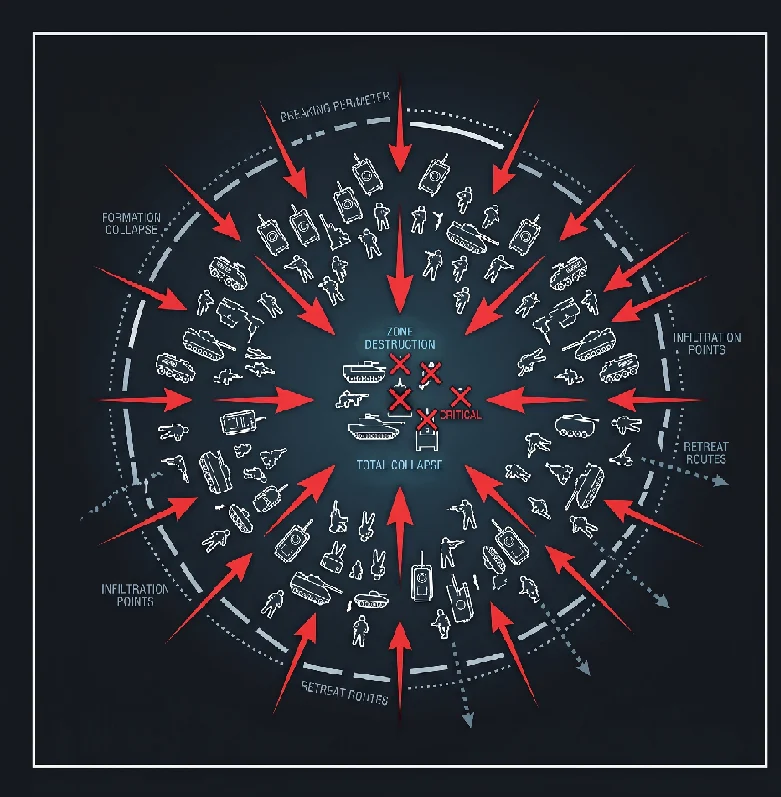
The flank has always been the soft underbelly of combat formations, but its vulnerability is as much mental as it is geometric. When a flank is turned, the principles of military psychology explain why entire armies collapse long before the enemy encircles their main body.
An infantryman facing forward behind a raised shield or leveled musket feels protected by the collective front of his formation. His front is secure, and his comrades guard his sides. The moment hostile cavalry or skirmishers appear on his flank, his defensive bubble bursts.
The psychological impact of a flank attack follows a rapid cascade:
-
Loss of Protective Directionality: Soldiers realize their primary defensive gear—whether scuta, pikes, or breastplates—cannot cover two directions simultaneously.
-
Peripheral Paralysis: Unable to face the new threat without breaking rank, soldiers freeze, waiting for commands that rarely arrive through the noise.
-
The Encirclement Delusion: Peripheral soldiers extrapolate localized flanking actions into total, unavoidable encirclement.
-
The Backward Rush: The rear ranks, who are unengaged and face no immediate physical obstacle to flight, break first, abandoning the front ranks to their fate.
The study of military psychology reveals a grim paradox: the rear ranks, which suffer the fewest casualties in combat, almost universally initiate a rout. The front ranks are physically locked against the enemy line, occupied by the urgent mechanics of parrying and thrusting. The rear ranks have nothing to do except listen to screaming, observe incoming missiles, and contemplate death.
Because rear ranks possess open space behind them, they have the physical freedom to run. Once the rear begins to dissolve, the frontline discovers it has lost its backing. The forward soldiers realize they are abandoned, drop their gear, and turn back.
Tactical Breakdown and the Anatomy of Panic
Panic is not a random emotional outburst. In the framework of military psychology, panic is an adaptive, albeit disastrous, survival mechanism operating under extreme stress. When communication lines snap, soldiers default to self-preservation.
The Stages of Cohesion Breakdown in Military Psychology
-
Phase One – Cognitive Dissonance: Incoming threats exceed the expectations set by officers, leading soldiers to doubt tactical leadership.
-
Phase Two – Loss of Situational Awareness: Units become blinded by dust, smoke, or topography, producing rumors of enemy breakthrough.
-
Phase Three – Micro-Defections: Individual soldiers invent tasks to escape the front, such as carrying a lightly wounded comrade to the rear.
-
Phase Four – Mass Inversion: Orderly lines reverse into an undifferentiated mob where soldiers trample their own companions to clear exit routes.
Once mass inversion occurs, the mechanisms of command are utterly impotent. Mounted couriers cannot penetrate the fleeing mass. Trumpet signals and drum rhythms are lost in the stampede.
In early modern and ancient warfare, generals frequently placed veteran reserves or file-closers behind the lines with drawn weapons to execute any soldier turning backward. Yet even the threat of summary execution fails once the threshold of panic is crossed. The fear of the charging enemy ahead or to the flank eclipses the fear of punishment from friendly officers.
The application of military psychology demonstrates that terror is exponential. It moves through a regiment with the speed of an acoustic wave, shifting an invincible battle line into an unarmed crowd in under sixty seconds.
The Asymmetry of the Rout: The True Harvest of Death
The most counterintuitive finding within historical military psychology concerns where and when casualties actually occur. Popular imagination pictures the bloodiest moments taking place during the titanic clash of weapons at the center of the field. Historical and forensic records show the exact opposite.
During the active, organized clash, casualties remain relatively light because defensive armor, parries, and shield walls function as intended. Both sides maintain defensive vigilance.
The catastrophic spike in fatalities occurs only after one side breaks:
-
Fleeing soldiers throw away heavy shields, body armor, and primary weapons to maximize running speed.
-
Turning their backs to the enemy exposes unarmored necks, spines, and kidneys to pursuing blades, lances, and projectiles.
-
The formation can no longer provide mutual cover, leaving isolated individuals to be hunted down piecemeal.
-
Pursuing cavalry run down running infantry with negligible risk of counter-injury, turning war into an industrial slaughter.
Battlefield data from the classical era to the nineteenth century indicates that between seventy and ninety percent of all combat deaths were inflicted during the pursuit phase. The rout is not the consequence of a high body count; the high body count is the consequence of the rout.
This reality explains why military thinkers steeped in military psychology placed supreme importance on cavalry pursuits. To defeat an enemy formation was merely to take ground; to break its cohesion and hunt down its fleeing elements was to erase that army from the strategic board permanently.
Forensic investigations [Internal Link: Battlefield Osteology and Trauma Analysis] regularly unearth skeletons displaying deep slicing wounds to the rear cranium and dorsal vertebrae, physical monuments to the lethal reality of rearward flight.
Leadership, Charisma, and Psychological Reclamation
If fear is contagious, resolve can be equally transmissible. A central focus of historical military psychology is the study of how exceptional field leaders stabilized wavering lines through physical presence and symbolic theater.
In the confusion of smoke and iron, the physical appearance of an identifiable commander acted as a psychological circuit-breaker. When Alexander the Great charged at the head of the Companion cavalry, or Julius Caesar donned his scarlet cloak (paludamentum) at the climax of the Siege of Alesia, they were not indulging in theatrical vanity. They were applying practical military psychology.
By making themselves visibly recognizable to the common soldier, these leaders accomplished several critical tasks:
-
They provided an unambiguous focal point that pierced the sensory chaos of the field.
-
They demonstrated that the situation was not yet hopeless, as the supreme commander was willing to share the immediate physical hazard.
-
They exploited the human desire for social approval, shaming men out of private flight through public scrutiny.
Charismatic intervention works only within narrow physical limits. A general can rally only those men who can directly see his gestures and hear his voice. As battlefields expanded in the nineteenth century, personal command presence became obsolete.
The discipline of military psychology had to shift its focus from the theatrical heroism of the general to the institutional conditioning of the small-unit leader. Non-commissioned officers and junior lieutenants became the primary anchors of combat resilience.
Historical Case Studies in Cohesion and Collapse
The historical record offers undeniable proofs of how military psychology overrides physical strength and numerical superiority. Across every continent, superior forces have disintegrated in minutes when their psychological cohesion fractured.
Consider the Battle of the Granicus in 334 BCE. The Persian satrapal army held the high, muddy bank of the river, possessing excellent defensive terrain and parity in heavy cavalry. Yet when Alexander’s shock cavalry drove wedge formations directly into their central command group, slaying several prominent aristocrats, the Persian cavalry withdrew.
Left without orders and shocked by the sudden flight of their mounted protectors, the massive force of Greek mercenary hoplites standing in reserve remained immobile. They were surrounded and slaughtered not because they were outmatched in martial prowess, but because cognitive shock had paralyzed their decision-making apparatus.
Similarly, at the Battle of Leuthen in 1757, Frederick the Great demonstrated the absolute operational power of applied military psychology. Facing an Austrian army nearly double his size, Frederick executed an oblique order maneuver behind a low chain of hills.
The maneuver concealed his true vector of approach, allowing his shock columns to strike the exposed Austrian left flank with devastating surprise. The Austrian troops on the far right could see smoke and hear gunfire, but their commanders hesitated, unable to comprehend the spatial threat.
Before the Austrian right could wheel into position, their left flank rolled up like a carpet. Men broke in blind terror, running into their own advancing columns and spreading panic like a virus across thirty thousand fresh troops. The Austrian host shattered from the inside out.
Archaeological Evidence of the Broken Line
The material reality of tactical panic is preserved in the physical earth. Modern battlefield archaeology provides empirical backing to the theoretical frameworks of military psychology.
Surveys of historical retreat corridors consistently reveal distinct patterns of material discard:
-
Discarded Weapons and Armor: Heavy items like breastplates, muskets, and broadswords are found concentrated in shallow ravines and roads radiating away from the primary engagement line.
-
Scattered Personal Effects: Excavations along flight routes unearth dropped pay chests, personal mess tins, and religious icons cast aside to lighten burdens.
-
Non-Combatant Entanglements: Baggage trains positioned near the rear are routinely discovered burned and looted, frequently by their own fleeing comrades desperate for pack horses.
Forensic examination of human remains in mass graves at sites like Towton (1461) and Lützen (1632) reveals that the vast majority of fatal trauma occurred from behind. Skulls show horizontal cuts along the occipital bone and crushed cervical vertebrae, sustained while running away from mounted pursuers.
These physical remnants prove that the moments before death were not spent in heroic, mutual fencing. They were spent in the desperate, lonely flight that occurs when the social fabric of the military unit dissolves.
The enduring contributions of military psychology remind us that war remains fundamentally a human enterprise. Long after weaponry changes, the human animal inside the steel or the kevlar remains subject to the same primordial balance between collective duty and self-preservation.
Frequently Asked Questions
What causes a disciplined army to panic suddenly during combat?
An army panics when soldiers perceive that their formation can no longer protect them from imminent destruction. This cognitive breakdown is typically triggered by flank attacks, the unexpected flight of adjacent units, the sudden death of visible leaders, or sensory disorientation caused by smoke and noise that isolates soldiers from their comrades.
Why do most battlefield casualties occur during the retreat rather than the initial fighting?
Most casualties occur during the retreat because fleeing soldiers cast away their shields, armor, and weapons to run faster, leaving their backs exposed to pursuers. Once defensive formations break, soldiers can no longer provide mutual protection, allowing pursuing cavalry or infantry to cut them down with minimal danger to themselves.
How does military psychology explain why rear ranks often break before front ranks?
Rear ranks often break first because they are unengaged in direct hand-to-hand combat and have the spatial freedom to look around and flee. While the front ranks are fully occupied with defending their lives, rear ranks experience intense sensory stress, feel helpless to influence the fight, and panic when they observe neighboring units falling back.