
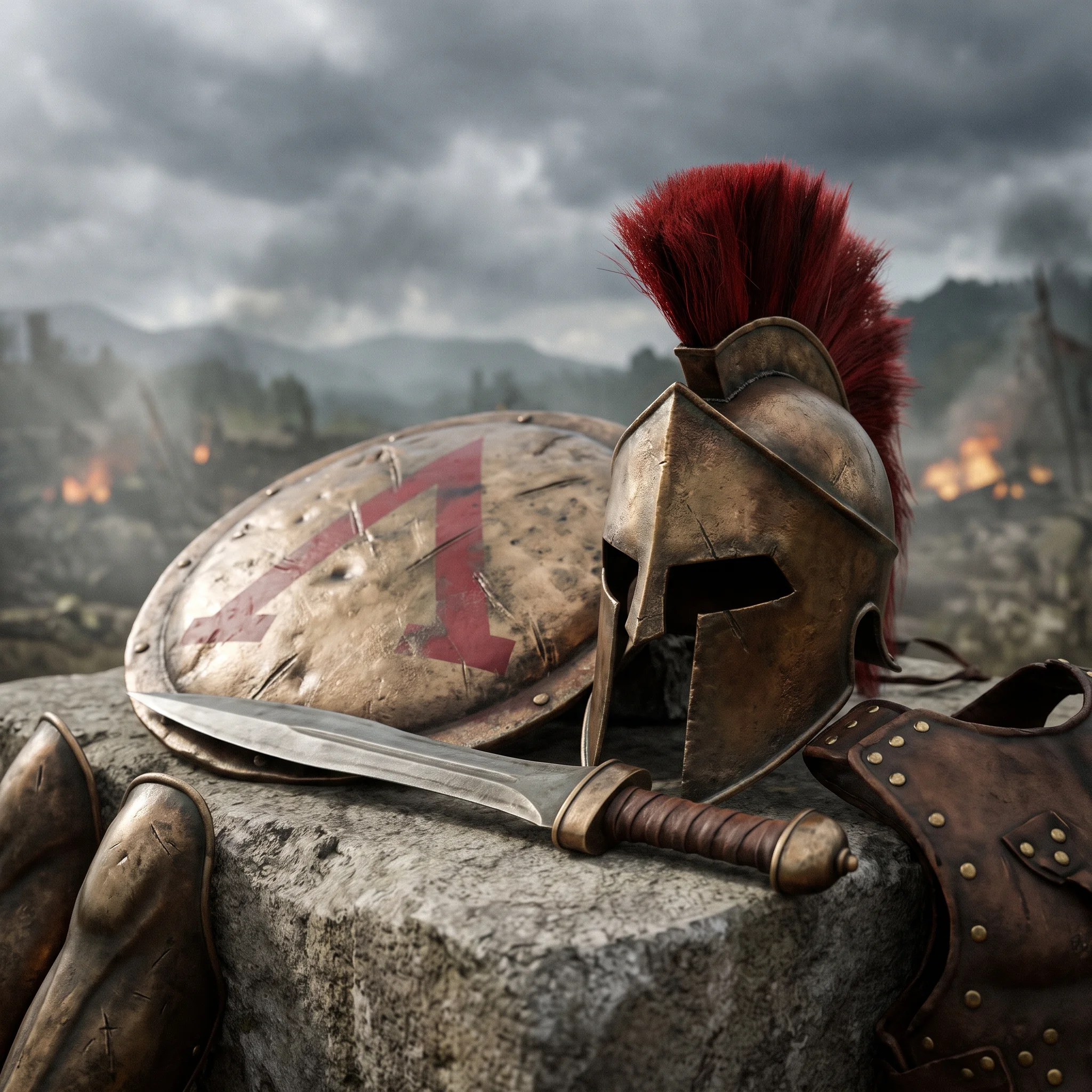
The Spartan Army: Training, Phalanx Tactics, and Reality
The Spartan army stood as the preeminent land fighting force of classical Greece, dominating Mediterranean warfare throughout the fifth and fourth centuries BCE. Unlike the citizen-soldiers of competing Greek city-states who farmed or practiced maritime commerce between seasonal military campaigns, every full Spartan citizen functioned as an elite, state-subsidized combat professional. This structural focus produced unmatched unit cohesion, rapid tactical deployment, and psychological dominance over regional rivals.
Classical historians like Xenophon and Thucydides documented how the Spartan army transformed military readiness from a civic burden into an all-encompassing lifestyle. Sustained entirely by an enslaved rural underclass known as helots, Spartan hoplites drilled constantly from boyhood to preserve their domestic hegemony. While popular culture depicts these soldiers as reckless berserkers, surviving historical records reveal a cold, methodical machine built on iron cadence, standardized maneuvering, and collective preservation.
The Agoge: Forging the Spartan Army from Youth
The combat superiority of the Spartan army began not on the drill field, but in early childhood through the agoge, the compulsory state education and conditioning system. Attributed by ancient tradition to the legendary lawgiver Lycurgus, this state pipeline stripped young boys of family domesticity at age seven. Its primary objective was the systematic elimination of personal self-interest in favor of unconditional obedience to the collective unit.
[Age 7: Enrollment]   ──► Paides Stage (Barefoot Conditioning & Scanty Rations)
           │
           ▼
[Age 14: Hardening]   ──► Paidikoi Stage (Weapon Drills, Choral Cadence & Krypteia)
           │
           ▼
[Age 20: Enlistment]  ──► Hebontes Stage (Active Field Service & Syssition Messes)
           │
           ▼
[Age 30: Full Status] ──► Spartiate Peer (Assembly Voting & Reserve Obligations)
Life within the agoge was defined by calculated privation and relentless physical testing. Boys wore a single coarse woolen cloak (himation) year-round through winter freezes, slept on sharp river reeds gathered without iron knives, and walked barefoot across rocky terrain to harden their soles. State trainers deliberately underfed the young wards to encourage the theft of food from storehouses, punishing recruits severely not for the moral crime of theft, but for the tactical clumsiness of being caught.
At age fourteen, youths entered the paidikoi phase, mastering weapon handling, shield formations, choral dances, and rhythmic movements performed to double-reed pipes. Select youths joined the Krypteia, an internal security apparatus where recruits lived off the land armed only with daggers. Their primary mission was stalking, terrorizing, and preemptively executing potentially rebellious helots across rural Laconia.
Upon reaching age twenty, a young man was conscripted into the active ranks of the Spartan army, living in common barracks and dining in mandatory military messes (syssitia). Election to a syssition required unanimous approval from its adult members; a single blackball vote resulted in permanent social disenfranchisement. Only at age thirty did a soldier gain full citizen rights and permission to reside with his domestic family, though active field obligations in the Spartan army continued until age sixty.
Phalanx Tactics and Standardized Command Architecture
The core battlefield engine of the Spartan army was the hoplite phalanx, an eight-to-twelve-rank deep formation of heavily armored spearmen locked shield-to-shield. While other Greek poleis deployed disorganized mobs of citizens who surged forward in an uncontrolled rush, Sparta developed an articulate command hierarchy capable of complex maneuvers under combat conditions.
The command pyramid relied on standardized military subdivisions:
-
Polemarch: A senior general officer commanding a full territorial regiment (mora), taking direct strategic orders from the reigning Spartan king.
-
Lochagos: An officer commanding a battalion-sized unit (lochos), responsible for executing tactical evolutions on the main battle line.
-
Pentekontekter: A junior commander directing a fifty-man line unit, ensuring file cohesion and spacing during operational marches.
-
Enomotarch: A frontline file leader directing an enomotia (roughly thirty-two men), serving as the foundational building block of the entire formation.
                            [ SPARTAN KING / POLEMARCH ]
                                         │
        ┌────────────────────────────────┴────────────────────────────────┐
        ▼                                                                 ▼
[Right Flank Command]                                           [Left Flank Support]
- King and 300 HiPPEIS royal guard                              - Allied Perioikoi and Neodamodeis
- Anchor of the entire battle formation                        - Defensive screen and cavalry cover
- Executes wheeling movements to envelop enemy                  - Absorbs initial skirmisher pressures
Unlike their rivals, the Spartan army did not charge into battle screaming discordant war cries. Retainers advanced in measured silence, marching to the slow tempo of double-reed flutes (auloi). This deliberate cadence kept the formation tight, prevented winded lungs, and kept shields overlapping before physical impact.
The ultimate maneuver of the Spartan army was the right-flank wheel. Because individual hoplites naturally drifted rightward to tuck their exposed sword arm behind their neighbor’s shield, the right flank of any Greek army tended to outflank its adversary’s left. Spartan commanders mastered this natural battlefield drift, deliberately executing a flanking wheel to roll up the enemy’s center from the rear, as analyzed in the strategic breakdowns of the [Internal Link: Battle of Sekigahara Tactics].
Phalanx Maneuvers of the Spartan Army
The disciplined structure of the Spartan army allowed it to execute complex evolutions under fire that shattered less-organized enemy lines. When ordered to reposition, files could open, compress, or reverse direction without breaking contact with adjacent squads.
+------------------------------------------------------------------------+
|                PHALANX COMBAT FORMATIONS & FIELD EVOLUTIONS            |
+------------------------------------------------------------------------+
| 1. PYKNYSIS: Shield lock compression reducing file width to 1.5 cubits |
| 2. EPIDROME: Controlled line advance executed to steady flute tempo    |
| 3. ANASTROPHE: File counter-march reversing facing against rear threats |
| 4. OTHISMOS: Massed rearward push driving shield bosses through enemy  |
+------------------------------------------------------------------------+
During the othismos, or massed shield press, the rear ranks used their shields to brace against the backs of front-line fighters, turning the entire unit into a unified battering ram. The Spartan army perfected this technique, relying on relentless collective drive to snap opposing spear walls through concentrated mechanical force.
Arms and Metallurgical Specifications of the Panoply
A soldier of the classical Spartan army was an imposing visual and metallurgical spectacle. Encased in cast bronze and wrought iron, the hoplite carried equipment designed for brutal blunt-force impact and high-density close combat.
+-------------------------------------------------------------+
|              SPARTAN HOPLITE COMBAT PANOPLY AUDIT           |
+-------------------------------------------------------------+
| • Primary Weapon: Dory (ash spear, 2.5–3 meters, 1–2 kg)    |
| • Secondary Weapon: Xiphos (short leaf-blade sword, 30 cm)  |
| • Shield: Aspis/Hoplon (wood core, bronze sheet, ~7–8 kg)   |
| • Armor: Bronze muscled cuirass or laminated linothorax     |
| • Helmet: Corinthian/Pilos style bronze cranial protection  |
| • Uniform: Crimson woolen cloak (phoinikis) dyed with kermes|
+-------------------------------------------------------------+
Every offensive and defensive piece served a specific tactical function:
-
The Aspis (Hoplon): A concave wooden shield measuring roughly one meter across, faced with a thin bronze sheet. It featured a dual-grip system consisting of a central bronze forearm band (porpax) and an edge cord (antilabe), allowing the hoplite to direct immense forward pushing power during the othismos.
-
The Dory: The main offensive thrusting spear, spanning between 2.5 and 3 meters. Crafted from straight-grained ash wood for tensile elasticity, it featured a leaf-shaped iron head and a bronze butt-spike (sauroter), which grounded the spear and served as a backup point if the main shaft snapped.
-
The Xiphos: A short iron cutting-and-thrusting blade. Spartan swords were famously shortened to approximately thirty centimeters, enabling retainers to stab over and under locked shield rims in dense crushes where longer Athenian blades became jammed.
-
The Crimson Cloak (Phoinikis): Woven from dense wool and dyed red with kermes insects, this uniform cloak concealed blood from wounds, presented a terrifying uniform wall of color, and prevented panic in the ranks.
The Logistical Engine: Helots, Perioikoi, and Social Reality
The combat performance of the Spartan army rested entirely on a brutal domestic foundation. Spartiates did not generate wealth, weave their clothing, or till the soil. The economic survival of the state was extracted through the permanent enslavement of the Messenian and Laconian populations, known as helots.
Helots outnumbered their Spartan masters by an estimated seven-to-one margin. Each Spartiate household was assigned state-owned parcels of land (kleroi) worked by assigned helot families who surrendered half their annual harvest in barley, wine, figs, and oil. This oppressive arrangement freed the Spartan citizen to train in arms daily, but it forced the military elite to live in constant fear of domestic rebellion.
                    [ SPARTAN CITIZEN ELITE: SPARTIATES ]
                      (Full-Time Professional Military)
                                      │
                                      ▼
                    [ PERIOIKOI: "DWELLERS ROUNDABOUT" ]
                 (Free Artisans, Miners, Armorers, Sailors)
                                      │
                                      ▼
                    [ HELOTS: STATE-ENSLAVED POPULATION ]
               (Agricultural Serfs, Camp Servants, Light Troops)
The free, non-citizen population known as the perioikoi (“those dwelling around”) managed external trade, copper mining, and arms production. They formed independent auxiliary contingents that fought alongside the regular Spartan army.
Helots were also impressed into military service as baggage handlers, shield-bearers, and light skirmishers armed with slings and stones. At the decisive Battle of Plataea in 479 BCE, classical historian Herodotus recorded that each Spartan hoplite was accompanied by seven light-armed helots, highlighting the massive labor footprint required to sustain heavy infantry in the field. As detailed in the historical analysis of Encyclopaedia Britannica’s history of Sparta and its military institutions, the entire polis was engineered to suppress internal slave revolts while projecting power abroad.
Tactical Decline, Demographic Collapse, and Leuctra
Despite its legendary status, the structural weaknesses of the Spartan army led to its eventual collapse in the fourth century BCE. The primary vulnerability was not tactical, but demographic. The total population of adult male Spartiates (oliganthropia) contracted steadily from approximately 8,000 during the Persian Wars to fewer than 1,000 by the middle of the fourth century.
[479 BCE: Persian Wars]       ──► ~8,000 Full Spartiate Citizens
            │
            ▼
[431–404 BCE: Peloponnesian] ──► Severe Combat Losses & Economic Fracturing
            │
            ▼
[371 BCE: Battle of Leuctra]  ──► Fewer than 1,000 Spartiates Remaining
            │
            ▼
[Post-Leuctra Realities]      ──► Messenia Liberated; Spartan Hegemony Crushed
The catastrophic turning point arrived at the Battle of Leuctra in 371 BCE. The innovative Theban commander Epaminondas dismantled classical doctrine through asymmetric tactics. Rather than deploying his army in standard eight-rank lines, Epaminondas concentrated a massive fifty-rank-deep strike column on his left wing, spearheaded by the elite Theban Sacred Band.
Epaminondas smashed directly into the royal right wing of the Spartan army before the Spartan king, Cleombrotus, could complete his signature flanking wheel. Cleombrotus was killed alongside four hundred elite Spartiates, destroying roughly one-third of the entire citizen infantry in a single afternoon. Theban forces subsequently invaded Laconia, liberated the Messenian helots, and built fortified city-states to hem in Sparta permanently.
Deprived of their enslaved agricultural base and facing an irreversible manpower deficit, the Spartan army never regained its regional supremacy. By the time Roman legions annexed Greece in 146 BCE, Sparta had declined into a provincial backwater, preserved largely as a tourist destination where Roman visitors observed mock floggings at the altar of Artemis Orthia.
Historic Reality vs. Modern Popular Culture
Modern cinema and literature frequently present the Spartan army as an invincible force of bare-chested individualists fighting for abstract concepts of freedom. Authentic classical history contradicts this image at every turn.
POPULAR HOLLYWOOD MYTHOLOGY
├── Bare-chested berserkers seeking individual glory
├── Ideological crusade for democracy and Western liberty
├── Total disdain for tactical retreat or strategic maneuvering
└── Reliance on wild, acrobatic sword dueling

AUTHENTIC CLASSICAL MILITARY RECORD
├── Heavy bronze muscle cuirasses, greaves, and helmets
├── Preservation of an oppressive oligopoly over enslaved helots
├── Pragmatic, disciplined retreats executed in strict formation
└── Crushing collective shield pushes orchestrated to flute music
The Spartan system was an authoritarian, closed society that maintained an internal police state built upon the systemic brutalization of an enslaved majority. Retainers fought not for personal glory or freedom, but for total conformity to ancestral laws and the preservation of an aristocratic oligarchy. Master strategists and philosophers of war, including those analyzed in the [Internal Link: Bushido Code Eight Virtues], recognized that the highest martial cultures balance internal restraint with legal order.
The authentic strength of the Spartan army was its clinical, collective discipline. They were the only Greek soldiers who practiced continuous unit drill, understood standardized formations, and operated under a formal chain of command. In an era dominated by seasonal citizen militias, the Spartan army dominated through organizational mastery rather than superhuman physical prowess.
Frequently Asked Questions
Did the Spartan army really never retreat in battle?
The claim that the Spartan army never retreated is a romantic myth contradicted by historical records. While Spartan law and social custom severely condemned cowardice (tresantes), commanders frequently utilized tactical withdrawals and feigned retreats. At the Battle of Thermopylae in 480 BCE, King Leonidas and his forces used feigned retreats to draw Persian infantry into narrow defiles where their numerical superiority was neutralized. Full surrenders also occurred, most notably at the Battle of Sphacteria in 425 BCE, where 120 elite Spartiates surrendered to Athenian forces.
Why did the Spartan army carry red cloaks into combat?
Spartan hoplites wore crimson cloaks (phoinikis) for practical and psychological reasons. Classical writer Xenophon noted that the red dye, produced from crushed kermes insects, served two core functions: it hid bloodstains from battlefield wounds to prevent panic among comrades, and its vivid, uniform appearance demoralized opposing formations. The cloaks were typically shed immediately before entering the physical shield press to maintain free arm movement.
How did the Spartan army handle logistics during long foreign campaigns?
The logistical apparatus of the Spartan army depended heavily on non-combatant labor supplied by helots and allied contingents. Every Spartiate on campaign was accompanied by helot attendants who carried bedding, hauled grain sacks, and maintained bronze armor. For prolonged operations, the state negotiated supply corridors with regional allies or relied on naval transport, though long-distance campaigns often strained Spartan logistics due to their lack of a merchant fleet.