
Roman Empire: The Architectural and Military Machine
In its earliest days, Rome was little more than a muddy settlement of shepherds and outlaws clustered along the banks of the Tiber River. Over centuries of existential warfare and administrative evolution, this central Italian republic transformed into an empire that circled the entire Mediterranean basin. The rise of the Roman Empire represented the triumph of institutional standardization over individual martial heroics.
At its zenith in the second century CE, the Roman Empire encompassed an estimated seventy million inhabitants spanning three continents. Rome did not dominate simply through ruthless battlefield violence. Its endurance stemmed from an industrialized approach to warfare, extraordinary civil engineering, and an administrative capacity to assimilate defeated adversaries into productive citizens.
The Gathering Storm: From Agrarian Levy to Standing Cohorts
The political and territorial expansion of the Roman Empire was repeatedly checked by the limitations of its early citizen militia. Originally, the state relied on an agrarian levy of property-owning citizens who furnished their own bronze panoplies and returned to their farms following seasonal campaigns.
This archaic levy structure cracked under the strain of overseas expansion. Protracted overseas sieges in Spain, Greece, and North Africa kept smallholders away from their fields for years. Small family farms fell into disrepair, foreclosed by wealthy patricians who consolidated massive slave-run agricultural estates known as latifundia.
Displaced farmers flooded into the capital, forming an impoverished, disenfranchised urban proletariat. Because Roman law restricted military enlistment to property owners who met strict census qualifications, the pool of eligible recruits plummeted.
By the close of the second century BCE, recurring Germanic migrations across the Alps exposed this structural manpower shortage. Tribal migrations of the Cimbri and Teutones annihilated successive consular armies in southern Gaul. Rome required a systemic military overhaul to stave off total territorial collapse.
The Marian Transformation: The Forging of Professional Legions
The turning point in Roman military dominance occurred in 107 BCE through the radical restructuring championed by the statesman and general Gaius Marius. Confronted with manpower exhaustion, Marius permanently dismantled the traditional property qualifications for military service.
The reform authorized the enlistment of the capite censi, the landless urban poor whose wealth was assessed solely by their physical presence. The state assumed responsibility for supplying standardized weapons, armor, rations, and medical care, transforming a seasonal civic levy into a permanent, career-driven standing army.
Volunteers enlisted for sixteen-to-twenty-year service terms, drawn by the guarantee of regular wages, a share of campaign plunder, and an imperial land grant upon honorable discharge. This structural shift tied the legionary’s economic survival directly to his commanding general rather than the Roman Senate.
Marius also eliminated the cumbersome baggage trains that choked military columns. Under the new doctrine, legionaries carried their own entrenching tools, cooking pots, clothing, stakes, and rations on their backs. Known derisively as “Marius’ Mules” (muli Mariani), these self-contained combat units regularly marched twenty-five miles a day and erected an impregnable fortified camp every night.
Tactical Weapons Specifications of the Roman Empire
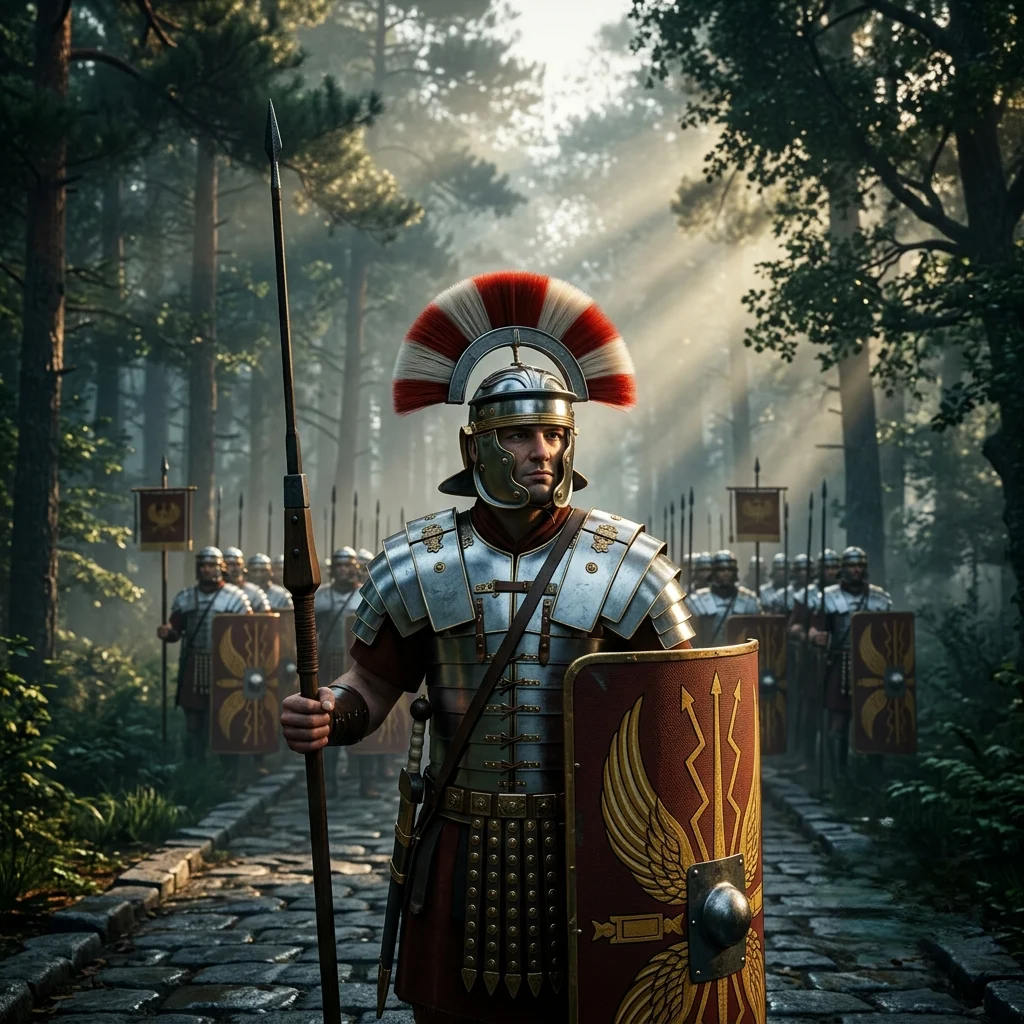
The standard combat kit of the legions was an exercise in industrial metallurgy and biomechanical efficiency. Rather than relying on ornate, personalized gear, arms factories across the Italian peninsula mass-produced standardized equipment designed for aggressive, close-quarter shock action.
The primary arms and protective kit of the legionary included:
-
Gladius Hispaniensis: A double-edged short sword measuring 60 to 68 cm in length, forged from pattern-welded iron and carbon-rich steel, engineered primarily for vicious thrusting between shield seams.
-
Pilum: A heavy, two-meter javelin featuring a hardened steel point and an unhardened soft iron shank, engineered to bend on impact so enemies could neither cast it back nor remove it from punctured wooden shields.
-
Pugio: A wide, leaf-shaped iron dagger with a 20-to-25 cm blade, functioning as an emergency backup sidearm during compressed, chaotic shield-wall melees.
-
Scutum: A curved, semi-cylindrical rectangular plywood body shield measuring 105 cm high, constructed from laminated wooden strips covered in canvas and calfskin, reinforced with a solid iron central boss.
-
Lorica Segmentata: Overlapping internal steel strips fastened to leather straps with brass buckles, providing defense against downward blade slashes and missile strikes while preserving upper-body mobility.
-
Lorica Hamata: Heavy iron chainmail tunics composed of alternating rows of punched solid and riveted iron rings, preferred on peripheral frontier posts for its durability and ease of field repair.
In combat, cohorts operated like a mechanical press. Approaching within thirty yards, ranks loosed coordinated volleys of heavy pila that shattered enemy frontlines and stripped away defensive shields. Drawing their gladii, the legionaries charged in tight, closed files, punching outward with the heavy bronze-shod bosses of their scuta to knock enemies off balance before delivering lethal underhand thrusts into abdomens and groins.
Tactical discipline and drill [Internal Link: Republican Infantry Formations] ensured that individual cohorts could cycle fatigued forward ranks into the secondary lines seamlessly, maintaining relentless physical pressure against exhausted barbarian warbands.
Engineering as an Operational Weapon: Concrete, Stone, and Turf
The ultimate weapon of the Roman Empire was not the gladius, but the spade, the plumb line, and pozzolanic concrete. Roman command understood that physical infrastructure cemented battlefield conquests into permanent fiscal provinces.
Every evening on the march, even in friendly territory, legions dug an elaborate defensive enclosure. Soldiers excavated a perimeter ditch (fossa), threw the soil inward to form a raised earthen rampart (agger), and topped it with a palisade of sharpened wooden stakes (vallum). These standard marching camps prevented night ambushes, secured supply stores, and guaranteed restful sleep in hostile borderlands.
The construction of paved roads transformed strategic mobility:
-
Over 50,000 miles of stone-paved highways linked military outposts from Britannia to the Euphrates River.
-
Road foundations incorporated layered beds of crushed gravel, stone, and lime mortar crowned by polygonal basalt slabs designed to shed rainwater into drainage ditches.
-
Fully equipped legions marched forty miles within twenty-four hours to reinforce threatened frontiers, moving four times faster than unmapped tribal hosts.
-
The state postal service (cursus publicus) maintained relay stations and fresh horses every ten miles, allowing dispatches to travel 150 miles a day across the Mediterranean.
Hydraulic engineering pacified annexed territories through urban prosperity. Legions constructed soaring stone aqueducts across mountain ravines, channeling millions of gallons of clean mountain water into frontier colonies. Surrounding tribal elites were enticed into Roman bathhouses, amphitheaters, and stone villas, trading armed resistance for imperial civic life.
On vulnerable frontier lines, emperors erected fortified cordons. Hadrian’s Wall in northern Britain stretched seventy-three miles from the North Sea to the Irish Sea, featuring stone watchtowers, milecastles, and military garrisons that regulated trade tariffs and severed communication between rebellious Caledonian tribes.
Frontier Bastions Across the Roman Empire
The defensive perimeter of the Roman Empire reached its most sophisticated configuration along the Rhine and Danube rivers. Known as the Limes Germanicus, this border defense system integrated natural river barriers with hundreds of timber watchtowers, stone castra, and earthen palisades.
The limes was never designed as an impenetrable wall meant to halt a massive invasion army. Instead, it operated as a sophisticated screening network:
-
Watchtowers used reflective signal mirrors by day and beacon fires by night to transmit tactical alerts along the river frontier within minutes.
-
Light auxiliary cavalry patrolled the outer riverbanks, intercepting small raiding parties before they struck interior farms.
-
Fortified stone hubs (castra), such as Mogontiacum (Mainz) and Carnuntum, housed full legions ready to deploy through protected sally ports to trap enemy columns against river crossings.
This strategic depth stabilized global trade across the Mediterranean world, allowing peaceful interior provinces to develop thriving ceramic, olive oil, and textile industries unmolested by frontier warfare.
The logistical framework of these border posts [Internal Link: Imperial Army Logistics and Supply Networks] relied on naval flotillas (Classis Germanica) patrolling navigable rivers, hauling grain, timber, and iron billets directly to legionary granaries.
Psychological Tenacity: Total War and Institutional Resilience
The distinguishing feature that separated the Roman Empire from Mediterranean rivals was not battlefield invulnerability, but an absolute refusal to accept defeat. Where other ancient monarchies negotiated concessions following the destruction of their field armies, Rome treated tactical catastrophe as an administrative setback requiring total mobilization.
During the Second Punic War, the Carthaginian general Hannibal Barca eliminated over 100,000 Roman and allied soldiers in three consecutive engagements at the Trebia, Lake Trasimene, and Cannae. Cannae alone claimed over 50,000 citizens in six hours, including a third of the Roman Senate.
Any contemporary Hellenistic empire would have sued for peace under such losses. The Roman Senate responded by outlawing public mourning, banning the word “peace,” lowering the enlistment age to seventeen, and forming two legions from convicted felons and armed slaves.
Rome refused to negotiate while a hostile army occupied Italian soil. By maintaining simultaneous campaigns in Spain, Sicily, and Greece, Rome slowly strangled Carthage’s empire through sheer strategic perseverance, ultimately invading North Africa to dismantle Carthaginian power at Zama.
This relentless institutional tenacity reappeared during the Jewish Revolts, the civil wars of the late Republic, and the suppression of the Illyrian uprising. A state capable of raising replacement legions year after year broke the morale of opponents whose manpower reserves were limited to a single warrior generation.
Forensic Archaeology: The Physical Evidence of Roman Conquest
Modern excavations across Europe and the Middle East provide tangible confirmation of the legionary machine’s destructive capabilities. Battlefield archaeology strips away imperial propaganda, exposing the raw physical reality of Roman operational doctrine.
At the siege site of Masada in Israel, the earthen assault ramp constructed by the Legio X Fretensis survives intact across a 200-foot chasm, demonstrating the extreme lengths of Roman siege engineering. Ballista stones weighing fifty pounds, chiseled from local limestone, litter the breach points, their impact faces shattered from striking mud-brick parapets.
Forensic investigations of skeletal remains at Maiden Castle in Britain and Kalkriese in Germany reveal consistent patterns of trauma inflicted by Roman ordnance:
-
Cranial Fractures: Skulls pierced by square-sectioned iron ballista bolts, fired from torsion catapults (scorpiones) with enough kinetic energy to drill through bone at three hundred yards.
-
Sword Trauma: Fractured pelvic girdles and severed femoral arteries displaying triangular wound paths consistent with the thrusting tip of the gladius.
-
Arrowhead Distribution: Tri-lobed bronze and iron arrow points discovered in dense clusters outside fortified gatehouses, marking massed suppressive volleys fired by Syrian auxiliary archers.
At Kalkriese, the presumed site of the Battle of the Teutoburg Forest (9 CE), archaeologists discovered mass bone pits containing the commingled remains of three legions annihilated in a swampy defile. Forensic analysis shows clear signs of defleshing and exposure to the elements, matching historical accounts of Germanicus revisiting the forest six years later to inter the unburied bones of Varus’s army.
The physical record corroborates the classical histories: Roman military victories were systematic, industrial operations characterized by massive earth-moving projects and disciplined close-quarter execution.
Geopolitical Aftermath: The Enduring Architectural Legacy
The collapse of the Western Roman Empire in the fifth century CE was not triggered by a sudden loss of martial courage. It was the terminal stage of an economic and structural unraveling driven by virulent pandemics, hyperinflation, civic fragmentation, and an over-reliance on unassimilated barbarian federates (foederati).
The Antonine Plague (165–180 CE) and the Plague of Cyprian depleted the agricultural labor base, leaving vast tracts of farmland deserted. To pay its swollen military payroll, the imperial mint progressively debased the silver denarius until it contained less than five percent precious metal, causing widespread currency collapse and forcing the state to collect taxes in grain and cattle.
Yet even as imperial political structures dissolved into feudal baronies, the institutional architecture of the Roman Empire refused to die. The Eastern Roman Empire in Constantinople preserved Roman legal codes and administrative machinery for another thousand years until 1453.
In Western Europe, the cultural blueprint of the Roman Empire dictated the development of the modern world:
-
The Latin Legal Tradition: Justinian’s Corpus Juris Civilis became the legal foundation for civil law systems governing continental Europe, Latin America, and beyond.
-
Linguistic Foundations: Vulgar Latin spoken by legionaries across the provinces evolved directly into the Romance languages: French, Spanish, Italian, Portuguese, and Romanian.
-
Urban Topography: Major modern capitals—including London (Londinium), Paris (Lutetia), Vienna (Vindobona), and Cologne (Colonia Claudia Ara Agrippinensium)—were founded as Roman military outposts.
The legions vanished from the plains of Europe, but their roads, language, and legal institutions formed the skeleton of Western civilization. The Roman Empire proved that true power resides not in the fury of the sword, but in the durable systems created to govern in its wake.
Frequently Asked Questions
What was the main significance of the Marian Reforms for the Roman Empire?
The Marian Reforms abolished property requirements for military service, allowing the landless urban poor to enlist in the legions. This created a professional, standardized standing army loyal to its commanding generals, enabling rapid strategic mobilization while paving the path for the political rise of military dictators.
Why was the Roman road system essential to military dominance?
The Roman road system enabled legions to march up to twenty-five to forty miles per day across paved stone surfaces, shifting troops across Europe far faster than enemy forces could travel. It also secured continuous supply lines, linked frontier fortifications, and allowed immediate communication through the imperial dispatch system (cursus publicus).
What led to the eventual fall of the Western Roman Empire?
The Western Roman Empire collapsed due to combined economic, logistical, and demographic pressures rather than battlefield failure alone. Plagues decimated the empire’s population, hyperinflation ruined its fiscal reserves, civil wars eroded political cohesion, and mass barbarian migrations overwhelmed frontiers defended by unassimilated federate troops (foederati).