
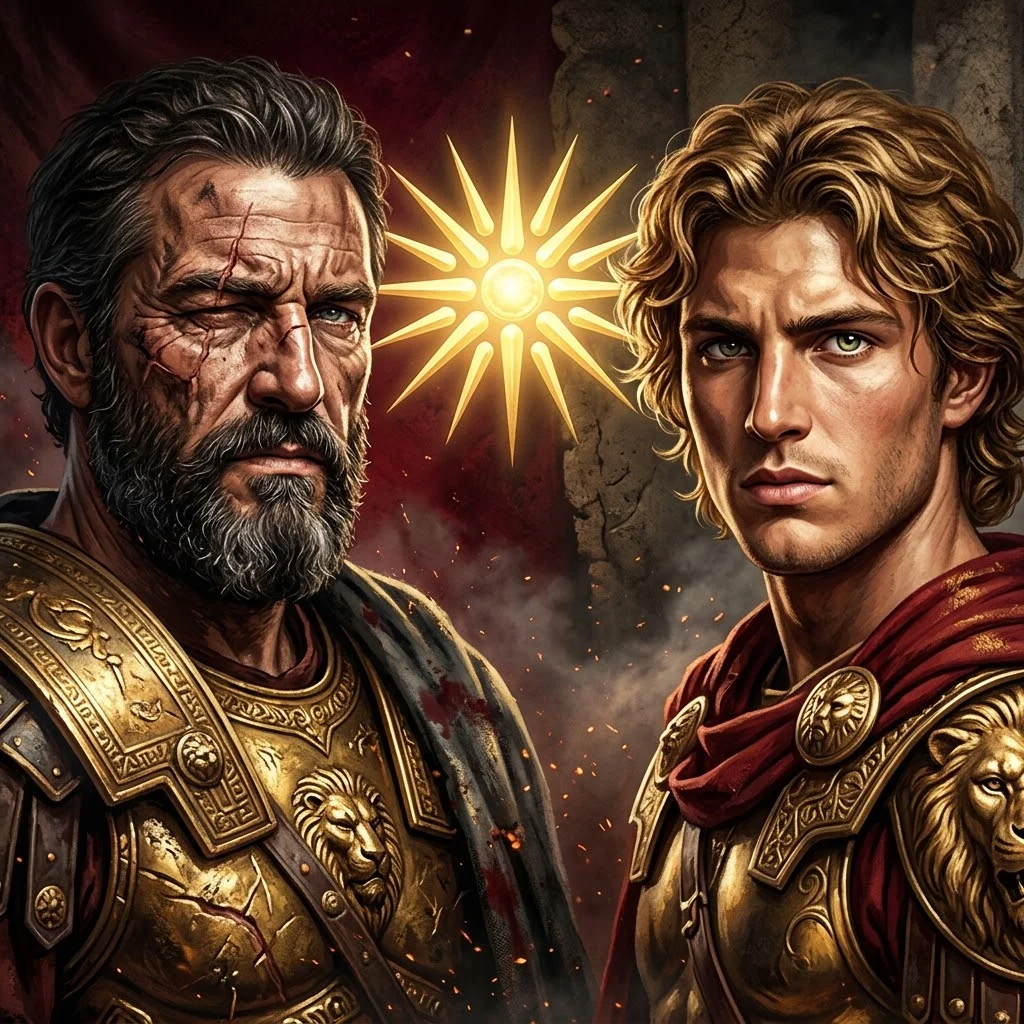
The Argead Dynasty: From Macedonian Outcasts to Masters of the Ancient World
For over four centuries, the Argead dynasty ruled a fractured, mountainous kingdom along the northern perimeter of the Greek world. Classical city-states like Athens, Sparta, and Thebes routinely looked down on Macedonia as an unpolished hinterland inhabited by illiterate pastoralists and illiterate baronies. Despite claiming direct descent from the mythic hero Heracles through the royal house of Argos, the ruling family found itself continually dismissed by southern neighbors who considered them cultural outsiders.
Within a single generation, that condescension evaporated. Driven by political instability, constant barbarian pressure, and sheer strategic necessity, the royal house engineered an institutional transformation that shattered the Mediterranean balance of power. Through administrative reform, battlefield innovation, and unrelenting ambition, the family turned a struggling frontier state into an imperial powerhouse that redrew the map of the ancient world
Origins and the Mythic Pedigree of the Argead Dynasty
Macedonian royal traditions traced the roots of the monarchy back to the Peloponnesian city of Argos. According to accounts recorded by the fifth-century historian Herodotus, three brothers of the Temenid royal house—Gauanes, Aeropus, and Perdiccas—fled southern Greece to seek fortune in the rugged north. Perdiccas I eventually claimed the throne, establishing the royal capital at Aegae, modern-day Vergina, in the fertile foothills of the Pierian Mountains.
This ancestral claim to southern Greek heritage was contentious from the start. When Alexander I sought to compete in the prestigious Olympic Games around 500 BC, rival competitors protested, arguing that the competition was reserved exclusively for Greeks, not northern monarchs. Alexander presented genealogical records tracing his family line to Heracles, and the Olympic judges, the Hellanodikai, accepted his pedigree.
Despite this official validation, ordinary Macedonians remained culturally distinct from the citizens of southern poleis. The kingdom spoke a northwest dialect of Greek heavily infused with regional vocabulary, maintained archaic heroic traditions, and preserved a tribal monarchy long after southern city-states had adopted oligarchies or direct democracies.
Geographically, the realm remained fractured into two opposing spheres:
-
Lower Macedonia: The coastal plains and river valleys around the Thermaic Gulf, governed directly by the crown from the capital of Pella.
-
Upper Macedonia: The rugged mountain principalities of Elimiotis, Orestis, and Lyncestis, where local tribal barons guarded their autonomy and routinely allied with foreign enemies.
Surrounded by predatory Illyrian tribes to the west, Thracian raiders to the northeast, and exploitative Athenian navies coveting Macedonian timber for their fleets, the kingdom spent centuries on the verge of territorial collapse.
                  [Perdiccas I]
                        │
                  (Mythic Roots)
                        │
                 [Alexander I] (c. 500 BC)
       (Validated by Hellanodikai at Olympia)
                        │
                [Perdiccas II & Archelaus I]
     (Urbanization, Roads, Moving Capital to Pella)
                        │
                 [Amyntas III]
             (Dynastic Fragmentation)
                        │
         ┌──────────────┴──────────────┐
  [Perdiccas III]               [Philip II] (359–336 BC)
  (Killed in battle vs Illyria)  (Reformer & Hegemon)
                                       │
                                [Alexander III] (336–323 BC)
                                (The World Conqueror)
The Theban Crucible: Philip II Reclaims the Realm
The transformation of Macedonia from a peripheral buffer state to an imperial power began in captivity. In the 360s BC, the young prince Philip, youngest son of King Amyntas III, was sent to Thebes as a political hostage to guarantee a fragile treaty.
Thebes was then the premier military power in Greece, having shattered Spartan dominance at the Battle of Leuctra in 371 BC under the guidance of Epaminondas and Pelopidas. Placed in the household of the prominent Theban general Pammenes, Philip spent three crucial years observing the inner workings of Greek military strategy.
He analyzed the tactics of the Sacred Band, a professional cadre of elite shock infantry, and studied the mechanics of the oblique phalanx, an asymmetric battle line that concentrated overwhelming force against a single enemy flank. He witnessed how civic finances, coordinated supply lines, and dedicated siegecraft could overcome traditional citizen militias.
In 359 BC, tragedy cleared Philip’s path to power. His older brother, King Perdiccas III, rode out to confront an invading army of Illyrians led by the elderly warlord Bardylis. The resulting battle was a slaughter: Perdiccas died alongside 4,000 Macedonian soldiers, leaving Upper Macedonia overrun and the infant prince Amyntas IV on a defenseless throne.
Stepping into the regency before claiming the crown outright, the twenty-three-year-old Philip inherited an empire facing imminent invasion. Rather than conceding defeat, he bought off Thracian pretenders with bribes, outmaneuvered Athenian-backed rivals, and set about reorganizing the broken remnants of the army.
Engineering the Argead Dynasty’s Unstoppable War Machine
Philip recognized that Macedonia’s traditional reliance on seasonal levies made the state structurally vulnerable. He replaced the part-time peasant militia with a standing, professional army paid through royal stipends, turning military service into a prestigious, full-time profession.
Within two years of ascending the throne, Philip conducted intense training regimens, forcing his infantry to march thirty miles a day under full pack. He banned wheeled baggage carts, compelled foot soldiers to carry their own grain rations, and forged an army that could maneuver through winter snows when traditional Greek armies remained in winter quarters.
       [ Sarissa: 16–18 Feet ]
▲═══════════════════════════════════╦═══════════════════════════════════●
Narrow Iron Spearhead               Central Bronze/Iron Collar          Sauroter
(Penetrates bronze armor)           (Threaded joint assembly)           (Ground spike/counterweight)
The Sarissa and the Reformed Foot Phalanx
The foundation of Philip’s tactical doctrine was the foot companion, or pezhetairos. Traditional Greek hoplites carried an eight-foot spear (dory) and a heavy, concave bronze-and-wood shield (hoplon) that required two hands for close-quarters fighting. Philip stripped away the heavy hoplon, replacing it with a smaller, lighter shield (pelte) slung across the left shoulder, freeing both hands to wield a radical weapon: the sarissa.
The sarissa was a massive pike crafted from cornel wood, measuring between sixteen and eighteen feet in length. Balanced by an iron butt-spike (sauroter) that could be planted into the dirt to absorb charging cavalry, the weapon featured a narrow iron leaf-shaped point designed to pierce heavy plate.
Because of the weapon’s length, the points of the first five ranks projected past the front line, presenting an impenetrable thicket of iron points. The ranks behind held their pikes upright or angled forward at forty-five degrees, creating a dense overhead lattice that intercepted incoming arrows and javelins.
The Hammer and Anvil: Shock Cavalry and Combined Arms
The infantry phalanx was not designed to deliver the decisive blow; it functioned as an immovable anvil. The real offensive hammer of the army was the noble shock cavalry, the Hetairoi (Companion Cavalry).
Philip reorganized the Macedonian nobility into disciplined cavalry squadrons (ilai) trained to charge in compact wedge formations. Riding without stirrups, the Companions gripped the xyston, a nine-foot cornel-wood lance, using its reach to run down broken enemy lines and strike vulnerable exposed flanks.
To support this core doctrine, Philip integrated specialized light auxiliaries:
-
Hypaspists: Elite foot guards equipped with lighter gear who bridged the dangerous gap between the slow-moving phalanx and the rapid cavalry wings.
-
Agrianians: Thracian hill-tribe javelin throwers who moved across rough, mountainous terrain where pikes could not deploy.
-
Cretan Archers: Mercenary missile troops whose high-velocity composite bows suppressed opposing skirmishers.
-
Torsion Artillery: Mobile siege trains operating tension catapults and ballistas, allowing the army to storm stone fortifications without enduring months of passive blockade.
| Unit Designation | Primary Armament | Tactical Function | Operational Placement |
| Pezhetairoi | 18-foot sarissa, small pelte | Pins enemy infantry; creates an impenetrable front | Central battle line |
| Hetairoi | 9-foot xyston, curved kopis | Delivers shock charges into enemy flanks and rears | Right cavalry wing |
| Hypaspists | Thrusting spear, round shield | Protects vulnerable flanks of the sarissa phalanx | Between center and right wing |
| Agrianians | Light javelins, side knives | Clears skirmishers; secures rugged terrain | Far forward / extreme flanks |
| Prodromoi | Light scouting lances | Gathers field intelligence; screens cavalry flanks | Reconnaissance screen |
Hegemony and Diplomacy: Unifying Greece
Military reforms were expensive, requiring substantial economic backing to maintain. In 357 BC, Philip seized the strategic Athenian colony of Amphipolis and gained control over the gold and silver deposits of Mount Pangaion.
Mining engineers modernized operations, yielding an unprecedented income of over 1,000 talents of precious metals annually. This wealth allowed Philip to mint the gold “Philippeion,” finance diplomatic bribery across the Peloponnese, and retain the eastern Mediterranean’s most capable engineers and mercenary captains.
Through a series of campaigns across the Third Sacred War, Philip annexed Thessaly, incorporating the famed Thessalian cavalry into his left wing. His expanding influence provoked panic in Athens, where the orator Demosthenes delivered blistering speeches—the Philippics—warning that the northern king was systematically undermining Greek liberty.
The inevitable confrontation occurred in August 338 BC on the plains of Boeotia at the Battle of Chaeronea. Facing an alliance of Athenian and Theban citizen hoplites, Philip showcased his masterclass in operational feint.
On the right wing, Philip led his veteran phalanxes forward, engaged the Athenians, and staged a disciplined fighting withdrawal. Believing the Macedonians were breaking, the Athenian line surged forward in disarray, opening an enormous gap in the center of the allied line.
Exploiting the opening, Philip’s eighteen-year-old son Alexander spearheaded an aggressive cavalry charge into the breach, surrounding and obliterating the elite Theban Sacred Band. Chaeronea permanently broke classical resistance.
Philip established the League of Corinth, uniting the Greek city-states under Macedonian military hegemony and announcing a pan-Hellenic expedition to avenge the Persian invasions of Greece.
Macedonian Line:     [Thessalian Cav] ==== [Sarissa Phalanx] ==== [Hypaspists] ==== [Philip's Guard]
                                                                        │
                                                (Gap Opens)             ▼ (Feigned Retreat)
                                                     │           [Athenians Advance]
Allied Greek Line:   [Theban Sacred Band] ═══════════╧═══════════ [Athenian Hoplites]
                                ▲
                                │  (Devastating Wedge Charge)
                     [Alexander & Hetairoi]
Palace Intrigue and the Rise of Alexander III
Despite outward triumphs, the royal court at Pella was a dangerous cauldron of factional tension. The royal house practiced polygamy to seal international alliances, and Philip married seven wives over his lifetime.
Tensions peaked between Philip and his primary queen, Olympias, a fiery Molossian princess from Epirus. Olympias was deeply devoted to the mystery cults of Dionysus and raised their son, Alexander, with the belief that his true father was not Philip, but Zeus himself.
Alexander was educated by the philosopher Aristotle in the quiet gardens of Mieza, reading Homer’s Iliad and studying natural science, rhetoric, and governance. He came of age with a competitive drive that bordered on obsession, desperate to surpass his father’s achievements.
Court politics turned volatile in 337 BC when Philip took a noble Macedonian bride named Cleopatra Eurydice. At the wedding feast, the bride’s uncle, general Attalus, toasted the union and called upon the assembly to pray for a legitimate heir to the Macedonian throne—a direct insult suggesting Alexander was an illegitimate foreigner through his Epirote mother.
Alexander hurled his cup at Attalus, shouting in fury. When Philip drew his sword and lunged toward his son, only to collapse drunkenly on the floor, Alexander delivered a biting insult: “Here is the man preparing to cross from Europe to Asia, yet he trips over moving from couch to couch.”
Alexander and his mother fled into self-imposed exile, and while formal relations were eventually patched up, trust was never fully restored.
The political crisis broke violently in October 336 BC during the grand festival at Aegae celebrating the wedding of Philip’s daughter. Walking into the theater without his bodyguard to demonstrate his popularity, Philip was ambushed by Pausanias of Orestis, a royal bodyguard with a personal grievance.
Pausanias drove a Celtic short sword through Philip’s ribs, killing the monarch instantly before being run down by pursuing guards. At just twenty years of age, Alexander was hailed king by the assembled soldiers.
[Royal Tomb II at Vergina (Aegae)]
 ├── Discovery: Uncovered intact by Manolis Andronikos in 1977
 ├── Golden Larnax: Contained cremated remains of a royal warrior (Philip II)
 ├── The Vergina Sun: 16-rayed royal emblem embossed on the solid gold casket
 └── Grave Goods: Ceremonial iron cuirass, gilded greaves (one shorter, matching Philip's limp),
     and exquisite miniature ivory portraits of the royal family.
The Conquest of Asia: The Argead Dynasty Reaches its Zenith
Taking the throne in 336 BC, Alexander acted decisively to secure his borders. He executed potential rivals, marched north to crush Thracian and Illyrian uprisings along the Danube, and when Thebes revolted on rumors of his death, he marched south in fourteen days, razed the city to the ground, and sold its survivors into slavery.
With Greece pacified, Alexander crossed the Hellespont into Asia Minor in the spring of 334 BC with 32,000 infantry and 5,100 cavalry. What followed was an unprecedented military campaign that dismantled the Achaemenid Persian Empire:
-
Battle of the Granicus (334 BC): Surviving a hand-to-hand duel with Persian aristocrats that nearly cost him his life, Alexander broke the satrapal army and liberated the Greek cities of the Ionian coast.
-
Battle of Issus (333 BC): Outmaneuvered on his supply lines, Alexander turned to fight Darius III on a narrow coastal plain, using his Companion Cavalry to drive directly at the Persian Great King, sending him fleeing from the field.
-
Siege of Tyre (332 BC): Demonstrating terrifying engineering capability, the army built a kilometer-long causeway across the sea, mounted battering rams on ship hulls, and breached the island city’s walls.
-
Battle of Gaugamela (331 BC): Confronted by a Persian army numbering well over 100,000 on an open plain, Alexander executed an oblique diagonal march that pulled the Persian line apart, punched through the gap, and shattered the Persian empire.
Pushing into the rugged mountains of Bactria and Sogdiana, the king adapted his tactics, waging ruthless counter-insurgency warfare and marrying the noblewoman Roxana to secure eastern allegiances.
In 326 BC, at the Battle of the Hydaspes in modern-day Pakistan, he faced King Porus across a monsoon-swollen river, overcoming deep mud and two hundred war elephants through complex night-time river crossings and coordinated flank charges.
Yet at the Hyphasis River, the exhausted Macedonian soldiers mutinied. Wept though he did in his tent, Alexander was forced to turn back, leading his men through the hellish sandstorms of the Gedrosian Desert before returning to Babylon.
The Extinction of the Royal Line
In June 323 BC, in the ancient palace of Nebuchadnezzar II in Babylon, Alexander contracted a violent fever and died at the age of thirty-two. He left behind an empire spanning three continents, but no competent, adult heir to manage it.
When asked on his deathbed to whom he left his realm, the dying king allegedly whispered, “To the strongest” (tôi kratistôi). His sudden death triggered the Wars of the Diadochi, a four-decade bloodbath in which his ambitious marshals—Perdiccas, Ptolemy, Seleucus, Antigonus, and Cassander—carved up the empire among themselves.
The royal house found itself caught in the middle of these ruthless power struggles. The army recognized Alexander’s mentally disabled half-brother, Philip III Arrhidaeus, and his unborn infant son by Roxana, Alexander IV, as joint kings.
The surviving family members became pawns and targets:
-
317 BC: Olympias returned from Epirus, seized control of Macedonia, and ordered the execution of Philip III Arrhidaeus and his ambitious young wife, Eurydice.
-
316 BC: The general Cassander besieged Olympias at Pydna, forced her surrender, and had her stoned to death by the relatives of her victims.
-
310/309 BC: Fearing that the adolescent Alexander IV would soon demand his royal birthright, Cassander secretly poisoned both the twelve-year-old king and his mother Roxana at Amphipolis.
With the murder of Alexander IV, four centuries of direct royal rule came to an abrupt, tragic end. The bloodline of Perdiccas I, Philip II, and Alexander the Great was wiped from the earth, leaving behind an interconnected Hellenistic world governed by rival Macedonian generals who crowned themselves kings.
Frequently Asked Questions
Why was the Argead dynasty dismissed by southern Greek city-states?
Southern Greeks viewed the kingdom as culturally backward because it preserved an archaic, warrior-based tribal monarchy rather than an urban democratic or oligarchic civic model. Although the royal house proved its genealogical descent from Argos to compete in the ancient Olympics, everyday Macedonians were viewed with deep cultural suspicion by southern poleis like Athens.
What weapon innovations defined the Macedonian military expansion?
The most critical innovation was the sarissa, a two-handed pike measuring between sixteen and eighteen feet in length. Equipped with an iron butt-spike to anchor against charges and balanced for dense formation fighting, the weapon allowed the infantry phalanx to hold enemy lines at bay while elite shock cavalry attacked exposed flanks.
How did the Argead dynasty come to an end?
The dynasty ended during the brutal Wars of the Successors following the death of Alexander the Great in 323 BC. Without an adult heir, the royal family fell victim to internal assassinations. The lineage was officially extinguished around 310 BC when the Macedonian general Cassander secretly poisoned Alexander’s twelve-year-old son, Alexander IV, and his mother Roxana.