
Ancient Greece at Marathon: Defending the Cradle
In September 490 BCE, the survival of democratic civilization across Ancient Greece hung on a narrow crescent of coastal mud. Ten thousand Athenian citizens and one thousand Plataean allies assembled along the marshy plain of Marathon to face an invading Achaemenid Persian armada. The imperial host had already sacked Eretria, incinerated its temples, and chained its populace for enslavement.
For the free poleis of Ancient Greece, surrender meant total political extinction. An empire spanning three continents now brought its full logistical weight against a solitary, defiant city. When the command sounded to advance, the destiny of European political thought converged on a single stretch of sand.
The Rising Threat to Ancient Greece: The Ionian Spark
The existential crisis confronting Ancient Greece began far across the Aegean Sea in 499 BCE. Greek cities along the coast of Asia Minor revolted against Persian-backed tyrants, appealing to their mainland kin for armed assistance. Athens and Eretria responded by dispatching twenty-five warships, briefly capturing and burning the regional satrapal capital of Sardis.
King Darius I never forgave the raid. To the Achaemenid court, the intervention of overseas city-states was an intolerable violation of imperial order. Darius appointed Datis, a seasoned Mede admiral, and Artaphernes, the satrap’s son, to lead an amphibious punitive expedition across the Cyclades.
Island after island submitted to imperial heralds bearing demands for earth and water, the ancient tokens of submission. When Persian envoys arrived in Athens and Sparta, the citizens defied diplomatic convention: the Athenians threw the envoys into an execution pit, while the Spartans hurled them down a dry well to fetch their own earth and water.
By late summer 490 BCE, the Persian fleet anchored in the sheltered Bay of Marathon, guided by the exiled Athenian tyrant Hippias. The imperial high command anticipated a quick victory followed by a triumphant restoration of autocratic rule. Instead, the civic ethos of Ancient Greece mounted an unprecedented defense of its homeland.
Arms, Armor, and Logistics in Ancient Greece
The battlefield collision pitted two fundamentally incompatible philosophies of armament against one another. The citizen-soldiers of Ancient Greece relied on heavy bronze panoplies designed for close-quarter kinetic shock.
The panoply was an expensive, privately financed assemblage of metal and wood:
-
Aspis: A concave wooden shield measuring roughly three feet in diameter, faced with a thin bronze sheet and supported by an internal leather arm-band (porpax) and handgrip (antilabe).
-
Dory: A six-to-nine-foot ash wood thrusting spear tipped with an iron point and balanced by a bronze counterweight spike (sauroter).
-
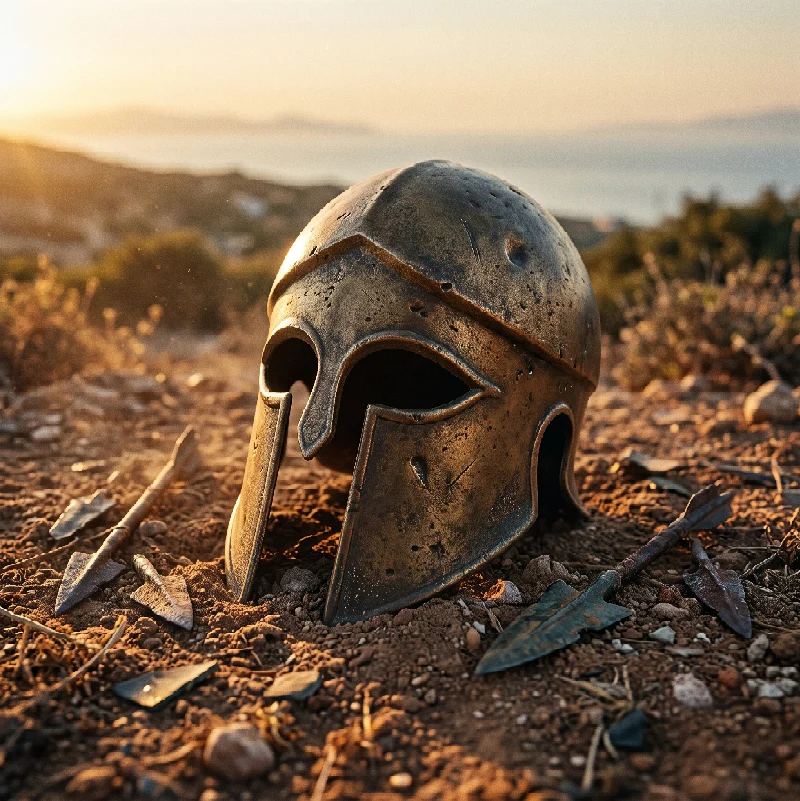
Corinthian Helmet: A solid bronze helmet beaten from a single sheet of metal, shielding the face and nose while restricting lateral hearing and peripheral vision.
-
Xiphos: A short, leaf-shaped iron cutting and thrusting sword used as an auxiliary sidearm when primary spear shafts splintered.
Opposing them stood a multi-ethnic imperial army composed of Persians, Medes, Saka horsemen, and Levantine sailors. Their equipment prioritized mobility, loose-order skirmishing, and long-range missile dominance:
-
Spasht: Woven wicker shields (spara) backed by leather, designed to deflect light arrows and slashing blows rather than heavy thrusting spears.
-
Composite Recurve Bow: Powerful weapons constructed of laminated wood, horn, and sinew, capable of discharging dozens of armor-piercing arrows per minute.
-
Akinakes and Sagaris: Short daggers and curved battle-axes designed for fluid close-range combat.
-
Quilted Linen Tunics: Soft, layered textiles that offered minimal defense against eighty-pound bronze-reinforced spear charges.
The logistical realities of Ancient Greece dictated that citizen-militias could not remain in the field indefinitely. Citizens were farmers, artisans, and merchants who carried only several days of barley cakes, cheese, and dried figs in canvas sacks. The campaign had to be settled quickly before domestic supplies evaporated.
Strategic choices [Internal Link: Classical Greek Defensive Strategy] were heavily shaped by the geographical barriers that divided the landscape of mainland Hellas into isolated mountain basins.
The Landscape of Marathon: The Spatial Trap
The physical terrain of Marathon favored the tactical doctrine of Ancient Greece. The plain formed a flat, six-mile strip bounded on the east by the Aegean Sea, on the north and south by treacherous salt marshes, and on the west by the steep limestone slopes of Mount Agrieliki and Mount Kotroni.
The Persian expeditionary force occupied the center of the plain near the shoreline, their fleet drawn up onto the sand behind a makeshift beach camp. The Athenian strategos Miltiades stationed his army across the valley of Avlona, sealing the two exit roads leading through the mountain passes toward the city of Athens.
For five days, both armies stood in a tense standoff:
-
The Persians hesitated to assault the heavy Greek spear wall entrenched on rising ground between groves of felled olive trees.
-
The Athenians refused to descend into the flat plain, where the dreaded Persian cavalry could execute wide flanking sweeps.
-
Couriers dashed across the Peloponnese seeking Spartan assistance, only to discover the Spartans were bound by religious festival rules until the full moon.
The stalemate broke when Persian commanders made an operational miscalculation. Believing the Athenians were paralyzed by political indecision, Datis began re-embarking his cavalry and part of his infantry onto transport ships to launch a surprise amphibious assault directly against the undefended harbor of Phaleron near Athens.
Seeing the hostile cavalry absent from the field, Miltiades recognized his moment. The assembly of free citizens voted to descend the slopes, committing the future of Ancient Greece to the hazard of open combat.
Tactical Innovation: Altering the Phalanx Depth
Traditional warfare in Ancient Greece was rigid, predictable, and dogmatic. Opposing city-states typically deployed their citizen phalanxes in uniform blocks eight ranks deep, clashing head-on in an endurance contest of shield-shoving (othismos).
Miltiades understood that standard doctrine would result in catastrophe against the Persians. The imperial battle line was exceptionally broad, and their central corps—composed of elite Persian immortals and Saka axemen—would outlast any thin formation. If Miltiades maintained an eight-rank depth throughout, his flanks would be enveloped and annihilated.
His solution transformed the military history of Ancient Greece:
-
The Weakened Center: Miltiades thinned the central ranks of the Athenian phalanx to a fragile depth of just four men.
-
The Reinforced Wings: He concentrated the bulk of his manpower on the left and right wings, stacking them eight ranks deep with veteran hoplites.
-
Equal Frontage: By stretching his line, the Greek army matched the exact width of the Persian front, preventing imperial skirmishers from curling around the edges.
The resulting formation resembled a hollowed chest with exceptionally heavy, armored arms. The operational concept was daring: the center would act as a deliberate shock absorber, while the dense wings crushed the enemy flanks and wheeled inward to complete the trap.
The Shock Charge of Ancient Greece
Around sunrise, the Greek trumpets sounded the advance. The allied line marched forward in disciplined silence until they reached approximately eight hundred yards from the Persian positions—the outer range of composite archers.
Then, to the utter astonishment of the Persian observers, the citizen-soldiers of Ancient Greece broke into a dead run. Herodotus recorded that the Persians thought the Greeks were seized by madness, charging across open ground without archers or cavalry to screen their advance.
The charge was not a wild, disorganized rush. It was a calculated sprint executed to minimize exposure to lethal missile showers:
-
Bronze shields were held tight against torsos, creating an overlapping metallic wall that deflected descending arrows.
-
The speed of the advance compressed the lethal missile window from several minutes to under sixty seconds.
-
The mass of heavy bronze, wood, and iron accelerated to a velocity of nearly eight miles per hour, multiplying its kinetic impact.
When the two lines collided, the physical shock was absolute. The bronze-clad front line of Ancient Greece slammed through the wicker shield wall of the Persian vanguard, shattering wood and driving men backward into the sand.
The Double Envelopment: Iron Wings Close the Trap
As predicted by Miltiades, the fighting developed along two completely divergent paths. In the center, the four-rank Greek line buckled under the sustained pressure of the elite Persian and Saka infantry.
The Persian center drove the Athenian center backward toward the foothills, breaking their formation and pursuing them up the valley. Under traditional rules of warfare, this breakthrough would have signaled total victory for the imperial force.
Yet on the flanks, the heavy wings of Ancient Greece were completely victorious. The eight-rank-deep formations on the left and right overwhelmed the lighter Levantine and Persian auxiliary wings, shattering their ranks and sending them fleeing toward the ships.
Rather than pursuing the routing Persian flanks down to the beach, the Greek commanders maintained extraordinary discipline:
-
Wing commanders halted their pursuit and ordered their men to reform their ranks.
-
The left and right wings pivoted ninety degrees inward, turning their spears toward the exposed rear of the victorious Persian center.
-
The retreating Athenian center halted, reformed its ranks against the slope, and counterattacked from the front.
The Persian center suddenly found itself trapped in an iron vice. Attacked simultaneously from the front, both flanks, and the rear, their superior numbers worked against them. The imperial soldiers were compressed into an unmaneuverable mass where they could neither draw their bows nor wield their axes.
The disciplined tactical cohesion of Ancient Greece triumphed over imperial scale. The trap turned the coastal plain into a chaotic execution ground.
The Rout to the Ships and the Fight at the Shoreline
The trapped Persian center shattered under the pressure of the encirclement. Breaking through the surrounding ring, the surviving imperial troops fled in wild panic toward the sea, pursued relentlessly by the victorious hoplites.
The final phase of the battle shifted to the muddy marshlands and the water’s edge. Many fleeing Persian soldiers, unfamiliar with the terrain, plunged into the Great Marsh of Schinias, where heavy mud and waterlogged gear dragged them down to be speared from the banks.
At the shoreline, a vicious hand-to-hand struggle erupted over the grounded Persian fleet:
-
Greek hoplites waded into the surf, attempting to seize hulls, sever mooring ropes, and set vessels ablaze with torches.
-
Persian marines fought back with bows and javelins from elevated ship decks to cover the frantic embarkation of their army.
-
Kynegeiros, the brother of the playwright Aeschylus, seized the stern ornament of a retreating Persian galley; his hand was severed by an axe, and he bled to death in the shallows.
Despite the ferocity of the coastal melee, the Persian fleet managed to launch most of its vessels, losing only seven ships out of six hundred to the Greek assault. The land battle was an unmitigated disaster for the Great King, but the operational danger was not entirely neutralized.
As the Persian fleet rounded the promontory of Cape Sounion, Miltiades realized the enemy was sailing directly toward Athens, hoping to capture the city before its army could return. The citizen-soldiers of Ancient Greece had to complete one final, superhuman physical trial.
Leaving a small detachment under Aristeides to guard the battlefield and secure the spoils, the main body of the Athenian army marched twenty-six miles across rugged mountain roads in full battle armor. In under eight hours, the exhausted soldiers reached the heights above the city.
When the Persian fleet anchored off Phaleron, its commanders saw the same bronze-clad hoplites who had defeated them that morning standing drawn up on the hills of Athens. Disheartened and outmaneuvered, the Persian fleet raised sail and set course back toward the satrapies of Asia Minor.
Archaeological Evidence and the Soros Mound
The material reality of this epochal engagement remains preserved in the soil of Attica. The focal point of modern historical research is the Soros, the massive burial mound erected by the Athenian state over the cremated remains of their fallen citizens.
Excavations conducted by Valerios Stais and modern forensic teams have unearthed conclusive physical evidence:
-
A thick layer of black ash containing the calcined bones of approximately 192 individuals, matching the exact casualty figure recorded by Herodotus.
-
Black-figure ceramic vessels and funerary lekythoi dating precisely to the opening decade of the fifth century BCE.
-
Numerous bronze and iron arrowhead heads embedded in soil layers, including eastern three-bladed socketed points characteristic of Achaemenid archers.
A separate burial mound, the tumulus of the Plataeans and slaves, was located nearby at Vrana, containing skeletal remains with severe traumatic injuries. The casualty figures stand as a stark historical testament: while Athens lost 192 citizens and Plataea lost eleven, the Persian army suffered approximately 6,400 dead.
Archaeological analysis [Internal Link: Classical Greek Armor Fabrication and Metallurgy] confirms that the cast bronze cuirasses and multi-layered linen armor (linothorax) worn by Greek citizens absorbed the vast majority of low-mass missile strikes, explaining the astonishing casualty disparity.
Geopolitical Aftermath: The Golden Age of Ancient Greece
The victory at Marathon redefined the geopolitical destiny of the Mediterranean basin. For the first time, a free citizen-militia had shattered the aura of invincibility surrounding the Achaemenid Persian Empire.
The success validated the political and institutional experiments of Ancient Greece. It proved that a community of self-governing citizens, fighting for their homes and political liberty, possessed a degree of combat resilience that surpassed imperial conscript levies.
The immediate consequences across the Aegean world were profound:
-
The Ascendance of Athens: Athens emerged from the shadow of Sparta, establishing itself as a premier military and intellectual power in Ancient Greece.
-
The Naval Revolution: Wealth generated by the Laurion silver mines was directed by Themistocles to construct a fleet of two hundred triremes, ensuring future maritime dominance.
-
The Persian Retaliation: The humiliation at Marathon compelled King Xerxes I to launch a massive, full-scale invasion of Europe a decade later in 480 BCE.
Had the Athenian phalanx buckled on the plain of Marathon, the nascent democratic institutions of Athens would have been dismantled, replaced by a puppet tyranny subservient to the Persian court. The philosophical, scientific, artistic, and historical foundations of Western civilization would have been strangled in their infancy.
Instead, the victory preserved the political autonomy of Ancient Greece, clearing the path for the Classical Golden Age of Pericles, Sophocles, Thucydides, and Plato. The stand at Marathon proved that free citizens, bound by civic duty and tactical discipline, could turn the tides of world history.
Frequently Asked Questions
Why did the Greek army charge at a run during the battle?
The Greek hoplites charged at a run to minimize their exposure to Persian archery. By closing the eight-hundred-yard gap between the lines in under a minute, the Greeks compressed the lethal missile window, neutralized the Persian composite bows, and preserved their front ranks for the decisive shock collision.
How did the Greek army compensate for its smaller numbers?
Miltiades restructured the traditional phalanx formation by thinning his center to only four ranks while heavily reinforcing his flanks to a depth of eight ranks. This allowed the Greek line to match the broad frontage of the Persian army, avoiding encirclement while enabling the reinforced wings to execute a devastating pincer maneuver.
What happened to the Persian cavalry at Marathon?
The Persian cavalry was largely absent during the battle because the Persian commanders had begun loading their horses and cavalry units onto transport ships to sail around Cape Sounion and attack an undefended Athens directly. Miltiades seized this exact window of opportunity to attack while the enemy lacked mounted mobility.