
Winged Hussars: The Armored Angels of the Polish Steppes
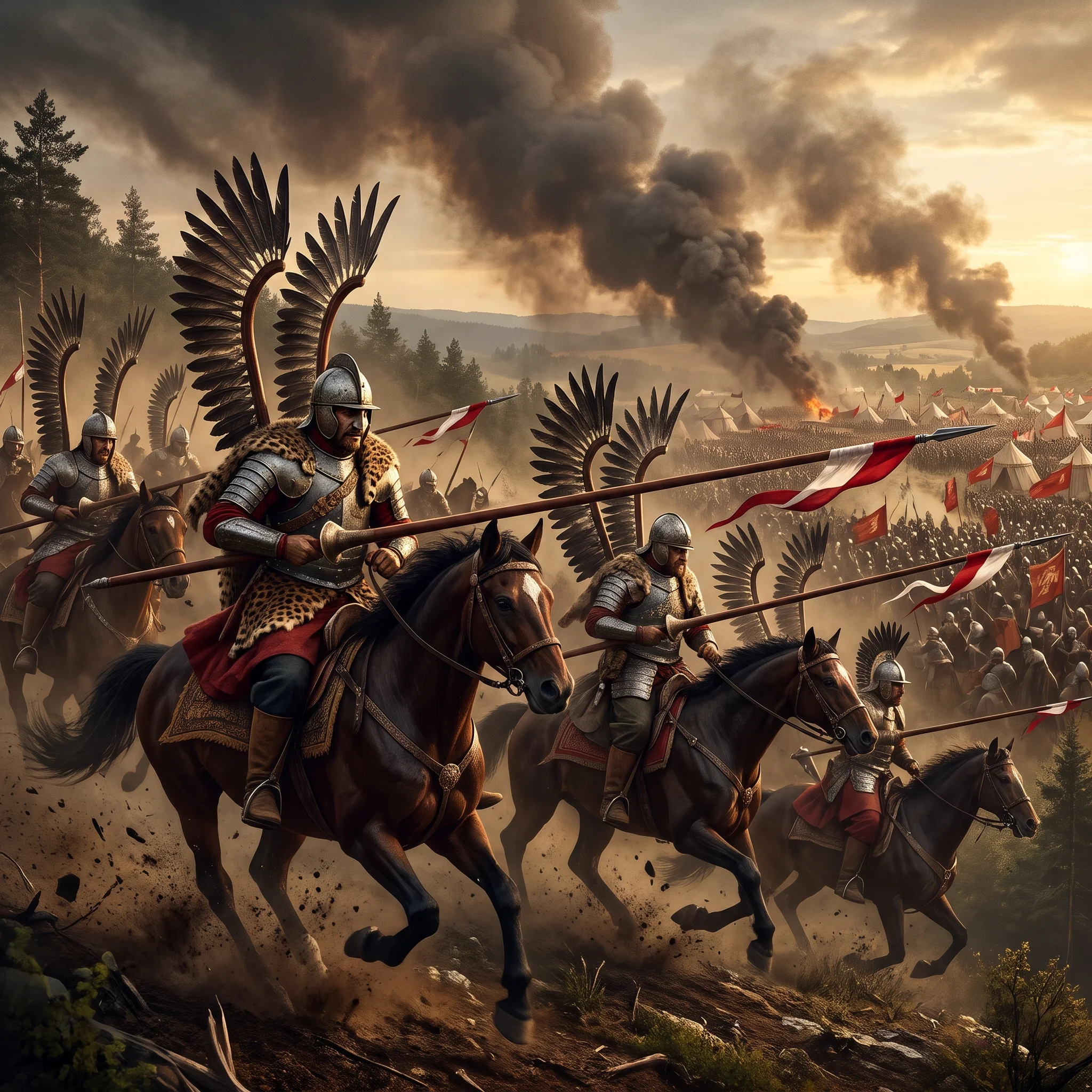
On the late afternoon of September 12, 1683, the fate of Central Europe hung on the slopes of the Kahlenberg ridge overlooking Vienna. After two months of subterranean mining and starvation, the Ottoman forces of Grand Vizier Merzifonlu Kara Mustafa Pasha stood poised to breach the city’s inner bastions. That defensive equilibrium shattered when King John III Sobieski unleashed the Winged Hussars down the wooded hillsides in the largest cavalry charge in recorded military history.
More than eighteen thousand horsemen plunged into the Ottoman lines, spearheaded by three thousand elite heavy lancers whose eagle-feathered frames roared in the wind. The shock broke the Grand Vizier’s army in under an hour, lifting the siege and permanently halting Ottoman territorial expansion into Western Europe. The Winged Hussars were not merely a theatrical formation; they represented the pinnacle of seventeenth-century shock cavalry engineering, designed to smash the dense pike-and-shot formations that dominated the early modern world.
The Origins: From Serbian Light Horse to Polish Heavy Shock
The institutional evolution of the Winged Hussars (Husaria) began far from the grand plains of Poland. Following the Ottoman conquest of Serbia in the late fourteenth century, displaced Balkan light horsemen (usars) migrated north into the Kingdom of Hungary and the Polish-Lithuanian Commonwealth.
In their initial sixteenth-century configuration, these early riders operated as light cavalry:
-
Armed with light wooden shields shaped like asymmetric wings (kalkan), short sabers, and light throwing spears.
-
Deployed primarily for frontier skirmishing, scouting, and pursuing broken infantry across the southern borderlands.
-
Wore quilted arming jackets and unarmored caps rather than heavy plate.
The transformation into an unstoppable heavy shock formation occurred under the military reforms of King Stephen Báthory in the 1570s. Báthory realized that while Western European armies were abandoning heavy lance cavalry in favor of caracole pistoliers and dense infantry blocks, Eastern European battlefields required an aggressive cavalry arm capable of shattering both Swedish pikes and Ottoman spahis.
Báthory standardized the unit:
-
Stripped away the wooden shield in favor of hardened steel breastplates and backplates.
-
Replaced short throwing javelins with an elongated hollow-drilled lance.
-
Recruited exclusively from the wealthy Polish nobility (szlachta), who financed their own horses and squires.
By the early seventeenth century, the Winged Hussars had become the elite shock fist of the Polish-Lithuanian Commonwealth, maintaining an unbroken string of victories against Muscovites, Tatars, Swedes, and Ottomans.
The Engineering of the Lance: The Hollow Kopia
The decisive offensive weapon of the Winged Hussars was the kopia, a hollowed lance that pushed early modern woodcraft to its mechanical limits. European infantry pikes of the era typically measured between 4 and 4.5 meters in length, presenting an impassable wall of steel points to charging horsemen.
Polish armorers engineered the kopia to systematically out-range those infantry pikes:
-
Extreme Length: Measured between 5.0 and 6.2 meters, allowing the hussar to impale an enemy pikeman before the infantry pike could reach the horse’s chest.
-
Hollow Core Construction: Built from two hollowed halves of seasoned aspen or fir glued together and wrapped tightly with silk ribbon, hemp twine, and weather-resistant lacquer.
-
Counterweight Ballast: Fitted with a solid wooden counterweight ball (jabłko) behind the leather grip, placing the balance point directly in the rider’s hand despite the immense forward reach.
-
The Pennon: Fastened beneath the steel spearhead was a fluttering silk pennon measuring up to three meters long, designed to confuse enemy horses and obscure the lance point during the charge.
Because the lance was hollow, it shattered on impact, dissipating kinetic energy through the target rather than unseating the rider. A single charge of the Winged Hussars could impale multiple infantrymen on a single spear.
The lance was a single-use expendable weapon; behind each hussar rode a retainer carrying three to four replacement lances to resupply the rider for subsequent attack runs.
Tactical cavalry formations [Internal Link: Nomadic Equestrian Warfare Mechanics] proved that reach and forward kinetic momentum routinely overpowered static defensive infantry lacking disciplined ballistic support.
Armor, Wings, and the Psychological Battlefield
The armor worn by the Winged Hussars achieved an exceptional compromise between projectile deflection and equestrian agility. Unlike Western heavy cuirassiers who wore full plate weighing upwards of thirty kilograms, the hussar fought in articulated half-plate (zbroja husarska) weighing between fifteen and twenty kilograms.
The protective panoply included:
-
The Cuirass: Forged from ductile low-carbon iron, designed with a pronounced vertical ridge (keel) to glance off musket balls, often decorated with a brass cross or the Virgin Mary.
-
The Lobster-Tailed Helmet (Szyszak): An open-faced steel bowl featuring an adjustable nasal bar, heart-shaped ear flaps, and a multi-segmented neck guard protecting against downward saber strikes.
-
The Animal Pelts: Leopard, tiger, wolf, or bear skins draped dramatically over the left shoulder, fastened with ornate silver brooches to project aristocratic opulence.
The most iconic and debated feature of the Winged Hussars remains the wooden wings (skrzydła) mounted to the back of the armor or the rear of the saddle. Crafted from curved wooden frames set with eagle, swan, or vulture feathers, these structures served a complex psychological and tactical purpose.
During high-speed cavalry charges, the rushing wind produced a rhythmic whistling and clattering sound through the feathers, unsettling enemy warhorses unaccustomed to the noise. Furthermore, the wooden arches prevented Tatar horsemen from looping throwing lassos (arkan) around the rider’s neck and cushioned the rider against catastrophic falls if his horse collapsed beneath him.
Most critically, the towering silhouettes made a charge of several hundred Winged Hussars look like thousands, magnifying panic among enemy foot soldiers peering through battlefield gun smoke.
+---------------------------------------------------------------------------------+
|                       CHARGE DYNAMICS OF THE HUSSARIA                           |
|                                                                                 |
|  [Loose Open Formation: 375 Meters Out] ──> Gallop begins; musket fire missed   |
|                 │                                                               |
|                 v                                                               |
|  [Tightening Ranks: 150 Meters Out]     ──> Speed increases to full gallop      |
|                 │                                                               |
|                 v                                                               |
|  [Knee-to-Knee Impact: Final 50 Meters] ──> Hollow kopia lances level forward   |
|                 │                                                               |
|                 v                                                               |
|  [Penetration & Shatter]                ──> Draw koncerz / szabla for melee     |
+---------------------------------------------------------------------------------+
Charge Dynamics: Knee-to-Knee Kinetic Shock
The tactical doctrine of the Winged Hussars relied on an elastic, progressive charge designed to minimize casualties from defensive musket volleys while maximizing point-of-impact kinetic energy.
The attack unfolded across precise geographical intervals:
-
The Advance (375 to 200 meters): The squadron (chorągiew) advanced at a measured trot in an open, dispersed formation, leaving wide intervals between files to ensure enemy cannon and matchlock balls passed through gaps.
-
The Compression (200 to 50 meters): As the range closed, the riders urged their mounts into a gallop, compressing their files inward until their stirrups and knees physically locked against one another.
-
The Couched Lance (Final 50 meters): The front rank lowered their six-meter kopia into the horizontal strike position, accelerating to maximum terminal velocity in an unbroken wall of steel and horseflesh.
When this mass struck the enemy line, the kinetic energy of a thousand-pound warhorse galloping at thirty miles per hour was concentrated entirely into the needle-sharp point of the hollow lance.
If the initial impact failed to break the formation, the hussars wheeled back, reformed their ranks, took fresh lances from their retainers, and delivered a second or third charge into the ruptured gap.
Once the lances shattered, the Winged Hussars transitioned immediately to sidearms:
-
The Koncerz: A long, 1.5-meter square-bladed estoc designed for thrusting into the seams of enemy armor from the saddle like an auxiliary lance.
-
The Palasz: A straight, heavy cavalry broadsword used for slashing broken infantry.
-
The Szabla: A curved, thumb-ringed saber optimized for high-speed wrist cuts during close-quarters pursuits.
Defensive armor transformations [Internal Link: Classical Greek Armor Fabrication and Metallurgy] showed that combat weapons were continuously engineered to exploit the mechanical vulnerabilities of rigid plate and quilted textiles.
Warhorses: The Secret Weapon of the Winged Hussars
Behind the mechanical genius of the lance stood the breeding program that produced the legendary Polish hussar warhorse (koń husarski). The animal was an extraordinary equine hybrid bred from indigenous Polish forest horses crossed with refined Arabian, Anatolian, and Persian bloodlines.
The resulting steed possessed unique physical characteristics:
-
Exceptional stamina, capable of carrying over one hundred kilograms of armor and equipment for fifty miles and charging immediately upon arrival.
-
Compact, muscular frames measuring between 15 and 16 hands high, possessing rapid acceleration from a standing start.
-
Absolute obedience in combat, trained to leap over defensive stakes and barrel directly into rows of glittering bayonets without balking.
The export of a Polish hussar warhorse was strictly classified as high treason, punishable by immediate public execution. A single prime hussar mount cost up to two hundred ducats—an amount equivalent to the annual revenue of an entire rural village—rendering the Winged Hussars an exclusively aristocratic preserve.
The Masterpiece of Kahlenberg: The Battle of Vienna (1683)
The defining historical trial of the Winged Hussars arrived in the late summer of 1683. Merzifonlu Kara Mustafa Pasha had surrounded Vienna with over 140,000 Ottoman troops, detonating subterranean gunpowder mines beneath the city walls. Inside the city, the garrison of Ernst Rüdiger von Starhemberg was reduced to fewer than four thousand combat-effective defenders.
King John III Sobieski marched a relief coalition of thirty thousand Poles alongside forty thousand imperial German and Austrian troops through the rugged hills of the Vienna Woods (Wienerwald).
On September 12, the battle opened with bloody infantry clearing actions across broken vineyard terraces:
-
Imperial Austrian and German troops under Charles of Lorraine fought through the Ravine of Döbling, pinning Ottoman wings along the Danube.
-
By four in the afternoon, Polish infantry cleared the rough ravines at the base of the Kahlenberg ridge, opening an unobstructed downward slope into the Ottoman siege camp.
-
Sobieski led twenty-four banners of his personal Winged Hussars onto the grassy shelf, their feathered banners snapping under the lowering sun.
At precisely six o’clock, Sobieski dropped his commander’s baton. A cannon shot boomed from the heights, and eighteen thousand Allied horsemen surged down the mountain in the largest cavalry charge in military history.
Leading the central wedge was the hussar banner of Prince Aleksander Sobieski, crashing directly into the tents of the Janissary headquarters. The psychological shock was instantaneous:
-
The Ottoman infantry, exhausted after two months of siege operations and caught without their defensive ditch networks facing the rear, collapsed in panic.
-
The fluttering pennons and screaming wings created widespread bedlam among the Ottoman pack camels and baggage trains.
-
Grand Vizier Kara Mustafa fled his pavilion on horseback, abandoning the holy banner of the Prophet, the entire imperial artillery train, and the state treasury.
In less than fifty minutes, the siege was shattered. The charge had saved Christian Europe, broken the military prestige of the Ottoman Empire, and secured the legendary zenith of the Winged Hussars.
Kircholm and Klushino: The Unbroken Century
The triumph at Vienna was not an isolated miracle; it was the final, grandest chapter in a century of tactical dominance. Decades prior, small detachments of Winged Hussars had repeatedly routed foreign armies outnumbering them four to one.
The military record of the hussaria includes unmatched operational feats:
-
The Battle of Kircholm (1605): Jan Karol Chodkiewicz led 2,600 hussars against 11,000 Swedish infantry and cavalry; a feigned retreat drew the Swedes out of their defensive lines, followed by a sudden hussar counter-charge that wiped out 9,000 Swedes in twenty minutes while losing barely one hundred men.
-
The Battle of Klushino (1610): Hetman Stanisław Żółkiewski confronted a coalition of 35,000 Russian troops and Western mercenaries with only 5,500 hussars; charging up to ten times into the enemy lines through burning village gaps, the hussars annihilated the army and marched into Moscow, occupying the Kremlin.
-
The Battle of Chocim (1621): Hussar squadrons repeatedly checked massive Ottoman assaults along the Dniester River, holding back a host of 100,000 troops and securing favorable peace terms for the Commonwealth.
These campaigns demonstrated that when commanded by imaginative tacticians, the Winged Hussars could dismantle both heavy Swedish pikes and light Tatar cavalry through rapid deployment and kinetic violence.
Archaeological Evidence: What Survives in the Armories
Modern museum collections across Warsaw, Krakow, and Stockholm preserve the unvarnished material reality of the Winged Hussars, confirming the advanced craftsmanship of their gear.
Curatorial analysis provides vital metallurgical and functional insights:
-
The Polish Army Museum (Warsaw): Preserves original seventeenth-century kopia fragments showing that the interior hollow channels were carved with precision gouges, leaving a uniform wall thickness of barely one centimeter.
-
Livrustkammaren (Stockholm): Contains hussar armor captured during the Deluge (1655–1660); ballistic testing shows multiple lead musket ball indentations that failed to penetrate the high-convexity breastplates.
-
Cranium Trauma in Mass Graves: Forensic examination of skeletal remains from seventeenth-century battle sites in Ukraine reveals catastrophic horizontal cranial splits inflicted by heavy szabla blades, verifying contemporary accounts of the extreme cutting leverage generated by the thumb-ring hilt.
These physical remnants verify that the hussar was not an ornamental courtier, but an iron-plated war machine designed to function under extreme physical stress.
The Twilight: Firearms, Tactics, and Political Collapse
The decline of the Winged Hussars arrived during the early eighteenth century, driven by rapid advancements in infantry firearms technology and the internal political rot of the Polish-Lithuanian Commonwealth.
The technical and tactical factors that rendered the formation obsolete include:
-
The Flintlock and the Socket Bayonet: The replacement of slow matchlocks with rapid-firing flintlocks and the invention of the ring bayonet in the 1690s converted every foot soldier into a pikeman, quadrupling defensive infantry firepower.
-
Field Artillery Standardization: Modernized European armies deployed quick-firing three-pounder regimental guns capable of firing grape-shot directly into approaching cavalry wedges, shattering formations before lances could be leveled.
-
The Ruin of the Nobility: The devastating conflicts of the Great Northern War (1700–1721) devastated the agricultural estates of the Polish szlachta, leaving nobles unable to afford the immense cost of elite mounts and armor.
By the reign of King Augustus III, the once-lethal hussaria had deteriorated into a ceremonial parade escort, contemptuously nicknamed “funeral soldiers” because their primary duty was riding in elaborate mourning processions for deceased oligarchs.
In 1776, the Polish Sejm formally abolished the Winged Hussars, replacing them with modern light cavalry national brigades (Kawaleria Narodowa). The age of armored shock lancers was over.
Yet the cultural memory of the Winged Hussars remains indestructible. They stand as a towering symbol of martial audacity—an armored vanguard that combined the nomadic horse heritage of the Eurasian steppe with the engineering of the European Renaissance to ride into history as the angels of the battlefield.
Frequently Asked Questions
Why did the Winged Hussars wear wings?
The Winged Hussars wore feathered wings for psychological and tactical defense. The clattering sound of the feathers in the wind startled enemy horses during the charge, the tall frames made the squadrons appear much larger through battlefield smoke, and the wooden arches protected the riders’ backs from throwing lassos and cushioned violent falls from horseback.
How long was the lance used by the Winged Hussars?
The hussar lance (kopia) was exceptionally long, typically measuring between 5.0 and 6.2 meters (16 to 20 feet). It was engineered with a hollowed-out interior of glued fir or aspen to reduce weight, allowing it to systematically out-range standard infantry pikes (4 to 4.5 meters) without breaking the rider’s arm on impact.
What was the largest cavalry charge in history?
The largest cavalry charge in recorded history occurred on September 12, 1683, at the Battle of Vienna. King John III Sobieski launched eighteen thousand Allied cavalrymen down the slopes of the Kahlenberg ridge, spearheaded by three thousand elite Winged Hussars, completely breaking the Ottoman siege camp in less than an hour