
Viking Berserkers: Historical Evidence and the Battle Trance
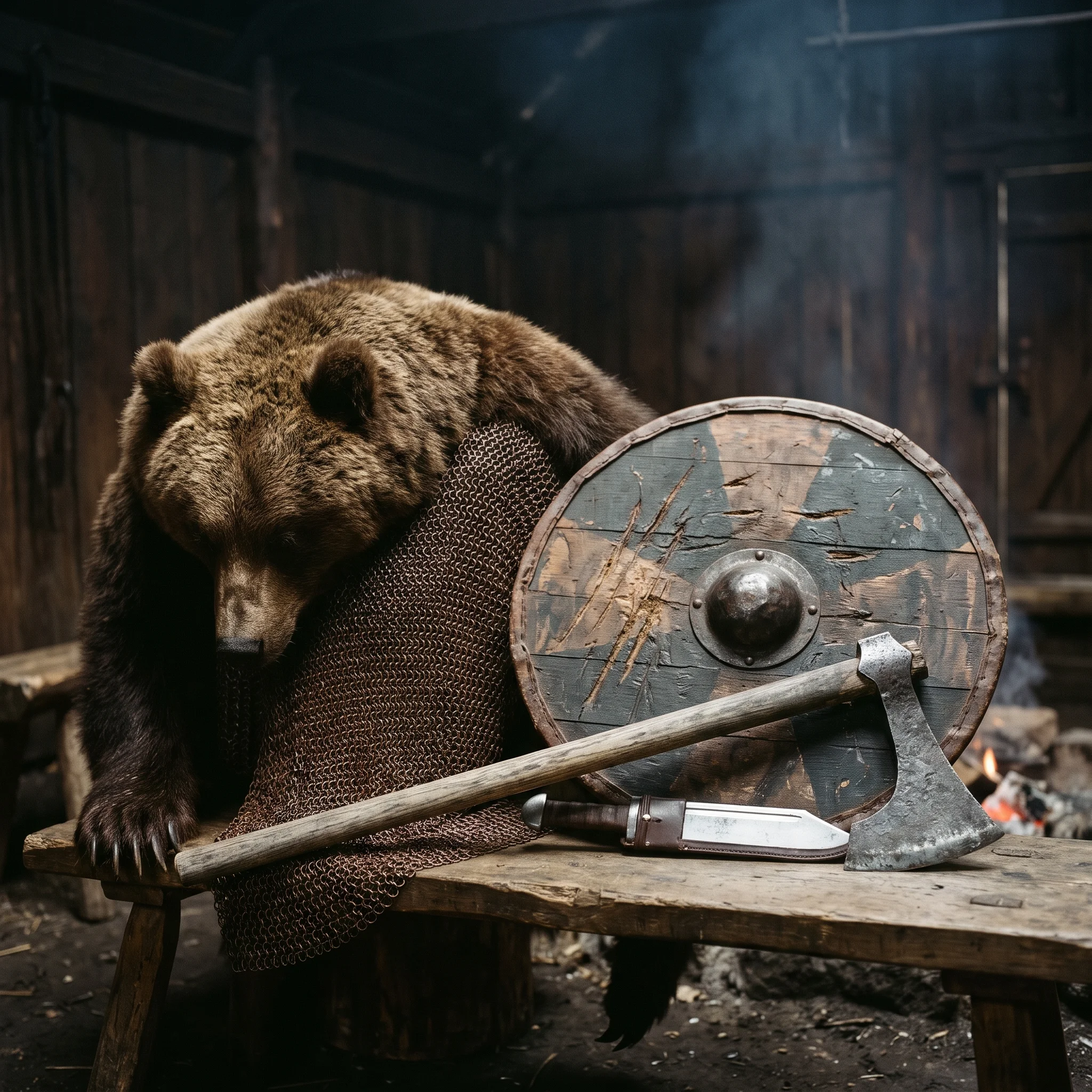
The historical phenomenon of the Viking berserkers stands among the most durable, misunderstood, and sensationalized elements of early medieval Scandinavian military history. Known in Old Norse sources as berserkir, these specialized shock troops earned lasting renown for their ecstatic, trance-like state of combat fury, termed the berserkergang. Surviving chronicles record how they howled like wild beasts, gnawed their wooden shield rims, and charged defensive lines with apparent disregard for their personal safety. Within the violent political landscape of pre-Christian Scandinavia, northern chieftains deployed Viking berserkers as elite assault vanguards and psychological weapons to dismantle opposing shield walls.
Historical reality, however, contradicts modern popular caricature. Rather than operating as solitary outcasts or uncontrolled maniacs, the Viking berserkers were originally integrated into the royal retinues of regional Scandinavian rulers. They functioned within well-defined religious, social, and tactical frameworks, dedicating their service to the war god Odin through totemic animal traditions and collective psychological conditioning. Separating verifiable historical evidence from later Christian saga romanticism reveals a disciplined warrior cadre rooted in Germanic cultic practices, tactical assault specialization, and systematic combat psychology.
The Origins and Historical Evidence of the Viking Berserkers
The operational roots of the Viking berserkers predate the formal Viking Age, which traditional scholarship dates from the 793 CE raid on Lindisfarne Priory. Roman magistrate Tacitus, compiling his ethnography Germania around 98 CE, documented the Hari, an eastern Germanic tribe whose retainers blackened their shields, darkened their skin, and assaulted enemies during night engagements with terrifying savagery. Five centuries later, East Roman historian Procopios observed the Scandinavian Heruli, whose vanguard troops charged into open battle wearing only linen waist wraps to exhibit complete contempt for blade injuries.
[c. 100 CE: Tacitus's Germania] ──► Night-assault tactics of the Hari
              │
              ▼
[c. 500 CE: Migration Period]  ──► Unarmored Heruli shock troops
              │
              ▼
[c. 872 CE: Battle of Hafrsfjord] ──► Royal retainer units in Harald's fleet
              │
              ▼
[c. 1100–1200s: Christian Laws] ──► Disenfranchisement, banishment, and outlawry
The earliest direct written evidence confirming the institutional standing of the Viking berserkers survives in contemporary skaldic verse. The late ninth-century praise poem Hrafnsmál (The Song of the Raven), composed by court poet Þorbjörn Hornklofi, documents King Harald Fairhair’s naval victory at the Battle of Hafrsfjord (c. 872 CE). Hornklofi explicitly describes berserkir serving alongside wolf-warriors (úlfhéðnar) aboard the royal flagship:
“I will ask of the berserkers, the tasters of blood, those gallant men who wade into battle: how do they fare, those who of wolf-skins are called, when they go into the clash of weapons? They are called wolf-skins (úlfhéðnar), they carry bloody shields in the fight, they redden their spears when they go to war; there they are gathered together, and the king, in his wisdom, trusts such men to break the enemy ranks.”
Hornklofi’s verses prove that early Viking berserkers were not lawless frontier vagrants. They occupied the most honored tactical station within the king’s household guard (hird). Regional rulers relied on these retainers to shatter defensive shield walls during maritime and amphibious assaults.
Totemic Traditions and the Bear-Warrior Cult
Philologists have debated the etymology of the compound noun berserker for over two centuries. Thirteenth-century Icelandic scholar Snorri Sturluson argued in the Ynglinga saga that the syllable ber- derived from the Old Norse for “bare,” concluding that these retainers entered battle without protective mail shirts:
“Odin’s men went into battle without armor, they were as mad as dogs or wolves, they bit their shields, and were as strong as bears or oxen. They killed people, but neither fire nor iron could hurt them. This is called going berserk.”
Modern Scandinavian linguistics and comparative Indo-European studies reject Sturluson’s bare-chest interpretation. The prefix ber- derives from the Proto-Germanic root for “bear,” indicating that Viking berserkers were literally “bear-shirt” warriors cloaked in predator pelts. This definition corresponds directly with their martial counterparts, the úlfhéðnar, who wore wolf hides into combat.
                  [ ODINIC SHAMANIC INITIATION ]
                                │
         ┌──────────────────────┴──────────────────────┐
         ▼                                             ▼
 [ THE BERSERKER (Bears) ]                     [ THE ÚLFHÉÐNAR (Wolves) ]
 - "Bear-shirt" heavy pelt vestments           - "Wolf-coat" assault vanguards
 - Raw blunt impact & crushing power           - Pack tactics, pursuit, and harassment
 - Invocations of the great apex beast         - Martial shapeshifting (*hamrammr*)
Draping an animal hide across one’s shoulders was not merely an aesthetic choice. In pagan Norse cosmology, the brown bear was the apex terrestrial predator, sacred to Odin in his aspect as the master of martial fury (óðr). By donning the pelt, the warrior claimed the physical density, endurance, and predatory spirit of the beast.
Norse literature refers to this metaphysical transition as hamask, translating as “shifting skin” or “assuming an alternate form.” In the Saga of King Hrólf Kraki, the champion Bödvar Bjarki sits motionless in deep meditation within the royal hall while a spectral, monstrous bear rampages through enemy lines outside. Medieval listeners understood that Viking berserkers possessed an expansive physical spirit (hamr) capable of projecting lethal violence across the battlefield.
Archaeological Evidence of Viking Berserkers and Cultic War Bands
Skeletal remains from mass graves cannot confirm an individual’s psychological mindset at the moment of death, yet the Scandinavian archaeological record provides tangible proof of this animal-warrior cult. Unearthed physical relics reveal that the imagery of Viking berserkers was embedded across aristocratic military equipment throughout the Baltic and North Sea basins.
The primary visual evidence survives on the sixth-century Torslunda plates, discovered in Öland, Sweden. These cast-bronze dies were engineered to stamp relief foils onto high-status Vendel-period helmets. One plate depicts an armed dancer clad in an animal skin complete with visible snout and claws, striding alongside a horned, one-eyed figure universally identified as Odin. The artifact connects ritual animal disguise directly to elite combat gear.
+------------------------------------------------------------------------+
|           ARCHAEOLOGICAL FOOTPRINT OF SCANDINAVIAN SHOCK TROOPS        |
+------------------------------------------------------------------------+
| • Torslunda Bronze Dies (Sweden): 6th-century pelt-clad spear dancers  |
| • Gutenstein Sheath (Germany): 7th-century sword scabbard animal cult  |
| • Oseberg Tapestries (Norway): 9th-century processions of beast masks  |
| • Lewis Chessmen (Outer Hebrides): 12th-century warders biting shields |
| • Fyrkat Grave IV (Denmark): 10th-century völva pouch with henbane     |
+------------------------------------------------------------------------+
Further evidence appears on the Lewis Chessmen, carved from walrus ivory and whale teeth in Trondheim, Norway, around 1150–1200 CE. Several warder pieces, corresponding to modern rooks, depict wide-eyed fighters biting the upper rims of their kite shields with bared teeth. This detail shows that ritual shield-gnawing was recognized across Norse-speaking settlements as an identifying hallmark of the Viking berserkers.
Excavations of the Oseberg ship burial (dated dendrochronologically to 834 CE) uncovered woven tapestry fragments depicting religious processions led by figures wearing animal masks and pelts. These textiles confirm that zoomorphic transformation rituals were integral to high-status Scandinavian court life. As observed across the exhibits of the National Museum of Denmark’s historical exhibitions on Norse warrior cultures, early medieval northern warfare remained deeply entwined with ritual performance and ancestral religion.
The Mechanics of the Berserkergang: Science, Psychology, and Combat Trance
The physiological nature of the berserkergang remains an active topic of modern neurological, toxicological, and military-psychiatric debate. Medieval sagas describe the trance as beginning with involuntary shivering, facial chilling, and teeth-chattering, followed by thermal flush, severe swelling of the face, and uncontrolled rage. During this phase, retainers struck indiscriminately at shields and perimeter posts before collapsing into profound physical exhaustion that lasted several days.
                      [ BERSERKERGANG INDUCTION HYPOTHESES ]
                                        │
       ┌────────────────────────────────┼────────────────────────────────┐
       ▼                                ▼                                ▼
 [ TOXICOLOGICAL TRIGGER ]    [ COGNITIVE HYPER-AROUSAL ]    [ NEUROLOGICAL ILLNESS ]
 - Black henbane alkaloids    - Ritual hyperventilation      - Temporal lobe epilepsy
 - Peripheral vasodilation    - Auditory chanting rhythms    - Dissociative hysteria
 - Temporary analgesia        - Sympathetic fight response   - Cultural combat trance
For over two centuries, the dominant explanation was the deliberate ingestion of the hallucinogenic fly agaric mushroom (Amanita muscaria). First suggested by Swedish naturalist Samuel Ödmann in 1784, this theory is now widely rejected by modern ethnobotanists and toxicologists. Amanita muscaria poisoning causes acute gastric distress, profuse vomiting, muscular tremors, and profound motor disorientation, conditions that would instantly incapacitate an infantryman in a shield-wall engagement.
Toxicological Evidence: Black Henbane
A more viable botanical candidate is black henbane (Hyoscyamus niger). Archaeologists excavating an elite tenth-century pagan seeress grave at Fyrkat, Denmark, uncovered hundreds of henbane seeds preserved inside an iron-clasped belt pouch. Henbane contains the tropane alkaloids hyoscyamine and scopolamine, compounds capable of inducing:
-
Acute delirium accompanied by severe sensory dissociation and emotional agitation.
-
Heightened pain tolerance resulting from peripheral central nervous system suppression.
-
Intense peripheral vasodilation, producing skin flushing and sensations of extreme internal heat.
-
Protracted, catatonic stupor and physical fatigue as the systemic alkaloids metabolize.
Combat Dissociation and Hyper-Arousal
Many modern psychiatrists argue that the combat trance of the Viking berserkers required no exogenous drugs. Military psychiatrist Jonathan Shay observed identical physiological reactions among modern combat veterans experiencing catastrophic stress. Under conditions of imminent mortal peril, human physiology can trigger an extreme sympathetic nervous system surge, releasing massive cascades of adrenaline, noradrenaline, and endorphins.
This natural survival mechanism induces temporary analgesia, tunnel vision, heightened gross motor strength, and loss of conscious fear. Combined with pre-battle hyperventilation, rhythmic chanting, shield percussion, and religious expectations, northern war bands learned to trigger this state deliberately. As explored in the psychological self-mastery analyzed within the [Internal Link: Bushido Code Eight Virtues], warrior aristocracies throughout history developed formalized mental disciplines to suppress biological fear during shock engagements.
Tactical Deployment in Shield-Wall Warfare
The Viking berserkers did not fight as disorderly skirmishers scattered across open fields. Early medieval Scandinavian warfare was dominated by the skjaldborg (shield wall), a dense defensive formation composed of interlocking wooden shields bristling with spears and broadaxes. Dismantling a well-constructed shield wall required concentrated kinetic force delivered against a narrow section of the opposing line.
Retainers functioning as Viking berserkers formed the forward wedge of the formation, known as the svinfylking (“boar’s snout”). By concentrating heavily armored, highly aggressive shock troops at the apex of an angular charge, a commander could drive a wedge through the opposing front ranks, splitting the enemy line into vulnerable segments.
                          [ THE SVINFYLKING FORMATION ]
                                       ▲
                                      / \
                                     /   \
                                    /     \
                                   /  [B]  \    <── Apex: Viking Berserkers
                                  /         \
                                 /   [H]     \   <── Center: Hird Armored Retainers
                                /             \
                               /     [L]       \  <── Base: Bondi Shield Levies
                              └─────────────────┘
The standard armament of these frontline retainers included versatile weaponry built for close-quarters fighting:
-
The Dane Axe: Two-handed bearded axes spanning 0.9 to 1.2 meters, with thin, hardened-steel cutting edges capable of cleaving shield rims and mail coifs with sweeping kinetic cuts.
-
The Ulfberht Sword: Crucible-steel broadswords featuring pattern-welded iron cores and high-carbon cutting edges, optimized for heavy slashing in tight melees.
-
The Hewing Spear: Ash-shafted thrusting polearms equipped with long, leaf-shaped steel heads and lateral lugs designed to deflect incoming blades and trap enemy shield rims.
-
Concealed Mail (Ringbrynja): Riveted iron link shirts worn beneath predator pelts to deflect stray missile fire while preserving mobility.
As evaluated in tactical analyses of the [Internal Link: Battle of Sekigahara Tactics], coordinated assault units succeed when aggressive momentum is applied against a specific weak point in the enemy line rather than dispersed in uncoordinated skirmishes. The Viking berserkers provided early Scandinavian chieftains with a dedicated assault tool engineered to break tactical stalemates.
Christianization, Criminalization, and Social Decline
The political utility of the Viking berserkers deteriorated rapidly as Scandinavia abandoned decentralized pagan chieftainships in favor of centralized Christian monarchies during the tenth and eleventh centuries. The ecstatic, violent religious practices that had served King Harald Fairhair at Hafrsfjord became a major threat to royal governance, merchant trade, and ecclesiastical law.
In later Icelandic sagas, including Egil’s Saga, Grettir’s Saga, and the Saga of the People of Eyri, the berserker character shifts from a respected royal retainer into a criminal antagonist. These later narratives depict berserkers as roving brigands and duel-mongers (hólmgöngumenn) who traveled between rural farmsteads demanding silver, seizing livestock, and challenging landowners to formal duels to confiscate property.
EARLY SCANDINAVIAN KINGDOMS (PRE-1000 CE)
├── Royal bodyguard units (*hird*) aboard flagships
├── Vanguard shock role in *svinfylking* maneuvers
├── Odinic ritual standing and cultural prestige
└── State-sanctioned martial force under royal command

CENTRALIZED CHRISTIAN STATES (POST-1015 CE)
├── Disbandment of private pagan warrior bands
├── Formal outlawry under Christian law codes
├── Cultural reassessment as demonic, extortionate bandits
└── Disappearance from professional military rosters
Centralized governments systematically moved to crush these independent war bands. In 1015 CE, Earl Eiríkr Hákonarson of Norway issued an official decree outlawing berserker practices and banning ritual dueling (hólmganga) throughout his territory.
When the Icelandic Commonwealth compiled its legal code, the Grágás (“Grey Goose Laws”), in the early twelfth century, the state established harsh statutory penalties for anyone displaying the battle trance:
“If anyone goes berserk, he shall be punished with lesser outlawry, and the same sentence applies to any men who are present and fail to restrain him.”
Deprived of royal backing, alienated from Christian court life, and targeted by criminal statutes, the Viking berserkers vanished from contemporary military rosters. Their historical identity was subsequently absorbed into oral folklore and transcribed centuries later by Christian saga authors, who reimagined them as legendary relics of an older pagan era.
Historical Reality vs. Modern Popular Myths
Modern media routinely depicts Viking berserkers as unarmored barbarians who charged blindly across battlefields without tactical coordination or cognitive awareness. Primary records and archaeological evidence present a far more professional military reality.
POPULAR HOLLYWOOD CLICHÉS
├── Bare-chested berserkers charging wildly without armor
├── Uncontrollable madmen slaughtering their own ranks
├── Casual ingestion of poisonous fly agaric mushrooms
└── Lawless social outcasts living on society's fringes

AUTHENTIC HISTORICAL RECORD
├── Bear pelts worn over riveted chainmail and padded wool
├── Coordinated vanguard units integrated into the *svinfylking*
├── Self-induced combat trance and controlled hyper-arousal
└── Aristocratic household retainers serving under royal patrons
The genuine strength of the Viking berserkers lay in rigorous weapons handling, shared unit discipline, and deliberate psychological conditioning. They were the premier assault infantry of their era, offering regional lords a shock force capable of piercing defensive formations through concentrated momentum and morale shock. Acknowledging the Viking berserkers as elite, institutional warriors strips away modern cinematic fantasy, restoring these fighters to their authentic context within early medieval military history.
Frequently Asked Questions
Did Viking berserkers really fight completely naked?
While certain sagas and older linguistic interpretations suggested that Viking berserkers fought without clothing, archaeological evidence and early skaldic verses indicate that retainers used protective gear. Primary sources describe them wearing animal skins over mail shirts (ringbrynja) and carrying wooden shields. The claim of fighting unarmored originated from poetic flourishes emphasizing their fearlessness, ritual dueling customs, or mistranslations of the Old Norse root ber- as “bare” rather than “bear.”
What was the precise tactical difference between a berserker and an úlfhéðnar?
In early Norse skaldic poetry, berserkir (“bear-shirts”) and úlfhéðnar (“wolf-coats”) served side-by-side as elite royal retainers within the ruler’s personal guard. The distinction was primarily totemic and ritual: berserkers channeled the crushing physical strength and endurance of the brown bear, whereas the úlfhéðnar were associated with the stealth, pack coordination, and harassment tactics of the wolf. Both groups practiced the same ecstatic combat trance under the patronage of the war god Odin.
Was the berserkergang caused by a medical or mental condition?
Modern medical scholars generally dismiss theories attributing the berserkergang to underlying neurological disorders such as epilepsy or schizophrenia. Pathological conditions produce erratic, unpredictable seizures that would have rendered a fighter a liability inside an infantry formation. Historical evidence indicates that retainers induced the trance voluntarily through shared sensory conditioning, hyperventilation, rhythmic chanting, and adrenaline surges, making it a learned psychological state rather than an organic illness