
Pyramids of Giza: The Engineering and Civic Engine
On the windswept limestone plateau south of modern Cairo, the Pyramids of Giza rise as monuments of unmatched precision. For centuries, folklore attributed these stone behemoths to mysterious lost technologies, cosmic intervention, or legions of enslaved captives laboring under whips. Modern archaeology dismantles these myths, exposing an operational reality far more impressive: a sophisticated bureaucratic state capable of organizing tens of thousands of skilled citizens.
The construction of the Pyramids of Giza was not an isolated triumph of raw muscle over stone. It was a civic, logistical, and religious enterprise that galvanized the entire Nile Valley during the Fourth Dynasty. By turning agricultural abundance into organized labor, ancient administrators transformed seasonal farmhands and master masons into the most disciplined construction workforce in human history.
The Funerary Complex: Beyond the Giant Tomb
Popular imagination views the Pyramids of Giza as standalone monuments jutting out from empty desert sands. In historical reality, each royal tomb anchored an integrated civic landscape designed to perpetuate the religious authority of the king after death.
A standard Old Kingdom royal funerary complex incorporated four interconnected components:
-
The Valley Temple: Situated at the desert edge alongside a harbor basin connected directly to the Nile floodplain, serving as the ceremonial arrival point for royal funerals.
-
The Covered Causeway: A roofed, limestone-lined corridor spanning several hundred meters, decorated with fine bas-reliefs illustrating religious rituals and royal triumphs.
-
The Mortuary Temple: Erected against the eastern face of the pyramid, functioning as an active ceremonial palace where priests delivered daily offerings of bread, beer, and meat to the king’s spirit.
-
The Main Pyramid and Subsidiary Satellites: Housing the granite burial chamber, surrounded by smaller pyramids for royal wives and expansive mastaba fields for senior officials.
This architectural configuration transformed the Pyramids of Giza into a perpetual economic hub. Endowments of agricultural land across the Delta supplied daily food to the priesthood, ensuring that economic activity radiated from the complex for centuries after the pharaoh’s burial.
The monument functioned as a cosmic engine. In royal theology, the king served as the living incarnation of Horus on earth and ascended to merge with Osiris and the sun god Ra in the afterlife. The pyramid was the physical ramp that ensured this cosmic transformation, preserving universal order (Ma’at) for every subject in Egypt.
Generations of Architectural Experimentation
The engineering mastery displayed at the Pyramids of Giza did not materialize overnight. It was the culmination of more than a century of architectural trials, structural errors, and rapid technical adaptation across earlier dynasties.
During the Third Dynasty, the royal architect Imhotep constructed the Step Pyramid at Saqqara for King Djoser. This design stacked six progressively smaller mastabas atop one another, translating mudbrick construction methods into quarried stone.
King Sneferu, the father of Khufu, expanded these experiments across three distinct building projects:
-
The Meidum Pyramid: Originally built as a stepped structure, later encased in smooth limestone that suffered structural instability and partial collapse.
-
The Bent Pyramid at Dahshur: Builders began at an unstable steep angle of fifty-four degrees before cracks forced them to reduce the slope to forty-three degrees halfway up, creating its characteristic bowed silhouette.
-
The Red Pyramid at Dahshur: Incorporating the lessons of previous structural failures, Sneferu’s engineers built Egypt’s first successful true, smooth-sided stone pyramid at a stable forty-three-degree incline.
When Khufu ascended the throne around 2589 BCE, his master builders possessed decades of empirical data regarding slope angles, foundation leveling, and internal weight distribution. The planning of the Pyramids of Giza refined these hard-won lessons into an absolute science, steepening the angle of the Great Pyramid to a daring fifty-one degrees and fifty minutes.
Strategic mobilization [Internal Link: Classical Logistics and Imperial Expansion] demonstrated that state institutions required decades of technical practice before attempting logistical feats on a continental scale.
Who Built the Pyramids of Giza? Structure of the Workforce
Excavations lead by Mark Lehner and Zahi Hawass along the southern escarpment of the Giza plateau have definitively identified the builders of the Pyramids of Giza. They were free Egyptian citizens, master craftsmen, and seasonal laborers organized through a sophisticated national service model.
The administrative hierarchy was structured with corporate efficiency:
-
The Bureaucrats and Royal Overseers: Led by figures like Hemiunu, the vizier and royal architect of Khufu, who managed schedules, tool production, and material shipments.
-
The Permanent Artisans: Master masons, scribes, surveyors, and metallurgists who resided permanently at Giza with their families in stone-and-mudbrick houses.
-
The Phyle System: The seasonal workforce was divided into phyles (brotherhood units) of roughly two hundred to one thousand men, bearing spirited titles such as “Friends of Khufu” or “Drunkards of Menkaure.”
-
The Za Units: Each phyle was partitioned into smaller squads of twenty to fifty workers tasked with specific day-to-day operations, competing against rival teams for extra rations and royal favor.
This rotational draft model operated during the annual Akhet flood season between July and October. When the Nile swelled over its banks, agricultural field labor became impossible. Farmers were summoned under the royal corvée system to work on the royal project in exchange for tax credits, fine food, and clothing.
Rather than an enslaved mass cowed by violence, the crews working on the Pyramids of Giza operated under an intense spirit of civic duty and religious pride. Participating in the pharaoh’s monument was understood as an active contribution toward the preservation of cosmic equilibrium.
Debunking the Slave Myth: Archaeological Realities
The long-standing belief that the Pyramids of Giza were constructed by mistreated slaves traces back to the Greek historian Herodotus, who visited Egypt two millennia after the monuments were built. Herodotus recorded sensational folklore describing one hundred thousand chained slaves forced to labor under tyrannical oppression.
Modern archaeological excavations reveal an entirely different reality. Directly adjacent to the monument stands an expansive worker cemetery discovered in 1990:
-
Tombs were constructed from mudbrick and limestone rubble, adorned with false doors, decorative lintels, and miniature stepped roofs echoing royal styles.
-
Skeletons recovered from these tombs were interred with burial goods, including beer jars, ceramic bowls, and bread molds to sustain them in the afterlife—privileges strictly forbidden to chattel slaves.
-
Inscriptions identify laborers as “Overseer of the Side of the Pyramid,” “Master Draughtsman,” and “Inspector of the Tomb Makers.”
Furthermore, osteological examinations of the skeletal remains provide conclusive proof of high-grade medical attention. Fractured arm bones (parry fractures) and leg fractures show clean, professional splinting and bone-setting, with complete bony union achieved before death.
Surgeons even performed successful trepanation—cranial surgery to relieve intracranial pressure—allowing wounded laborers to survive on-site trauma for years. The investment in advanced medical care and honourable burials proves that the state regarded the builders of the Pyramids of Giza as indispensable national assets.
The Lost City: Feeding and Housing the Multitude
South of the monumental enclosure wall known as the Wall of the Crow (Heit el-Ghurab), archaeologists unearthed the lost settlement of the builders. This planned urban complex, known as the “Lost City of the Pyramids,” housed between fifteen thousand and twenty thousand people at any given time.
The residential settlement was equipped with sophisticated municipal facilities:
-
Long Gallery Barracks: Massive colonnaded dormitory halls measuring over thirty meters long, featuring sleeping platforms, plastered floors, and specialized drainage channels.
-
Industrial Bakeries: Facilities containing thousands of heavy, bell-shaped ceramic bread pots (bedja), designed to bake dense emmer-wheat loaves by burying them in hot ash beds.
-
Fish Processing Plants: Specialized yards containing drying vats, coarse salt deposits, and millions of catfish and perch bones, pointing to industrial-scale curing.
-
Breweries: Facilities manufacturing thick, carbohydrate-dense beer that provided clean calories and clean hydration free from river-borne pathogens.
Logistical modeling reveals that feeding the workforce of the Pyramids of Giza required immense agricultural extraction. Faunal analyses of animal bones excavated across the settlement show that workers consumed hundreds of young male cattle, sheep, and goats daily.
Cattle were expensive luxury livestock in ancient Egypt. Consuming prime beef on this scale proves that royal estates throughout the Delta dispatched thousands of head of cattle each month to sustain the workforce. The builders enjoyed a diet vastly superior to that of the average Egyptian peasant.
Heavy Extraction and Stone Logistics for the Pyramids of Giza
Erecting the Great Pyramid required quarrying, transporting, and dressing approximately 2.3 million stone blocks weighing an average of 2.5 tons each. Managing this material supply chain was the core triumph of the Pyramids of Giza.
The stone procurement strategy exploited different geological deposits:
-
Local Nummulitic Limestone: Quarried directly south of the construction plateau, providing the dense, yellowish core blocks that compose the overwhelming mass of the structure.
-
Fine Tura Limestone: Transported across the Nile from the eastern quarries of Tura, selected for its pure white color and fine grain to form the polished outer casing stones.
-
Aswan Granite: Hewn from pink granite quarries over five hundred miles to the south, yielding massive beams weighing up to fifty tons each to roof the King’s Chamber.
Quarry workers utilized simple yet effective copper chisels, wooden mallets, and hard dolerite hammerstones to pound channels into the rock. Wet wooden wedges driven into pre-drilled fissures expanded under moisture, cracking massive blocks cleanly along natural bedding planes.
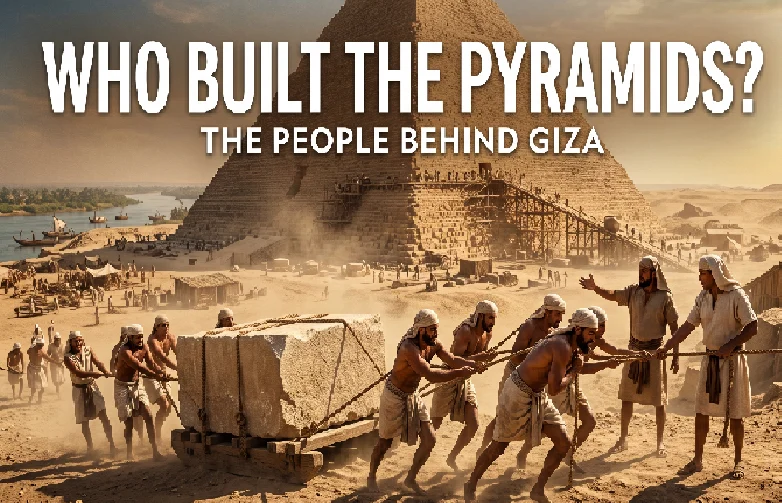
Transporting these monoliths across the plateau required sledges pulled by gangs of men over packed tracks. Archaeological paintings from the tomb of Djehutihotep depict workers pouring water directly in front of the wooden sledge runners, a technique that lubricated the sand and reduced friction by nearly fifty percent.
The sheer organizational complexity [Internal Link: Ancient Egyptian Kingdoms Dynastic Architecture] transformed stone transport into a synchronized mechanical operation that kept the monument rising season after season.
The Nile as a Highway: The Harbor of Khufu
Stone cannot be hauled hundreds of miles over trackless desert without prohibitive energetic costs. The builders of the Pyramids of Giza solved this challenge by exploiting the natural hydrography of the Nile River.
Recent paleo-ecological studies and sediment core analyses confirm that an extinct branch of the river—the Khufu Branch—flowed directly alongside the base of the Giza plateau during the Fourth Dynasty. The seasonal floodwaters rose close to the construction site, allowing engineers to excavate deep artificial canals and docking basins.
The logistics of river transport were illuminated in 2013 by the discovery of the Diary of Merer at the Red Sea port of Wadi al-Jarf. Written in hieratic script on papyrus rolls, this document is the personal logbook of a mid-level inspector named Merer:
-
Merer commanded a company of two hundred elite sailors operating a flotilla of wooden cargo vessels.
-
The logs record daily shipments of fine white Tura casing limestone from eastern quarries to the construction basin of the Great Pyramid.
-
Vessels traveled downstream along the Nile, entered deep artificial canals, and unloaded their cargo directly onto the harbor quays at Giza within two days.
-
Merer noted that the entire operation fell under the administrative oversight of Prince Ankhhaf, the half-brother of Khufu.
This discovery transformed our understanding of the Pyramids of Giza. It proved that water infrastructure and harbor engineering were just as crucial to the monument’s completion as the ramps used on the plateau itself.
Administrative Precision and Tool Manufacture
The coordination of the construction site demanded an advanced system of accounting and material inventory. A workforce using thousands of soft copper tools every day faced catastrophic bottlenecks if dull blades were not immediately recycled.
The metallurgy of the Old Kingdom was strictly controlled:
-
The Copper Foundry: Masons used tools cast from unalloyed copper or arsenical bronze, metals that lost their cutting edge rapidly against hard limestone.
-
Tool Recycling: Scribes weighed tools before issuing them to quarry squads and reweighed them upon return; lost copper shavings were charged against workers’ wages to prevent theft.
-
Blacksmith Forges: Continuous-fire charcoal furnaces operated around the clock at the site, melting down deformed chisels and re-forging them into sharp tools.
Surveyors aligned the Pyramids of Giza with jaw-dropping astronomical precision. The Great Pyramid’s base is level to within less than an inch across thirteen acres, and its sides align to true north with an error of less than one-fifteenth of a degree.
Engineers achieved this alignment using simple plumb lines (merkhet) and sighting rods (bay), tracking the transit of circumpolar stars across the northern night sky. By establishing an artificial horizon with water-filled trenches, they leveled the bedrock plateau before the first course of stone was laid.
Forensic Trauma and Skeletal Records
The skeletal remains excavated at Giza provide an intimate, unvarnished look at the physical toll borne by the workers who raised the Pyramids of Giza. Masons and haulers lived lives of strenuous physical labor that left permanent markers on their bones.
Forensic anthropologists have identified consistent osteological stress patterns across the workforce:
-
Degenerative Osteoarthritis: Severe compression and degeneration of the lumbar vertebrae and knee joints, resulting from years of hauling sledges and lifting heavy loads up ramps.
-
Compressed Fractures: Crushed vertebrae and shattered metatarsals, sustained when heavy stone blocks shifted suddenly during placement.
-
Hypertrophic Muscle Attachments: Markedly enlarged muscle insertion points on humeri and clavicles, indicating exceptional upper-body muscle development from swinging heavy stone pounders.
Despite these physical rigors, life expectancy among the skilled craftsmen averaged between thirty and thirty-five years, comparable to other urban populations in the Bronze Age.
The presence of female skeletons displaying identical spinal stress patterns, alongside infant burials, proves that entire families lived within the support city. Women managed the industrial bakeries, wove linen clothing, and operated beer breweries, forming an indispensable pillar of the construction machine.
Geopolitical Aftermath: The Economic Legacy of the Pyramids of Giza
The construction of the Pyramids of Giza fundamentally altered the state institutions of ancient Egypt. Undertaking projects of this magnitude forced the royal administration to expand its fiscal reach into every corner of the country.
The economic impacts permanently reshaped the kingdom:
-
Centralized Resource Extraction: The need to supply Giza led to the establishment of hundreds of royal cattle estates (hut) and agricultural colonies throughout the Delta, binding rural provinces into a unified fiscal network.
-
Rise of the Bureaucracy: The sheer volume of bookkeeping required to manage rations, tools, and labor created a powerful caste of professional scribes and administrators who gradually asserted their own political independence.
-
Decentralization of Wealth: To maintain the mortuary cults of Khufu, Khafre, and Menkaure, successive pharaohs granted tax-exempt status to vast agricultural endowments, slowly bleeding the central treasury of operating revenue.
By the Fifth and Sixth Dynasties, royal pyramids grew significantly smaller, built with inferior rubble cores and thin limestone casings. Meanwhile, private mastaba tombs of provincial governors (nomarchs) grew increasingly lavish, reflecting the gradual diffusion of wealth away from the divine pharaoh toward local lords.
This administrative shift culminated in the political breakdown of the First Intermediate Period, proving that the colossal investments poured into the Pyramids of Giza stretched the fiscal architecture of the Old Kingdom to its limits.
Yet the monuments outlived the state that built them. Four and a half millennia later, they stand not as symbols of ancient cruelty, but as physical testaments to what human collective willpower can achieve when guided by unmatched state logistics, engineering skill, and administrative vision.
Frequently Asked Questions
Were the Pyramids of Giza built by slaves?
No, archaeological evidence confirms the pyramids were built by free Egyptian citizens, master craftsmen, and seasonal agricultural laborers. Excavations at the Giza workers’ village and cemetery show that laborers received high-protein meat diets, professional medical care for fractures, and honourable burials with funerary provisions.
How was stone transported to the Pyramids of Giza?
Limestone core blocks were quarried directly on the Giza plateau and dragged on wooden sledges over lubricated tracks. High-grade white casing limestone from Tura and pink granite from Aswan were transported hundreds of miles along the Nile River on cargo barges, entering artificial canals that delivered stone directly to harbor basins at the foot of the plateau.
How many people worked on the Pyramids of Giza?
Archaeological evidence from housing barracks and food facilities indicates a permanent workforce of roughly four to five thousand skilled craftsmen, masons, and administrators, supported by a rotating seasonal labor force of fifteen to twenty thousand conscripts during the annual Nile flood season.