
White Ship Disaster 1120: The Midnight Wreck That Broke a Crown
The White Ship disaster 1120 remains the most consequential maritime catastrophe in medieval British history. On a freezing, moonlit November evening along the rocky Cotentin Peninsula, an ostensibly invincible vessel sank beneath calm waters, dragging England’s royal succession into the abyss. In a few moments, the future of the Anglo-Norman empire disintegrated, triggering an era of dynastic bloodshed that reshaped medieval Europe.
The port of Barfleur was alive with celebration on the night of November 25. King Henry I of England had concluded a triumphant military campaign across Normandy, forcing King Louis VI of France to concede disputed feudal borderlands. Norman supremacy across northern France appeared indisputable, anchored by the formal investiture of Henry’s only legitimate son and heir, Prince William Adelin.
While Henry I embarked on his own royal flagship at dusk, William Adelin chose to linger at the quay with his companions. The White Ship disaster 1120 was conceived not in the fury of a sudden ocean gale, but in an atmosphere of uninhibited courtly revelry and reckless hubris.
The Gathering Storm of Revelry in Barfleur Harbor
The vessel moored at the quay was the Blanche-Nef, or White Ship, a sleek, newly fitted clinker-built craft owned by Thomas FitzStephen. FitzStephen’s father had captained the Mora, the flagship that carried William the Conqueror across the English Channel in 1066. FitzStephen approached King Henry I, requesting the honor of transporting the monarch. Henry had already finalized his travel arrangements, but he granted FitzStephen permission to carry Prince William instead.
The young prince, eighteen years old and celebrated as the undisputed heir to the English throne, boarded the craft with a retinue of roughly three hundred aristocrats, courtiers, and retainers. Among them were his illegitimate half-siblings, Richard of Lincoln and Matilda, Countess of Perche, alongside the wealthiest young scions of Anglo-Norman high society.
Before casting off, Prince William ordered three enormous wooden casks of vintage wine rolled up the gangways and distributed directly to the crew. Fifty seasoned rowers and their helmsmen abandoned discipline, joining the wealthy passengers in heavy carousing. Priests who arrived at the quay to offer traditional blessings before departure were driven away with jeers and drunken laughter.
Certain prudent passengers recognized the clear hazards of the unfolding spectacle. Stephen of Blois, the prince’s cousin, excused himself from boarding, citing a sudden bout of violent dysentery. A handful of sober courtiers quietly followed him off the ship. By the time midnight approached, the ship stood ready to cast off, its crew and passengers thoroughly intoxicated in the freezing air.
[Key Figures Aboard the Blanche-Nef]
- William Adelin: Only legitimate son and heir of King Henry I of England
- Richard of Lincoln: Illegitimate son of King Henry I, skilled military commander
- Matilda: Countess of Perche, illegitimate daughter of King Henry I
- Thomas FitzStephen: Master mariner, son of William the Conqueror's former captain
- Berold of Rouen: Common butcher, sole survivor of the wreck
- Stephen of Blois: Royal cousin, disembarked prior to sailing due to illness
Hubris on the High Tide: A Midnight Sprint
Prince William watched Henry’s convoy vanish past the headland hours before his own ship was untied. He demanded that FitzStephen catch up with the king’s royal fleet before it crossed the Channel. The crew, eager to prove their speed, boasted that their modern vessel could effortlessly overtake the king’s convoy.
Around midnight, FitzStephen gave the order to cast off into the flat, black waters of Barfleur Bay. Fifty oars plunged violently into the surface, with the rowers pulling at maximum speed. The vessel surged across the calm water, its speed amplified by the falling tide.
Navigating the waters outside Barfleur required precise vigilance even for seasoned sailors. Less than a mile off the coast lay the deadly Quilleboeuf Rock, a jagged granite reef that sat submerged just beneath the surface during high water. In broad daylight, experienced pilots navigated well clear of its hidden ridges.
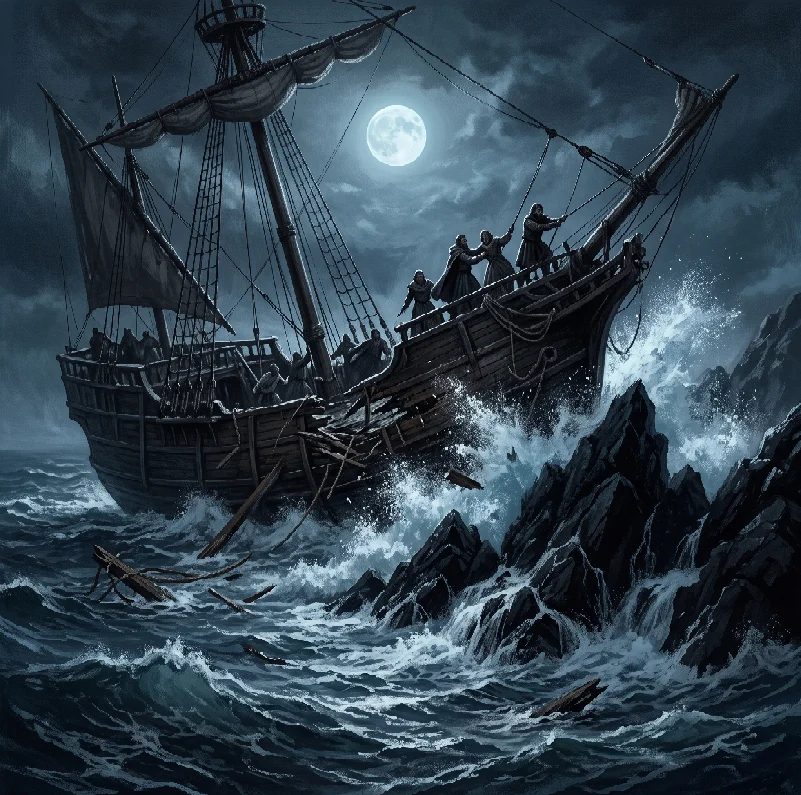
Blinded by alcohol, darkness, and speed, the helmsman steered straight toward the submerged hazard. The White Ship disaster 1120 occurred without warning. The ship’s port bow struck the Quilleboeuf Rock with immense velocity, splintering oak ribs and tearing through the lower clinker strakes like parchment.
[Timeline of the Midnight Catastrophe]
23:00 - Heavy drinking continues aboard the White Ship; holy men dismissed with ridicule.
23:45 - Blanche-Nef unties from Barfleur harbor, rowers operating at maximum speed.
00:15 - Port bow strikes the submerged Quilleboeuf Rock; hull breaches instantly.
00:25 - William Adelin boards the skiff, attempts to rescue Matilda of Perche.
00:30 - Overloaded skiff capsizes; all royal heirs drown in freezing waters.
07:00 - Morning fishermen discover Berold of Rouen clinging to the exposed yardarm.
The Wreck of the Blanche-Nef and the Death of Prince William
The impact threw passengers and crew across the deck as seawater rushed into the damaged hold. Panic swept through the vessel as the hull began to tilt sideways. The rowers abandoned their benches in terror, their calls for help echoing across the calm bay toward the shores of Barfleur.
FitzStephen scrambled to preserve the royal heir. Sailors managed to lower the vessel’s lone small skiff, dragging Prince William aboard. FitzStephen ordered the oarsmen to row hard toward the shoreline, where the lights of Barfleur were still visible across the water. The heir to the English throne was safely away from the sinking vessel.
As the skiff pulled away, a piercing voice echoed through the freezing dark. It was Prince William’s half-sister, the Countess of Perche, trapped upon the sinking deck and crying out to him for salvation. William could not bear to abandon her. Over the desperate protests of his rowers, he commanded the skiff to turn back into the wreckage.
It was a fatal misjudgment. As the small skiff pulled alongside the main hull, dozens of drowning courtiers leaped frantically toward it. The sudden weight capsized the skiff instantly, plunging the heir of England and his companions into the icy sea. Weighed down by heavy wool tunics, furs, and leather boots, Prince William Adelin vanished beneath the surface.
The Lone Survivor of the Quilleboeuf Rock
The main vessel sank rapidly, leaving only the tip of its main mast and yardarm protruding above the freezing sea. Three individuals managed to seize the rigging: Thomas FitzStephen, a young nobleman named Geoffrey de l’Aigle, and Berold, a humble butcher from Rouen who had boarded the ship to collect debts from the aristocratic passengers.
FitzStephen surfaced, broke through the waves, and asked the two men what had become of Prince William. When informed that the royal heir had drowned, FitzStephen declared that he could never face the wrath of King Henry I and allowed himself to sink into the dark water.
Hypothermia claimed Geoffrey de l’Aigle shortly before dawn, his frozen fingers slipping from the wooden yardarm despite Berold’s efforts to keep him conscious. Only Berold survived through the night, insulated by heavy sheepskin garments. When dawn broke over the Channel, local fishermen spotted the wreckage and pulled the shivering butcher from the sea. Berold was the sole survivor among roughly three hundred individuals who had set sail the previous night.
Royal Grief and Dynastic Paralysis at Westminster
Word of the White Ship disaster 1120 crossed the Channel ahead of the official confirmation, throwing the royal court at Westminster into deep panic. Norman barons and royal chancellors walked the halls in silence, paralyzed with dread. None possessed the courage to tell the King of England that his only legitimate son, two of his illegitimate children, and the cream of Anglo-Norman nobility had drowned.
For two days, courtiers kept the King in total ignorance, deflecting his questions regarding the delayed arrival of the prince’s ship. Finally, they orchestrated a delicate strategy to deliver the catastrophic news. They sent a young boy into Henry’s private chambers. The child threw himself weeping at the monarch’s feet and confessed that the Blanche-Nef was lost and all aboard had perished.
Contemporary chronicler Orderic Vitalis recorded that upon hearing the words, King Henry collapsed to the stone floor in absolute despair. Servants carried the unconscious monarch to his royal bedchamber. Chroniclers across the realm noted that Henry never smiled again for the remainder of his life.
The political fallout was immediate and devastating. The White Ship disaster 1120 wiped out an entire generation of royal administrators, military officers, and diplomatic links. With William Adelin dead, the succession to the crown of England hung by an exceptionally fragile thread.
[Geopolitical Repercussions of the Disaster]
- Immediate Loss: Death of the sole legitimate male heir to the Anglo-Norman dynasty
- Administrative Impact: Elimination of key royal scribes, treasurers, and military captains
- Diplomatic Rupture: Anjou marriage alliance severed, reigniting French-Norman hostilities
- Long-term Destabilization: Succession crisis leading directly to the 19-year civil war known as The Anarchy
Matilda’s Claim and the Oath of the Norman Barons
Desperate to secure his legacy, Henry I took immediate steps to rectify the succession crisis. He married Adeliza of Louvain in the hope of siring a new male heir, but the union produced no children. Henry had only one remaining legitimate child: his daughter, Empress Matilda, widow of Holy Roman Emperor Henry V.
Designating a woman as ruler over the violent, hyper-masculine Anglo-Norman realm was unprecedented. The Norman barony was built on physical lordship, military leadership, and personal feudal authority. To counter their skepticism, Henry summoned the great lords and clergy to Westminster, compelling them to swear sacred oaths recognizing Matilda as his rightful successor.
Among those who stepped forward to swear absolute fealty was Stephen of Blois—the very nephew who had avoided the sinking ship due to illness. Henry subsequently arranged a strategic marriage between Matilda and Geoffrey Plantagenet, Count of Anjou. The alliance was designed to neutralize border disputes, as explored in our study of the [Internal Link: Angevin Empire Rise and Continental Wars].
The union, however, alienated the conservative Anglo-Norman barons, who deeply distrusted the Angevins as historic enemies. When King Henry I died suddenly in 1135 from eating a surfeit of lampreys, the solemn oaths sworn to Matilda dissolved. The lingering consequences of the White Ship disaster 1120 erupted into open war.
The Anarchy: Nineteen Years of Brutal Civil Strife
Upon learning of Henry’s death, Stephen of Blois broke his oath. He rushed across the Channel to London, seized the royal treasury at Winchester, and had himself crowned King of England with the support of the church and major barons. Empress Matilda mobilized her military forces in Normandy and crossed into England to assert her rightful claim, triggering nearly two decades of civil war known as The Anarchy.
The kingdom descended into prolonged violence. Contemporary accounts in the Anglo-Saxon Chronicle recorded that barons built unlicensed castles across the realm, extorting taxes and torturing peasants with calculated cruelty:
“They hung men up by the feet and smoked them with foul smoke. They put knotted strings about their heads and twisted them until they went into the brain… Men said openly that Christ and his saints slept.”
The conflict ground into a military stalemate. In 1141, Matilda’s forces captured King Stephen at the Battle of Lincoln, but her abrasive manner alienated the citizens of London, preventing her coronation at Westminster Abbey. Stephen was subsequently exchanged for Matilda’s captured commander, Robert of Gloucester, and the war dragged on without resolution.
The country suffered catastrophic agricultural and commercial collapse. It was not until the Treaty of Wallingford in 1153 that the conflict was resolved. Under the agreement, Stephen retained the throne for the remainder of his life, but acknowledged Matilda’s son, Henry Plantagenet, as his rightful successor. When Stephen died in 1154, Henry II ascended the throne, inaugurating the Plantagenet dynasty. The White Ship disaster 1120 had permanently altered the royal line of England.
The Evolution of Twelfth-Century Warfare and Royal Fortifications
The protracted civil war ignited by the loss of the White Ship drove major developments in military architecture and combat technology. Both sides relied heavily on stone fortifications to assert dominance over agricultural districts.
-
Square Stone Keeps: Massive rectangular towers constructed from Caen stone or local flint, featuring walls three to four meters thick designed to resist subterranean mining.
-
Chain Mail Hauberks: Heavy iron knee-length mail shirts, weighing approximately twelve to fifteen kilograms, providing protection against slashing swords and arrows.
-
The Spurred Kite Shield: Elongated wooden shields covered in leather, measuring over a meter in length to protect horsemen from the shoulder down to the shin.
-
The Nasal Helmet: Conical iron helmets hammered from single blooms of iron, equipped with rigid nose guards to protect the face from lateral weapon cuts.
These military innovations transformed regional strongholds into nearly impregnable centers of defiance, as detailed in our analysis of [Internal Link: Norman Castle Siege Warfare Strategies]. The prolonged construction of these fortresses was an architectural consequence of the succession vacuum created at Barfleur.
Maritime Archaeology and the Memory of the Disaster
Centuries later, the submerged granite reef of the Quilleboeuf Rock continues to draw historical interest. In recent decades, underwater archaeological expeditions utilizing modern sonar and magnetometry have surveyed the seabed near Barfleur. While wooden timbers from the twelfth century rarely survive the marine environment of the English Channel, the survey work has confirmed the exact geography of the wreck site.
The tragedy endures as an early lesson in maritime chain of command and the vulnerability of hereditary monarchies. If the wine casks had remained in the cellars of Barfleur, William Adelin would have ascended the throne as a strong, unified ruler. The Plantagenet dynasty, the Angevin empire, and the subsequent Hundred Years’ War might never have unfolded.
A single night of drunken negligence on the water diverted the history of western Europe. The White Ship disaster 1120 stands as a stark testament to the role of chance, demonstrating how the course of an empire can be shattered by a hidden reef in the moonlight.
Frequently Asked Questions
What caused the White Ship disaster 1120?
The disaster was caused by reckless speed, heavy drinking among the crew and passengers, and night navigation along a dangerous coastline. After drinking three casks of wine provided by Prince William, the intoxicated crew rowed the ship into the submerged Quilleboeuf Rock just outside Barfleur harbor.
How did Prince William die during the White Ship disaster 1120?
Prince William initially escaped the sinking ship on a small rowboat. However, upon hearing the desperate cries of his half-sister, Matilda of Perche, he ordered the boat turned around to save her. Panicked survivors swarmed the small vessel, capsizing it and drowning the royal heir.
How did the sinking lead directly to The Anarchy?
Prince William was the only legitimate son and heir of King Henry I. His unexpected death left the succession contested between his sister, Empress Matilda, and his cousin, Stephen of Blois. When Henry I died in 1135, Stephen seized the throne, igniting nineteen years of civil war known as The Anarchy.