
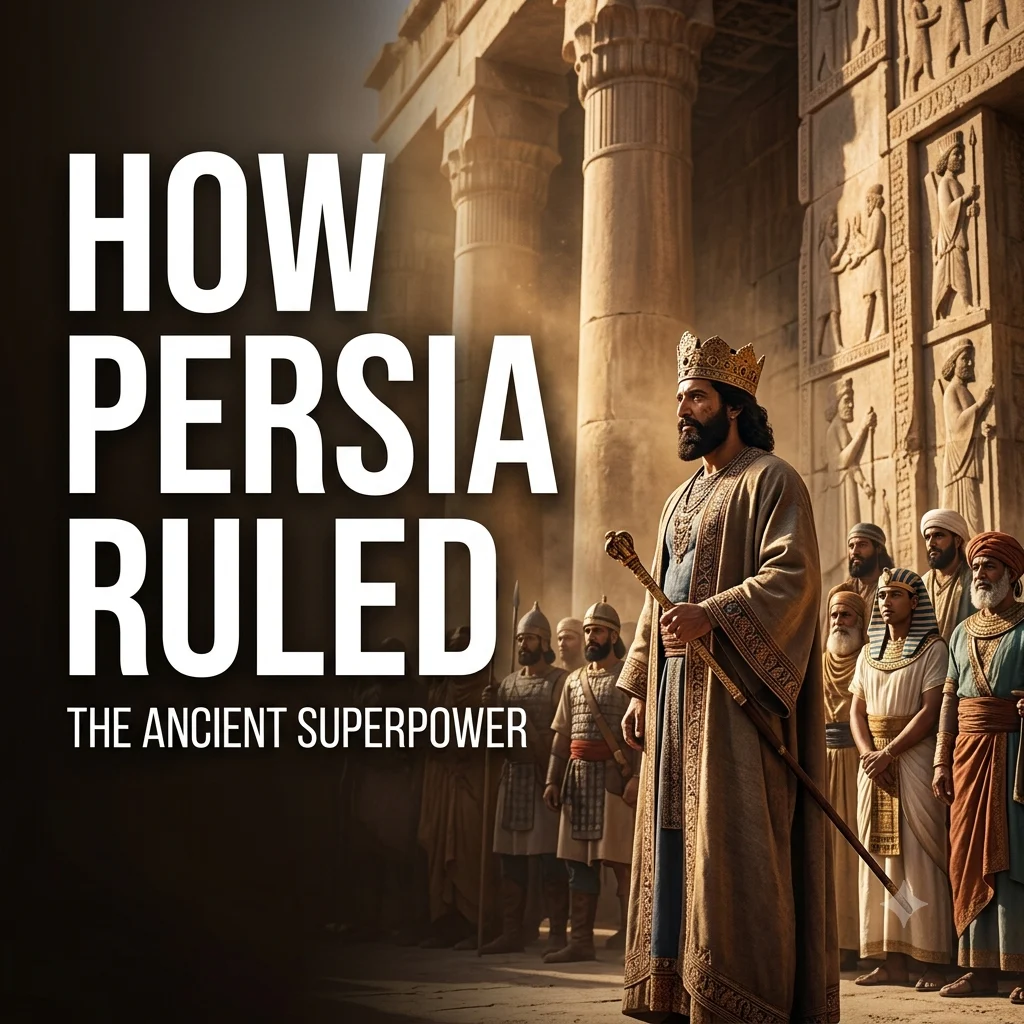
Achaemenid Empire: The Imperial Blueprint of Persia
In the mid-sixth century BCE, the Achaemenid Empire established a standard of statecraft never before seen in the ancient world. At its territorial peak, this dynamic hegemony spanned from the Nile Delta and Macedonian fringes to the Indus Valley, encompassing an estimated forty-four percent of the human population. Ruling such vast, culturally disparate lands without modern communication networks was history’s most demanding administrative challenge.
The success of the Achaemenid Empire did not rely on physical violence alone. Earlier Near Eastern kingdoms, particularly the Neo-Assyrians, maintained control through mass deportations, terror, and deliberate cultural erasure. The Persians replaced that destructive approach with an institutional framework that combined centralized royal oversight with extensive local autonomy, binding dozens of distinct ethnic nations to the throne of the Great King.
The Genesis: Cyrus II and the Expansion from Anshan
The emergence of the Achaemenid Empire began within the rugged highlands of Persis, centered around the ancient city of Anshan in southwestern Iran. In 550 BCE, Cyrus II united disparate Persian clans and led an insurrection against the ruling Median monarch Astyages, absorbing Media into a unified realm.
Rather than massacring the defeated Medes, Cyrus integrated their aristocracy into high imperial offices. Median generals commanded Persian divisions, and Median scribes served alongside Persian nobles. This established an enduring precedent: imperial expansion would incorporate defeated elites rather than eradicate them.
Cyrus turned westward to confront King Croesus of Lydia, securing Anatolia and absorbing the Greek coastal colonies. In 539 BCE, Persian divisions marched into Babylon without sacking the city, putting an end to the Neo-Babylonian dynasty. Cyrus presented himself not as a brutal invader, but as the chosen liberator favored by the Babylonian god Marduk.
To cement this conquest, the crown issued the Cyrus Cylinder, a clay foundation document inscribed in Babylonian cuneiform. The text recorded royal decrees restoring local religious cults and repatriating displaced populations, including the Judean captives. This sophisticated propaganda proved that the Achaemenid Empire preferred voluntary collaboration over costly military occupations.
The Satrapy System: Provincial Governance and Oversight
Administering millions of subjects across three continents required systemic decentralization. Under Darius I, who seized the throne in 522 BCE, the provinces of the Achaemenid Empire were codified into approximately twenty vast administrative divisions known as satrapies.
Each satrapy was led by a governor (satrap), typically drawn from the Persian royal court or trusted regional dynasts:
-
Civil and Judicial Authority: The satrap managed regional courts, public works, canal irrigation, and the collection of imperial revenues assessed by royal land surveys.
-
Separation of Military Powers: To deter regional rebellions, provincial fortress garrisons reported directly to an independent general answering solely to the Great King.
-
The Royal Inspectors: Traveling officials known to contemporary Greek observers as the “King’s Eyes and Ears” conducted unannounced audits of provincial treasuries, accompanied by royal strike detachments.
-
Preservation of Legal Customs: Local populations retained their indigenous laws, priesthoods, and commercial practices; Egyptian priests adjudicated local disputes using traditional temple statutes, while Babylonian merchants executed contracts under established cuneiform law.
This structural balance allowed the Achaemenid Empire to adapt to preexisting institutions rather than building an administrative machinery from scratch. By validating local customs, the imperial administration minimized regional revolts while ensuring a steady inflow of bullion into the central treasuries at Susa and Ecbatana.
Institutional adaptations [Internal Link: Classical Logistics and Imperial Expansion] proved that provincial efficiency depended on predictable legal structures rather than unchecked military coercion.
Arteries of the Throne: The Royal Road and Mobility
The logistical coherence of the Achaemenid Empire depended on an engineering network designed to eliminate distance. Without rapid transport, a coordinated revolt in western Anatolia or Egypt could dismantle the empire before the central court in Persis even received word.
To secure internal communication, Darius constructed the Royal Road, a paved stone highway stretching over 1,600 miles (2,600 kilometers) from Susa to Sardis:
-
Staging Infrastructure: The highway maintained 111 royal relay stations (chapar khaneh) positioned at intervals of one day’s ride, each equipped with fresh horses, food supplies, and armed guards.
-
Express Couriers: Royal messengers (pirradazis) rode in continuous shifts day and night, carrying official dispatches along the entire 1,600-mile artery in seven days.
-
Traveler Security: The highway was defended by regular cavalry patrols and mountain garrisons, transforming formerly dangerous trade tracks into secure transit corridors.
-
Commercial Integration: While built for official state business, the road permitted merchant caravans to haul textiles, perfumes, metals, and grain safely between the Mediterranean and the Persian Gulf.
Herodotus famously celebrated these couriers, noting that neither snow, rain, heat, nor darkness prevented them from completing their appointed stages. The postal grid of the Achaemenid Empire functioned as the nervous system of the state, ensuring that royal orders projected outward and intelligence flowed inward with unmatched speed.
The crown expanded maritime infrastructure with equal vigor. Darius completed the construction of an eighty-meter-wide canal connecting the Nile River to the Red Sea, enabling royal naval flotillas and merchant vessels to sail from the Mediterranean directly into the Persian Gulf.
Weapons, Armor, and the Imperial Battlefield Model
The armed forces of the Achaemenid Empire operated under a doctrine of mobile missile warfare combined with decisive heavy cavalry strikes. Because the empire spanned distinct ecological zones, armies were multi-ethnic coalitions fielding specialized contingents from across Eurasia.
The technical specifications of the core infantry and cavalry arms included:
-
The Composite Recurve Bow: Crafted from laminated layers of horn, wood, and sinew, carrying thirty to forty reed arrows tipped with socketed bronze three-bladed points capable of penetrating light defenses at two hundred yards.
-
Gerron: A tall rectangular woven-wicker shield faced with hardened ox-hide, exceptionally light on long desert marches while effective at stopping enemy arrow volleys.
-
Akinakes: A double-edged iron short sword measuring forty to forty-five centimeters, worn suspended from a leather belt for close-quarter infighting.
-
Sagaris: A pointed iron battle-axe carried by elite horsemen and guards, engineered to crack bronze helmets and puncture body armor.
-
Iron Scale Cuirass: Overlapping bronze or iron scales laced to leather or linen vests, worn discreetly beneath dyed embroidered tunics.
What Factors Allowed Persia to Build the Largest Empire of Its Time?
The premier vanguard of the ground forces was the Ten Thousand Immortals (Athanatoi). This elite standing brigade served as the sovereign’s personal guard in peace and the shock infantry core in battle. Their name derived from an unyielding administrative protocol: if a soldier died, was wounded, or fell ill, a veteran recruit instantly filled his place, maintaining the corps at an unchanging strength of exactly ten thousand men.
In standard field deployments, Persian spearmen (sparabara) drove their tall wicker shields into the earth to construct an unbroken defensive wall. From behind this screen, thousands of archers discharged continuous, coordinated volleys that showered hostile lines under clouds of bronze and iron.
Once the enemy’s formations fractured under this suppressive fire, armored cavalry riding large Nisean warhorses struck the disordered flanks to finish the engagement.
Tactical Friction: The Greek Phalanx vs. the Achaemenid Empire
The operational doctrine that secured the dominance of the Achaemenid Empire across Asia faced severe limits when encountering the heavy infantry of mainland Greece. The Persian model was engineered for open, dry plains where horsemen had space to maneuver and archers had clear sightlines to thin enemy ranks.
During the campaigns of Darius and Xerxes, the rugged topography of the Aegean shattered this operational framework:
-
Constricted Topography: Mountain passes, coastal bottlenecks, and marshland mud neutralized the Persian cavalry and eliminated long-range archery sightlines.
-
Material Disparity: Light wicker gerron shields easily splintered under the shock impact of heavy ash spears wielded by bronze-clad hoplites.
-
Close-Quarter Reach: The short six-foot Persian spear was outranged by the nine-foot Greek thrusting lance (dory).
-
Speed of Advance: At Marathon in 490 BCE, the Athenian phalanx crossed the final hundreds of yards at a dead run, compressing the missile window and driving directly into the thinner Persian center.
How Did the Persian Empire End
These tactical realities resulted in decisive reversals for the Achaemenid Empire at Marathon and Plataea. Recognizing these vulnerabilities, the Great Kings demonstrated characteristic administrative pragmatism.
Instead of forcing Persian levies into roles for which they were untrained, the empire began hiring thousands of Greek mercenary hoplites. By the fourth century BCE, Greek heavy infantry formed an indispensable frontline component of every major royal field army.
Tactical adjustments in antiquity [Internal Link: Nomadic Equestrian Warfare Mechanics] demonstrated that multi-regional superpowers maintained authority by continually integrating foreign weapon systems.
Monumental Theater: The Stone City of Persepolis
Nowhere was the ideological vision of the Achaemenid Empire projected more dramatically than at Persepolis (Takht-e Jamshid). Founded by Darius I around 518 BCE in the Persian heartland, the complex rose atop an artificial stone terrace covering 125,000 square meters.
Persepolis was not an ordinary administrative city; it functioned as the ceremonial theater of universal kingship. The palace reliefs presented a radical alternative to earlier imperial art:
-
The Apadana Procession: Grand stone staircases displayed carved reliefs of twenty-three subject nations marching peacefully toward the royal audience hall.
-
Voluntary Tribute: Delegations of Medes, Babylonians, Ionians, Scythians, and Nubians appeared wearing their native garments, carrying gifts of regional craftsmanship, horses, and vessels rather than kneeling as chained captives.
-
Absence of Graphic Slaughter: Unlike Assyrian and Roman victory monuments that celebrated flaying, beheading, and enslavement, Persepolis projected an empire of cooperative peace, mutual commerce, and cosmic harmony under the blessing of Ahura Mazda.
-
The Fortification Archive: Thousands of excavated Elamite administrative tablets reveal that the workforce who built Persepolis consisted of salaried, free men and women receiving fixed rations of grain, wine, and silver, disproving the myth of slave labor.
The complex operated as the spiritual center for the annual Nowruz spring festival, where the Great King renewed the social contract between the throne and the multi-ethnic realm.
Economic Architecture and Standardization
The military endurance of the Achaemenid Empire was funded through a revolutionary standardization of the imperial economy. Before Darius, international trade across the Near East relied on cumbersome weighed silver ingots and localized barter.
Darius transformed Mediterranean and Asian trade by introducing a bimetallic currency standard:
-
The Gold Daric: A high-purity gold coin containing 8.4 grams of refined gold, stamped with the image of the Great King kneeling with bow and spear.
-
The Silver Siglos: A circulating silver coin containing 5.6 grams of silver, serving as the standard currency for daily business and soldier payrolls across the provinces.
-
Standardized Weights and Measures: The royal cubit and royal talent were unified throughout the realm, ensuring honest commerce from the Aegean to the Indus.
-
Taxation Based on Capacity: Rather than arbitrary confiscations, the state completed comprehensive land surveys, assessing tribute based on agricultural yields, soil fertility, and rainfall records.
How Large Was the Persian Empire
This economic framework turned the empire into an interconnected trade network. Egyptian grain, Phoenician cedar, Babylonian wool, Indian spices, and Greek wine moved along imperial highways under the protection of royal peace.
By making trade safe, predictable, and profitable, the Achaemenid Empire ensured that local merchant classes maintained a vested financial interest in the preservation of the Persian throne.
Archaeology and the Epigraphic Record
The physical history of the Achaemenid Empire has been illuminated by extensive excavations and linguistic breakthroughs across Iran, Iraq, and Egypt. The pivotal document confirming the administrative mechanics of the state is the monumental Behistun Inscription.
Carved into a limestone cliff 300 feet above the royal road in western Iran, the trilingual inscription records the rise of Darius I in Old Persian, Elamite, and Babylonian:
-
The relief portrays Darius standing victorious over rebellious rivals under the winged symbol of the god Ahura Mazda.
-
The trilingual text provided the critical key that allowed nineteenth-century scholars to decipher ancient cuneiform script, unlocking the written history of Mesopotamia.
-
The inscription explicitly lists the dahyāva (peoples and lands) under imperial command, confirming the geographic scope of the administration.
Excavations at the ancient administrative capital of Susa revealed the Palace of Darius, an architectural marvel featuring enameled brick reliefs depicting the Immortals in vibrant colors. The texts describe materials shipped from across the empire: cedar wood from Lebanon, gold from Sardis and Bactria, lapis lazuli from Central Asia, and ivory from Nubia.
These physical relics prove that the Achaemenid Empire was an unprecedented industrial coordinator, capable of mobilizing material resources across thousands of miles to build monuments of enduring technical perfection.
The Fall and the Immortal Legacy of Achaemenid Rule
The sovereign independence of the Achaemenid Empire concluded between 334 and 330 BCE under the relentless offensive of Alexander the Great. Exploiting tactical genius and the shock power of his Companion Cavalry, Alexander defeated Darius III at the Granicus, Issus, and Gaugamela.
Following the capture of the royal capitals, Alexander ordered the looting and deliberate burning of Persepolis in 330 BCE. The conflagration destroyed the cedar rooflines and royal archives, an act of symbolic vengeance for the Persian destruction of Athens 150 years earlier.
Yet while the dynasty fell, the administrative systems of the Achaemenid Empire survived:
-
The Hellenistic Continuity: Alexander retained the satrapy boundaries, postal routes, and court etiquette, marrying his senior officers to Persian noblewomen to stabilize his conquests.
-
The Seleucid and Parthian Realms: The successor kingdoms governed through the bureaucratic infrastructure established by Darius, relying on Iranian administrators to maintain order.
-
The Sasanian Empire: The native Sasanian dynasty consciously revived the Achaemenid heritage, establishing an imperial state that challenged Rome and Byzantium for four centuries.
-
Roman Imperial Adaptation: The Roman provincial system, with its professional governors, state postal relays (cursus publicus), and road engineering, drew inspiration from Hellenistic adaptations of the Persian model.
The Great Kings demonstrated that ruling an empire does not require forcing diverse populations into cultural conformity. By pairing military precision with administrative tolerance, structural roads, and economic standardization, the Achaemenid Empire created the first true universal empire in human history, leaving a political legacy that helped shape the modern world.
Frequently Asked Questions
What was the purpose of the Royal Road in the Achaemenid Empire?
The Royal Road was an engineered highway spanning over 1,600 miles between Susa and Sardis. It maintained 111 royal staging stations with fresh horses and couriers, allowing the king’s messages to travel across the empire in seven days while facilitating trade and rapid troop movements.
What were the responsibilities of a satrap?
A satrap was a royal provincial governor who managed civil administration, collected taxes assessed by imperial land surveys, and enforced justice. To prevent regional rebellions, the satrap’s authority was balanced by independent garrison commanders and traveling royal inspectors who reported directly to the king.
Why did the Achaemenid Empire struggle against Greek hoplites?
The Persian military relied on light wicker shields, short spears, and long-range composite archery, an operational model designed for maneuver on open Asian plains. When fighting in restricted Greek mountain terrain, light Persian infantry was outmatched by the interlocking heavy bronze armor, nine-foot thrusting lances, and massed shock charges of the Greek phalanx.