
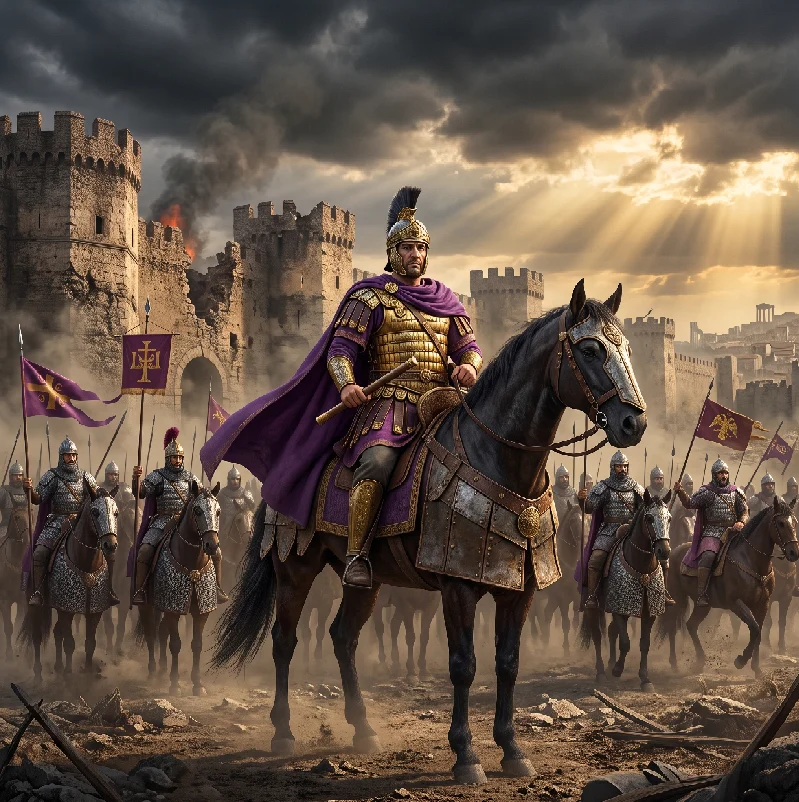
Emperor Justinian: The Sovereign Who Fought to Restore Rome
When Emperor Justinian assumed the imperial throne in Constantinople in 527 AD, he inherited an Eastern Roman realm haunted by the lost provinces of the West. To the patricians and bureaucrats of the eastern court, Italy, North Africa, and southern Hispania were not sovereign barbarian kingdoms. They remained ancestral Roman territories unjustly torn from the empire by Germanic usurpers.
Driven by deep religious conviction and an unyielding legal ideology, Emperor Justinian pursued a single grand mission: Renovatio Imperii, the complete renewal of the Roman Empire. Through legal codification, monumental architectural construction, and audacious foreign campaigns, he came closer than any other late antique sovereign to piecing the shattered Mediterranean back together.
Belisarius and the Italian Campaigns of Emperor Justinian
In 535 AD, the imperial command directed its attention across the Ionian Sea toward the Italian heartland. The Ostrogothic Kingdom had fallen into dynastic confusion following the death of King Theodoric the Great, offering Emperor Justinian a diplomatic justification to intervene.
Belisarius struck quickly, securing Sicily before crossing the Strait of Messina onto the Italian mainland. Pushing north against retreating Gothic divisions, the general captured Naples by sending a strike team crawling through the underground channels of an ancient aqueduct into the heart of the defended city.
By December 536 AD, Roman troops entered Rome through the Porta Asinaria, driving the Ostrogothic garrison northward toward Ravenna.
[Ostrogothic Host: ~40,000 Warriors]
                 │
                 ▼  (Surrounds Aurelian Walls)
┌────────────────────────────────────────────────┐
│   Rome Under Siege (537–538 AD)                │
│   Defended by Belisarius & 5,000 Veteran Roman │
│   Archers, Engineers, and Elite Bucellarii     │
└────────────────────────────────────────────────┘
                 ▲
                 │  (Precision Sallies & Ballistas)
[Mounted Bowmen Strike & Retreat Behind Walls]
The Gothic king Vitiges answered by mobilizing an army of roughly 40,000 warriors to besiege Rome. Belisarius held the sprawling Aurelian Walls for over a year with just 5,000 veteran troops, conducting precision mounted sallies and using torsion artillery:
Ballista Precision
Roman defensive artillery mounted atop the city towers hurled heavy bolts that pierced Gothic wooden siege engines and armor at exceptional range.
Asymmetric Horse Archery
Belisarius observed that Gothic cavalry relied on heavy lances and broadswords with no archery training, while Gothic foot archers lacked mobility. He fielded mounted horse archers who repeatedly lured the enemy within arrow range, inflicted devastating casualties, and retreated safely behind the stone ramparts.
Supply Line Severance
Through swift naval operations along the Tiber and raids across the Campagna, Belisarius gradually intercepted Vitiges’ supply convoys, starving the larger besieging army until the Ostrogoths burned their camps and withdrew.
By 540 AD, Belisarius stood outside Ravenna. When Gothic aristocrats secretly offered him the crown of Western Roman Emperor if he would break with Constantinople, Belisarius feigned consent to gain bloodless entry into the fortress.
The moment Ravenna’s gates opened, the general seized the city in the name of Emperor Justinian, honoring his sovereign oath despite the rising suspicion of the court.
Legal Reformation: The Enduring Code of Emperor Justinian
While field armies maneuvered across Italy, Emperor Justinian orchestrated an institutional revolution within the imperial administration. Over centuries, Roman jurisprudence had accumulated into thousands of contradictory statutes, conflicting imperial rescripts, and overlapping court precedents.
Justinian tasked his brilliant legal minister, Tribonian, with standardizing and pruning this disorganized legal mass:
Corpus Juris Civilis
The compilation, produced between 529 and 534 AD, condensed centuries of legal writing into four unified components: the Codex Justinianus (imperial statutes), the Digest (opinions of classical jurists), the Institutes (a definitive textbook for law students), and the Novellae (new laws issued during the emperor’s reign).
                 [Corpus Juris Civilis]
                            │
     ┌──────────────────────┼──────────────────────┐
     ▼                      ▼                      ▼
[Codex Justinianus]     [The Digest]       [The Institutes]
Imperial edicts pruned  Decisions of elite  Standardized legal
and organized           classical jurists  student textbook
This monumental codification reorganized principles governing property rights, contracts, marriage, and judicial precedent. The legal work of Emperor Justinian provided the civil blueprint that eventually shaped modern European legal traditions, ensuring that the essence of Roman law survived the fall of the empire.
To examine how late antique warfare evolved alongside these administrative overhauls, study [Internal Link: Late Antiquity Lamellar Cuirasses] to understand the metallurgy that equipped frontline forces.
The Golden Dome: Hagia Sophia and Imperial Architecture
In January 532 AD, Emperor Justinian faced the most dangerous domestic crisis of his reign: the Nika Riots. What began as violent partisan clashes between chariot-racing factions (the Blues and the Greens) in the Hippodrome escalated into a coordinated urban rebellion that burned much of Constantinople to the ground.
Besieged within the imperial palace, the emperor prepared to flee by ship. Empress Theodora intervened, delivering a legendary address asserting that royal purple made a noble burial shroud.
Rallied by her defiance, Justinian unleashed Belisarius and the Illyrian commander Mundus. The imperial guard stormed the Hippodrome, crushed the insurrection, and permanently secured the emperor’s autocracy.
       [January 532 AD: The Nika Riots]
                      │
  ┌───────────────────┴───────────────────┐
  ▼                                       ▼
[Hippodrome Rebellion Suppressed]   [Capital Burned in Ashes]
  │                                       │
  └───────────────────┬───────────────────┘
                      ▼
[Isidore of Miletus & Anthemius of Tralles Commissioned]
                      │
                      ▼
[Hagia Sophia Erected in Under Six Years (532–537 AD)]
Emerging from the ashes of the riots, Emperor Justinian commissioned a public works program to reassert divine and imperial authority. At its center stood the rebuilt cathedral of Hagia Sophia (Holy Wisdom), designed by the physicist Isidore of Miletus and the mathematician Anthemius of Tralles.
Erected in just under six years, the structure was a masterpiece of architectural engineering:
-
Pendentive Geometry: The architects solved the challenge of setting an immense circular dome over a square base using four massive stone pendentives, creating the illusion that the dome hung suspended from the heavens.
-
Interior Illumination: Forty arched windows ringed the base of the dome, flooding the central nave with light that reflected off acres of gold mosaics and polished marble slabs brought from across the empire.
-
Monumental Scale: For nearly a thousand years, the cathedral stood as the largest enclosed interior space in the Christian world, an architectural statement of imperial majesty.
Upon crossing the threshold at the cathedral’s formal dedication in 537 AD, Emperor Justinian looked upon the soaring dome and famously proclaimed, “Solomon, I have surpassed thee.”
Weapons, Armor, and Military Logistics
The sixth-century Roman field army differed radically from the classical legions that marched under Julius Caesar. The traditional [Internal Link: Roman Legionaries Heavy Infantry] formations had evolved into a mobile combined-arms force centered on heavy shock cavalry (cataphractarii) and versatile horse archers.
                 [Late Roman Armament System]
┌────────────────────────┬────────────────────────────────────────────┐
│ Primary Body Armor     │ Iron lamellar cuirass laced over chainmail │
│ Helmet Architecture    │ Spangenhelm (riveted iron-plate dome)      │
│ Offensive Hand Weapons │ Spatha (long cavalry sword) & Kontos lance │
│ Missile Armament       │ Composite recurve horn bow & Plumbatae     │
└────────────────────────┴────────────────────────────────────────────┘
The elite frontline warrior was equipped to deliver devastating shock charges and execute flexible skirmishing maneuvers:
-
Lamellar Cuirass: Constructed from overlapping iron or hardened rawhide plates laced with leather thongs, this armor deflected slashing blows while offering flexibility in the saddle.
-
The Spatha: Unlike the short stabbing gladius of the early empire, late antique soldiers wielded the spatha, a three-foot double-edged slashing blade optimized for mounted combat.
-
The Composite Bow: Crafted from laminated wood, horn, and sinew, these recurve bows could pierce mail armor at mid-range, giving Roman cavalry missile superiority over unmounted barbarian levies.
-
Plumbatae: Lead-weighted throwing darts carried in the hollow interior of shields allowed infantry to launch lethal missile volleys before colliding with charging enemy ranks.
Logistically, maintaining this professional standing force across thousands of miles required deep financial reserves. Every soldier received imperial wages (annona), state-manufactured weapons, and cavalry mounts bred on imperial estates in Anatolia.
The tremendous cost of sustaining simultaneous military fronts in Italy, North Africa, the Danube border, and the Persian frontier placed persistent pressure on the imperial treasury in Constantinople.
| Military Factor | Early Principate Legions | Late Imperial Reconquest Army |
| Primary Tactical Core | Heavy infantry cohorts in lock-step | Mobile combined-arms cavalry and horse archers |
| Primary Torso Armor | Segmented plate (Lorica Segmentata) | Iron lamellar cuirass and mail shirts |
| Main Offensive Weapon | Short gladius and pilum javelins | Long spatha, kontos lance, and composite bow |
| Strategic Deployment | Stationary frontier bases and legions | Rapid expeditionary strike forces moved by sea |
The Pestilence That Broke an Empire: The Plague of Justinian
By 540 AD, the dream of total Mediterranean reunification seemed entirely within reach. North Africa was pacified, Italy was being brought back under imperial administration, and royal treasuries were filled with captured plunder.
Then, an unexpected biological catastrophe halted the empire’s resurgence. In 541 AD, the bubonic plague (Yersinia pestis) arrived at the Egyptian port of Pelusium, carried across grain trade routes from Central Asia and East Africa.
Within months, the epidemic radiated across the sea lines, striking Constantinople with devastating force. At the height of the outbreak, the contagion claimed up to five thousand lives a day in the capital, filling mass burial pits outside the city walls.
Emperor Justinian himself contracted the disease and fell into a deep coma, surviving only through intensive medical care while Empress Theodora managed imperial affairs.
       [541 AD: Bubonic Plague Strikes Pelusium]
                           │
                           ▼  (Grain Fleets)
       [Constantinople: Up to 5,000 Deaths Per Day]
                           │
         ┌─────────────────┴─────────────────┐
         ▼                                   ▼
[Tax Revenues Plummet]             [Military Recruitment Halts]
Agrarian fields lie barren         Cavalry units run under strength
Treasuries strained                Troop wages unpaid
         │                                   │
         └─────────────────┬─────────────────┘
                           ▼
[Overextended Garrisons Crumble Across Italy and Africa]
The demographic and economic fallout was catastrophic:
Population Collapse
The pandemic wiped out an estimated twenty to twenty-five percent of the Eastern Roman Empire’s total population, creating a severe shortage of agricultural labor and urban craftsmen.
Treasury Exhaustion
Because tax assessments were tied to land cultivation and head taxes, the sudden loss of millions of citizens drained the imperial exchequer. Emperor Justinian struggled to pay mercenary stipends, fund border forts, or equip new cavalry units.
Military Paralyzation
Recruitment dried up overnight. Belisarius was starved of reinforcements in Italy, allowing a resurgent Ostrogothic leadership under the charismatic King Totila to recapture southern Italy and reverse hard-won imperial gains.
The Italian peninsula descended into a grinding, sixteen-year war of attrition that shattered municipal aqueducts, ruined urban centers, and turned farmland into desolate marshes.
Although the eunuch general Narses eventually defeated Totila at the Battle of Taginae in 552 AD and completed the formal subjugation of Italy, the peninsula was left economically broken.
Geopolitical Aftermath: The Fragile Imperial Frontier
When Emperor Justinian died in November 565 AD, after an extraordinary thirty-eight-year reign, he left behind an empire that spanned the Mediterranean basin. Imperial eagles once again flew from the Pillars of Hercules to the Euphrates River.
Yet this restored realm was structurally exhausted. The treasury was depleted, border regions were strained by pestilence, and the standing army was stretched thin across thousands of miles of hostile frontiers.
Reconquest Frontier Strains (c. 565–575 AD)
├── Italy: Overextended garrisons fall to Lombard invasion (568 AD)
├── Danube: Avar and Slavic migrations breach northern border
├── Levant: Sasanian Persia launches aggressive counter-offensives
└── North Africa: Berber tribal revolts drain provincial resources
The fragility of the reconquest became apparent within years of the emperor’s death:
-
The Lombard Migration (568 AD): Just three years after Justinian’s passing, the Lombards swept over the Alps into Italy. The devastated and depopulated peninsula could not mount an effective defense, and large swaths of the interior fell out of imperial control forever.
-
The Avar and Slavic Incursions: The depleted garrisons along the Danube River collapsed under the weight of migrating tribes, permanently altering the demographic makeup of the Balkans.
-
The Persian Wars: Sasanian Persia exploited Roman exhaustion, launching destructive invasions that culminated in early seventh-century sieges of Constantinople itself.
Despite these reversals, the Mediterranean reclamation directed by Emperor Justinian profoundly shaped European civilization.
By preserving Roman legal science within the Corpus Juris Civilis, establishing an enduring theological and architectural standard at Hagia Sophia, and proving that late antique administrative systems could project power across continental distances, Emperor Justinian ensured that the institutional memory of Rome survived to inspire future generations.
Frequently Asked Questions
What was the main goal of Emperor Justinian during his reign?
Emperor Justinian sought the programmatic renewal of the Roman Empire (Renovatio Imperii). His goal was to reclaim lost Western Roman provinces—including Italy, North Africa, and southern Hispania—from Germanic kingdoms, unify Christian doctrine, rebuild the civic grandeur of Constantinople, and codify centuries of disordered Roman law into a single legal body.
Why did the military reconquest of Italy ultimately falter?
The reconquest of Italy faltered primarily due to the devastating outbreak of the Justinian Plague in 541 AD, which decimated the empire’s population, destroyed tax revenues, and halted troop recruitment. The resulting Gothic Wars turned into a destructive, multi-decade struggle that devastated Italy’s infrastructure, leaving the peninsula vulnerable when the Lombards invaded in 568 AD.
How did the Corpus Juris Civilis influence modern legal systems?
The Corpus Juris Civilis, organized by Tribonian under the direction of Emperor Justinian, pruned, organized, and standardized centuries of Roman statutes and legal opinions. It introduced systematic frameworks for property contracts, civil liberties, family law, and corporate jurisprudence, serving as the direct foundation for the Napoleonic Code and modern European civil law traditions.