
Byzantine Empire History: The Golden Shield of Christendom
In 476 CE, when the Western Roman provinces buckled under economic ruin and barbarian migrations, imperial authority did not vanish. Eleven hundred miles to the east, the imperial eagle retained its perch above the Bosporus. The enduring reality of Byzantine Empire history was that its citizens never called themselves Byzantines. They lived, governed, and died as Rhomaioi—Romans.
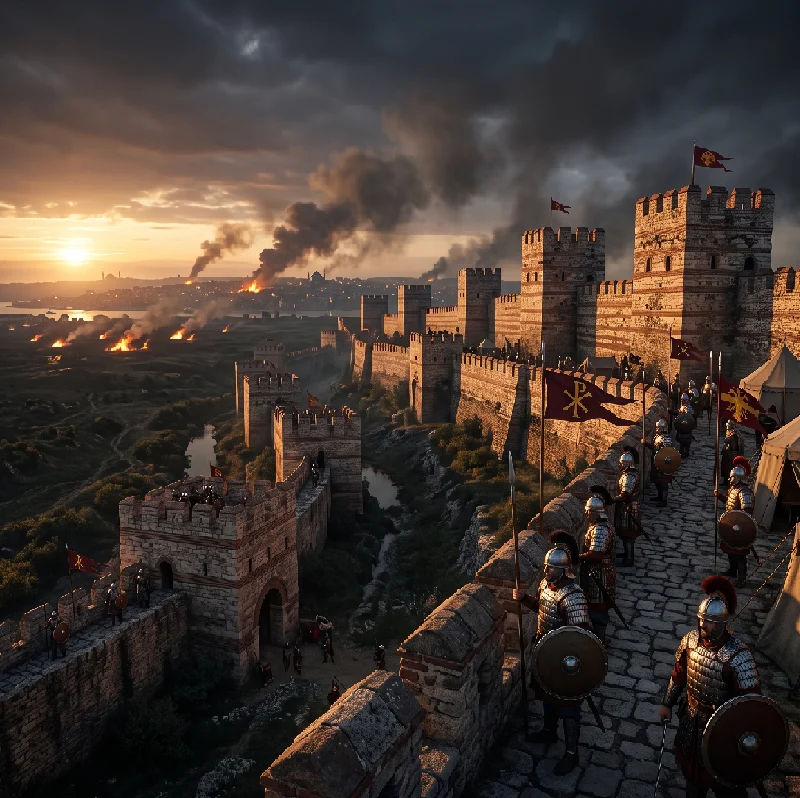
For more than a millennium, Byzantine Empire history served as the armored bastion shielding medieval Europe from external conquest. Operating from the fortified peninsula of Constantinople, this state survived Persian sieges, Arab naval incursions, nomadic steppe horsemen, and Western crusaders. Its longevity stemmed from an exceptional synthesis of administrative resilience, lethal incendiary technology, and defensive engineering.
The Imperial Capital: Architecture of Defiance in Byzantine Empire History
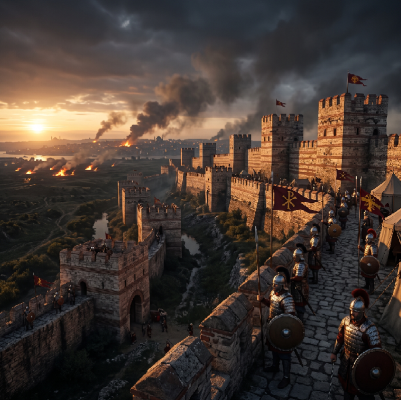
At the geographical epicenter of Byzantine Empire history stood Constantinople. Established by Constantine the Great in 330 CE atop ancient Byzantion, the capital occupied an enviable maritime promontory. Flanked by the Golden Horn to the north and the Sea of Marmara to the south, the city required landward defense only along its western approach.
That western frontier was secured during the fifth century by Emperor Theodosius II, who erected the Theodosian Walls. This defensive barrier was not an ordinary stone parapet, but a dynamic, triple-tiered defensive machine designed to dismantle enemy siegecraft:
-
The Flooded Fossa: An outer moat measuring twenty meters wide and ten meters deep, divided into compartmentalized locks with masonry retaining dikes to hold water and shatter infantry formations.
-
The Outer Terrace and Breastwork: An elevated patrol road backed by a castellated wall, providing low-angle firing platforms for forward archers and siphon operators.
-
The Outer Wall: An intermediate rampart eight meters tall, lined with defensive towers staggered between the bastions of the main wall.
-
The Inner Great Wall: An imposing twelve-meter stone barrier five meters thick, flanked by ninety-six monumental projecting towers that housed torsion artillery engines and counterweight ballistas.
For eight centuries, this defensive system remained unbroken. Sassanid Persian armies, Avar nomadic khaganates, and Umayyad caliphate forces battered against these limestone battlements, only to retreat starved, exhausted, and decimated by defensive artillery.
The capital became both a financial sanctuary and a military depot. Grain shipments from Egypt and later the Black Sea coast filled subterranean cisterns like the Basilica Cistern, ensuring that over half a million inhabitants could endure year-long sieges without water deprivation.
Hygron Pyr: Thermal Superiority at Sea
No single technological innovation altered the trajectory of Byzantine Empire history more decisively than the development of Hygron Pyr—liquid fire, known to Western chroniclers as Greek Fire. Developed around 672 CE by Kallinikos of Heliopolis, an architect and engineer fleeing the Arab conquest of Syria, this thermal weapon permanently transformed naval combat.
The substance was an incendiary chemical compound projected under pressure through bronze siphons mounted on the prows of dromon warships:
-
Chemical Profile: An airtight mixture derived from distilled light petroleum fractions, pine resins, sulfur, pitch, and quicklime (calcium oxide).
-
Thermal Ignition: Heated in sealed copper cauldrons with force pumps, the liquid ignited upon emerging from bronze nozzles shaped like snarling beasts.
-
Hydrophobic Combustion: The pressurized spray burned with intense heat across the surface of seawater, sticking to timber hulls, sails, and human skin.
-
Psychological Terror: The weapon roared like thunder, producing dense black smoke that blinded enemy rowers and caused crews to abandon burning ships in panic.
The state guarded the manufacturing formula as a capital state secret. Unauthorized possession or disclosure of the ingredients was punishable by blinding, excommunication, and summary execution.
The strategic deployment of this incendiary saved European civilization during the catastrophic Arab sieges of 674–678 and 717–718 CE. In both engagements, massed Byzantine naval squadrons turned hundreds of hostile galleys into floating torches, securing the imperial maritime lines and protecting the European continent from conquest.
Early military reforms [Internal Link: Classical Siege Craft Innovations] proved that defensive technology, when paired with industrial state secrets, could defeat coalitions fielding superior numerical manpower.
The Theme System: Agrarian Defense and Standing Armies
The political endurance central to Byzantine Empire history was forged during the existential crises of the seventh century. As the Persian wars and early Arab expansions stripped the empire of Syria, Palestine, and Egypt, the central treasury faced total fiscal bankruptcy. The state could no longer pay cash wages to professional mercenary armies.
Emperor Heraclius and his successors dismantled the old Roman diocesan model, introducing the Theme (Themata) system across Anatolia and the Balkans. This administrative model militarized provincial society without bankrupting the state.
The administrative mechanics functioned through self-funding land tenure:
-
Imperial provinces were partitioned into military districts governed by a military governor (strategos) wielding unified civil and armed authority.
-
Veteran soldiers (stratiotai) received hereditary, inalienable plots of productive farmland exempt from standard fiscal duties.
-
In exchange for land grants, each soldier was legally required to report for service with a warhorse, lamellar armor, a bow, and iron sidearms.
-
When enemy raiding columns crossed the mountain passes of the Taurus range, local theme garrisons mobilized immediately to shadow, isolate, and ambush invaders without waiting for imperial orders from the capital.
The theme system transformed provincial defense into a patriotic duty. Peasant-soldiers were not fighting for an abstract distant emperor in Constantinople; they were defending their ancestral soil, family farmsteads, and local churches.
This decentralized network was complemented by the Tagmata, elite professional cavalry regiments stationed directly around Constantinople. When a major territorial offensive was launched, the emperor combined the provincial themes with the heavy shock strike force of the imperial guard.
Arms, Armor, and Tactical Doctrine of the Rhomaioi
The soldiers who marched through the chapters of Byzantine Empire history utilized a sophisticated synthesis of Roman discipline, Persian heavy cavalry, and nomadic equestrian archery. The battlefield manual Strategikon, attributed to Emperor Maurice, alongside the later Taktika of Leo VI, codified an operational doctrine based on deception, combined arms, and spatial geometry.
The tactical equipment of the frontline imperial forces reflected this defensive versatility:
-
Klivanion: A torso cuirass composed of overlapping iron or hardened rawhide lamellar plates laced together with leather cords, engineered to deflect slashing sabers and arrows.
-
Kontarion: A heavy cavalry lance measuring four to five meters, wielded by armored cataphracts (kataphraktoi) during coordinated shock charges.
-
Paramereion: A single-edged, slightly curved steel cutting saber worn on a waist sash, optimized for fluid close-range mounted combat.
-
Solenarion: A hollow wooden guide tube fitted onto composite bows, allowing archers to loose ultra-short, armor-piercing iron darts (sphendobolonai) at high muzzle velocity.
-
Spion-shield: A teardrop kite shield or circular wooden targe reinforced with bronze rims and painted with imperial or saintly iconography.
Cataphracts formed the ultimate shock arm of the imperial army. Both the rider and his heavy mount were encased in iron mail and lamellar barding. These mounted iron fortresses advanced at a steady trot in deep wedges, pulverizing disrupted infantry lines once skirmishers broke defensive cohesion.
Tactical deployment [Internal Link: Nomadic Equestrian Warfare Mechanics] demonstrated that flexibility and missile suppression were far more valuable than reckless frontal assaults against unbroken spear walls.
Diplomatic Bureaucracy and the Art of Strategic Subversion
A dominant theme throughout Byzantine Empire history was the weaponization of diplomacy. Imperial strategists recognized that an army destroyed on the field could take decades to replace, while gold, prestige, and political intrigue cost far less than a full military campaign.
The imperial chancellery operated the Bureau of Barbarians (Skrinion ton Barbaron), history’s first institutional foreign intelligence and diplomatic service:
-
Scribes and translators compiled detailed ethnographic dossiers on foreign monarchs, religious schisms, tribal rivalries, and trade dependencies.
-
Gold subsidies, silk robes, and imperial titles were distributed to peripheral tribal chieftains to incite them against more dangerous hostile neighbors.
-
Royal marriages were negotiated to convert pagan princes into Christian allies bound to the imperial orbit.
-
Hostage diplomacy ensured foreign stability by educating the sons of foreign kings in the palaces of Constantinople, sending them home thoroughly Romanized.
When the Bulgarian Empire threatened the Danube frontier, Constantinople paid Kievan Rus to strike the Bulgars from the rear. When the Rus advanced too close to the Bosporus, imperial emissaries paid the Pecheneg nomads to ambush them on the Dnieper River.
Byzantine commanders used combat as a last resort. If an opposing general could be bribed, poisoned, starved through supply interdiction, or tied down by domestic civil wars, the empire won without drawing a single sword.
Internal Stability and the Legal Framework of Byzantine Empire History
The administrative continuity that sustained Byzantine Empire history was rooted in Justinian I’s legal codification, the Corpus Juris Civilis. Promulgated between 529 and 534 CE, this monumental restructuring compiled centuries of contradictory Roman laws, edicts, and jurisprudence into a coherent, standardized legal framework.
The legal apparatus preserved civil stability during extreme crises:
-
It codified uniform property rights, commercial contracts, maritime trade insurance, and inheritance procedures across the eastern Mediterranean.
-
It elevated the sovereign as the living law (nomos empsychos), while ensuring that imperial power was checked by constitutional procedure and Christian civic ethics.
-
It provided an enduring legal language that bound disparate ethnic groups—Greeks, Armenians, Illyrians, Isaurians, and Slavs—into a common Roman legal identity.
Even during periods of violent dynastic overthrow, the civil bureaucracy in Constantinople continued to collect customs duties, register property deeds, and dispense justice in the imperial courts.
This institutional stability insulated the state from catastrophic dissolution, allowing it to survive palace coups and peasant rebellions that would have destroyed less organized kingdoms.
Forensic Archaeology: Excavating the Imperial Guard and Frontier Castra
Modern battlefield excavations and urban archaeology continue to uncover the physical artifacts that corroborate Byzantine Empire history. The excavation of the ancient Harbor of Theodosius (Yenikapı) in modern Istanbul revealed the remains of thirty-seven well-preserved shipwrecks, including dromons and transport vessels.
Forensic investigations of these shipwrecks have provided unprecedented technical data:
-
Oak, chestnut, and pine hulls constructed using “shell-first” joinery, confirming the maritime engineering standards documented in tenth-century naval treatises.
-
Remnants of copper tubing, nozzle fittings, and stone ballast stones retaining chemical traces of petroleum and sulfur compounds associated with incendiary siphons.
-
Personal belongings of rowers and marines, including bronze coins, ceramic pilgrim flasks, and bone dice.
Excavations along the Crimean frontier at Chersonesus and the Danube fortress of Dinogetia have unearthed mass graves associated with the wars of Emperor Basil II. Skeletons show severe cranial trauma inflicted by heavy Varangian broadaxes and socketed iron crossbow bolts:
-
Cranial Fractures: Skulls displaying vertical cleaving fractures consistent with heavy two-handed axes used by the Scandinavian and Anglo-Saxon Varangian Guard.
-
Blunt Force Compression: Crushed thoracic cages resulting from cataphract trampling during pursuit melees.
-
Armor Fragments: Interlocking iron scale plates recovered with preserved leather stitching, showing where bodkin arrow points penetrated seams.
These material findings demonstrate that the defensive resilience celebrated in chronicle sources was an everyday physical reality experienced by professional garrison soldiers stationed along rugged frontiers.
The Fourth Crusade and the Shattered Shield of the East
The terminal decline in Byzantine Empire history was initiated not by Islamic armies, but by Western Christian crusaders. In 1204, the Fourth Crusade, bankrolled by the Republic of Venice and manipulated by rival Byzantine dynastic claimants, diverted from its goal of reaching Egypt and laid siege to Constantinople.
Venetian ships fitted with flying assault bridges scaled the sea walls along the Golden Horn. The crusaders breached the defenses, subjecting the greatest metropolis in the Christian world to three days of systematic looting, murder, and arson:
-
Inestimable classical libraries containing ancient Greek and Roman philosophy were torched or scattered.
-
Masterpieces of bronze sculpture, including the monumental Horses of Saint Mark, were shipped to Venice as war trophies.
-
Sacred relics, gold altar screens, and jeweled icons in the Hagia Sophia were smashed, melted into coin, or divided among French knights.
-
The empire was dismantled into feudal fiefdoms known as the Latin Empire, forcing Byzantine elites into exile states at Nicaea, Trebizond, and Epirus.
Although Michael VIII Palaiologos recaptured Constantinople in 1261, the state was mortally wounded. The trade routes of the Black Sea and Aegean were monopolized by Venetian and Genoese merchant cartels, leaving the restored imperial treasury bankrupt.
The rural themes of Anatolia, neglected by the central government, fractured under the pressure of newly arrived Turkmen pastoral principalities (beyliks). The empire was reduced to a desolate urban shell surrounded by hostile powers.
The Final Defense: 1453 and the Close of the Roman Era
The final chapter of Byzantine Empire history closed in the spring of 1453. Sultan Mehmed II led an Ottoman army of over eighty thousand men and massive naval flotillas to besiege Constantinople, which was defended by fewer than seven thousand soldiers, including Greek citizens and a handful of Genoese volunteers under Giovanni Giustiniani Longo.
The siege marked the collision between medieval masonry defense and the Industrial Gunpowder Era:
-
The Ottoman engineer Urban cast colossal bronze bombards, including the “Basilica” gun, which hurled half-ton granite projectiles against the Theodosian Walls for fifty-three days.
-
The Byzantine garrison repaired breaches by day using earth-filled barrels and timber palisades, holding off relentless infantry assaults by Janissary companies.
-
Ottoman ships were hauled overland across wooden rollers on the hills of Galata, bypassing the massive iron chain blocking the Golden Horn to surround the city from all sides.
On May 29, 1453, the final assault breached the Blachernae sector after Giustiniani was mortally wounded and evacuated from the ramparts.
Emperor Constantine XI Palaiologos, recognizing that the defensive line was broken, cast off his royal purple cloak and led his remaining guardsmen into the breach, dying in close combat alongside his soldiers.
When Ottoman troops entered the city, the unbroken political chain connecting Augustus Caesar to the medieval world was extinguished. Yet the intellectual and spiritual heritage preserved across Byzantine Empire history refused to die.
Byzantine scholars fled westward into Italy, carrying classical manuscripts, Plato’s philosophy, and Hellenistic mathematics, sparking the intellectual firestorm of the Italian Renaissance. The laws, religion, and artistic traditions of the Rhomaioi spread north into the Slavic lands of Russia and the Balkans, ensuring that the legacy of the Eastern Roman Empire remained indelibly stamped upon the modern world.
Frequently Asked Questions
What was the difference between the Byzantine Empire and the Roman Empire?
There was no institutional break between the two; the Byzantine Empire was the direct, unbroken continuation of the Eastern Roman Empire. While modern historians use the term “Byzantine” to differentiate the Greek-speaking, Christian, medieval state based in Constantinople, its citizens called themselves Rhomaioi (Romans) and retained Roman law, administrative institutions, and civic culture.
How did the Theme system protect the empire from invasion?
The Theme system divided the empire into military districts governed by a military commander (strategos). Provincial soldiers were granted hereditary farmland in exchange for military service, creating a self-funding, patriotic peasant militia that could mobilize instantly to defend local territory without draining the central treasury.
Why was Greek Fire such an effective naval weapon in Byzantine Empire history?
Greek Fire was effective because it was a thermal, petroleum-based incendiary compound that ignited on contact with air and burned on the surface of open water. Projected through pressurized bronze siphons mounted on warships, it set wooden enemy hulls ablaze, could not be extinguished by water, and produced blinding toxic smoke that shattered enemy morale