
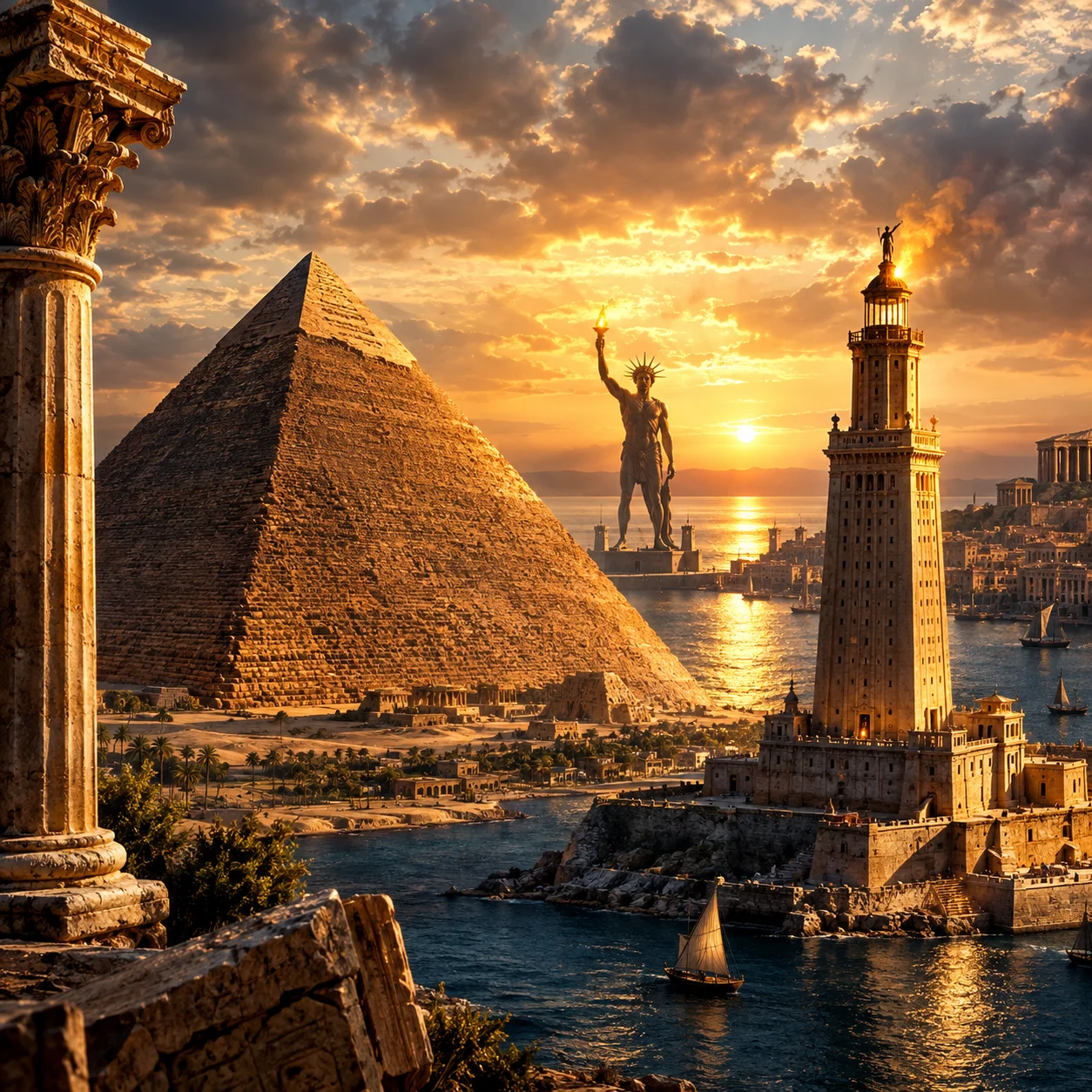
7 Wonders of the Ancient World: Engineering, Power, and Ruin
Long before satellite mapping or modern structural engineering, Hellenistic travelers compiled an extraordinary catalog of architectural audacity. Known to classical writers not as decorative tourist monuments but as theamata—sights that commanded astonishment—the 7 Wonders of the Ancient World embodied humanity’s early technical mastery over landscape and stone.
These monumental achievements stretched from the fertile alluvial soils of the Nile to the river valleys of Mesopotamia and the rugged volcanic coasts of the Aegean. The 7 Wonders of the Ancient World represented more than aesthetic grandeur; they were strategic expressions of political dominance, religious authority, and state logistics.
The Hellenistic Origins: How the Canon Was Forged
The formal canon of the 7 Wonders of the Ancient World was born out of the conquests of Alexander the Great. When Macedonian armies swept through Egypt, Persia, and the borders of India, Greek engineers and geographers suddenly gained unprecedented access to the monumental architectures of the Near East.
Writers and poets began assembling selective inventories of these colossal achievements:
-
Antipater of Sidon: Authored an influential poem in the second century BCE praising the massive limestone temple foundations of Artemis and the soaring heights of the pyramids.
-
Philo of Byzantium: Penned the foundational technical treatise De Septem Mundi Miraculis, evaluating monuments based on structural difficulty, material extraction, and human ingenuity.
-
Callimachus of Cyrene: Scribe and scholar at the Great Library of Alexandria, who cataloged regional wonders to enrich the Ptolemaic court’s geographical archives.
The selection of seven monuments was not arbitrary. In classical Mediterranean cosmology, the number seven symbolized perfection, sacred balance, and the total tally of known planetary bodies: the Sun, the Moon, and the five visible planets.
These architectural titans were not built concurrently. While the Great Pyramid had already stood for over two millennia when the canon was codified, the Colossus of Rhodes survived for barely half a century before falling to tectonic fracture. The 7 Wonders of the Ancient World captured an ephemeral snapshot of antiquity’s architectural peak.
1. The Great Pyramid of Giza: The Sole Surviving Monolith
Erected during the Fourth Dynasty of Egypt’s Old Kingdom around 2560 BCE, the Great Pyramid of Giza remains the only member of the 7 Wonders of the Ancient World still standing today. Built as the eternal mortuary horizon for Pharaoh Khufu, the monument held the title of the world’s tallest human-made structure for more than 3,800 years.
The physical dimensions of the monument reflect near-impossible mathematical precision:
-
Composed of approximately 2.3 million quarried limestone and granite blocks, weighing an average of 2.5 tons each.
-
The base spans 230.3 meters on each side, aligned to true geographical north with an error of less than one-fifteenth of a single degree.
-
The bedrock plateau was leveled using water trench grids before workers laid courses of local nummulitic limestone.
-
The structure was originally clad in polished white Tura limestone, which reflected sunlight like a mirror across the Nile Delta.
The builders solved colossal supply-chain bottlenecks through the Nile’s hydraulic cycle. During the annual Akhet flood season, transport barges ferried fifty-ton pink granite roofing beams downriver from quarries in Aswan, five hundred miles to the south.
Direct logistics planning [Internal Link: Classical Logistics and Imperial Expansion] proved that public works on this scale required an administrative civil service capable of organizing rotating seasonal conscripts rather than relying on chattel slave labor.
2. The Hanging Gardens of Babylon: Engineering Feat or Royal Mirage?
Among all entries in the 7 Wonders of the Ancient World, the Hanging Gardens of Babylon remain the most archaeologically elusive. Classical writers, including Diodorus Siculus and Strabo, claimed King Nebuchadnezzar II constructed this stepped botanical mountain around 600 BCE to comfort his Median queen, Amytis, who longed for the forested hills of her homeland.
Historical descriptions portray an extraordinary hydraulic paradise rising in tiered terraces:
-
Terraces supported by massive baked-brick vaults and stone pillars, sealed with layers of bitumen, reeds, and thick sheets of lead to prevent irrigation runoff from eroding masonry.
-
Deep soil beds capable of sustaining fully grown date palms, cedar trees, and exotic flowering plants imported from across the Zagros Mountains.
-
Continuous hydraulic lift systems, likely utilizing early chain pumps or Archimedean water screws, drawing cubic meters of water daily from the Euphrates River to crown-level reservoirs.
Extensive German excavations at Babylon led by Robert Koldewey unearthed vaulted substructures, yet found no definitive cuneiform records mentioning the gardens.
This absence led Oxford Assyriologist Stephanie Dalley to propose that the wonder was actually constructed three hundred miles north at Nineveh by Assyrian King Sennacherib. Sennacherib left detailed cuneiform inscriptions celebrating an expansive terraced palace garden irrigated by stone aqueducts spanning the desert plain.
3. The Statue of Zeus at Olympia: The Masterwork of Phidias
In 435 BCE, the Sanctuary of Zeus at Olympia commissioned the supreme Athenian sculptor Phidias to create a cult image worthy of the ancient Olympic Games. Housed inside the Temple of Zeus, this twelve-meter-tall seated effigy redefined the artistic identity of the 7 Wonders of the Ancient World.
Phidias utilized the luxurious technique of chryselephantine sculpture:
-
A colossal interior timber armature of cedar and cypress wood, secured to a massive stone pedestal.
-
The deity’s flesh was formed from meticulously curved, carved sections of African ivory, softened with steam and oil to achieve human-skin translucency.
-
The god’s robes, sandals, and olive wreath crown were cast from hammered sheets of solid gold, totaling over forty talents of bullion.
-
The cedarwood throne was encrusted with ebony, gemstones, and engraved mythological bas-reliefs illustrating the Labors of Heracles.
The monument’s physical upkeep was an engineering challenge. Because the humid climate of the Peloponnesian river valley threatened to warp the ivory plates, priests maintained a shallow pool of olive oil on the temple floor in front of the statue.
The oil reflected ambient light through the high doorway onto the golden robes while moisture vapor shielded the fragile ivory seams from cracking. The statue stood intact for eight centuries before being transported to Constantinople, where it perished in a palace conflagration in 475 CE.
4. The Temple of Artemis at Ephesus: The Colossal Ionian Sanction
Located on the Aegean coast of modern Turkey, the Temple of Artemis at Ephesus was constructed three separate times, each iteration larger than the last. The grandest reconstruction, begun in 323 BCE, was an architectural giant that surpassed the Athenian Parthenon in footprint and scale, cementing its place among the 7 Wonders of the Ancient World.
The temple’s design reflected innovative structural solutions to marshland geology:
-
The Marsh Foundation: Architect Chersiphron laid deep bedding layers of packed charcoal and sheep fleeces beneath the foundation stones to cushion the colossal building against seismic tremors.
-
The Forest of Columns: The hypostyle hall was flanked by 127 ionic marble columns standing eighteen meters high, each carved from single blocks of local Anatolian marble.
-
Sculpted Drums (Columnae Caelatae): The lower sections of thirty-six columns featured bas-relief carvings of gods and heroes executed by master sculptors like Scopas.
-
The Timber Roof: Spanned by giant trusses of Lebanese cedarwood, sheltering a rich treasury holding precious offerings from across Lydia and Persia.
The temple functioned not merely as a pagan sanctuary, but as the premier financial repository of Asia Minor. Cities, merchants, and foreign monarchs deposited silver and gold within its perimeter, which enjoyed international religious immunity (asylia).
The second temple burned in 356 BCE when an arsonist named Herostratus deliberately set fire to the wooden roof trusses, seeking to immortalize his name through infamy. The Ephesians rebuilt the structure with even greater magnificence, but it fell to Gothic raiders in 268 CE and was eventually quarried for materials to construct Christian basilicas.
+---------------------------------------------------------------------------------+
|                    TIMELINE OF THE ANCIENT WONDERS' COLLAPSE                    |
|                                                                                 |
|  [Colossus of Rhodes]          ──> Destroyed by Earthquake in 226 BCE (~54 yrs) |
|  [Hanging Gardens of Babylon]  ──> Abandoned/Destroyed by Seismic Activity ~1st |
|  [Temple of Artemis, Ephesus]  ──> Torched 356 BCE; Razed by Goths in 268 CE    |
|  [Statue of Zeus at Olympia]   ──> Incinerated in Constantinople Fire, 475 CE   |
|  [Mausoleum at Halicarnassus]  ──> Shattered by Earthquakes (12th-15th C)       |
|  [Lighthouse of Alexandria]    ──> Toppled by 1303/1323 Earthquakes (~1500 yrs) |
|  [Great Pyramid of Giza]       ──> SURVIVING TODAY (4,500+ Years Intact)        |
+---------------------------------------------------------------------------------+
5. The Mausoleum at Halicarnassus: The Tomb That Named All Tombs
When Mausolus, the Persian satrap of Caria, died in 353 BCE, his wife and sister, Artemisia II, began construction of a funerary palace that gave the world the word “mausoleum.” Erected on a hilltop overlooking the Aegean harbor of Bodrum, this monument within the 7 Wonders of the Ancient World stood as a monument to dynastic ambition.
The architectural profile blended Greek, Lycian, and Egyptian traditions:
-
The Three-Tiered Structure: A massive rectangular podium of local green volcanic tufa faced with Proconnesian marble, rising thirteen meters high.
-
The Ionic Peristyle: Thirty-six slender marble columns encircled the royal tomb chamber, housing masterwork statues of the Carian royal family.
-
The Stepped Pyramid: A stepped roof of twenty-four tiers tapering upward toward a peak.
-
The Marble Quadriga: Crowned by a colossal marble chariot pulled by four rearing warhorses, containing statues of Mausolus and Artemisia.
Four of the greatest sculptors of classical Greece—Scopas, Bryaxis, Timotheus, and Leochares—competed to carve the friezes adorning each face of the perimeter. These reliefs depicted violent scenes of Greeks battling Centaurs and Amazons with fluid anatomical realism.
The Mausoleum survived intact for over sixteen centuries. Between the twelfth and fifteenth centuries CE, a sequence of severe Mediterranean earthquakes shattered the roof and toppled the columns.
The Knights of Saint John salvaged the fallen marble to fortify their nearby crusader stronghold, the Castle of Saint Peter, burning priceless classical sculptures into mortar lime.
6. The Colossus of Rhodes: Bronze Sentinel of the Aegean
No monument in the catalog of the 7 Wonders of the Ancient World captured the Hellenistic spirit of victory more vividly than the Colossus of Rhodes. Erected between 292 and 280 BCE by the sculptor Chares of Lindos, this bronze giant commemorated the island republic’s successful resistance against the year-long siege of Demetrius Poliorcetes in 305 BCE.
The logistics of its construction were an engineering tour de force:
-
The Rhodians melted down hundreds of bronze and iron siege weapons abandoned by Demetrius’s fleeing forces, turning engines of war into an effigy of their sun god, Helios.
-
Stood thirty-three meters tall—roughly the size of the modern Statue of Liberty from foot to crown.
-
Chares cast the figure in successive horizontal tiers, packing the interior with massive stone masonry ballast blocks to secure the center of gravity against maritime gales.
-
Builders erected circular earthen ramps around the growing monument, burying the bronze skin as it rose to provide a working platform for foundry teams.
Medieval folklore popularized the image of the Colossus standing straddling the mouth of Mandraki harbor with ships sailing between its legs. Structural engineering proves this posture was impossible, as the lateral thrust of such a stance would have caused the statue to collapse during construction.
The statue stood on a stone plinth along the eastern shore. In 226 BCE, barely fifty-four years after completion, a violent earthquake ruptured the statue at its weakest mechanical point: the knees.
The oracle of Delphi forbade the Rhodians from rebuilding the monument, warning that they had offended Helios. The bronze giant lay in ruins for eight centuries, where travelers marveled that few men could wrap their arms around its severed thumb.
Classical manufacturing networks [Internal Link: Classical Greek Armor Fabrication and Metallurgy] demonstrated how regional foundry techniques enabled island states to process thousands of pounds of cast bronze for public fortifications and religious statues.
7. The Lighthouse of Alexandria: Light of Ptolemaic Hegemony
Commissioned by Ptolemy I Soter and completed around 280 BCE by the Greek architect Sostratus of Cnidus, the Pharos of Alexandria was the only functional infrastructure asset among the 7 Wonders of the Ancient World. Positioned on the eastern tip of Pharos Island, it guarded the treacherous, shallow approaches to the twin harbors of Ptolemaic Alexandria.
The lighthouse rose over one hundred meters into the sky across three tapering architectural stages:
-
The Lower Tier: A massive square limestone base housing garrison barracks, cisterns, and storage vaults for fuel oil and timber.
-
The Middle Tier: An elegant octagonal marble tower fitted with interior spiral ramps wide enough for pack animals to carry wood up to the beacon platform.
-
The Upper Tier: A circular lantern hall surmounted by a monumental bronze statue of Poseidon or Zeus the Savior.
The light produced atop the Pharos was visible to merchant fleets up to thirty nautical miles away. Scribes recorded that engineers burned bitumen and dried wood within an open furnace, using an enormous polished concave mirror—likely forged from specular metal or silvered bronze—to project a concentrated beam across the horizon.
During the daytime, a thick column of smoke warned incoming navigators away from offshore limestone shoals. The Pharos functioned for more than fifteen centuries, surviving multiple Mediterranean earthquakes until twin tremors in 1303 and 1323 CE reduced the tower to rubble.
In 1480 CE, Mamluk Sultan Qaitbay recycled the remaining granite blocks to erect a defensive fortress atop the original foundation.
Archaeological Evidence: Submerged Blocks and Broken Marble
Modern marine and terrestrial archaeology has recovered substantial physical remnants of the 7 Wonders of the Ancient World. These underwater excavations and field surveys verify the dimensions and material compositions described by ancient geographers.
In 1994, French marine archaeologist Jean-Yves Empereur surveyed the seabed surrounding Fort Qaitbay in Alexandria, discovering an expansive submerged archaeological park:
-
Thousands of tons of fractured red Aswan granite blocks, shattered column drums, and colossal statues of Ptolemaic kings carved in pharaonic style.
-
Monumental granite door lintels weighing up to seventy-five tons, matching the entrance proportions documented for the Pharos.
Similarly, excavations at Halicarnassus in the nineteenth century led by Charles Thomas Newton recovered monumental friezes and fragmented marble horses from the quadriga, now preserved in the British Museum.
Forensic analysis of the marble reveals high-purity crystalline structures quarried on the Aegean island of Paros, corroborating historical accounts of the immense financial capital poured into these imperial mausoleums.
The Geopolitical Legacy: Memory in Stone and Modern Consciousness
The long-term geopolitical significance of the 7 Wonders of the Ancient World outlasted the physical stones themselves. These monuments served as visible symbols of political legitimacy, signaling that a state possessed the organizational, mathematical, and economic muscle to alter the earth.
The enduring achievements of the ancient wonders include:
-
The Standard of Engineering Scale: The quarrying, transport, and erection of fifty-ton stone blocks established the empirical standards that guided Roman civil engineering, from the Pantheon to the Colosseum.
-
The Ideology of Civic Identity: Cities like Rhodes and Ephesus unified diverse populations through shared monumental projects, proving that civic pride could replace tribal divisions.
-
The Etymological Blueprint: The names of these monuments entered universal language; Pharos became the root word for lighthouse in Romance languages, while Mausoleum became the universal term for monumental burial architecture.
-
The Transmission of Structural Mathematics: The calculations required to balance the dome-like vaults of the Hanging Gardens and the tapering tiers of Alexandria’s Pharos enriched the Islamic and European engineering traditions.
Only the Great Pyramid survives to greet the modern sky, standing unchanged while empires, religions, and languages dissolved around its base. Yet the conceptual legacy of the 7 Wonders of the Ancient World remains intact.
They stand as proof that human beings, armed with copper chisels, wooden levers, and collective organization, could reach into the sky and engineer monuments designed to challenge eternity.
Frequently Asked Questions
Which of the 7 Wonders of the Ancient World still exists today?
The only surviving monument of the 7 Wonders of the Ancient World is the Great Pyramid of Giza in Egypt. Constructed around 2560 BCE during the Old Kingdom reign of Pharaoh Khufu, this monumental tomb has endured over 4,500 years of weathering, seismic activity, and stone quarrying.
Why were there only seven ancient wonders chosen?
Classical writers selected seven monuments because the number seven held mystical, cosmic, and mathematical significance throughout ancient Mediterranean cultures. In Hellenistic astronomy, seven represented perfection and matched the total number of known moving celestial bodies: the Sun, the Moon, Mercury, Venus, Mars, Jupiter, and Saturn.
Did the Colossus of Rhodes actually stand with its legs straddling the harbor?
No, that is a medieval myth that emerged centuries after the monument was destroyed. Structural engineers and archaeologists confirm that straddling the harbor entrance was structurally impossible, as the lateral forces would have caused the bronze statue to buckle during construction; it actually stood upon a stone plinth along the shore.