
Ancient Sparta Economy: The Cost of Total Militarism
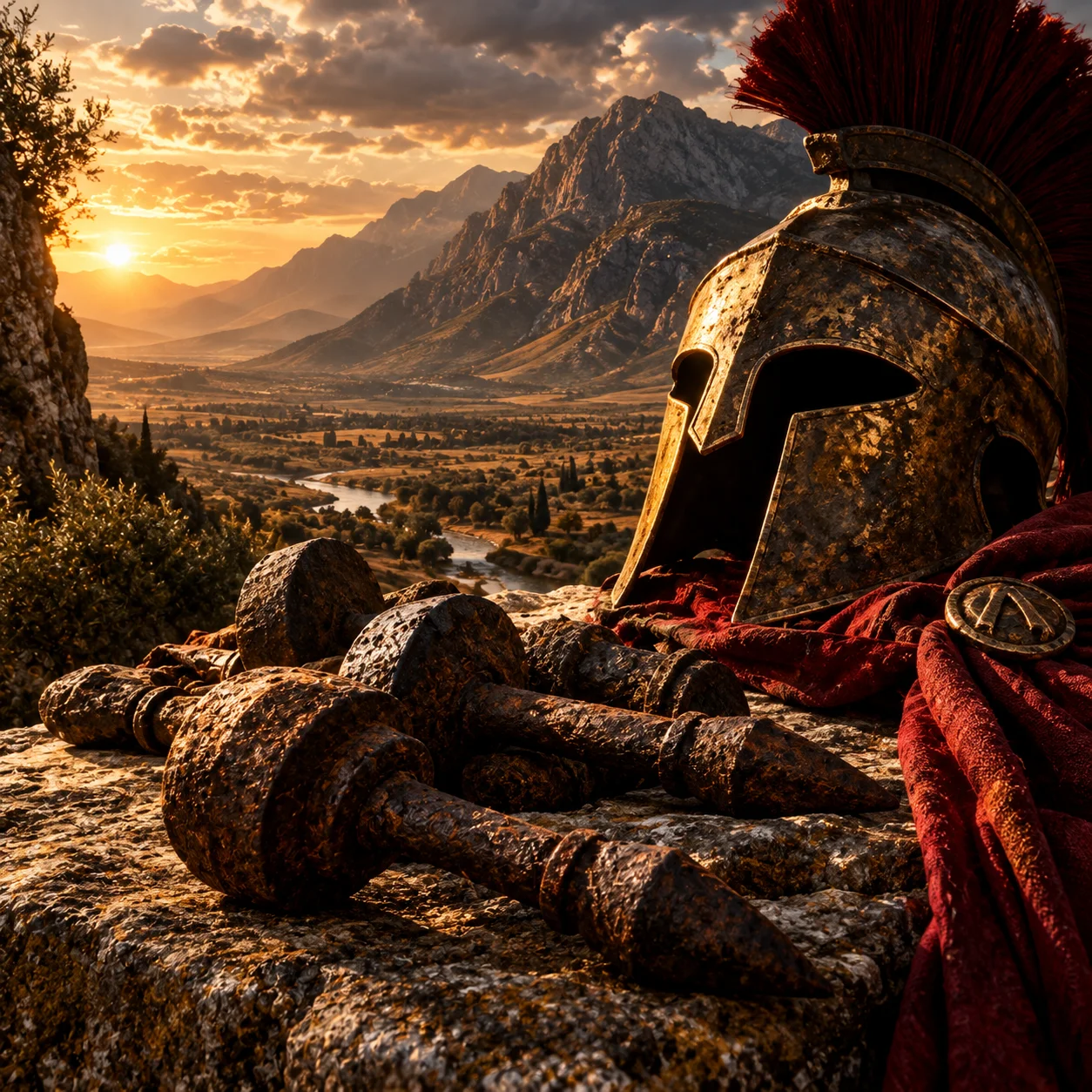
Popular culture depicts the warriors of classical Lacedaemon as ascetic purists who disdained material wealth in favor of eternal martial virtue. In factual reality, the Ancient Sparta economy was an unyielding, state-mandated command system engineered solely to finance a permanent standing elite. Behind the bronze shields and scarlet cloaks lay a brutal agrarian machinery designed to sustain combat readiness without a conventional merchant class.
Rather than relying on market commerce or maritime trade networks, the Ancient Sparta economy depended upon systemic state serfdom, deliberate monetary isolation, and rigid agrarian land tenure. This unnatural fiscal structure granted the city-state unparalleled military focus across the fifth century BCE. Yet the fatal internal contradictions of the system eventually triggered land monopolization, extreme domestic poverty, and demographic extinction.
The Lycurgan Injunction: Engineered Financial Isolation
The foundational architecture of the Ancient Sparta economy was attributed by classical historians to the mythical lawgiver Lycurgus. Following the catastrophic civil upheavals of the eighth century BCE, Spartan authorities restructured society to eliminate the factional greed, private debt, and urban decadence that destabilized neighboring Greek poleis.
The primary directive was the total insulation of the citizen body from commercial activities:
-
Full citizen peers (Spartiates or Homoioi, meaning “Equals”) were legally prohibited from engaging in retail trade, agriculture, manual craft production, and maritime seafaring.
-
The state banned private ownership of gold and silver bullion, classifying the possession of precious metal coinage within domestic households as a capital crime punishable by exile or death.
-
Citizens were forbidden from traveling abroad without explicit magisterial permission from the Ephors, preventing contact with foreign luxuries and cosmopolitan philosophies.
This deliberate isolation transformed the Ancient Sparta economy into a closed system. While contemporary Athens flourished through private banking, commercial silver extraction at Laurion, and maritime customs duties at Piraeus, Sparta chose complete economic autarky.
Wealth was redirected away from conspicuous consumption toward physical endurance, equine breeding, and weapons procurement. The Spartan state was not poor by accident; it was impoverished by constitutional design.
Iron Spit Currency: The Deliberate Friction of Trade
To make commercial accumulation practically impossible, the Ancient Sparta economy famously rejected standard Mediterranean silver coinage. While the rest of the Hellenic world traded with high-purity silver drachmas and Athenian “owls,” Sparta introduced iron spits (pelanoi) as legal tender.
This primitive monetary tool introduced immense physical friction into domestic trade:
-
Material Composition: Thick, heavy rods or discs of forged low-grade iron, allegedly dipped in vinegar while red-hot to make the metal brittle, non-ductile, and useless for re-forging into tools.
-
Prohibitive Bulk: An amount of iron currency equivalent to a modest sum of silver required an entire two-ox cart to transport and a dedicated storage room within a private home.
-
Zero External Value: Foreign merchant ships arriving at the Peloponnesian coast refused to accept iron spits, cutting Spartan domestic markets off from foreign imports of grain, wine, and fine textiles.
The iron currency functioned as an internal trade barrier. Petty domestic exchanges—such as purchasing local vegetables or rustic pottery—could occur in local villages, but large-scale financial speculation, usury, and commercial capital accumulation were eradicated.
Through this monetary mechanism, the Ancient Sparta economy suppressed the rise of an independent merchant middle class that could challenge the political monopoly of the landed military aristocracy.
The Helot Backbone: Subjugated Agrarian Serfdom
The true engine of the Ancient Sparta economy was not free labor, but state-sponsored human subjugation. The entire leisure of the Spartiate class rested upon the backs of the helots (heilotai)—the enslaved indigenous Greek populations of Laconia and conquered Messenia.
Helots occupied an agrarian status fundamentally distinct from the chattel slaves of Athens or Rome:
-
Helots were not the private personal property of individual citizens; they were public state serfs tied permanently to specific agricultural plots (kleroi).
-
They could not be sold abroad, emancipated by individual masters, or removed from their assigned land without an official act of the Spartan assembly.
-
They lived in family units within their ancestral rural villages, cultivating the rich alluvial soils of the Pamisos and Eurotas valleys.
-
The state compelled helot farming communities to deliver an unalterable annual rent (apophora) of barley, wine, olive oil, figs, and cheese directly to their designated Spartiate master.
Surpassing their Spartan overseers by an estimated ratio of ten to one, helots constituted the overwhelming labor force within the Ancient Sparta economy. Because the annual rent quota was fixed, any surplus harvest produced beyond the statutory demand remained with the helot household, creating a fragile rural economy underneath elite military control.
Yet this economic dependence generated perpetual domestic paranoia. To prevent organized peasant insurrections, the Spartan magistrates declared ritual war against the helots annually upon taking office.
The Krypteia—the elite state secret police composed of athletic Spartan youths—patrolled the countryside at night, assassinating prominent, strong, or outspoken helots to maintain psychological terror over the agricultural labor force.
Tactical and social mobilization [Internal Link: Classical Greek Defensive Strategy] demonstrated that Sparta’s defensive readiness was primarily directed inward to suppress domestic slave revolts rather than outward against foreign powers.
+---------------------------------------------------------------------------------+
|                       THE SPARTAN ECONOMIC PYRAMID                              |
|                                                                                 |
|  [Spartiates / Homoioi]    ──> Landed warrior peers; no labor; consume apophora |
|            │                                                                    |
|            v                                                                    |
|  [Perioikoi]               ──> Autonomous towns; artisans, smiths, foreign trade|
|            │                                                                    |
|            v                                                                    |
|  [Helots (State Serfs)]    ──> Agricultural laborers; pay fixed grain quotas    |
+---------------------------------------------------------------------------------+
The Perioikoi: The Industrial and Manufacturing Engine
Because Spartan citizens were legally barred from manual labor, the physical manufacturing of the Ancient Sparta economy was conducted by the Perioikoi (“those who dwell round about”). These free, non-citizen inhabitants resided in roughly one hundred autonomous coastal and upland townships across Laconia and Messenia.
The Perioikoi held an indispensable economic monopoly within the Spartan hegemony:
-
Weapons Metallurgy: Blacksmiths of the Perioikoi forged the heavy ash spears, iron short swords (xiphos), and cast-bronze concave shields (aspides) carried by the frontline army.
-
Textile and Leather Production: Crafted the iconic crimson wool cloaks (phoinikis), horse harnesses, leather sandals, and combat baldrics required by the state.
-
Mining and Quarrying: Operated the iron and lead mines of the Taygetus mountain range and quarried fine green porphyry and marble for monumental sanctuary dedications.
-
Maritime Commerce: Governed the strategic port town of Gytheio on the Laconian Gulf, handling what little external trade and deep-sea fishing the region maintained.
Although socially subordinate and excluded from voting in the central Spartan assembly, the Perioikoi managed their own internal municipal affairs and property rights. They were permitted to hold silver and gold currency, allowing them to accumulate real liquid fortunes.
In exchange for these commercial monopolies, the Perioikoi owed unconditional military service. By the fifth century BCE, battalions of heavily armed Perioikoi hoplites marched alongside Spartan peers in the battle line, keeping the Ancient Sparta economy and its military apparatus functional.
The Kleros and the Syssitia: Membership in the Elite
The ultimate purpose of the Ancient Sparta economy was the maintenance of the Syssitia—the mandatory communal dining mess that defined full citizen status. Unlike other Greek city-states where citizenship was an inalienable birthright, Spartan citizenship had an uncompromising monthly economic price tag.
The mechanism operated through land endowments and agrarian food dues:
-
Every adult male citizen was assigned an ancestral land allotment (kleros) worked by state-allocated helot families.
-
The agricultural yields from this plot supplied the exact monthly food dues required for membership in the mess: roughly one bushel of barley meal, eight gallons of wine, five pounds of cheese, two and a half pounds of dried figs, and small sums of iron currency for meat.
-
If a citizen suffered agricultural blight, mismanaged his estate, or saw his land partitioned among multiple heirs to the point where he could no longer deliver his full monthly assessment to the mess, he suffered immediate civil death.
The fallen citizen was stripped of his voting rights, expelled from the assembly, and relegated to the degraded status of the Hypomeiones (“Inferiors”).
Economic failure was synonymous with political disenfranchisement. The Ancient Sparta economy did not provide a social safety net for its citizen soldiers; it expelled those who faltered into social ignominy.
Gold from Persia: The Corruption of Spartan Autarky
The fragile ideological purity of the Ancient Sparta economy ruptured irrevocably during the Peloponnesian War (431–404 BCE). Confronting the vast maritime wealth and timber reserves of the Athenian Empire, Sparta discovered that iron spits could not construct triremes, pay foreign mercenary rowers, or purchase provisions abroad.
To secure naval victory, Spartan commanders made a fateful diplomatic pact with the Achaemenid Persian Empire:
-
Persian satraps Pharnabazus and Tissaphernes poured thousands of gold darics into Spartan naval funds.
-
Spartan admirals like Lysander commanded fleet budgets exceeding hundreds of silver talents, transforming provincial military commanders into international financial powerbrokers.
-
When Athens surrendered in 404 BCE, Lysander returned to Sparta carrying immense personal spoils, including over four hundred and seventy talents of foreign silver and gold coin.
The sudden influx of hard bullion shattered domestic sumptuary laws. The assembly attempted a clumsy legal compromise: precious metals could be held in the state public treasury for imperial operations, while private domestic ownership remained strictly prohibited.
The prohibition was ignored. Suda and Xenophon record that Spartan officers buried silver caches beneath floorboards, invested illicit fortunes with foreign bankers in Arcadia, and accepted massive bribes from foreign potentates. The Ancient Sparta economy was flooded with liquid capital, eroding the traditional egalitarian ethos of the warrior elite.
Institutional evolutions and bullion influxes [Internal Link: Imperial Bureaucracy in Antiquity] underscored how isolated agrarian states consistently fractured when suddenly integrated into global currency networks.
The Oliganthropia Crisis: Demographics and Land Monopolization
The fatal flaw of the Ancient Sparta economy was its vulnerability to property concentration, a structural defect that caused the catastrophic collapse of its citizen population—an institutional disaster known to Greek historians as oliganthropia (“scarcity of men”).
The mechanics of this demographic self-destruction were recorded by Aristotle in his Politics:
-
The Epitadeus Decree: Passed in the early fourth century BCE, this law dismantled traditional restrictions on land alienation, allowing citizens to freely gift or bequeath their ancestral kleros to others.
-
Dowry and Inheritance Concentration: Spartan women enjoyed exceptional property rights compared to other Greek women; through inheritance and extensive dowries, wealthy heiresses (epikleroi) accumulated vast estates.
-
The Rise of Land Barons: A tiny circle of elite families bought up or absorbed the agricultural land of bankrupt peers; Aristotle noted that by the mid-fourth century BCE, nearly two-fifths of all Spartan land was owned by women.
As land accumulated in fewer hands, ordinary citizens lost their kleroi. Unable to meet their mandatory monthly food dues for the Syssitia, hundreds of families fell from the citizen ranks into the disenfranchised Hypomeiones.
The demographic plunge was mathematically fatal for the Ancient Sparta economy:
-
At the Battle of Plataea in 479 BCE, Sparta fielded 5,000 elite Spartiate hoplites.
-
By the fourth century BCE, the number of full citizens fell below 1,500.
-
In 371 BCE, at the Battle of Leuctra, only 700 Spartiates stood in the battle line; when 400 fell under the deep phalanx of Epaminondas, Sparta lost more than half its citizen army in an afternoon.
The Liberation of Messenia: The Collapse of the Fiscal Engine
The decisive blow to the Ancient Sparta economy arrived immediately following the disaster at Leuctra. In the winter of 370–369 BCE, the Theban general Epaminondas marched an allied army deep into the Peloponnese, bypassing the mountain defenses of Laconia and invading Messenia.
Epaminondas did not merely defeat the Spartan army; he dismantled the economic foundation that sustained it:
-
The Emancipation of the Helots: Theban forces liberated hundreds of thousands of Messenian helots, ending three centuries of unfree agrarian labor.
-
The Founding of Mount Messene: On the slopes of Mount Ithome, Epaminondas constructed the massive, fortified city of Messene, providing a secure, independent capital for the liberated population.
-
The Loss of Farmland: Sparta was permanently stripped of half its arable agricultural territory, depriving the Spartiate elite of the apophora rents that funded their lifestyle.
Without Messenian agrarian labor, the Ancient Sparta economy collapsed completely. The Spartiate class could no longer sustain their communal dining messes, maintain full-time martial training, or finance cavalry breeding programs.
Sparta was reduced to a second-rate regional power overnight. The city that once dictated terms to the Mediterranean basin found itself scrambling to hire foreign mercenaries using borrowed coin, entirely unable to rebuild its legendary citizen army.
Archaeological Evidence: Excavating the Spartan Hearth
Modern archaeological investigations in Laconia have stripped away literary folklore to confirm the unvarnished material reality of the Ancient Sparta economy. Excavations led by the British School at Athens across urban Sparta and rural sanctuaries provide concrete physical data.
The material record reveals a society defined by austerity and functionalism:
-
The Epigraphic Void: Unlike Athens, which left thousands of stone public accounts, tribute lists, and legal decrees, Sparta produced virtually no public economic inscriptions, confirming the secretive nature of the state administration.
-
The Lead Votives of Artemis Orthia: Thousands of crude, mass-manufactured miniature lead figurines recovered from temple deposits, depicting hoplites, winged deities, and lions, reflecting a society where bronze and silver were withheld from religious dedications.
-
Laconian Black-Glaze Pottery: Excavations of domestic quarters reveal sturdy, undecorated black-gloss drinking cups (kothon) designed for military campaign use, engineered to trap river silt in their rims rather than provide aesthetic elegance.
-
Scarcity of Early Coinage: Hoards dating before the third century BCE contain almost no local silver coins, verifying that foreign silver was strictly restricted to state-level military operations until the Hellenistic period.
The archaeology confirms what contemporary critics asserted: the material culture of Sparta was stark, industrial, and utilitarian, entirely focused on equipping an army rather than beautifying a civic community.
Geopolitical Aftermath: The Tragic Legacy of an Inflexible State
In the late third century BCE, visionary Spartan monarchs like Agis IV and Cleomenes III recognized that the city faced total extinction without radical economic intervention.
They attempted to revive the ancient institutions by revolutionary means:
-
Canceling all outstanding private mortgages and financial debts.
-
Confiscating large accumulated landholdings to re-divide the territory into thousands of equal agricultural kleroi.
-
Enfranchising thousands of Perioikoi and loyal freed helots to restore the depleted citizen military ranks.
The reforms came far too late. The entrenched landed aristocracy resisted the redistribution, assassinating Agis and sabotaging political consensus. When Cleomenes forced the reforms through at sword-point, the Macedonian king Antigonus Doson intervened, crushing the rejuvenated Spartan army at Sellasia in 222 BCE.
Sparta’s historical tragedy was rooted in its economic design. By viewing economy as an enemy of virtue rather than an engine of adaptation, the state built an architecture incapable of evolving.
The Ancient Sparta economy demonstrated that a civilization that sacrifices commerce, education, and human freedom entirely to military optimization will eventually be consumed by the very administrative rigidity it created.
Frequently Asked Questions
Why did Ancient Sparta use iron spits as currency instead of silver?
The Ancient Sparta economy utilized heavy, brittle iron spits (pelanoi) to deliberately suppress trade, prevent private capital accumulation, and eliminate foreign luxury imports. The currency was so bulky that storing modest wealth required an entire room and a cart, ensuring that citizens remained focused on state military duties rather than personal financial speculation.
Who were the helots and what was their economic role in Sparta?
The helots were state-owned agrarian serfs, drawn primarily from the indigenous conquered populations of Laconia and Messenia. Tied to public agricultural estates (kleroi), they farmed the land and delivered a mandatory annual food quota (apophora) to Spartan citizens, freeing the Spartan warrior elite from manual labor to train full-time for war.
What caused the collapse of the Ancient Sparta economy?
The collapse was caused by severe land concentration, the loss of agricultural territory, and demographic ruin. Wealthy families monopolized estates through inheritance and dowries, leaving ordinary citizens unable to afford their mandatory dining mess fees, which stripped them of citizenship. When Thebes liberated Messenia in 370 BCE, Sparta lost its agricultural workforce, permanently shattering its fiscal mode