
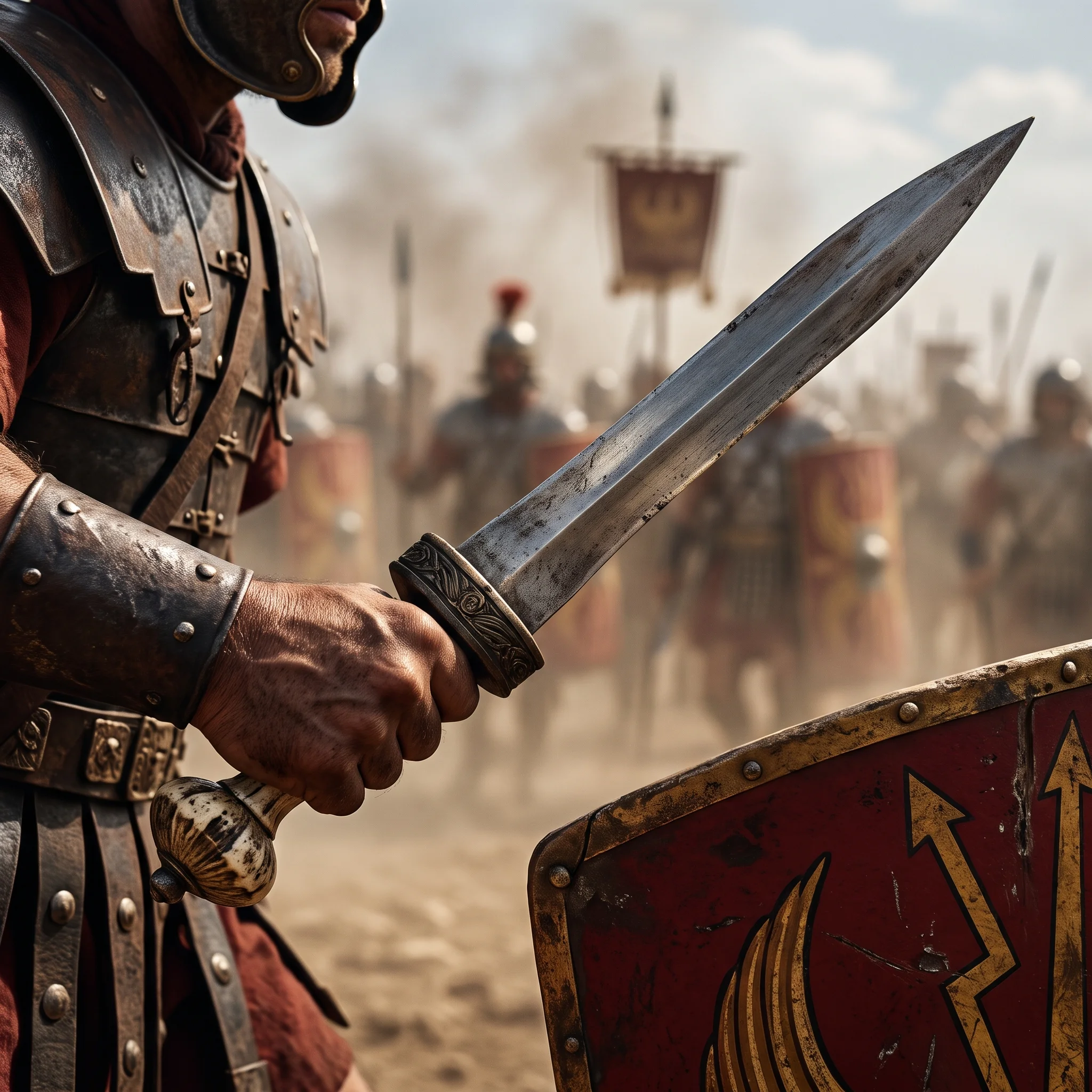
The Roman Gladius: The Blade That Carved an Empire
For over four centuries, the undisputed centerpiece of Mediterranean warfare was not a towering spear or a massive broadsword, but a compact, double-edged short sword known as the Roman Gladius. While the armies of Rome’s adversaries favored sweeping, expansive slashing weapons, the disciplined legionary utilized an unyielding, specialized thrusting tool. Purpose-built for close-Formation combat, the Roman Gladius was the primary offensive instrument that secured, expanded, and protected the borders of a massive empire.
The success of the Roman Gladius lay in its seamless Integration with Rome’s defensive systems. Operating behind the massive wall of the scutum (large rectangular shield), the legionary did not require the wide swinging arcs of longer blades. Instead, the short, robust sword was engineered to identify and penetrate gaps in an opponent’s guard through rapid, biomechanically optimal thrusting movements. From the initial clash of the Punic Wars to the pacification of Germany, this compact sidearm remains one of the most effective military designs in human history.
The Origins: Adopting the Spanish Edge
The weapon that would define Roman infantry supremacy was an imported technology, not an indigenous invention. During the First and Second Punic Wars (264–201 BCE), Roman forces encountered Celtiberian mercenaries in the service of Carthage, who were armed with highly versatile, deeply tapering swords.
Recognizing their superior metallurgy and lethal versatility, Rome adopted the design, designating it the gladius Hispaniensis (“Spanish sword”):
-
Strategic Introduction: Formally adopted around the late third century BCE, particularly during the campaigns of Scipio Africanus during the Second Punic War [Internal Link: Classical Logistics and Imperial Expansion].
-
Material Advantage: The original Iberian design was fabricated using advanced folding and hammering techniques that produced high-carbon edges capable of holding a razor-sharp point while retaining enough internal elasticity to resist shattering.
-
The Dual Capability: Unlike some later, highly specialized variants, the gladius Hispaniensis was larger and heavier, allowing for devastating, downward slicing cuts as well as rapid thrusts.
As Rome’s military system transitioned from a citizen militia to a permanent, professional standing army under the late Republic, the sword was continuously refined. It became shorter, more parallel, and highly standardized to suit the tight, defensive environments of legionary battle lines.
Anatomy and Craftsmanship of the Legionary Sidearm
The physical construction of the Roman Gladius was an exercise in ergonomic efficiency, designed to reduce weight while maximizing thrusting leverage and control. A complete sword measured between 60 and 85 centimeters in length, with the blade comprising 45 to 68 centimeters, and weighed a remarkably agile 700 to 1,000 grams.
Its physical anatomy comprised several specialized components:
-
The Blade: Forged from iron of varying carbon content, often featuring a core of low-carbon, impact-absorbing iron enveloped by high-carbon, hardened steel edges.
-
The Hilt (Capulus): Crafted from bone, horn, or hard woods such as boxwood, featuring four distinct finger ridges to guarantee a secure, non-slip grip even when wet with sweat or blood.
-
The Pommel (Pila): A large, spherical wooden or bone ball at the base of the hilt, which served as a critical counterweight to balance the blade, shifting the pivot point closer to the user’s hand for rapid, directional changes.
-
The Guard (Guardia): A natural wood or bone hand-guard that prevented the hand from sliding forward onto the double-edged blade during forceful thrusts while shielding the fingers from sliding impact.
The Roman Gladius was worn on the right hip, suspended from a leather shoulder belt (balteus) or waist belt. Because Roman infantry fought behind a large shield on the left side, drawing a sword from the right hip prevented the blade from catching on their own shield rim, allowing for an immediate, unobstructed draw. Centurions and officers, who did not carry the massive scutum, wore their swords on the left hip as a visible mark of their rank.
The Evolution of the Four Primary Types
Modern archaeological classifications, based on finds across European river frontiers and Roman camps, distinguish four primary variants of the Roman Gladius:
-
Gladius Hispaniensis (3rd Century BCE – 20 BCE): The earliest, longest, and heaviest variant. Characterized by a slight “wasp-waisted” or leaf-shaped profile, a long, sharply tapered point, and a weight of up to one kilogram. It was a formidable cutting and thrusting weapon.
-
The Mainz Type (13 BCE – Early 1st Century CE): Named after archaeological finds near Mainz (Germany). Features a broad, waisted blade (approx. 7 cm wide) and a very long, triangular point, optimized for both forceful thrusting and deep, downward hacking cuts along the northern frontiers.
-
The Fulham Type (43 CE – Late 1st Century CE): Often treated as the transitional link between the Mainz and Pompeii variants. Retains the narrow, tapered point of the Mainz but features straight, parallel cutting edges (approx. 6 cm wide) and a slightly shorter overall profile.
-
The Pompeii Type (1st Century CE – 3rd Century CE): The most famous, widely standardized variant of the high Empire, named after examples preserved in the ruins of Pompeii. It featured straight, parallel edges, a short, triangular tip, and a lightweight, 700-gram frame that was easy to mass-produce and maneuver in dense formations.
+---------------------------------------------------------------------------------+
|                       EVOLUTION OF THE ROMAN GLADIUS                            |
|                                                                                 |
|  [Hispaniensis Type]   (3rd-1st C BCE: Long, leaf-shaped, heavy, versatile)      |
|         │                                                                       |
|         v                                                                       |
|  [Mainz Type]          (1st C BCE - 1st C CE: Broad, "wasp-waisted", long point) |
|         │                                                                       |
|         v                                                                       |
|  [Fulham Type]         (1st C CE: Transitional, straight edges, long point)     |
|         │                                                                       |
|         v                                                                       |
|  [Pompeii Type]        (1st-3rd C CE: Parallel edges, short tip, lightweight)   |
+---------------------------------------------------------------------------------+
Biomechanics and Thrusting Mechanics: Why Thrusting Wins
Ancient military analysts, including the late fourth-century writer Vegetius in his De Re Militari, emphasized that Roman training rigorously prioritized the thrust over the cut. The Roman Gladius was systematically engineered to exploit the physiological advantages of thrusting mechanics.
The tactical and biomechanical reasons for this doctrine were unyielding:
-
The Lethality of Depth: A thrust of merely two inches (five centimeters) into the torso was often fatal, penetrating vital organs, major blood vessels, or the thoracic cavity. Slashing cuts, while visually dramatic, often spent their force against heavy bone, thick armor, or shields.
-
Exposure Risk: Executing a swinging cut requires a soldier to raise his arm and open his shoulder, exposing his flank, armpit, and neck to counter-attacks. A thrust, by contrast, is a compact, linear punch that allows the user to remain fully covered behind his shield.
-
Energy Conservation: Slicing and hacking are metabolically exhausting movements that fatigue back, shoulder, and arm muscles rapidly. A short, straight thrust employs the larger muscle groups of the chest, hips, and legs, allowing a soldier to fight for hours without exhaustion.
-
Tight-Space Efficiency: In close-quarters combat, where soldiers are packed shoulder-to-shoulder with fewer than three feet of clearance, swinging a blade is impossible without striking companions or catching on terrain. The Roman Gladius required only forward and backward clearance, functioning as a lethal piston inside the dense, pressed lines.
Standard training drills required soldiers to thrust downward at the belly, forward at the groin, or upward under the chin and throat, where unarmored gaps in helmets and scale mail were most vulnerable.
The Combined-Arms System: Gladius, Pilum, and Scutum
The Roman Gladius was never used as a standalone weapon. It functioned as the close-quarters finisher within an integrated combined-arms infantry system. Behind the frontlines, the legionary relied on a layered sequence of offensive and defensive gear to systematically dismantle enemy formations before drawn steel ever collided.
The combat sequence progressed through highly disciplined phases:
-
The Barrage: At a range of fifteen to twenty-five paces, the advancing Roman lines unleashed a coordinated volley of heavy throwing javelins, the pila (pilum). Designed with long, soft iron shanks behind hardened points, the javelin bent upon impact, rendering it useless for return throws while dragging down the enemy’s shields and disrupting their advance.
-
The Clash: Armed with the scutum, a large, semi-cylindrical plywood shield faced with leather and bound with iron, the legionaries slammed into the disrupted enemy. The heavy, iron-bossed center (umbo) of the shield was used as an active bludgeoning tool to knock opponents off-balance, while the red-and-gold walls formed an impenetrable barrier.
-
The Thrust: As the battle collapsed into a dense, hand-to-hand press, the legionary deployed the Roman Gladius. He did not reach or swing; he peered over or around the top and right side of his scutum, delivering rapid, piston-like thrusts to the exposed faces, guts, and thighs of opponents struggling against the massive shields.
Tactical formation discipline [Internal Link: Classical Greek Defensive Strategy] demonstrated that personal, individual heroism invariably shattered when confronted by a wall of overlapping shields backed by short, rapid-striking blades.
+-------------------------------------------------------------------------+
|                  THE LEGIONARY COMBAT SEQUENCE                          |
|                                                                         |
|  [Pilum Barrage] ──> Javelins thrown at 20 paces; disables enemy shields|
|         │                                                               |
|         ▼                                                               |
|  [Scutum Clash]  ──> Heavy shield-wall collision; bludgeons with boss    |
|         │                                                               |
|         ▼                                                               |
|  [Gladius Jab]   ──> Short, downward thrusts to the belly, groin, & thigh|
+-------------------------------------------------------------------------+
Archaeological Evidence: Unearthing the Legionary Edge
Modern understanding of the Roman Gladius is grounded in a robust, diverse archaeological record. Submerged river finds, excavated camps, and decorative armor scabbards recovered across Europe have allowed materials scientists and historians to dismantle cinematic folklore.
Key archaeological sites and hoards have provided critical data:
-
The Rhine finds near Mainz (Germany): Excavated river deposits yielded several highly decorative early Imperial swords, including the famous “Sword of Tiberius” now preserved in the British Museum. The sword features a gilded bronze scabbard celebrating Tiberius presenting a victory statuette to Augustus, highlighting the weapon’s immense cultural and political prestige.
-
The Pompeii Hoard (Italy): The eruption of Mount Vesuvius in 79 CE preserved four distinct Pompeii-type swords in situ, providing historians with the exact parallel-edged, lightweight standardized dimensions that armed the legions during the High Empire.
-
The Künzing Hoard (Germany): A third-century CE deposit that included several heavily shortened, transitional short swords (23 to 39 cm), likely re-forged from broken cavalry swords (spathae), demonstrating the resourcefulness of frontier armories.
Modern metallographic testing on these recovered blades reveals that while some swords were highly refined with complex heat-treatment and layered carbon boundaries, many were simple, air-cooled low-carbon steel or work-hardened iron.
Roman military success did not rely on legendary, “magical” metallurgy; it was the product of industrial mass production, ergonomic design, and, above all, the relentless, collective training of the troops who carried them.
The Transition to the Spatha and the Fall of the Short Sword
The dominance of the short Roman Gladius was not eternal. By the late second and third centuries CE, the military challenges facing Rome had fundamentally shifted, forcing a gradual, systemic transition in infantry armament.
Several factors dictated the decline of the short sword:
-
The Nature of Enemies: As Roman forces faced increasingly mobile, mounted adversaries—such as German horsemen and Sasanian cataphracts—they required greater reach to engage combatants from the ground.
-
The Loosening of Formations: The tight, shoulder-to-shoulder infantry phalanx of the Republic and early Empire was increasingly abandoned in favor of more dispersed, open formations, where a longer blade was necessary to defend open ground.
-
The Adoption of the Spatha: The spatha, a longer, straight double-edged sword (measuring 75 to 100 cm) originally reserved for auxiliary cavalry, was universally adopted by Roman infantry. It offered greater reach and cutting power, effectively replacing the compact gladius by the end of the third century.
The short sword did not vanish immediately; it was gradually absorbed and lengthened, leaving behind a tactical legacy that remains synonymous with the iron discipline of Rome’s ancient military machinery.
The Enduring Legacy of Rome’s Steel Piston
The Roman Gladius remains a towering symbol of martial pragmatism. It was a weapon that rejected the glamorous, individualized display of larger swords, prioritizing the anonymous, relentless efficiency of collective close-quarter combat.
Its legacy survives in every modern infantry doctrine that prioritizes discipline, coverage, and compact leverage over individual theatrics.
The achievements of this iconic short sword continue to define historical military thought:
-
The Triumph of Utility: The gladius proved that in warfare, a compact, specialized tool that fits the larger defensive system is infinitely more valuable than a longer, more versatile, but unwieldy weapon.
-
The Standardization of Warfare: The transition from the Hispaniensis to the Pompeii type illustrated the world’s first successful attempts at military industrialization, supplying millions of soldiers with uniform, highly reliable weaponry.
-
Cultural Iconography: The sword’s name gave birth to the gladiator (arena fighter) and remains the enduring visual shorthand for the expansion of classical Western civilization.
The legions have long since returned to the earth, their iron armor rusted and their great rectangular shields decayed. Yet the compact, double-edged steel of the Roman Gladius continues to capture the human imagination, standing as a testament to the era when the fate of the known world was decided by a two-foot blade and the courage of the men who thrust it.
Frequently Asked Questions
Why did the Roman legions use such a short sword?
The Roman legions used a short sword because it was specifically engineered for tight, dense infantry formations. Roman soldiers fought shoulder-to-shoulder behind large scutum (shields), leaving less than three feet of clearance between files; in such a crowded environment, longer swords were useless and dangerous to allies, whereas the compact Roman Gladius could be rapidly thrust from behind the shield without drawing back or exposing the user’s arm.
What was the difference between a Gladius and a Spatha?
The main difference was length and tactical application. The Roman Gladius was a short sword (60–85 cm overall) designed for close-Formation thrusting by heavy infantry behind shield walls. The spatha was a longer sword (75–100 cm overall) with a straight, double-edged blade originally designed for auxiliary cavalry to reach ground infantry from horseback, which was later adopted by all Roman infantry during the late Empire as combat formations became more open and fluid.
How was the Roman Gladius worn and drawn in battle?
Legionaries wore the Roman Gladius on their right hip, suspended from a shoulder or waist belt, while officers and centurions wore it on the left. Drawing the sword from the right side allowed the soldier to deploy the blade using his right hand without it catching on his large scutum shield, which was held firmly by the left arm, ensuring an unobstructed and immediate draw in the press of battle.