
10000 Immortals: The Iron Vanguard of the Persian Kings
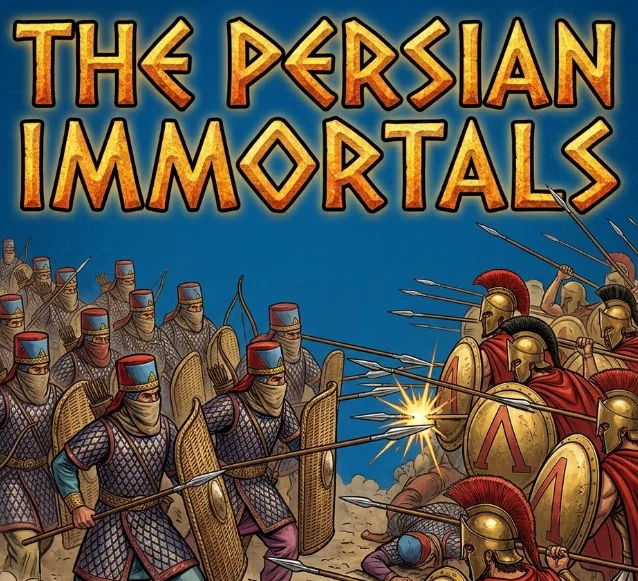
The 10000 Immortals formed the undisputed military backbone of the Persian Empire at its zenith. When King Xerxes I marched toward mainland Greece in 480 BCE, this elite imperial formation spearheaded the royal advance, designed to break enemy morale through calculated battlefield intimidation and disciplined tactical deployment.
Unlike standard feudal levies gathered from distant imperial satrapies, the 10000 Immortals operated as a permanent, highly trained standing army. Their presence transformed regional frontier skirmishes into systematic demonstrations of imperial power, establishing a standard of elite infantry warfare that dominated the ancient Near East for two centuries.
Origins and Structure of the 10000 Immortals
The institution of the imperial guard began during the explosive territorial expansions directed by Cyrus the Great in the mid-sixth century BCE. Recognizing that an emperor could not trust his life to temporary tribal levies or shifting mercenary loyalties, Cyrus formed an inner circle of household shock troops.
Under the administrative reorganizations of Darius I, this bodyguard became a permanent institution within the imperial military hierarchy. The force operated as both the frontline shock corps of the imperial field army and the palace guard protecting the royal court at Persepolis, Susa, and Ecbatana.
Known to Greek historians as the Athanatoi, the unit earned its famous title through an unbending administrative protocol rather than supernatural legend. The standing strength of the division was held strictly at exactly ten thousand men at all times.
If a soldier fell in combat, succumbed to illness, or suffered disabling wounds, a replacement was drawn immediately from the reserve regiments. The roster never dropped to 9,999, nor did it expand past 10,000.
To opposing commanders watching across smoke-filled battle lines, the formation appeared completely impervious to casualties. Men fell beneath spear thrusts and arrows, yet by the following dawn, the ranks stood unbroken, complete, and fully dressed.
                   [The King of Kings]
                            │
               [The Hazahrapati (Chiliarch)]
             (Imperial High Grand Vizier)
                            │
              ┌─────────────┴─────────────┐
              ▼                           ▼
      [The Melophoroi]           [The 9,000 Line Guards]
     (1,000 "Apple-Bearers")       (Organized into Regiments)
     • Gold Spear Terminals       • Silver Spear Terminals
     • Inner Royal Retinue        • Frontline Combined-Arms
The Imperial Core: Recruitment and the Apple-Bearers
Membership in the 10000 Immortals was an exclusive hereditary privilege reserved almost entirely for men of pure Persian and Median nobility. From the age of five to twenty, aristocratic youths underwent continuous military training centered on three foundational virtues: riding hard, shooting straight, and speaking the absolute truth.
This educational pipeline produced warriors fiercely dedicated to the reigning dynasty and steeped in the religious traditions of Zoroastrian order (Asha).
Within the larger division stood a legendary inner circle known as the Melophoroi, or the “Apple-Bearers.” This senior thousand-man detachment formed the king’s personal bodyguard:
-
Distinguished Regalia: While the outer nine thousand soldiers carried spears weighted with silver counterweights, the thousand guards of the royal core carried spears tipped with solid gold pomegranates or apples.
-
Proximity to the Throne: On the march, the Apple-Bearers surrounded the royal carriage, forming an impenetrable physical perimeter around the sovereign.
-
Political Influence: The commander of this elite inner regiment, titled the Hazahrapati (Chiliarch), served as the grand vizier of the entire empire. Foreign ambassadors and satrapal governors could not gain an audience with the king without the Chiliarch’s formal authorization.
       [Composite Bow: Recurve Horn & Wood]
     (Volleys launch up to 200 meters away)
                       │
                       ▼
       [Gerron: Wicker & Rawhide Shield]
     (Pitched into soil to create dynamic barricade)
                       │
                       ▼
       [Doryphoroi Spear: 6-Foot Thrusting Pike]
     (Fitted with silver/gold pomegranate counterweight)
                       │
                       ▼
       [Akinakes: Short Iron Slashing Dagger]
     (Double-edged blade drawn for tight melee combat)
Weaponry and Gear: Inside the Immortals’ Arsenal
The weaponry carried by the 10000 Immortals reflected an operational doctrine tuned for the open plains and arid plateaus of Southwestern Asia. Unlike heavy infantry formations designed solely for stationary head-on collisions, the Persian guard operated as a versatile combined-arms unit capable of shifting between long-range missile barrages and rapid close-quarters shock assaults.
Behind their outer robes, each warrior was equipped with advanced metallurgy and defensive craft:
Scale Armor and Concealed Defense
Classical Greek observers frequently noted with disdain that Persian soldiers fought in flowered tunics rather than solid bronze plate. This critique missed their defensive engineering.
Beneath long, elaborately patterned tunics woven from dyed wool and silk, the guards wore shirts of overlapping bronze and iron scales. These fish-scale plates, laced directly onto sturdy leather or linen jackets, allowed full torso flexibility while deflecting glancing sword cuts and spending arrows.
The Missile Weapon: The Recurve Composite Bow
The primary offensive tool was the composite recurve bow, crafted from horn, wood, and sinew bound with animal hide glue. Stored alongside fifty iron-tipped arrows in a specialized carrying case called a goryt—which held both bow and quiver—the weapon delivered devastating kinetic energy at ranges exceeding two hundred meters.
Working in coordinated ranks, the guards discharged waves of iron points capable of suppressing incoming infantry and cavalry before lines collided.
Close-Combat Armament: Spears and the Akinakes
For melee combat, the guard deployed a six-foot thrusting spear (arsti) fitted with a forged leaf-shaped iron blade. Its short length compared to Greek pikes allowed fluid hand transitions, balanced by the heavy metal counterweight at the butt.
At close quarters, the warrior drew the akinakes, a double-edged iron short sword measuring roughly eighteen inches, optimized for rapid, infighting thrusts into exposed gaps.
Defensive Wickerwork: The Gerron
The guards carried a tall, rectangular shield known as the gerron, constructed from woven wicker branches stretched over cured rawhide. Light and resilient, these shields could absorb cutting blades without splintering like solid timber.
During static defensive actions, the frontline embedded their shields directly into the soft earth, forming a continuous protective palisade behind which rear ranks loosed rapid missile barrages.
| Equipment Element | Construction Materials | Battlefield Function | Tactical Trade-off |
| Gerron (Shield) | Wicker cane, rawhide cover | Absorbs arrows, forms static defensive line | Prone to fracturing against heavy bronze spear thrusts |
| Scale Cuirass | Overlapping iron or bronze plates on leather | Protects vital organs, preserves maximum agility | Vulnerable to direct blunt-force trauma from heavy weapons |
| Arsti (Spear) | Ash wood, iron tip, bronze terminal | Mid-range thrusting, tight melee control | Shorter reach compared to eight-foot Greek dory |
| Composite Bow | Layered wood, horn, sinew, animal glue | Long-range suppressive barrages up to 200m | Loses tension and structural glue bond in heavy rain |
| Akinakes | Forged iron, gold/bronze hilt | Swift slashing and close-quarters stabbing | Ineffective against heavily armored bronze greaves |
Clash of Doctrines: The 10000 Immortals at Thermopylae
The legendary clash between the 10000 Immortals and the Greek allied army occurred in the late summer of 480 BCE at the narrow pass of Thermopylae. Here, two irreconcilable military philosophies met head-on: the fluid, missile-centric doctrine of the Persian East and the rigid, heavy infantry phalanx of the Hellenic West.
King Xerxes dispatched his elite corps on the second day of fighting after frontline Median and Cissian levies failed to dislodge the Spartan line. Led by their general, Hydarnes, the guard advanced with absolute confidence, expecting to break the defenders through sheer prestige and coordinated pressure.
       [Cliff Walls of Mount Kallidromo]
                      ▼
═══════════════════════════════════════════════════ (Narrow Pass)
[Spartan Phalanx: Bronze Wall]  ◄───►  [10000 Immortals: Wicker & Bows]
═══════════════════════════════════════════════════
                      ▲
            [Maliam Gulf Waters]
The constricted geography of the pass stripped the guards of every tactical advantage they held on open terrain:
Terrain Nullification
Flanked by the steep cliffs of Mount Kallidromo on one side and the deep waters of the Malian Gulf on the other, the pass prevented Hydarnes from deploying his archers in wide crescent wings. He could not envelop the Greek flanks or maneuver cavalry around their rear.
Shield and Weapon Disparity
The light wicker gerra buckled under the concentrated weight of eighty-pound Greek hoplites driving forward behind massive, bronze-faced hoplon shields. The Immortals’ six-foot spears lacked the reach to bypass the heavy eight-foot ash spears (dory) of the Spartans, leaving Persian frontline ranks exposed to lethal thrusts before they could close the distance.
The Simulated Retreat
The Spartan king, Leonidas, exploited his men’s superior unit discipline. The Spartans feigned disordered retreats, drawing the overconfident guards into broken pursuit, only to wheel around in lock-step formation to butcher the disorganized pursuers.
The stalemate broke not through frontline penetration, but through strategic reconnaissance. When a local Greek resident named Ephialtes revealed the mountain track of Anopaia, Hydarnes led the 10000 Immortals through oak forests under cover of darkness.
Emerging behind the allied lines on the third morning, the guards encircled the rearguard, destroying the remaining Spartans and Thespians with archery volleys from elevated positions.
Logistics and Royal Mobility across Continents
The logistical apparatus required to support the imperial guard surpassed anything seen in early European warfare. While Greek armies lived off the land or relied on civilian supply wagons, the Achaemenid court operated a sophisticated supply system.
According to ancient accounts preserved by the Greek historian Herodotus in his landmark work, The Histories (Books VII and VIII), the guard traveled with royal accommodations that mirrored the luxury of imperial palaces. Dedicated supply trains of covered wagons carried specialized food provisions, concubines, cooks, and royal attendants across thousands of miles.
Camels and draft mules hauled private rations to guarantee that the guard never suffered malnutrition during extended campaigns across desolate landscapes.
         [The Royal Road Network]
                    │
   (Waystations / Chapar Khaneh Relays)
                    │
  ┌─────────────────┼─────────────────┐
  ▼                 ▼                 ▼
[Fresh Mounts]  [Grain Depots]  [Deep Water Reserves]
  │                 │                 │
  └─────────────────┼─────────────────┘
                    ▼
[10000 Immortals Supplied Across 2,500 Kilometers]
The Persian Royal Road system, spanning more than 2,500 kilometers from Susa to Sardis, formed the logistical spine of this empire. Station houses (chapar khaneh) were placed at single-day riding intervals, maintaining stabled horses, dried provisions, and freshwater cisterns.
This infrastructure allowed the Persian high command to move ten thousand elite troops across provinces in weeks rather than months, reinforcing rebellious frontiers before local insurgencies could entrench themselves.
The Archaeological Record: Deciphering Susa and Persepolis
Much of what is known regarding the material reality of the imperial guard comes not from hostile Greek chroniclers, but from Persian monumental architecture. Excavations conducted during the late nineteenth and twentieth centuries at the royal palace sites of Susa and Persepolis brought the guards to life in vivid relief.
The French archaeological missions at Susa uncovered the famous Palace of Darius Frieze, now held in the Louvre Museum. Crafted from glazed siliceous brick tiles, these polychrome friezes display royal guardsmen in profile:
-
Vibrant Textiles: The figures wear long robes patterned in brilliant yellow, turquoise, white, and lapis lazuli glazes, decorated with rosettes, stepped battlements, and eight-pointed stars.
-
Intricate Hairstyles: The guards sport carefully curled beards and plaited hair bound by twisted cord fillets, showing that they maintained aristocratic grooming standards even on active military service.
-
Realistic Weapon Holsters: The reliefs clearly show the construction of the goryt, the quivers packed with reed arrows, and the spears ending in rounded metal knobs, directly corroborating ancient historical manuscripts.
At Persepolis, the colossal Apadana staircase reliefs show rows of royal spearmen standing at attention, holding their weapons with two hands while flanking delegations of subject peoples bearing tribute. These stone carvings served as imperial propaganda, reminding visiting diplomats that the sovereignty of the Persian king was anchored by ten thousand disciplined warriors.
Relief Site: Palace of Darius, Susa (Louvre)
├── Material: Molded, kiln-fired glazed siliceous brick
├── Palette: Lapis lazuli blue, sulfur yellow, emerald green, white
└── Features: Full ceremonial robes, quiver slung over shoulder, spear rested on foot

Relief Site: The Apadana, Persepolis
├── Material: Dark grey limestone bas-relief
├── Context: Grand reception staircase flanking tribute processions
└── Features: Alternate rows of Persians and Medes, standing in rigid posture of guard duty
The Disintegration of the Imperial Guard
The institutional stability of the imperial guard began to erode during the fourth century BCE. Palace coups, succession assassinations, and royal infighting hollowed out the core nobility of the empire.
Regiments once composed solely of seasoned aristocrats were diluted with poorly drilled recruits, and internal court intrigues degraded field discipline.
The final operational test came during the invasion of Alexander the Great between 334 and 330 BCE. At the Battle of Issus (333 BCE) and the Battle of Gaugamela (331 BCE), the royal guards stood alongside King Darius III, attempting to protect the imperial standard against the aggressive cavalry charges of the Macedonian Companions.
       [Achaemenid Immortals: Broad Frontage]
                         │
                         ▼  (Diagonal Wedge Feint)
       [Macedonian Sarissa Phalanx Anvil]
                         │
                         ▼  (Hammer Blow Charge)
       [Alexander & Companion Cavalry Wedge]
                         │
                         ▼
       [Collapse of Imperial Center / Flight of Darius III]
At Gaugamela, the guards fought with courage, standing their ground around the royal chariot amidst clouds of dust and chaotic cavalry skirmishes. However, their light equipment, short spears, and scale tunics were outmatched by the eighteen-foot pikes of the Macedonian phalanx and the heavy bronze cuirasses of the Companion cavalry.
When Darius fled the battlefield, the royal formation broke. Following the burning of Persepolis and the assassination of Darius III by the satrap Bessus, the original Achaemenid guard ceased to exist as an operational fighting force.
Yet the concept survived. Centuries later, the Sasanian Empire revived the military tradition, establishing their own elite heavy cavalry corps titled the Zhayedan—the new Immortals.
Clad from head to toe in iron cataphract plate, these Sasanian riders carried the tactical lineage of the royal guard forward into Late Antiquity, proving that the psychological power of an unbroken army outlived the empire that first conceived it.
The Legacy of the 10000 Immortals
The 10000 Immortals left an indelible mark on ancient history. They demonstrated that imperial authority depended on systematic logistical management, standing professional recruitment, and psychological dominance rather than erratic seasonal militia levies.
While classical authors framed them through the lens of Eastern decadence, the historical record paints a different picture. The Persian royal guard was a resilient, highly organized military body that secured stability across three continents for two centuries, leaving behind a legendary reputation that echoed long after the empire fell.
Frequently Asked Questions
What were the 10000 Immortals?
The 10000 Immortals were an elite, permanent standing infantry division of the Persian Empire. They served both as the royal household guard for the Achaemenid King of Kings and as the primary shock force of the imperial field army, held at a permanent strength of exactly ten thousand men.
Why were they called the Immortals?
They were named the Immortals because their unit numbers never changed. Whenever a member of the unit was killed, wounded, or fell sick, an elite recruit instantly filled the vacancy. To opposing forces, the army appeared completely immune to battle attrition.
Why did the 10000 Immortals lose at Thermopylae?
The guards struggled during initial assaults at Thermopylae because the narrow geography eliminated their tactical mobility, missile superiority, and cavalry support. In close-quarters combat, their shorter spears and light wicker shields could not penetrate the dense, bronze-armored phalanx of the Spartans.