
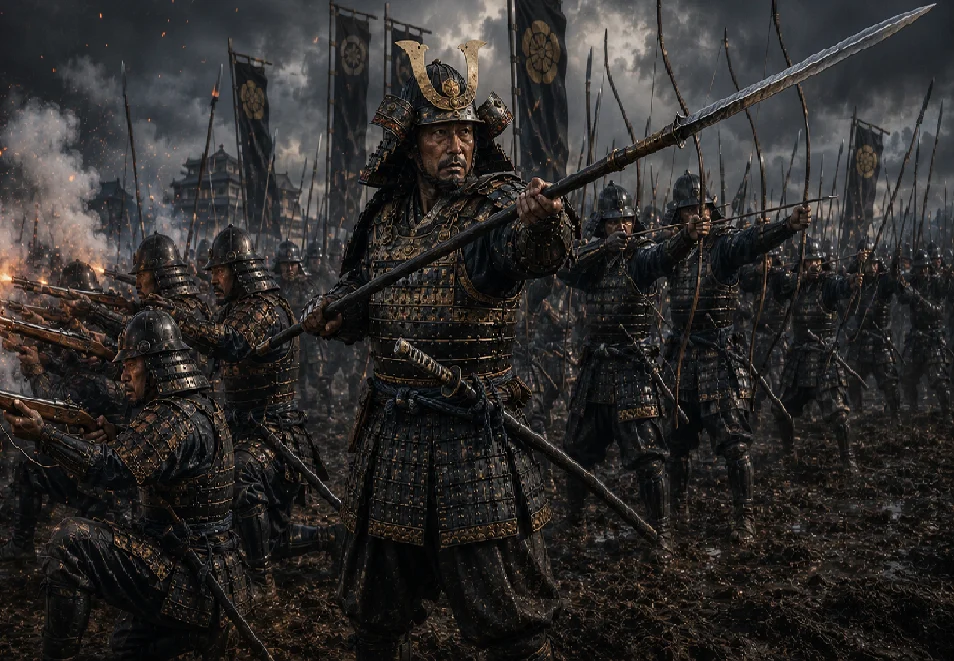
Samurai Weapons: The Lethal Arsenal Beyond the Katana
When modern audiences picture traditional Japanese warfare, the curved steel of the katana inevitably commands center stage, yet the true history of Samurai Weapons reveals a far more complex military reality. Pop culture treats the sword as an all-powerful battlefield centerpiece capable of cleaving through steel plate and deciding wars in single flashes of martial artistry.
Centuries of military scrolls and battlefield excavation records prove that samurai weapons were chosen for reach, projectile leverage, and tactical utility rather than romantic dueling ideals. To a frontline warrior, the sword was a secondary sidearm, the equivalent of an officer’s sidearm pistol drawn only when primary arms splintered or distance collapsed.
The Forensic Casualty Record: Ranking Primary Samurai Weapons
To understand the reality of battlefield trauma, historians examine the physical injuries inflicted by various samurai weapons during medieval engagements. Military casualty rolls (gunchūjō) from the Kamakura, Nanboku-chō, and Muromachi periods provide empirical proof regarding the lethality of arms on the frontline.
These written petitions were submitted by warriors to their clan lords to claim land grants and monetary rewards based on wounds sustained in active service. Historian Thomas Conlan’s quantitative analysis of fourteenth-century battle reports dismantles popular assumptions regarding lethal samurai weapons in combat.
The statistical distribution of recorded combat wounds reveals a stark hierarchy:
-
Missile Projectiles (Arrows / Yumi): Accounted for approximately sixty-eight to seventy-three percent of all recorded battlefield wounds.
-
Polearms and Pikes (Naginata / Yari): Caused roughly eighteen to twenty-one percent of recorded trauma.
-
Thrown Rocks and Hurled Slings: Inflicted approximately seven to eight percent of blunt-force head trauma and fractures.
-
Swords (Tachi / Katana): Accounted for barely two to four percent of documented battlefield injuries.
These official combat petitions demonstrate that primary samurai weapons functioned within an integrated combined-arms framework where hand-to-hand blades played an auxiliary role. Marching into mass tactical combat armed exclusively with a katana against formations of archers and five-meter pikes was an act of tactical suicide.
Tactical evolutions in the field [Internal Link: Sengoku Jidai Strategic Evolution] forced armies to prioritize long-range missile suppression and collective formation density over individual aristocratic swordsmanship.
The Asymmetrical Warbow: King of the Early Medieval Field
Between the tenth and fourteenth centuries, the supreme centerpiece among all Samurai Weapons was the asymmetrical longbow (yumi). Early medieval samurai were, above all else, horse-archers. The code of the warrior was not known as bushidō in this era; it was called the “Way of the Bow and the Horse” (kyūba no michi).
Mounted archery (kuba-jutsu) dictated early tactical doctrine, establishing the bow as the most deadly of all early samurai weapons:
-
The Asymmetrical Profile: Measuring between 2.1 and 2.3 meters in length, the upper curve comprised roughly two-thirds of the bow’s total length, with the leather grip positioned one-third from the base.
-
Equestrian Mechanics: This deliberate off-center grip allowed a mounted warrior to rapidly shift the bow from the left to the right side of his horse’s neck without striking the saddle pommel.
-
Laminated Composition: Constructed from strips of seasoned bamboo laminated around a core of dense hardwood using fish-bladder glues, curing for months to produce draw weights ranging from sixty to over one hundred pounds.
-
Armor-Piercing Projectiles: Arrows carried specialized forged steel tips, including the chisel-shaped chisel-point (tagane-ya) engineered to split iron scales, alongside wide barbed broadheads (watakusi) for unarmored flesh.
Engagements opened with massed flights of arrows. Mounted samurai galloped in semicircular lines outside spear range, loosing shafts at close range against opposing cavalry commanders. The bow remained the primary engine of lethality, while swords remained sheathed in lacquered scabbards.
Combat discipline [Internal Link: Nomadic Equestrian Warfare Mechanics] demonstrated that equestrian horse-archery maintained tactical dominance across open plains until infantry formations learned to counter cavalry with defensive earthworks.
The Shift to Infantry Shock: Naginata and the Five-Meter Yari
As battlefields transitioned from equestrian duels to packed infantry collisions, polearms replaced bows as the dominant frontline samurai weapons. The fourteenth century witnessed the rise of the naginata, a curved single-edged blade mounted on a six-foot oval wooden shaft.
The naginata was an exceptional cutting weapon designed to sever horse hamstrings and disembowel charging mounts. However, as troop densities increased during the Sengoku period, its sweeping circular arcs became hazardous to comrades packed tightly into line formations.
Armorers answered this problem with the yari (thrusting spear), which became the supreme infantry arm of the sixteenth century:
-
The Sō-yari: A straight, double-edged spear featuring a triangular cross-section (sankaku-yari) forged with a thick spine designed specifically to pierce iron plate armor without snapping.
-
The Nagae-yari (Pike): Deployed by massed ashigaru regiments, these ash-wood pikes stretched between 4.5 and 5.6 meters in length.
-
Shaft Metallurgy: Shafts were reinforced with alternating bands of woven cord, raw silk, and water-resistant urushi lacquer to prevent splintering from sword blows.
The emergence of the five-meter yari spear proved that length, leverage, and formation discipline superseded individual virtuosity among samurai weapons.
Troops did not simply thrust their pikes; they advanced in dense blocks, slamming their shafts downward in unison over defensive palisades. The blunt concussive kinetic energy of hundreds of heavy wooden shafts crashing down simultaneously fractured iron helmets and crushed collarbones long before an enemy could close to sword distance.
+---------------------------------------------------------------------------------+
|                       HISTORICAL CHRONOLOGY OF PRIMARY ARMS                     |
|                                                                                 |
|  [Early Medieval: 10th-14th C]  ──>  The Yumi (Mounted Asymmetrical Longbow)    |
|                 │                                                               |
|                 v                                                               |
|  [Mid-Sengoku: 14th-16th C]     ──>  The Naginata & Nagae-yari (Reach Polearms) |
|                 │                                                               |
|                 v                                                               |
|  [Late Sengoku: 1543-1600]      ──>  Tanegashima Matchlocks (Volley Gunpowder)  |
|                 │                                                               |
|                 v                                                               |
|  [Edo Period: 1603-1868]        ──>  The Katana (Civilian Status Symbol)        |
+---------------------------------------------------------------------------------+
Firearms Revolution: Gunpowder Among Samurai Weapons
The arrival of Portuguese matchlocks on Tanegashima Island in 1543 permanently transformed the tactical hierarchy of Samurai Weapons. Warlords recognized the ballistic potential of smoothbore firearms immediately, purchasing the original weapons and commissioning domestic swordsmiths to reverse-engineer their mechanical locks.
Japanese gunsmiths mastered screw-cutting and metallurgy within months, initiating the mass production of the tanegashima matchlock:
-
Barrel Construction: Forged using coiled ribbon welding techniques, wrapping heated strips of iron around a mandrel to produce barrels capable of withstanding heavy powder detonations.
-
Serpentine Mechanism: A spring-loaded bronze arm holding a slow-burning match cord treated with potassium nitrate, plunging into the flashpan upon pulling the trigger.
-
Waterproof Innovation: Engineers designed lacquered wooden lock boxes and oiled paper covers (ama-ōi), allowing gunners to discharge volleys during torrential seasonal rains.
-
Caliber Diversity: Standard munitions firearms fired lead balls weighing fifteen to thirty grams, while massive hand-cannons (ōzutsu) fired three-hundred-gram projectiles capable of breaching wooden gates.
Rather than rejecting gunpowder as dishonorable, warlords mass-produced arquebuses, turning volley-fired matchlocks into the most decisive samurai weapons of the late Sengoku period.
At the Battle of Nagashino in 1575, Oda Nobunaga deployed three thousand gunners behind wooden palisades along the Rengo River. Firing in rotating, disciplined volleys, the gunners annihilated the elite mounted cavalry of the Takeda clan in an afternoon. Gunpowder proved that disciplined conscripts armed with firearms could dismantle lifetime aristocratic martial training.
The Real Battlefield Role of the Katana: Sidearm and Finishing Tool
Within this brutal hierarchy, the sword held a precise, secondary position among functional samurai weapons. The sword was never meant to chop through breastplates or cleave helmets in half. Forged iron and steel plate defeated edge-slashing strikes effortlessly.
The katana was the warrior’s sidearm, functioning like a modern officer’s service pistol rather than the primary offensive instrument among battlefield samurai weapons:
-
The Tachi Era: Early cavalry swords (tachi) featured deep curvatures and hung suspended edge-downward from waist slings, optimized for downward drawing cuts from horseback.
-
The Katana Shift: Ground infantry carried the katana, worn thrust through the sash (obi) edge-upward, allowing the warrior to draw and strike in a single defensive motion (iai).
-
Targeting Seams: Swords were wielded against structural armor gaps: the exposed throat (nodowa), the inner armpits (haidate seams), the groin, and the femoral arteries.
-
Grappling Transition (Kumi-uchi): When pike lines fractured into close-quarters wrestling, combatants grappled their opponents to the mud, using short swords (wakizashi) or armor-piercing daggers (yoroi-dōshi) to deliver finishing thrusts.
The blade served as a badge of caste and a tool for decapitation. After combat, samurai severed the heads of defeated enemy commanders to present to their general during the formal head-viewing ceremony (kubi-jikken), securing verification for their battlefield land claims.
Metallurgy, Tamahagane, and Material Vulnerability
Metallurgical analysis also clarifies why blades occupied this auxiliary tier among late-medieval samurai weapons. Popular mythology attributes supernatural metallurgical qualities to Japanese steel, claiming thousands of folds produced an indestructible metal.
Historical engineering tells an objective physical story:
-
The Raw Material: Japan possessed poor-quality iron sand (satetsu), which was melted with charcoal inside clay tatara furnaces to extract bloomery iron (tamahagane).
-
The Folding Process: Blacksmiths folded the steel twelve to sixteen times not to grant magical sharpness, but to homogenize the erratic carbon distribution and purge brittle silicate slag inclusions.
-
Differential Hardening: The blade was coated with variable layers of clay, sand, and charcoal powder before water quenching, producing a glass-hard high-carbon edge (martensite) supported by a ductile, shock-absorbing low-carbon body (ferrite).
Folded tamahagane steel produced exquisite cutting edges, but striking hardened iron armor ruined blades, compelling troops to rely on impact-driven samurai weapons.
An edge heat-treated to sixty Rockwell hardness fractured, chipped, or curled when slammed into an iron breastplate or a heavy ash spear shaft. Swords bent under lateral stress, requiring field straightenings during prolonged melees. Warriors understood that their blades were perishable tools, not indestructible relics.
The Edo Transformation: How a Sidearm Became the Soul
The transformation of the sword into an ideological symbol occurred only after domestic peace retired active samurai weapons from the field. With the establishment of the Pax Tokugawa in 1603, massive open-field combat ceased across Japan.
The nature of arms underwent an institutional metamorphosis:
-
The Disarmament of Commoners: The Tokugawa Shogunate enforced the Great Sword Hunt (Katanagari), confiscating bows, spears, and firearms from peasants to prevent insurrections.
-
The Daishō Privilege: Only registered samurai were legally permitted to wear the daishō—the matched pair of long katana and short wakizashi—transforming the sword into an exclusive emblem of social rank.
-
The Ban on Battlefield Arms: Large polearms, cavalry bows, and matchlocks were locked inside clan armories, strictly regulated by the central military government (bakufu).
-
The Philosophy of Bushidō: Peace allowed Confucian scholars and retired warriors, such as Miyamoto Musashi and Yamamoto Tsunetomo, to romanticize the katana as the “soul of the samurai.”
Cut off from the harsh realities of mass missile combat, martial schools focused on civil defense, formal dueling in silk robes, and meditative philosophy. The realities of fourteenth-century bloodbaths were replaced by an idealized culture centered entirely on the blade.
Archaeological Evidence: What Excavations Reveal
Modern forensic archaeology confirms the historical distribution of casualties recorded in feudal documents. Excavations of mass graves and battlefields across Japan provide unvarnished physical evidence of battlefield trauma.
Excavated human remains tell an indisputable story:
-
Kamakura Beach Graves (1333): Skeletons excavated from the battlefield of Kamakura show that over seventy percent of identifiable weapon trauma consisted of cranial fractures caused by arrowheads and thrown rocks.
-
Arrowhead Embedding: Vertebrae, pelvic girdles, and scapulae regularly reveal square-sectioned iron bodkin points lodged deep within the bone, proving that archery volleys penetrated through rawhide armor.
-
Absence of Clean Sword Cuts: Bones exhibiting clean, sliced sword cuts are exceedingly rare; where present, blade marks appear predominantly on cervical vertebrae and jawbones, inflicted during post-battle decapitations rather than active fencing.
Artifacts recovered from castle moats and riverbanks further highlight the dominance of utilitarian ordnance: thousands of lead matchlock balls, corroded iron arrow tips, and broken spear ferrules far outnumber recovered sword fittings.
The physical earth verifies what medieval casualty records stated: victory belonged to distance, leverage, and massed firepower.
The True Martial Legacy of Japan’s Warrior Class
The military genius of the samurai resided not in blind adherence to a mythical sword, but in ruthless pragmatic adaptability. When archery dominated the field, they engineered the world’s most sophisticated asymmetrical composite bows. When infantry masses clashed, they deployed impenetrable hedges of five-meter pikes.
When European firearms arrived, they established industrial foundries that manufactured hundreds of thousands of matchlocks, transforming field tactics generations ahead of continental rivals.
The true history of Samurai Weapons reflects a culture that valued survival, tactical flexibility, and engineering precision over poetic illusions. By understanding the bow, the pike, the arquebus, and the sword in their proper operational context, we strip away centuries of peacetime mythology, revealing the genuine, lethal reality of Japan’s warrior heritage.
Frequently Asked Questions
Was the katana really the primary weapon of the samurai?
No. Military casualty rolls, archaeological excavations, and historical chronicles confirm that the katana was an auxiliary sidearm. On the battlefield, warriors relied primarily on the yumi (longbow), the yari (thrusting spear), and the tanegashima (matchlock firearm). The sword was drawn only for personal self-defense, wrestling in armor, or post-battle decapitation.
Did samurai reject guns because they were considered dishonorable?
No, that is a modern myth popularized by twentieth-century romantic fiction. Sengoku daimyos eagerly adopted firearms immediately after their introduction by Portuguese traders in 1543. Japanese warlords established mass foundries, refined waterproof firing mechanisms, and deployed rotating-volley gun lines that decided major conflicts like the Battle of Nagashino.
What was the deadliest weapon on the medieval Japanese battlefield?
Historically, the deadliest weapon on the medieval Japanese battlefield was the yumi (asymmetrical composite longbow), followed by the yari (pike) and the tanegashima (matchlock musket). Fourteenth-century casualty records demonstrate that arrows inflicted over seventy percent of all combat wounds, illustrating the practical, lethal evolution of historical samurai weapons.