
Greek Fire: The Lost Chemical Superweapon That Saved Byzantium
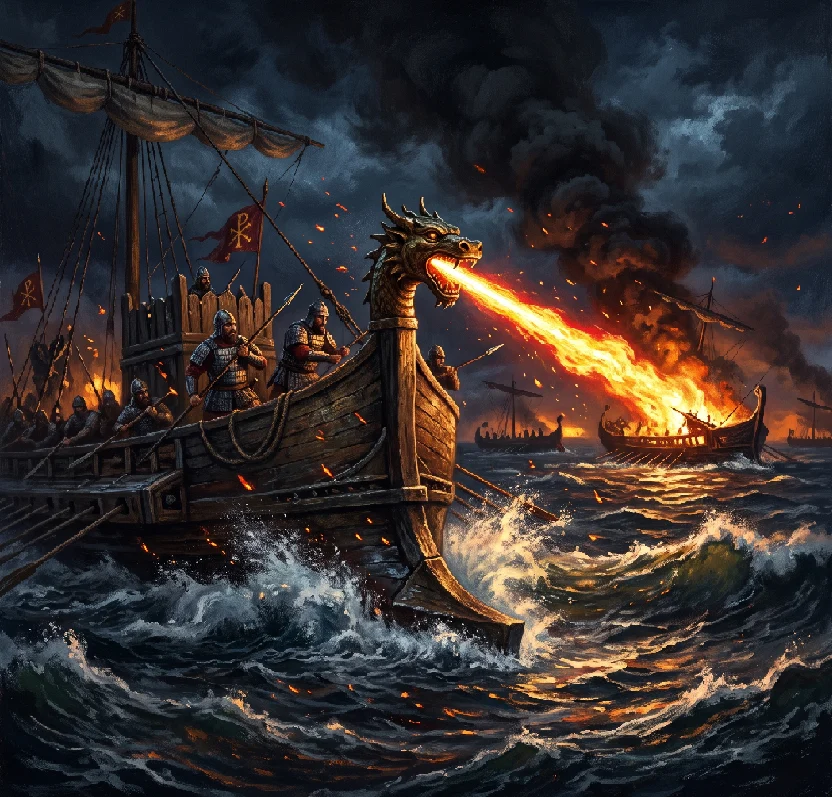
In the late summer of 678 CE, the naval forces of the Umayyad Caliphate ringed the waters surrounding Constantinople, confident that the imperial capital was on the verge of capitulation. Yet as the imperial counter-offensive pushed into the Sea of Marmara, the defenders revealed an unprecedented technological horror. Mounted along the prows of their war galleys were gilded bronze beasts that discharged roaring torrents of liquid flame directly across the waves.
The incendiary weapon known across Western Europe as Greek Fire changed the trajectory of early medieval warfare. Clinging stubbornly to wooden hulls, burning upon the surface of the sea, and resisting water, Greek Fire rescued the Eastern Roman Empire from total collapse and safeguarded the capital for another five centuries
The Geopolitical Crucible of Seventh-Century Constantinople
The seventh century brought catastrophic losses to the Byzantine state. Waves of Islamic armies swept out of the Arabian Peninsula, claiming the affluent southern provinces of Syria, Palestine, and Egypt within a generation.
By the late 670s CE, Umayyad naval fleets dominated the Aegean and laid persistent siege to Constantinople itself. The survival of the empire depended upon the formidable Theodosian land walls and the seaward approaches to the Golden Horn.
Had the capital fallen during these early naval sieges, the defensive shield protecting southeast Europe would have crumbled. The city needed more than conventional ramming galleys, boarding marines, and composite bows to counter massive enemy fleets.
It required an asymmetric battlefield equalizer. That breakthrough arrived through an engineer fleeing regional conflict in Syria, offering the imperial court a chemical mixture capable of dominating naval engagements.
       [Arab Conquest of the Levant (630s–660s CE)]
                            │
                            ▼
         [Kallinikos Flees Heliopolis / Baalbek]
                            │
                            ▼
     [Arrives at Imperial Workshops in Constantinople]
                            │
                            ▼
  [Development of Greek Fire & Pressurized Siphons (c. 673 CE)]
                            │
                            ▼
  [Decisive Repulsion of Umayyad Fleets (678 & 717–718 CE)]
Kallinikos of Heliopolis and the Birth of Greek Fire
Byzantine accounts, including the chronicles of Theophanes the Confessor, credit the weapon’s introduction to Kallinikos of Heliopolis, a Syrian architect and metallurgist. Around 673 CE, Kallinikos fled his homeland and offered his services directly to Emperor Constantine IV in Constantinople.
Kallinikos did not simply supply a recipe for flammable oil. Pre-modern militaries had used incendiary pots filled with sulfur, pitch, and bitumen for centuries.
His singular breakthrough was mechanical and thermodynamic: he developed a pressurized delivery system that sprayed a continuous, adhesive jet of burning liquid. Combining chemical synthesis with bronze foundry craft, Kallinikos provided the state with the earliest mechanized flamethrower system in military history.
                  [Kallinikos's Technological Leap]
┌──────────────────────────────────────┬──────────────────────────────────────┐
│ Traditional Incendiary Mixtures      │ The System of Greek Fire             │
├──────────────────────────────────────┼──────────────────────────────────────┤
│ Thrown passively in clay jars        │ Expelled under pneumatic pressure    │
│ Extinguished by smothering sand/brine│ Floats on seawater while burning hot │
│ Unpredictable ballistic trajectory   │ Directed stream targeting enemy rigs │
│ Short, localized ignition area       │ Wide adhesive coverage on impact     │
└──────────────────────────────────────┴──────────────────────────────────────┘
The imperial navy tested this weapon during the First Arab Siege of Constantinople (674–678 CE). The sudden discharge of burning fluid incinerated enemy flagships, broke unit cohesion, and forced surviving Arab ships to retreat through autumn storms that wrecked the rest of their fleet.
Anatomy of the Flame: Chemical Composition and Metallurgy
The exact recipe of Greek Fire was one of the most successful state secrets in antiquity, dying alongside the empire itself. Modern historians, chemists, and pyrotechnic specialists have combined physical chemistry with historical texts to identify its probable composition.
The foundational fuel was light crude petroleum, or naphtha. The empire held direct access to natural petroleum seepages around the Black Sea basin, particularly along the Crimean peninsula and the Caucasus foothills:
-
Distilled Naphtha Base: Naturally occurring surface crude was distilled in royal cauldrons to isolate the light, highly flammable hydrocarbon fractions that ignite easily.
-
Resinous Thickeners: Left unadulterated, burning naphtha would disperse into an ineffective aerosol mist when sprayed. Armorers dissolved pine resins, wood pitch, or sulfur into the mixture, providing high viscosity so the fuel clung to timber, canvas sails, and skin.
-
Thermal Additives: Some scholars argue that calcium oxide (quicklime) or potassium nitrate was incorporated into the solution. Quicklime reacts exothermically with moisture, generating intense heat upon striking ocean water and igniting the surrounding fuel slick.
       [Petroleum Base: Distilled Naphtha]
                       │
       ┌───────────────┴───────────────┐
       ▼                               ▼
[Pine Resin / Pitch]          [Sulfur / Quicklime]
(Viscosity & Adhesion)        (Thermal Catalyst & Odor)
       │                               │
       └───────────────┬───────────────┘
                       ▼
            [Greek Fire Liquid Fuel]
Other researchers maintain that the stream was ignited externally by an open pilot flame at the mouth of the nozzle. Either way, the resulting fire burned aggressively across damp wood and floated atop ocean currents, rendering seawater useless as an extinguishing agent.
The Mechanical Delivery System: Bronze Siphons and Force Pumps
The delivery hardware was just as important as the chemical mixture. The liquid could not be deployed safely using primitive timber pumps, which would catch fire or melt under high operational heat.
The weapon required an airtight, pressurized bronze pumping system mounted inside the warship’s hull:
The Heating Boiler
In the forecastle hold of a Byzantine war galley sat a sealed, heavy bronze cauldron mounted atop an insulated furnace. The viscous petroleum mixture was brought to a gentle boil, creating internal vapor pressure without igniting the sealed fuel.
The Pneumatic Force Pump
Artisans built two-cylinder force pumps based on classical designs from Hero of Alexandria and Ctesibius. Naval crews pumped these levers manually, forcing air into the heated cauldron to drive the pressurized fluid upward into the delivery pipes.
The Articulated Discharge Siphon
On the top deck stood the siphonophoros, a swiveling bronze pipe ending in a decorative snout shaped like an open-jawed lion or dragon. The operator aimed the nozzle using directional handles, projecting a high-velocity stream of ignited fuel up to fifteen meters across the open sea.
               [Forecastle Topdeck]
                        │
             ┌──────────▼──────────┐
             │ Swiveling Nozzle    │ ──► [Ignited Jet: 15m Range]
             │ (Cast-Bronze Beast) │
             └──────────▲──────────┘
                        │ (Sealed Piping)
  ═════════════════════════════════════════════════════  [Deck Line]
                        │
             ┌──────────┴──────────┐
             │ Airtight Bronze Tank│ ◄── [Pneumatic Force Pump]
             │ (Preheated Mixture) │
             └──────────▲──────────┘
                        │
             [Insulated Fire Hearth]
To explore how ancient armies engineered specialized equipment to counter unexpected tactical hazards, examine the mechanics of [Internal Link: Tetsu-Geta Fumi Samurai Countermeasure] against covert area-denial weapons.
Naval Warfare and the Byzantine Dromon
The primary vessel for deploying Greek Fire was the dromon (“the runner”), the standard Byzantine naval galley. Measuring thirty to fifty meters long, the dromon was built for rapid acceleration and maneuverability along narrow straits.
These warships carried two banks of oars rowed by roughly a hundred to two hundred oarsmen, who also served as armed marines (epibatai). The ship carried lateen sails, but relied on oar power during combat:
                  [Byzantine Dromon Profile]
┌───────────────────────┬────────────────────────────────────────────┐
│ Ship Length & Draft   │ 30 to 50 meters, shallow coastal draft     │
│ Primary Propulsion    │ Dual-bank oars (100–200 rowers) + sails    │
│ Armament Profile      │ Bow bronze siphon, marine archers, catapult│
│ Specialized Personnel │ Siphonophoroi (Imperial Fire Specialists)  │
└───────────────────────┴────────────────────────────────────────────┘
The tactical integration of the weapon dictated naval combat doctrine:
-
Ram and Spray Maneuvers: The dromon moved aggressively toward an enemy vessel’s flank, rowers pulling at full sprint. At thirty feet, the bow operator opened the valve, drenching the target’s sails, rigging, and rowers in burning liquid.
-
Psychological Terror: The combustion process released a thunderous roar accompanied by thick clouds of dark, acrid smoke. Sailors accustomed to conventional boarding actions panicked when confronting flames that water only spread.
-
Secondary Ordnance: Beyond the bow-mounted siphons, crews threw ceramic hand grenades (cheirosiphona) filled with incendiary fluids, shattering against enemy decks to ignite lingering fuel pockets.
      [Approaching Umayyad Warship]
                    │
                    ▼  (Flanking Interception)
      [Byzantine Dromon at Full Oar Speed]
                    │
                    ▼  (Valve Opened at 10–15 Meters)
      [High-Pressure Jet of Greek Fire Discharged]
                    │
                    ▼
[Rigging Ignites / Water Fails / Hull Abandoned]
In fleet engagements, small squadrons of dromons disrupted organized battle lines, forcing enemy commanders to scatter their ships to avoid spreading the fire.
Secrets of the State: The Imperial Monopoly
Understanding that this chemical weapon was the empire’s ultimate defense, the Byzantine administration safeguarded its technical details with great care. The formula and machinery were classified under an early form of state security.
Emperor Constantine VII Porphyrogenitus outlined this policy in the tenth-century manual De Administrando Imperio. He instructed his son and successor that the secret of the imperial flame was delivered directly to Constantine the Great by an angel of God.
The text ordered that any official or citizen who shared the formula with foreign powers should be cast out of the church, stripped of rank, and condemned as an enemy of the Christian state.
           [The Emperor & Inner Privy Council]
                           │
       ┌───────────────────┴───────────────────┐
       ▼                                       ▼
[Ministry of Armaments]             [Imperial Shipwright Guild]
• Harvests raw naphtha              • Casts specialized bronze boilers
• Refines fuel in palace labs       • Builds concealed dromon mounts
• Never sees the completed pump     • Never receives chemical formula
       │                                       │
       └───────────────────┬───────────────────┘
                           ▼
          [Siphonophoroi Operating at Sea]
     (Sworn to Holy Oaths of Imperial Silence)
The state segmented every stage of production to prevent leaks:
Compartmentalized Labor
No single artisan, guild, or officer oversaw the entire process. The harvesting of petroleum took place in closed imperial enclaves, chemical refinement occurred within the walls of the Great Palace in Constantinople, and the bronze pumps were cast by separate metal guilds.
Royal Siphon Operators
The crews tasked with aiming and firing the siphons, the siphonophoroi, were recruited from loyal families in Constantinople. They were sworn to religious oaths and rewarded with imperial stipends.
This compartmentalization was effective. Even when enemy forces captured individual dromons during coastal skirmishes, they could not replicate the system.
Without the specific chemical fuel, the bronze pumps were useless. Without the pressurized pumps, the oil was just an ordinary incendiary fuel that could not be thrown far enough to threaten opposing navies.
To see how early defensive strategies prioritized physical infrastructure over secrecy, explore the construction of [Internal Link: The Fortifications of Ancient Babylon] across early Mesopotamian history.
Turning Points: Sieges That Shaped Europe
The historical significance of Greek Fire is rooted in three major naval engagements that preserved the Byzantine state during periods of extreme vulnerability.
[678 CE: First Arab Siege]   ──► Shattered Umayyad sea blockade of Constantinople
              │
[717 CE: Second Arab Siege]  ──► Destroyed Caliphate transport fleet; lifted siege
              │
[941 CE: Rus' Naval Incursion] ──► Decimated Igor's 1,000-ship fleet off the Bosporus
The First Arab Siege of Constantinople (674–678 CE)
Over four years, Arab naval forces used the Cyzicus peninsula as a base to attack the capital’s sea walls every spring.
In 678 CE, Emperor Constantine IV deployed his fire-bearing dromons into the Sea of Marmara. The unexpected destruction of the Umayyad vanguard caused panic across the fleet, forcing the caliphate to agree to a thirty-year peace treaty with the empire.
The Second Arab Siege (717–718 CE)
In 717 CE, the Umayyad general Maslama led an army of over 100,000 men and an armada of eighteen hundred ships to besiege the capital by land and sea. Emperor Leo III used the defensive chains across the Golden Horn to bottle up the invading ships before dispatching dromons into the straits.
The resulting inferno destroyed the Arab supply lines, leaving the besieging army to freeze and starve through the winter until the siege was abandoned.
The Rus’ Maritime Incursion (941 CE)
In the summer of 941 CE, Prince Igor of Kiev sailed into the Bosporus with an armada of roughly a thousand small longships (monoxyla), exploiting the absence of the imperial army, which was campaigning against the Abbasids in the East.
The Byzantine admiral Theophanes mobilized fifteen retired dromons outfitted with spare siphons. The small squadron engaged the fleet in calm water, destroying dozens of northern boats within hours and routing the Russian invasion.
Loss of the Formula: The Fall of the Secret
Despite centuries of service, Greek Fire gradually disappeared from the historical record during the later Middle Ages. The loss of the technology stemmed from political fracturing rather than a single lost manuscript.
In 1204, Western European crusaders of the Fourth Crusade sacked Constantinople, plundering its churches, destroying centuries of archives, and driving the imperial government into exile. The specialized guild system and palace laboratories were dismantled.
       [1204: Fourth Crusade Sacks Constantinople]
                           │
       ┌───────────────────┴───────────────────┐
       ▼                                       ▼
[Imperial Workshops Broken]         [Black Sea Crude Sources Lost]
Chemist guilds disbanded            Genoese/Venetian trade controls
Refining equipment looted           Access to naphtha deposits severed
       │                                       │
       └───────────────────┬───────────────────┘
                           ▼
  [Weapon Ceases Production; Replaced by Early Gunpowder]
At the same time, the empire lost control of the raw materials required to produce the fuel. Italian maritime republics, particularly Venice and Genoa, seized regional trade networks, cutting Constantinople off from the Black Sea petroleum seepages that supplied its refineries.
By the fourteenth century, early forms of gunpowder arrived from East Asia. Firearms and cannon were simpler to manufacture, easier to operate, and did not require the expensive bronze plumbing or volatile chemicals of the ancient siphon.
When Sultan Mehmed II breached the walls of Constantinople in 1453, the formula for Greek Fire had been forgotten, leaving behind only the dramatic accounts of medieval chroniclers.
The Enduring Legacy of Greek Fire
The story of Greek Fire highlights the profound effect that sudden technological leaps can have on geopolitics. For over five hundred years, a chemical mixture and a pressurized pump protected the Eastern Roman Empire from existential threats.
More than an ancient novelty, the weapon was a sophisticated integration of chemical synthesis, metallurgy, and counter-espionage. By shielding Constantinople during critical centuries of early medieval history, Greek Fire preserved the Byzantine realm and fundamentally shaped the borders of the medieval Mediterranean.
Frequently Asked Questions
What was Greek Fire?
Greek Fire was a volatile liquid incendiary weapon developed by the Byzantine Empire in the late seventh century CE. Expelled under pressure from bronze siphons mounted on war galleys, the substance ignited on contact, burned upon the surface of the sea, and could not be extinguished by water, making it a devastating naval weapon.
Who invented Greek Fire?
Historical chroniclers credit the invention of the weapon around 673 CE to Kallinikos of Heliopolis, a Syrian-Greek architect and metallurgist who fled the Arab conquests of his homeland to seek refuge in Constantinople, offering the emperor his chemical delivery system.
Why was the formula for Greek Fire lost?
The formula for Greek Fire was treated as a state secret, protected by strict compartmentalization where no single craftsman or official knew every component. When the Fourth Crusade sacked Constantinople in 1204, the imperial workshops and guild structures collapsed, while the loss of Black Sea territories cut off access to crude petroleum reserves, permanently severing the production chain.