
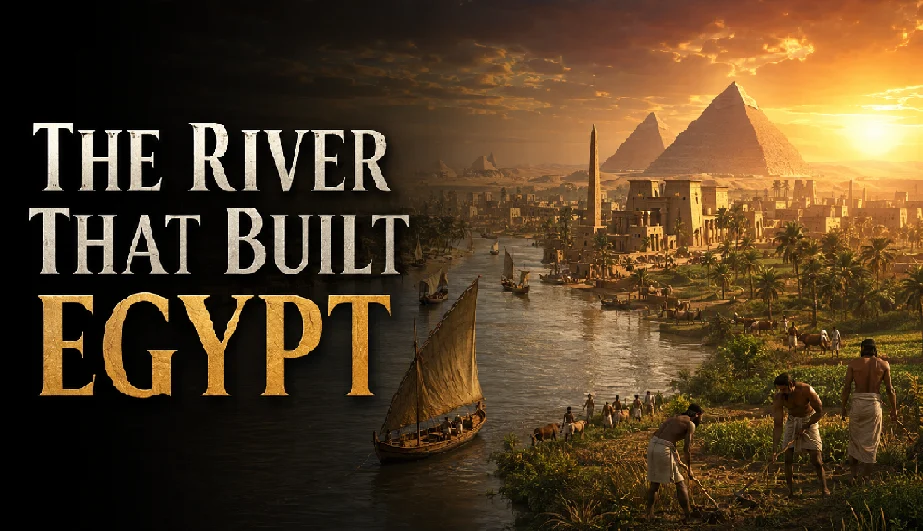
Early Egypt: The Sacred Rise of a Unified State
Every autumn across northeast Africa, a predictable inundation transformed the desert landscape into a ribbon of black silt. In this hyper-arid environment, the Nile River provided an agricultural baseline that nurtured the dawn of Early Egypt. Long before limestone pyramids touched the sky or imperial armies pushed into the Levant, scattered pastoralist settlements along the riverbanks coalesced into a complex civil society.
The formation of Early Egypt was not a sudden historical miracle. It represented centuries of technological experimentation, basin irrigation engineering, regional warfare, and institutional consolidation. By roughly 3100 BCE, the political synthesis of Upper and Lower Egypt established the world’s first territorial nation-state, providing the institutional bedrock that sustained dynastic power for three thousand years.
The Ecological Engine: Basin Irrigation and River Transport
The natural environment of the Nile Valley dictated the political rhythm of Early Egypt. Hemmed in by the hyper-arid limestone and granite wastes of the Eastern and Western Deserts, human settlement was confined to the fertile floodplain.
The foundation of agrarian surplus rested on natural inundation:
-
Summer monsoons over the Ethiopian highlands swelled the Blue Nile and Atbara rivers, carrying volcanic basalt minerals northward.
-
Beginning in July, floodwaters overtopped the low riverbanks, depositing millions of tons of rich black alluvial silt (kemet) across the flood basin.
-
By late October, the waters receded naturally into the main channel, leaving saturated soil ready for planting without extensive animal plowing.
-
Communities sowed drought-tolerant emmer wheat, six-row barley, flax for linen production, and lentils directly into the wet silt.
To control this natural cycle, farming communities organized basin irrigation networks. Farmers excavated earthen dikes to divide the floodplain into compartmentalized basins, trapping standing floodwaters for up to six weeks to soak the soil before draining downstream.
The river was equally vital as a transport artery. The northward current carried cargo barges downstream toward the Delta, while prevailing northern Mediterranean winds allowed sailing vessels to travel upstream under square linen sails.
This dual highway eliminated the overland transport barriers that fragmented contemporary civilizations. Bulky commodities—grain, cattle, timber, building stone, and beer jars—moved between distant settlements with minimal energetic cost, laying the logistical framework of Early Egypt.
Predynastic Foundations: Badari, Naqada, and Regional Polities
The societal roots of Early Egypt stretch deep into the fifth and fourth millennia BCE. Archaeological excavations across Upper Egypt have illuminated the continuous material progression of the Badarian, Naqada I (Amratian), Naqada II (Gerzean), and Naqada III (Semainean) cultural sequences.
During these formative phases, egalitarian Neolithic pastoralism gave way to pronounced social stratification:
-
The Badarian Culture (c. 4400–4000 BCE): Known for exceptionally thin-walled, black-topped red pottery polished to a high luster, accompanied by ivory cosmetic palettes and copper pins.
-
The Naqada I Period (c. 4000–3500 BCE): Characterized by white-cross-lined ceramics depicting riverboats, aquatic hunting scenes, and stylized fauna, reflecting an elite class commanding local river trade.
-
The Naqada II Period (c. 3500–3200 BCE): Buff-colored marl clay vessels decorated in red pigment with multi-oared river galleys, animal standards, and dancing figures, marking the expansion of Upper Egyptian material culture northward into the Delta.
By the mid-fourth millennium BCE, autonomous farming hamlets had coalesced into fortified proto-states centered on regional capitals. Three primary urban nuclei emerged in Upper Egypt: This (near Abydos), Naqada (ancient Nubt, the “City of Gold”), and Nekhen (Hierakonpolis, the “City of the Hawk”).
Excavations at Hierakonpolis reveal an industrial-scale predynastic settlement:
-
Specialized pottery kilns capable of firing thousands of vessels in a single batch.
-
Massive industrial breweries producing hundreds of gallons of fermented emmer beer daily to support organized craft laborers and elite feast gatherings.
-
A ceremonial elite cemetery (Locality 6) featuring rock-cut tombs, pillared timber halls, and burials containing sacrificed exotic animals, including elephants, baboons, and leopards.
These regional chiefdoms were not peaceful agrarian communes. They engaged in sustained military conflict, competing for arable land, copper mines in the Eastern Desert, and access to raw gold deposits along the wadis leading to the Red Sea.
Strategic maneuvers and spatial centralization [Internal Link: Classical Logistics and Imperial Expansion] proved that long-distance resource acquisition was the primary driver of political consolidation across the ancient world.
Elite Weapons and Warfare in Proto-Dynastic Egypt
The martial apparatus of Early Egypt was built around shock combat and missile suppression. Archaeological graves and ceremonial victory monuments provide precise forensic data regarding the weapons utilized by predynastic warbands.
The battlefield kit of fourth-millennium warriors included:
-
The Disc-Shaped and Pear-Shaped Maceheads: Carved from hard diorite, limestone, and porphyry, mounted on wooden shafts; the heavier pear-shaped macehead became the universal icon of royal smiting because its focused impact easily shattered human crania.
-
Flaked Flint Knives: The pinnacle of pressure-flaking lithic technology, exemplified by the ceremonial Gebel el-Arak knife, featuring a ripple-flaked flint blade paired with an ivory handle depicting hand-to-hand combat between rival riverboat crews.
-
Transverse Arrowheads: Chiseled flint trapezoids and triangles mounted on reed shafts, designed to sever major arteries and inflict massive bleeding wounds on unarmored torsos.
-
Curved Throwing Sticks and Ash Lances: Hardwood boomerangs for skirmishing alongside heavy wooden thrusting spears tipped with copper or flaked flint points.
Tactical engagements were fluid and brutal. Opposing warbands transported by high-prowed wooden riverboats made amphibious landings along disputed canal embankments. Skirmishers exchanged volleys of flint-tipped arrows before lines collided in hand-to-hand combat, where maces cracked skulls and flint daggers finished fallen foes.
The transition from dispersed tribal warfare to organized state violence required a fundamental technological leap: the adoption of cast copper axes and spears, which allowed elite guards to dismantle traditional wooden shields.
The Road to Statehood: Territorial Unification Around 3100 BCE
The political consolidation that established Early Egypt was once viewed as a single, dramatic military conquest of the northern Delta by a southern king. Modern archaeological evidence reveals a far more complex, multi-generational process of cultural assimilation, economic coercion, and punctuated military campaigns.
Upper Egyptian material culture had gradually penetrated the northern Buto-Maadi cultural complex through trade expansion long before formal political union. Southern elites sought direct control over northern trade nodes connecting Egypt with Lebanese cedar forests and the copper mines of southern Canaan.
Yet organized military violence was essential to final state formation:
-
Inscriptions carved on limestone cliffs at Gebel Tjauti and Gebel Sheikh Suleiman document predynastic military raids led by early rulers like King Scorpion.
-
Elite necropolises at Abydos (Cemetery U) reveal royal tombs containing imported Syro-Palestinian wine jars, inscribed bone tags, and ivory scepters, confirming centralized bureaucratic control over international commerce.
-
Royal annals preserved on the later Palermo Stone record punitive raids against northern marsh dwellers and Libyan border tribes.
The ceremonial culmination of this unification is recorded on the Narmer Palette, an iconic green siltstone artifact excavated from the temple deposit at Nekhen:
-
On the obverse, King Narmer wears the tall White Crown (hedjet) of Upper Egypt, raising a pear-shaped stone mace to smite a kneeling northern captive beneath the gaze of the falcon god Horus.
-
On the reverse, Narmer wears the Red Crown (deshret) of Lower Egypt, marching in a victory procession preceded by standard-bearers to inspect rows of decapitated enemy soldiers.
-
The intertwined serpentine necks of two mythical beasts (serpopards) are held fast by leashed ropes, symbolizing the forceful, permanent harmonizing of two fractured realms under a single sovereign will.
Whether Narmer was identical to the legendary Menes recorded by the third-century BCE historian Manetho remains debated. What is historically certain is that by 3100 BCE, Narmer and his immediate successors stood as undisputed monarchs over a unified Nile state.
Administrative Innovation in Early Egypt
Governing a unified territorial realm stretching over six hundred miles demanded an administrative apparatus capable of projecting power beyond the physical reach of the monarch. The rulers of Early Egypt addressed this challenge by developing formal writing and founding a strategic national capital.
The founding of Memphis, positioned strategically at the apex of the Nile Delta, established the administrative hub of the new kingdom:
-
Memphis served as the “Balance of the Two Lands” (Ineb-Hedj, the White Walls), guarding the convergence where the narrow valley of Upper Egypt broadened into the marshy expanses of Lower Egypt.
-
Royal granaries, tax evaluation chanceries, and judicial courts were centralized within the capital, directly linked to both regions via river shipping.
-
The court instituted a biennial royal tour known as the “Following of Horus” (Shemsu Hor), wherein the king and his retinue sailed up and down the Nile to conduct censuses, assess cattle counts, and collect taxes directly from local governors.
Simultaneously, early hieroglyphic script transitioned from primitive pictographic tags into a standardized writing system. Scribes incised bone, ivory, and wood labels attached to oil jars, recording harvest years, vineyard origins, and royal tax assessments.
Writing in Early Egypt was an instrument of state control. Scribes tracked grain reserves, surveyed flooded property boundaries, registered conscript labor quotas, and carved royal triumphs into temple walls.
State building through systematic administrative records [Internal Link: Imperial Bureaucracy in Antiquity] proved that political longevity across antiquity was forged through continuous scribal accounting.
+---------------------------------------------------------------------------------+
|                       POLITICAL CONSOLIDATION OF EARLY EGYPT                    |
|                                                                                 |
|  [Neolithic River Hamlets]    (5th Millennium BCE: Basin farming, Badarian)     |
|             |                                                                   |
|             v                                                                   |
|  [Naqada Regional Polities]   (4th Millennium BCE: Nekhen, Abydos, Naqada)      |
|             |                                                                   |
|             v                                                                   |
|  [Military Consolidation]     (c. 3200 BCE: Scorpion, Proto-dynastic raids)     |
|             |                                                                   |
|             +-------------------------+-------------------------+               |
|             |                         |                         |               |
|             v                         v                         v               |
|  [Narmer Unification]        [Founding of Memphis]      [Early Hieroglyphs]     |
|  - White & Red Crowns        - Strategic Delta apex     - Ivory labels, census  |
|  - 3100 BCE First Dynasty    - Centralized taxation     - Royal tax registers   |
+---------------------------------------------------------------------------------+
Royal Theology and the Maintenance of Ma’at
The supreme ruler of Early Egypt occupied an institutional office unlike any contemporary Near Eastern chieftain. The pharaoh was not simply a mortal king favored by the gods; he was the living embodiment of divine order itself.
The philosophical anchor of early dynastic statecraft was the concept of Ma’at—universal truth, cosmic balance, cosmic justice, and stability:
-
The natural world was perceived in perpetual tension between Ma’at (divine order) and Isfet (destructive chaos, drought, and invasion).
-
The king served as the sole pontiff mediating between humanity and the divine pantheon, performing temple rituals to guarantee the annual rising of the Nile.
-
Defeating foreign enemies and crushing domestic insurrections were understood not merely as political acts, but as cosmic obligations to repel Isfet.
This divine kingship was expressed through the complex titulary that evolved during the First and Second Dynasties. The monarch was identified primarily by his Horus Name, written within a serekh—a rectangular palace facade surmounted by the royal falcon god Horus.
The king’s physical vitality was inextricably tied to the prosperity of the land. Periodic jubilee festivals, known as the Sed festival, subjected the aging monarch to rigorous ritual trials, including a ceremonial run around an outdoor track, to prove his continued physical capability to channel divine abundance into the soil of Early Egypt.
Early Dynastic Architecture: From Mastabas to Saqqara
The architectural trajectory of Early Egypt laid the structural foundations for the subsequent pyramid age. The royal necropolises of Umm el-Qa’ab at Abydos and the elite cemeteries of Saqqara reveal a steady progression in funerary engineering.
First Dynasty kings were buried at Abydos within subterranean chambers lined with mudbrick:
-
Central burial chambers were roofed with massive timber beams, surrounded by storage rooms packed with thousands of wine jars, copper weapons, and ivory furniture.
-
Surrounding the royal enclosures of early kings like Djer and Aha stood rows of subsidiary graves containing hundreds of young retainers, court officials, and hunting dogs, who were sacrificed upon the monarch’s death to serve him in the underworld.
-
This practice of retainer sacrifice was rapidly abandoned by the Second Dynasty, replaced by magical offering formulas, stone stelae, and symbolic funerary models.
At Saqqara, royal architects constructed monumental mastaba tombs—rectangular bench-like structures built of baked mudbrick, featuring elaborate recessed palace-facade paneling painted in dazzling geometric patterns.
These architectural experiments culminated in the late Early Dynastic transition to stone masonry under King Khasekhemwy, the final ruler of the Second Dynasty. His vast mortuary enclosure at Hierakonpolis, the Shunet el-Zebib, featured mudbrick walls rising over thirty feet high.
When the Third Dynasty dawned around 2686 BCE, royal architect Imhotep possessed the institutional and engineering legacy necessary to stack successive stone mastabas atop one another at Saqqara, creating the Step Pyramid for King Djoser and launching the monumental Old Kingdom.
Archaeological Evidence: The Physical Record of the First Dynasties
Modern excavations across Egypt have fundamentally revised historical understandings of the archaic period, stripping away mythological layers to expose physical artifacts. Archaeological science confirms the industrial scale of the early royal court.
Excavations have yielded critical empirical data:
-
The Royal Tombs of Abydos: Excavations by Sir Flinders Petrie and the German Archaeological Institute recovered thousands of broken wine jar sealings stamped with cylinder seals bearing the names of First Dynasty kings, documenting trade with southern Palestine.
-
The Cedar Boat Graves of Abydos: Fourteen buried wooden hulls measuring over sixty feet in length, constructed using mortise-and-tenon joints, representing the world’s oldest surviving planked seafaring vessels.
-
The Inscribed Vessels of Hierakonpolis: Hundreds of ceremonial stone bowls carved from translucent alabaster, diorite, and volcanic breccia, bearing incised royal serekhs that testify to unmatched stone-drilling craftsmanship.
Forensic examinations of human remains recovered from elite early dynastic cemeteries indicate that the ruling caste enjoyed superior nutrition, marked by lower rates of childhood dental enamel hypoplasia and greater skeletal stature compared to the rural peasantry.
The material record confirms that Early Egypt was an organized fiscal state. Royal workshops mass-produced standardized pottery, distributed state rations, and controlled elite trade monopolies that enriched the central crown.
Geopolitical Aftermath: The Enduring Legacy of Early Egypt
The consolidation of Early Egypt during the First and Second Dynasties permanently altered the course of human history. By welding the agricultural capacity of the Nile Valley to a unified bureaucratic apparatus, the early kings established an institutional model that endured for three millennia.
The enduring achievements of the early dynastic state include:
-
The Dynastic Framework: The canonical sequence of royal dynasties codified by early scribes provided the administrative template that survived foreign invasions by the Hyksos, Persians, Greeks, and Romans.
-
Standardization of Art and Writing: The artistic canon seen on the Narmer Palette—hieratic scale, composite profile perspective, and formal registers—remained the unvarying baseline of Egyptian monumental expression until the Roman era.
-
The National Identity: By dissolving provincial tribal loyalties into the dual monarchy of Upper and Lower Egypt (Nesut-Bity), the early state forged a unified cultural identity that outlasted periods of civil collapse.
-
Architectural Foundations: The masonry techniques, labor mobilization methods, and religious ideologies developed in early Abydos and Saqqara directly enabled the construction of the Great Pyramids during the Fourth Dynasty.
The pyramids of Giza and the golden treasures of Tutankhamun capture popular historical imagination, yet those monumental peaks were merely the late blossoms of a tree planted centuries earlier.
The true genesis of the ancient world’s most enduring civilization belonged to the nameless farmers, craftspeople, scribes, and visionary rulers of Early Egypt, who looked upon the seasonal retreat of the Nile and engineered an empire from its fertile black mud.
Frequently Asked Questions
When did Early Egypt become a unified state?
Early Egypt coalesced into a unified state around 3100 BCE, marking the transition from the Predynastic Period to the First Dynasty under King Narmer. This political unification was the culmination of centuries of regional warfare, trade expansion, and administrative consolidation between the chiefdoms of Upper Egypt and the settlements of the Nile Delta.
What was the historical significance of the Narmer Palette?
The Narmer Palette is a ceremonial green siltstone artifact discovered at Hierakonpolis that serves as the premier historical document of Egyptian unification. It depicts King Narmer wearing the White Crown of Upper Egypt on one side and the Red Crown of Lower Egypt on the other, smiting enemies and parading before decapitated foes, symbolizing the triumph of centralized order over regional division.
How did the Nile River influence the government of Early Egypt?
The Nile River provided natural basin irrigation that produced massive grain surpluses, which funded royal administrators, standing armies, and specialized craftsmen. Furthermore, the river acted as a unified transportation highway, enabling the central capital at Memphis to dispatch decrees, collect taxes, and deploy military forces across six hundred miles of river valley in days