
Samurai Armor History: The Evolution of Battlefield Steel
A persistent misconception in popular culture portrays traditional Japanese military defenses as delicate constructions made of lacquered wood and bamboo slats. In factual reality, Samurai Armor History reflects seven centuries of metallurgical innovation, ballistics testing, and rapid operational adaptation. Japanese armorers were master blacksmiths whose craft evolved continuously to counter emerging weapon systems across the archipelago.
The complete trajectory of Samurai Armor History reveals a relentless military arms race. Defensive designs transformed from heavy, boxy equestrian barriers engineered to deflect longbow volleys into articulated, bullet-tested steel cuirasses capable of withstanding matchlock fire at close range. Examining this material progression exposes how Japanese warriors survived the changing realities of medieval and early modern combat.
The Mounted Archer Era: Engineering the Classical Ō-yoroi
The foundational chapter of Samurai Armor History developed between the tenth and thirteenth centuries during the late Heian and Kamakura periods. In this era, elite warriors fought primarily as mounted archers (kiba-yumi). Engagements began with ritual arrow exchanges at long distances rather than massed infantry collisions.
Armorers solved a specific tactical problem: shielding a mounted warrior from descending arrow storms while leaving both hands free to draw the asymmetrical Japanese longbow (yumi).
The technical response was the Ō-yoroi (Great Armor), an engineering system assembled from thousands of miniature individual scales (kozane):
-
Scale Architecture (Kozane): Individual plates of hammered iron and boiled rawhide measuring roughly seven centimeters high and three centimeters wide, pierced with multiple lacing apertures.
-
Lacing Mechanics (Odoshi): Scales were laced together horizontally and vertically using tightly braided silk or smoked deerskin cords, creating flexible structural plaques.
-
Sap Sealing (Urushi): Assembled plaque rows were repeatedly dipped in toxic sap harvested from the lacquer tree (Toxicodendron vernicifluum), curing into an iron-hard, waterproof, and rust-resistant shell.
-
The Suspended Box Design: The rigid, square torso cuirass rested its immense weight—approximately twenty-five to thirty kilograms—entirely upon the warrior’s shoulders rather than his hips.
On horseback, the Ō-yoroi functioned like an armored turret. The left side was protected by a solid iron plate (waidate), while the front of the cuirass was faced with supple stenciled leather (tsurubashiri) to prevent the bowstring from snagging on protruding scale edges during release.
Massive rectangular shoulder guards (sode) acted as dynamic shields. When the samurai drew his bow, the sode pivoted backward; when he wheeled his mount to retreat, the guards fell forward to shield his neck and armpits from flanking archery fire.
The limitation of this early phase of Samurai Armor History was its rigid immobility. The suit was engineered exclusively for the saddle. If a warrior was unhorsed, the boxy frame crushed down onto his clavicles, leaving him clumsy, slow, and easily overwhelmed in ground melees.
The Transition to Infantry: Dō-maru and Haramaki
By the fourteenth century, during the Nanboku-chō and early Muromachi periods, the tactical doctrine of Japan shifted away from aristocratic single combat on horseback toward mass ground combat. Battles were increasingly decided by aggressive infantry maneuvers wielding polearms, naginata glaives, and heavy battlefield swords (nodachi).
This tactical change forced a fundamental pivot in Samurai Armor History:
-
The rigid box silhouette of the Ō-yoroi was discarded because foot soldiers could not sprint, jump drainage ditches, or climb fortified palisades under shoulder-suspended weight.
-
Armorers popularized the Dō-maru, a form-fitting scale cuirass that wrapped snugly around the torso and fastened under the right armpit.
-
The weight was transferred from the fragile shoulders down to the pelvic girdle, stabilizing the warrior’s center of gravity.
-
The hanging skirt (kusazuri), formerly four wide and rigid flaps on the Ō-yoroi, was subdivided into six or eight flexible panels.
These split skirt panels allowed foot soldiers to run freely through waterlogged rice paddies without the protective skirts battering their knees.
A variant known as the Haramaki opened along the spine, providing a clean, seamless front plate that protected against direct thrusts. High-ranking officers wearing the Haramaki laced an auxiliary iron plate, the se-ita (“coward’s plate”), over the rear opening to safeguard against dishonorable strikes from behind.
During this dynamic era of Samurai Armor History, metallurgy began replacing rawhide. As slashing polearms grew heavier, armorers laced wider iron plates (iyo-kozane) into the torso sections to distribute blunt impact across larger bone surfaces.
Tactical adjustments on the field [Internal Link: Sengoku Jidai Strategic Evolution] forced regional blacksmith guilds to abandon delicate craftsmanship in favor of practical durability.
The Gunpowder Crisis and the Birth of Tōsei-gusoku
In 1543, Portuguese traders landed on Tanegashima Island, introducing European matchlock firearms (arquebuses) to Japan. Within a generation, Sengoku warlords established domestic gunsmith foundries capable of manufacturing tens of thousands of smoothbore muskets.
This technological shock created a severe crisis within Samurai Armor History. The traditional scale construction (kozane) was completely obsolete against lead projectiles:
-
Heavy lead musket balls fired from a tanegashima possessed enough kinetic energy to split small iron scales and shatter silk cords instantly.
-
Fragmented scales were driven deep into tissue and bone, causing lethal infections.
-
The thousands of silk cords (odoshi) soaked up rainwater and river mud, doubling the suit’s weight on long marches and rotting in storage.
-
Assembling a single traditional scale suit required upwards of ten months of meticulous hand-lacing, making it impossible to equip expanding armies of ashigaru (conscripted foot soldiers).
To counter firearms, sixteenth-century armorers developed Tōsei-gusoku (“Modern Armor”), the most technologically advanced system in Samurai Armor History:
-
Small scales were replaced by wide, solid plates of beaten iron (ita-mono) riveted together into continuous torso sections.
-
Lacing was reduced to bare essentials (sugake-odoshi), eliminating trapped moisture and speeding up manufacturing turnaround.
-
Plates were forged with convex, ridged centerlines to deflect incoming musket balls and long pikes (yari) away from vital organs.
-
Articulated splinted sleeves (kote), thigh guards (haidate), and shin guards (suneate) provided full-body protection while preserving complete flexibility.
The Tōsei-gusoku was a practical weapon system designed for industrial-scale warfare. It could be stamped out by forge workshops, cleaned in muddy camp streams, and adjusted to fit foot soldiers and generals alike.
Nanban-dō: The European Influence in Samurai Armor History
The globalization of trade brought European military hardware into the Japanese theater. Portuguese merchants and Spanish missionaries traded solid steel breastplates, cabasset helmets, and morions with wealthy regional daimyos.
This interaction birthed a specialized subcategory within Samurai Armor History: Nanban-dō (“Southern Barbarian Armor”):
-
Japanese armorers acquired imported European peascod cuirasses forged from high-carbon steel in Milan and Augsburg.
-
Blacksmiths disassembled the Western pieces, retrofitting them with traditional Japanese hanging silk skirts (kusazuri) and articulated shoulder plates.
-
The pronounced vertical central ridge (keel) of the European breastplate proved exceptionally capable of glancing off incoming matchlock rounds.
-
Famous warlords, including Oda Nobunaga and Tokugawa Ieyasu, wore customized Nanban-dō suits as personal declarations of forward-thinking military readiness.
By combining European metallurgical hardening with traditional Japanese articulation, armorers demonstrated the adaptability that characterized Samurai Armor History.
Tameshi-gusoku: Forensic Proof of Ballistic Testing
Sengoku commanders refused to gamble their lives on armorer promises. Before accepting delivery of a high-grade steel cuirass, a daimyo demanded physical, ballistic verification of its stopping power.
This testing protocol, known as Tameshi-gusoku (“Tested Armor”), was a defining quality control standard in Samurai Armor History:
-
The completed steel breastplate was mounted on a wooden frame at a proving range.
-
A marksman discharged a military-grade matchlock musket loaded with service-weight powder and a lead ball from a range of thirty to fifty paces.
-
If the bullet pierced the steel, the plate was scrapped.
-
If the plate absorbed the impact—producing a smooth, circular crater without cracking the steel or splitting the rivets—it passed inspection.
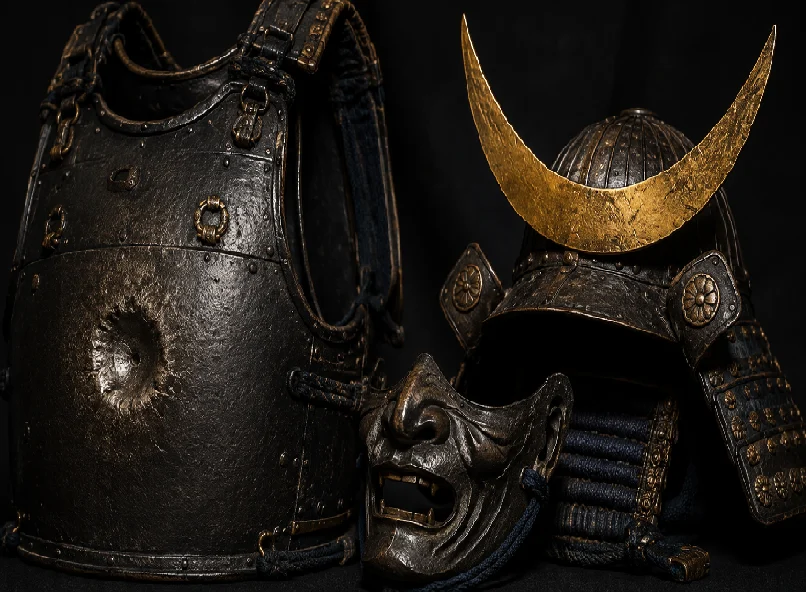
Rather than hammering out or concealing the ballistic crater, the armorer deliberately lacquered around the indentation, occasionally adding gold leaf to highlight the strike point.
Surviving museum pieces around the world preserve these undeniable bullet craters. Inscriptions chiseled onto the interior iron backings often record the tester’s name, the weight of the powder charge, and the date of the test.
This metallurgical resilience [Internal Link: Classical Greek Armor Fabrication and Metallurgy] proved that late-feudal Japanese armorers had achieved heat-treatment standards comparable to the finest workshops of Renaissance Europe.
Helmets and Masks: The Psychology of Intimidation
Defensive armor was engineered to break an opponent’s spirit before a weapon was drawn. The upper components of the suit combined structural protection with theatrical psychological intimidation.
The Kabuto (helmet) represented the highest achievement of cold-forge ironworking in Samurai Armor History:
-
The Skull Bowl (Hachi): Forged from multiple pie-shaped iron plates (kei) joined by raised rivets (hoshi), designed to deflect downward chopping strikes from swords and poleaxes.
-
The Neck Guard (Shikoro): A tiered curtain of curved, lacquered iron plates suspended from the rim of the bowl, protecting the cervical vertebrae while leaving head rotation unrestricted.
-
Heraldic Crests (Maedate): Sculpted brass, gold, or wood crests mounted on the helmet brow, shaped like crescent moons, dragonfly wings, or demonic horns to ensure instant commander identification through battlefield smoke.
The face was shielded by the Menpo, an iron mask sculpted into the likeness of a snarling demon, fierce mythological creature, or foreign warrior:
-
Masks featured deep wrinkles, flared nostrils, and bared teeth cast in iron or gilded bronze.
-
Beyond psychological terror, the Menpo served an essential mechanical function: anchoring the heavy helmet cords (shinobi-no-o) to prevent the helmet from being knocked loose during wrestling melees.
-
A small drainage hole (asada) beneath the chin allowed sweat and condensed breath to escape during prolonged combat in summer heat.
Through these expressive iron faces, Samurai Armor History bridged functional protective engineering with aggressive visual statecraft.
Social Stratification: Munitions Armor vs. Daimyo Masterpieces
Popular media routinely assumes that every warrior on a Sengoku battlefield wore an elaborate, customized suit of armor. The historical reality was divided along rigid class and economic lines.
The vast majority of troops marching through the late chapters of Samurai Armor History were ashigaru. These conscripts were equipped with cheap, mass-manufactured munitions gear known as Okashi-gusoku (“Lent Armor”):
-
Cuirasses were stamped out from two simple curved iron plates hinged at the side (haraate).
-
Breastplates were painted with uniform clan crests (mon) using cheap black lacquer to provide rustproofing and instant identification.
-
Conscripts wore lightweight conical iron or hardened-leather helmets (jingasa) that could double as cooking pans over campfires.
At the opposite extreme stood the custom masterpieces commissioned by regional lords. Warlords employed dedicated armor workshops that spent thousands of hours folding high-carbon Tamahagane steel, applying gold-leaf inlays, and tailoring breastplates to anatomical measurements.
This economic divide created two distinct paths within Samurai Armor History: rapid industrial standardization for mass infantry, and bespoke metallurgical engineering for the aristocratic officer corps.
+---------------------------------------------------------------------------------+
|                       SEVEN CENTURIES OF SAMURAI ARMOR                          |
|                                                                                 |
|  [Ō-yoroi Scale Armor]     (10th-13th C: Mounted archery, boxy, shoulder-hung)  |
|            |                                                                    |
|            v                                                                    |
|  [Dō-maru & Haramaki]      (14th-15th C: Foot soldiers, hip-hung, split skirts) |
|            |                                                                    |
|            v                                                                    |
|  [Tōsei-gusoku]            (16th C: Matchlock defense, solid plates, few laces) |
|            |                                                                    |
|            +-------------------------+-------------------------+                |
|            |                         |                         |                |
|            v                         v                         v                |
|  [Nanban-dō Hybrids]       [Tameshi Ballistic Testing] [Okashi Mass Munitions]  |
+---------------------------------------------------------------------------------+
Archaeological Evidence and Metallurgical Analysis
Modern laboratory examinations of surviving suits have stripped away romantic folklore, confirming the scientific sophistication of Samurai Armor History. Scanning electron microscopy and non-destructive X-ray fluorescence (pXRF) conducted on museum pieces reveal complex multi-phase metallurgy.
Forensic investigations confirm key manufacturing standards:
-
Differential Hardening: Breastplates were intentionally forged with softer, ductile low-carbon iron backs and work-hardened high-carbon steel outer faces, allowing the armor to absorb kinetic shock without shattering.
-
Corrosion Resistance: Gas chromatography confirms that authentic urushi lacquer formed a stable, non-porous polymer barrier that preserved the underlying iron plates from corrosion across four hundred years of humid storage.
-
Textile Reinforcement: High-tensile hemp, ramie, and raw silk fibers were embedded directly into the lacquer substrate, functioning as early composite material reinforcement.
Excavations at Sengoku battlefield sites and urban castle moats have unearthed fragmented armor pieces displaying clear weapon trauma:
-
Iron plate fragments punctured by square-sectioned armor-piercing arrows.
-
Dented breastplates showing partial penetration from five-meter pike thrusts.
-
Severed helmet crests bearing glancing cuts from heavy two-handed blades.
These physical remnants demonstrate that Samurai Armor History was defined by practical utility. Every rivet, strap, and iron plate was engineered to ensure physical survival in extreme environments.
The Peaceful Twilight: The Edo Period and Ceremonial Decline
The functional development of Samurai Armor History concluded abruptly with the establishment of the Tokugawa Shogunate in 1603. Following the decisive clashes at Sekigahara and the Siege of Osaka, Japan entered two and a half centuries of internal peace (sakoku).
Without battlefield pressure, the engineering craft stagnated:
-
The demand for bulletproof, functional steel plate evaporated.
-
Wealthy samurai commissioned nostalgic, ornamental suits inspired by romanticized Heian-era Ō-yoroi styles.
-
Armorers shifted focus from metallurgy to decorative goldsmithing, intricate silk-braiding, and fragile lacquer inlays.
-
Suits were displayed inside domestic alcoves (tokonoma) as ancestral status symbols rather than worn in field maneuvers.
When the final samurai uprisings erupted during the Boshin War (1868–1869), modern bolt-action rifles, Gatling guns, and French artillery rendered traditional iron armor obsolete overnight. Officers quickly discarded their lacquered cuirasses in favor of wool uniforms and leather boots.
Yet the material legacy of Samurai Armor History endures. It stands as an exceptional record of human ingenuity, demonstrating how a martial culture turned iron, sap, and silk into an evolving technological shield that answered every tactical challenge of medieval warfare.
Frequently Asked Questions
Was samurai armor actually made of wood and paper?
No, that is an enduring myth. Traditional samurai armor was constructed from hammered iron plates, hardened high-carbon steel, and treated rawhide. While paper and silk were utilized for interior padding, lacing cords, and decorative backings, the protective shell was forged from metal and sealed in hardened tree lacquer.
Could samurai armor stop a bullet?
Yes, high-grade late Sengoku-period Tōsei-gusoku and Nanban-dō armor were engineered to stop matchlock musket rounds. Daimyo routinely conducted Tameshi-gusoku (ballistic testing), firing actual matchlocks at breastplates from thirty paces. Cuirasses that survived without penetration were stamped or signed by the tester and worn into combat with the bullet dent proudly displayed.
What made the Ō-yoroi different from later Tōsei-gusoku armor?
The Ō-yoroi was a boxy, heavy scale suit engineered in the Heian period exclusively for mounted archers, hanging its entire weight from the warrior’s shoulders. The later Tōsei-gusoku was developed in the sixteenth century for infantry and matchlock warfare, utilizing solid iron plates, minimal water-trapping lacing, and a hip-supported center of gravity that allowed agile running.