
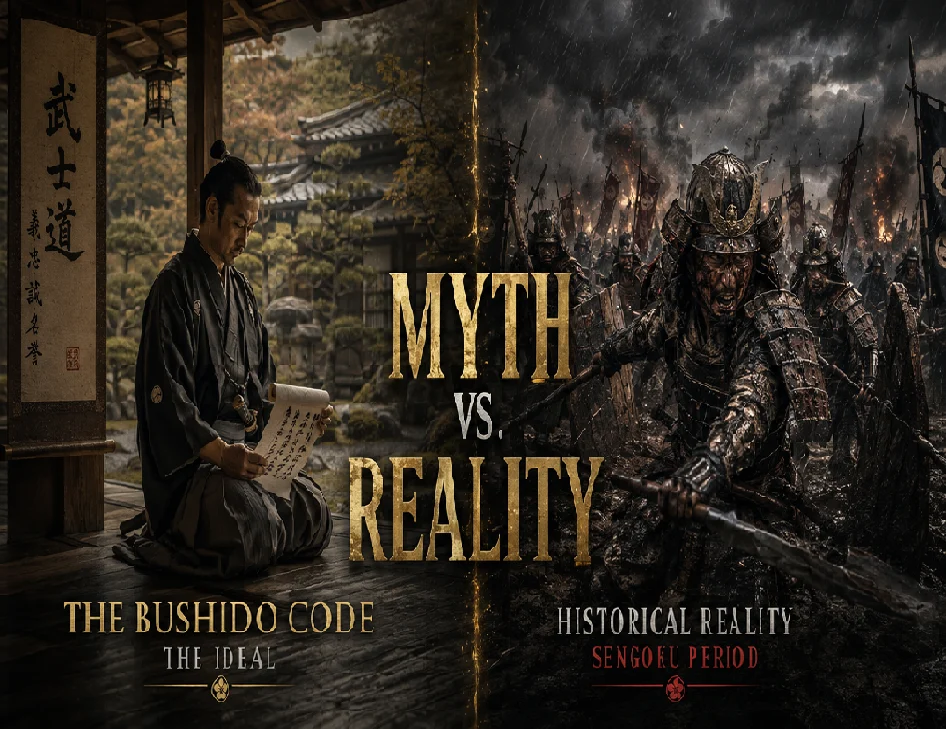
Bushido Code: Deconstructing the Myth of the Samurai
Modern global culture portrays the classical samurai as a stoic ascetic governed by an unyielding ethical doctrine known as the Bushido Code. In popular cinema, literature, and martial arts mythology, this warrior ethos supposedly demanded absolute honesty, selfless loyalty to one’s sovereign, and immediate ritual suicide at the slightest compromise of personal honor.
Historical military records, legal documents, and clan ledgers reveal an entirely different reality. The Bushido Code as it is understood today was not an ancient, universal doctrine practiced during Japan’s brutal civil wars. Instead, it was an idealized philosophy largely manufactured during centuries of peaceful bureaucratic stagnation and codified in the twilight of the nineteenth century.
The Sengoku Reality: Pragmatism and Transactional Loyalty
During the Warring States period (Sengoku Jidai, 1467–1603), survival outweighed moral philosophy. Samurai operated within an unstable feudal environment where political alliances fractured overnight. Loyalty was not an abstract spiritual duty; it was a strictly transactional contract between a lord (daimyo) and his armed retainers.
A commander secured allegiance through material incentives:
-
Allocation of productive rice-producing land grants (chigyō).
-
Direct distributions of captured arms, horses, and luxury trade items.
-
Explicit written promises of estate succession for heirs following combat deaths.
When a daimyo exhausted his treasury or suffered catastrophic battlefield reversals, retainers defected without hesitation. Samurai regularly evaluated whether their lord possessed the military capacity to guarantee their clan’s survival. Abandoning an incompetent or bankrupt master was considered prudent stewardship of family lands rather than cowardice.
Medieval clan house codes (kaho) prioritized pragmatic battlefield survival over chivalric honor. The famous house rules of the Asakura, Takeda, and Hōjō clans urged retainers to avoid reckless single combat, conserve resources, and employ deceit whenever possible. In the harsh crucible of civil war, victory validated the warrior, regardless of the tactics employed.
Tactical evolutions in the field [Internal Link: Sengoku Jidai Strategic Evolution] proved that military commanders valued synchronized firepower and disciplined formations far above theatrical dueling conventions.
Tactical Betrayal as an Accepted Military Art
The chronicle of late-medieval Japan is defined by calculated treachery executed by its most prominent leaders. If the romanticized Bushido Code had governed military conduct, the defining engagements of the sixteenth century could never have occurred.
Treachery was an operational weapon refined to a fine art:
-
The Incident at Honnō-ji (1582): Akechi Mitsuhide, one of Oda Nobunaga’s most trusted senior generals, turned his division back from an active deployment, surrounded his supreme commander at a Kyoto temple, and burned the complex to the ground.
-
The Battle of Sekigahara (1600): Kobayakawa Hideaki deployed his 15,000 troops on Mount Matsuo as an ostensible pillar of the Western Army, only to execute a pre-arranged flank assault into his own allies after receiving a ballistic warning from Tokugawa Ieyasu.
-
Night Raids and Deception: The legendary strategist Takeda Shingen explicitly championed covert night attacks (yoshū), false peace negotiations, and targeted assassinations to dismantle enemy alliances before battle lines converged.
Battlefield reward systems further incentivized ruthless pragmatism. During post-combat head-viewing ceremonies (kubi-jikken), officers verified severed enemy heads against payroll registers to award promotions and land grants.
Samurai frequently fought over corpses to claim heads, occasionally severed the heads of dead comrades to prevent enemy claims, and regularly executed captured commoners to inflate their tallies. Honorable fair play had no place in an operational environment where survival required the total destruction of opposing lineages.
The Edo Transformation: Peacetime Bureaucrats and Invented Honor
The genesis of the romanticized Bushido Code emerged only after the fires of civil war were extinguished. Following the establishment of the Tokugawa Shogunate in 1603, Japan entered the Pax Tokugawa—over two centuries of enforced domestic isolation and stability.
This unprecedented peace triggered an acute identity crisis for the martial elite:
-
The shogunate barred samurai from engaging in warfare, private dueling, or mercenary operations.
-
Warriors were legally compelled to abandon their rural estates and move into designated castle towns (jōkamachi).
-
Hereditary retainers transitioned into civil bureaucrats, accountants, tax collectors, and judicial clerks.
Stripped of their functional role as killers, samurai found themselves questioned by common merchants who generated real economic wealth. To legitimize their privileged social standing and perpetual hereditary rice stipends, elite retainers and Confucian philosophers began generating idealized literature regarding the moral mission of the warrior caste.
During this era, thinkers like Yamaga Sokō synthesized martial traditions with Neo-Confucian ethics. Sokō argued that because the samurai did not produce food or manufactured goods, their societal role was to serve as moral exemplars for the lower classes.
This transformation converted the violent, opportunistic warlord of the sixteenth century into the refined, disciplined scholar-bureaucrat of the eighteenth century.
Two Divergent Texts: The Kōyō Gunkan and the Hagakure Myth
The written development of warrior philosophy during the Edo period produced distinct literary traditions that modern observers frequently conflate under the broad label of the Bushido Code.
The historical divergence between these texts highlights the changing psychology of the samurai caste:
-
The Kōyō Gunkan (c. 1616): Attributed to retainers of the Takeda clan, this military chronicle contains the earliest recorded written appearances of the term bushidō. However, the text did not outline a universal moral religion; it was a pragmatic manual on military tactics, logistical supply, and clan administration designed to preserve battlefield knowledge in a pacified world.
-
The Hagakure (c. 1716): Dictated by Yamamoto Tsunetomo, an aging clerk of the Nabeshima clan who lived decades after the civil wars ended and never participated in an active military campaign.
Tsunetomo wrote from a position of intense political isolation and nostalgic resentment. Mourning the loss of martial vigor among effeminate castle clerks, he famously declared that “The Way of the Warrior is found in death” (Bushidō to wa shinu koto to mitsuketari).
Far from representing mainstream samurai values, the Hagakure was dismissed by contemporary authorities as the radical rantings of an eccentric monk. The text was kept as a private, secret manual within the Saga domain, largely unread across wider Japan until it was rediscovered and weaponized by twentieth-century militarists.
Institutional adaptations [Internal Link: Imperial Bureaucracy in Antiquity] demonstrate that stagnant military castes consistently generate nostalgic codes of honor to mask their functional obsolescence.
+---------------------------------------------------------------------------------+
|                       HISTORICAL CHRONOLOGY OF BUSHIDO                          |
|                                                                                 |
|  [Sengoku Pragmatism]     (15th-16th C: Transactional loyalty, field betrayal)  |
|            |                                                                    |
|            v                                                                    |
|  [Edo Bureaucratization]  (17th-18th C: Pacified clerks, Neo-Confucian ethics)  |
|            |                                                                    |
|            v                                                                    |
|  [Nitobe's 1899 Synthesis](Meiji Era: Victorian chivalry mapped onto Japan)     |
|            |                                                                    |
|            v                                                                    |
|  [Imperial Militarization](1930s-1945: State-mandated suicidal fanatical code)  |
+---------------------------------------------------------------------------------+
Inazo Nitobe and the Victorian Reinvention of the Bushido Code
The definitive iteration of the Bushido Code that colonized the modern global imagination was manufactured not in the castles of Kyoto, but in California at the end of the nineteenth century. In 1899, educator and diplomat Inazo Nitobe published Bushido: The Soul of Japan.
Nitobe’s motivations were explicitly diplomatic:
-
He wrote the book entirely in English to challenge Western prejudices that viewed Japan as an uncivilized, pagan nation.
-
Living in the United States and married to an American Quaker, Nitobe sought to demonstrate that Japan possessed an ethical foundation equal to European Christian culture.
-
Lacking formal training as a military historian, he composed the treatise without citing primary medieval battlefield scrolls or legal house codes.
Nitobe deliberately mapped late-feudal Japanese culture directly onto the romanticized ideals of medieval European chivalry. He presented the samurai as a direct equivalent to the mythical knights of King Arthur’s Round Table, categorizing the warrior’s life into seven neat Victorian virtues: Rectitude, Courage, Benevolence, Politeness, Sincerity, Honor, and Loyalty.
The book became an international bestseller, read and championed by figures like President Theodore Roosevelt. When the text was later translated into Japanese, it presented modernizing citizens with a flattering, sanitized mirror of their ancestral heritage. Nitobe did not record an existing medieval tradition; he invented a Victorian myth that Japan and the world eagerly embraced as historical fact.
Imperial Militarization: Weaponizing the Bushido Code
Following the Meiji Restoration of 1868, the feudal system was abolished, the samurai were officially disbanded, and universal peasant conscription was instituted. Yet within decades, the imperial government discovered an ideological use for the newly popularized Bushido Code.
During the 1930s and the Pacific War, military ideologues transformed Nitobe’s romantic concept into a totalitarian tool of absolute state control:
-
Democratizing the Warrior Elite: Peasant conscripts from rural farms, whose ancestors were historically barred from carrying swords, were indoctrinated to believe they were spiritual heirs to the samurai.
-
The Absolute Ban on Surrender: The Senjinkun (Field Service Code) issued in 1941 commanded soldiers to die rather than suffer the shame of capture, completely erasing the historical reality that medieval samurai negotiated surrenders and ransomed captives regularly.
-
Mandated Suicidal Tactics (Gyokusai): The fatalistic lines of the once-obscure Hagakure were elevated to mandatory military dogma, justifying mass banzai charges, kamikaze suicide flights, and civilian self-destruction on Saipan and Okinawa.
The imperial state extracted the aesthetic trappings of the samurai—swords, armor crests, and fatalism—while stripping away the pragmatic, self-preserving calculation that actually defined historical warriors. The resulting doctrine of fanaticism was a modern industrial distortion, not an ancient cultural inheritance.
Seppuku: Legal Execution vs. Romanced Honor
No ritual is more inextricably bound to the myth of the Bushido Code than seppuku (ritual disembowelment). Romantic depictions portray the act as a voluntary, poetic demonstration of personal integrity performed when a warrior suffered a minor spiritual slight.
The documentary and forensic record demonstrates that seppuku operated primarily as a formalized judicial execution method:
-
In feudal jurisprudence, an condemned samurai of high rank was permitted to commit seppuku to spare his family the degradation of common decapitation at the hands of an outcast executioner.
-
Completing the ritual preserved the family’s honor, prevented the legal confiscation of ancestral estates, and allowed heirs to inherit clan titles.
-
By the late Edo period, the actual physical disembowelment was rarely executed; the condemned warrior merely touched a wooden fan or a blunted ceremonial blade to his stomach, at which precise instant the second (kaishakunin) severed his head from behind.
Voluntary battlefield suicides did occur during the civil wars, but they were desperate measures designed to avoid torture, public humiliation, and the desecration of physical remains by advancing enemy squads. Translating a desperate emergency measure or a capital judicial sentence into a romantic proof of personal virtue was a retrospective fiction of peacetime writers.
Deconstructing the Myths of the Bushido Code
Separating the historical samurai from modern pop-cultural fabrications requires an objective evaluation of medieval evidence against modern assumptions:
These distinctions do not diminish the samurai; they restore their humanity. Medieval warriors were not robotic caricatures bound to a suicidal death cult; they were skilled, intelligent, and flexible survivors navigating an extraordinarily perilous feudal society.
The Enduring Cultural Legacy of an Invented Tradition
The global persistence of the Bushido Code offers a case study in how nations construct and repurpose their cultural heritage. When historical realities proved too chaotic or morally ambiguous for a modernizing world power, Japan’s political and intellectual elites systematically curated a sanitized, noble lineage.
The modern corporate ethos, martial arts traditions (budo), and global entertainment franchises continue to celebrate Nitobe’s seven virtues. This enduring fascination proves the seductive power of invented traditions.
The authentic history of the samurai is far more compelling than the sanitized myth. By discarding the fabricated facade of the Bushido Code, we encounter the genuine Japanese warrior: a pragmatic master of survival, an adaptable technician of violence, and a complex historical actor whose true legacy was written in sweat, steel, and calculated adaptation.
Frequently Asked Questions
Did the Bushido Code exist during the Sengoku Period?
No, the Bushido Code as a formalized, universal ethical doctrine did not exist during the Sengoku Period. While individual clans maintained written house codes governing military readiness and camp discipline, warriors operated under pragmatic rules of survival, where tactical betrayals, ambushes, and shifting alliances were standard practices.
Who actually invented the modern concept of Bushido?
The modern global concept of Bushido was largely synthesized in 1899 by Inazo Nitobe in his English-language book, Bushido: The Soul of Japan. Nitobe deliberately mapped traditional Japanese values onto European Christian chivalry to present a civilized image of Japan to Western audiences, creating a romanticized code that medieval warriors would not have recognized.
Why did the Imperial Japanese Army promote Bushido during World War II?
The imperial military promoted the Bushido Code to instill absolute, unquestioning obedience to the Emperor and to enforce a total ban on surrender. By distorting obscure texts like the Hagakure and democratizing what had historically been an exclusive aristocratic tradition, the state indoctrinated peasant conscripts into accepting suicidal attacks as sacred cultural duties.