
Mongol Empire: The Nomadic Machine That Reshaped Eurasia
At the dawn of the thirteenth century, the Eurasian steppe was a fractured expanse of warring pastoral clans locked in generational feuds. Sedentary powers dismissed these dispersed horsemen as an uncontrollable nuisance rather than an existential threat. That assessment changed when the Mongol Empire erupted from the northern grasslands to conquer the known world.
Within four decades, the armies of the Mongol Empire tore down the fortified capitals of Eurasia. Spanning over nine million square miles, this contiguous land hegemony linked the Sea of Japan directly to the plains of Central Europe. It was an imperial system driven by social restructuring, extreme equestrian mobility, and unmatched operational intelligence.
From Tribal Anarchy to the Decimal War Machine
The political architecture of the Mongol Empire began with the consolidation of steppe factions under Temüjin, crowned Genghis Khan in 1206. Before his ascendance, nomadic armies organized around hereditary aristocratic lineages. Bloodline loyalties fostered internal squabbling, erratic discipline, and desertion during campaigns.
Genghis Khan dismantled this lineage framework completely, establishing a rigorous decimal hierarchy based strictly on merit and meritocratic service:
-
Arban (10 warriors): The primary tactical cell whose members were bound by oath; abandoning a comrade under fire carried the death penalty for the entire group.
-
Jaghun (100 warriors): A company-sized tactical unit led by elected veterans capable of independent reconnaissance.
-
Mingghan (1,000 warriors): An operational regiment drawn from mixed tribal backgrounds to break old clan rivalries permanently.
-
Tumen (10,000 warriors): A self-sustaining operational army corps outfitted with organic artillery, signal couriers, and medical detachments.
This decimal matrix transformed disparate tribesmen into an integrated standing army. The sovereign created an imperial bodyguard, the Keshik, which served as both an elite combat reserve and an administrative training school for future army commanders.
By severing tribal identity, the Mongol Empire replaced traditional feud politics with absolute obedience to the supreme Yassa legal code. Soldiers saw their survival directly linked to the success of the decimal hierarchy rather than the glory of an ancestral clan chief.
Logistics, Equine Stamina, and the Steppe Arsenal
The physical mobility achieved by the Mongol Empire remained unmatched until the twentieth-century advent of mechanized armor. While Western and Middle Eastern hosts struggled along muddy highways with sluggish ox-cart baggage trains, the steppe army moved without static supply corridors.
Every mounted soldier maintained a remount string of four to five hardy steppe ponies:
-
The Steppe Pony: A stocky, cold-resistant breed standing twelve to fourteen hands high, capable of foraging on winter grasses beneath frozen snowpack.
-
Sustained Operational Speed: By rotating fatigued mounts on the march, tumens covered fifty to sixty miles in twenty-four hours across hostile deserts and frozen rivers.
-
Trail Rations: Troopers carried dried curd (aaruul), smoked meat (borts), and fermented mare’s milk (airag), eliminating the need for cumbersome field kitchens.
-
Emergency Subsistence: In acute survival situations, riders drew small amounts of blood from the neck veins of their spare horses to sustain themselves on the march.
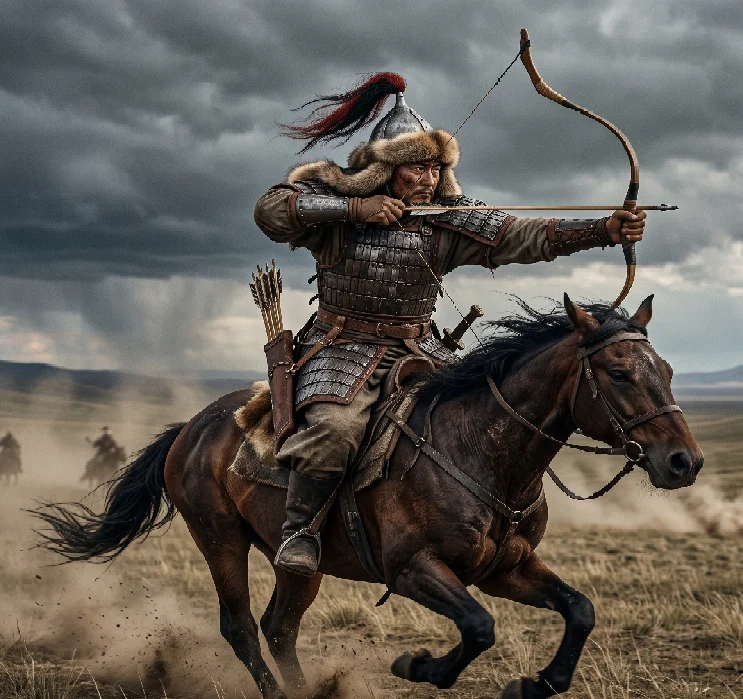
The primary offensive weapon of the Mongol Empire was the composite recurve bow:
-
Materials and Engineering: Laminated layers of animal horn, birch wood, sinew, and fish bladder glue, curing for up to two years.
-
Draw Weights: Typically ranging between 100 and 160 pounds, delivering heavy kinetic energy over distances up to three hundred yards.
-
The Thumb Ring: Carved from jade, horn, or bone, allowing a clean string release without pinching fingers during rapid fire.
-
Armor-Piercing Ammunition: Heavy square-shank bodkin points designed to punch through European chainmail and Chinese iron lamellar plates.
Horse archers unleashed volleys at full gallop, timing their release to the exact moment when all four hooves left the ground to eliminate body bounce.
Tactical deployment [Internal Link: Nomadic Equestrian Warfare Mechanics] relied on coordination rather than chaotic charges, turning the horse archer into a mobile firing platform.
Combined Arms, Siegecraft, and Subutai’s Operational Art
A persistent myth suggests that the Mongol Empire operated as an undisciplined barbarian horde relying exclusively on sheer numbers. In historical reality, Mongol expeditionary forces were almost always outnumbered by the large sedentary imperial hosts they confronted.
Victory was engineered through the operational brilliance of general Subutai, who directed campaigns across fronts separated by thousands of miles. Subutai synchronized separate tumens through the Örtöö, an empire-wide postal relay network featuring post stations (morin örtöö) every twenty-five to thirty miles.
The tactical doctrine of the Mongol Empire weaponized psychological deception:
-
The Feigned Retreat (Mangudai): A specialized vanguard attacked enemy positions, faked panic, and fled in apparent disarray over days or miles.
-
The Disorganized Chase: Overconfident hostile cavalry broke formation to pursue the retreat, stringing out their lines into vulnerable columns.
-
The Ambush and Envelopment: At a pre-surveyed location, the retreating vanguard wheeled around as concealed heavy cavalry struck the flanks, closing an iron perimeter.
At the Battle of the Kalka River (1223) and the Battle of Mohi (1241), this doctrine annihilated the elite chivalric forces of Kievan Rus and the Kingdom of Hungary.
When approaching fortified stone cities, the Mongol Empire proved equally lethal. Recognizing that field cavalry could not breach stone battlements, the khans recruited thousands of Chinese, Persian, and Arab engineers into permanent siege corps.
At the sieges of Samarkand, Nishapur, and Baghdad, engineers deployed counterweight trebuchets, traction catapults, and incendiary naphtha pots. If a fortress held out, engineers diverted river channels to drown defenders or constructed timber stockades around city perimeters to starve out populations systematically.
Total War and the Psychological Weapons of the Mongol Empire
The strategic framework of the Mongol Empire employed terror as a calculated, cost-effective force multiplier. Rather than squandering valuable veteran troops in protracted assaults against every fortified center, the khans used mass executions to force voluntary submissions.
Cities that resisted were subjected to absolute destruction:
-
Population censuses were taken, and inhabitants were systematically divided into skilled artisans, military conscripts, and those to be executed.
-
Captured laborers were forced into forward assault columns (hashar), serving as human shields against defensive missile fire.
-
Escaped survivors fled to adjacent towns, carrying graphic accounts of butchery that shattered the defensive will of downstream garrisons.
Conversely, cities that surrendered without drawing bowstrings received royal protection, tax exemptions, and religious freedom. By establishing a predictable policy—immediate annihilation for resistance, total security for compliance—the Mongol Empire saved immense manpower and money.
Whole provinces capitulated to small Mongol delegations without a skirmish, having calculated that resistance against the steppe war machine was suicidal.
The Administrative Blueprint of the Mongol Empire
The endurance of the Mongol Empire was cemented off the battlefield through progressive civil administration. The khans understood that while an empire could be conquered on horseback, it could not be governed from the saddle.
The primary administrative pillars included:
-
The Paiza Passports: Metal tablets stamped with imperial authority in gold, silver, or bronze, granting envoys and certified merchants safe passage, fresh horses, and lodging across Eurasia.
-
The Census and Fiscal Cadastres: Scribes systematically mapped regional agricultural yields, mines, and trade traffic to assess equitable taxation.
-
The Imperial Yassa: A unified legal code that superseded local tribal laws, severely punishing highway banditry, horse theft, and administrative corruption.
This administrative order birthed the Pax Mongolica, a century of commercial security across the Silk Road that connected Mediterranean markets directly with Beijing.
Trade security [Internal Link: Trans-Eurasian Medieval Trade Networks] flourished because the khans actively protected international merchant guilds (ortaq), lowering trade tariffs and paving the way for the cross-continental journeys of travelers like Marco Polo and Ibn Battuta.
Archaeological Evidence: The Physical Footprint of the Khans
The material remnants of the Mongol Empire are preserved within archaeological excavations stretching across Mongolia, Russia, China, and Iran. The imperial capital of Karakorum, situated in the Orkhon Valley, reveals an international hub far removed from the primitive yurt camps of popular imagination.
Excavations led by the Mongolian-German Karakorum Expedition uncovered extensive industrial and urban infrastructure:
-
The Palace of Wan’an: Massive stone column bases supporting an expansive banquet hall that once housed the legendary silver drinking fountain designed by Parisian goldsmith Guillaume Boucher.
-
Metallurgical Centers: Blast furnaces, casting pits, and iron slag deposits demonstrating large-scale domestic production of plowshares, arrow points, and cauldron hardware.
-
Multi-Confessional Quarters: Remains of Christian churches, Islamic mosques, Daoist shrines, and Buddhist temples standing side-by-side along paved municipal streets.
Battlefield archaeology confirms the forensic trauma documented in medieval chronicles. Mass graves unearthed at Ryazan in Russia and Muhi in Hungary show skeletal remains bearing catastrophic wounds inflicted by heavy composite bows:
-
Bodkin arrow points found embedded deep within spinal columns and pelvic bones.
-
Skulls sliced clean by curved Turko-Mongol sabers wielded by galloping heavy cavalry.
-
Extensive burning and charred soil layers corroborating the systemic torching of defensive palisades.
The archaeological record demonstrates that the Mongol Empire possessed an exceptional material infrastructure capable of arming and mounting hundreds of thousands of soldiers with industrial consistency.
Fragmentation and Geopolitical Legacy
The monolithic administrative core of the Mongol Empire fractured within sixty years of its founder’s death. Ideological disagreements over nomadic traditions versus sedentary governance, paired with bitter succession wars, tore the empire apart following the death of Möngke Khan in 1259.
The universal empire shattered into four independent successor realms:
-
The Yuan Dynasty (East Asia): Founded by Kublai Khan, integrating traditional Chinese imperial governance with steppe military oversight.
-
The Ilkhanate (Middle East): Governing Persia and Mesopotamia, which eventually converted to Islam and patronized Persian art and architecture.
-
The Chagatai Khaganate (Central Asia): Retaining the austere nomadic traditions of the steppe across the Silk Road trade hubs of Samarkand and Bukhara.
-
The Golden Horde (Eastern Europe): Dominating the Russian principalities for over two centuries, deeply shaping the political culture and fiscal centralization of the Grand Duchy of Moscow.
Despite this political fragmentation, the systemic impact of the Mongol Empire remade global history. By creating a unified commercial and diplomatic corridor across Eurasia, it accelerated the transmission of printing, the magnetic compass, and gunpowder technology from China to Western Europe.
This transcontinental connectivity came with a devastating epidemiological cost. The very trade routes protected by the khans functioned as the vector that carried Yersinia pestis—the Black Death—from Central Asia into the Mediterranean and Europe in 1347, killing over a third of the European population.
The Mongol Empire permanently redrew the cultural map of Eurasia. It catalyzed the rise of a centralized Russian state, integrated China under a unified imperial throne, and demonstrated that mobile equestrian warfare, when matched with industrial siegecraft and administrative tolerance, could build the largest contiguous empire the world has ever seen.
Frequently Asked Questions
How were the Mongols able to defeat armies that heavily outnumbered them?
The Mongols defeated larger armies through superior operational mobility, psychological warfare, and strict decimal command discipline. By utilizing the feigned retreat, mobile horse archery, and the imperial Örtöö messenger network, they isolated and encircled enemy detachments piecemeal before sedentary commanders could coordinate their forces.
What was the Pax Mongolica?
The Pax Mongolica was an era of relative peace and stability across Eurasia during the thirteenth and fourteenth centuries under Mongol rule. By enforcing the Yassa legal code and issuing paiza passports, the khans suppressed banditry, secured Silk Road trading posts, and fostered cross-continental trade between Europe and East Asia.
Why did the unified Mongol Empire eventually collapse?
The unified Mongol Empire collapsed due to succession disputes, vast geographical distances, and deep cultural assimilation. Following the death of Möngke Khan, the empire divided into four separate successor states that developed distinct religious, cultural, and political priorities, eventually losing administrative cohesion.