
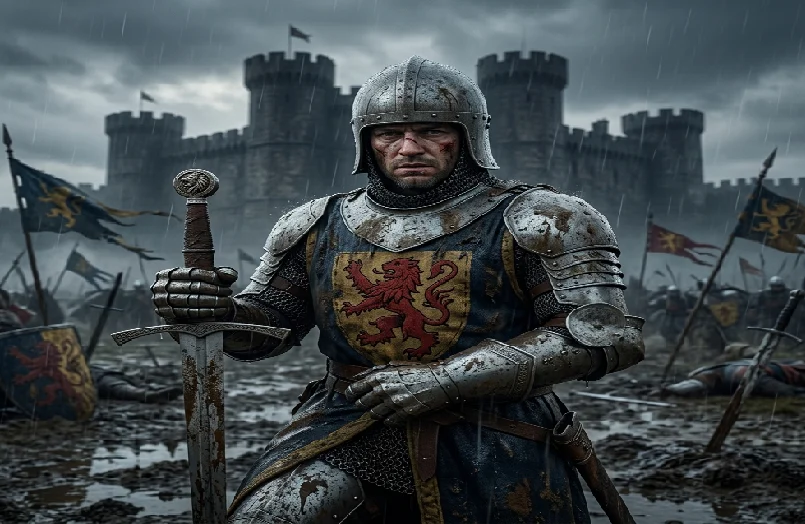
Medieval Kingdoms: Blood, Chivalry, and Sovereign Power
When the Carolingian Empire fractured in the ninth century, Western Europe dissolved into a patchwork of fortified feudal lordships. Centralized governance vanished, imperial roads crumbled into disrepair, and real authority belonged exclusively to whoever controlled stone battlements, destrier warhorses, and armored retainers. From this violent instability emerged the classical Medieval Kingdoms that shaped the foundations of Europe.
For nearly five centuries, the Medieval Kingdoms engaged in relentless domestic and international struggles. Monarchs clashed with overmighty dukes, wrestled with the papacy, and fought rival crowns across sodden plains. Through this continuous trial of arms, the decentralized networks of the Medieval Kingdoms transformed into the centralized dynastic monarchies of the Renaissance.
The Feudal Pyramid: The Architecture of Medieval Kingdoms
The administrative bedrock of the Medieval Kingdoms was feudal land tenure, a hierarchical system engineered to maintain heavy shock cavalry without a circulating cash economy. When monetized taxation systems collapsed along with Roman civil authority, monarchs substituted land for currency.
The hierarchy operated through reciprocal, highly structured feudal contracts:
-
The Sovereign Crown: The monarch held ultimate dominion over the realm by divine mandate, granting expansive territorial fiefdoms directly to tenants-in-chief, including dukes, counts, and bishops.
-
The Feudal Baronage: In exchange for territorial estates, noble vassals swore solemn oaths of homage and fealty, legally pledging to provide an allotment of mounted, fully equipped knights for a customary period, usually forty days annually.
-
The Agrarian Peasantry: Bound to manorial estates, unfree serfs generated the grain, wool, and livestock required to finance the exorbitant costs of warhorses, smithing, and masonry fortifications.
While this decentralized architecture provided immediate local defense against Viking and Magyar incursions, it created structural political vulnerability across the Medieval Kingdoms. Great territorial magnates—such as the Dukes of Normandy, Aquitaine, and Burgundy—frequently commanded greater revenues and larger field armies than their nominal royal sovereigns.
These imbalances led to chronic dynastic warfare, private feuds, and disputed successions. Kings spend decades curbing the privileges of rebellious barons, slowly reasserting royal justice through traveling judicial circuits and fiscal courts.
The Crucible of Warfare: Armor, Metallurgy, and Mounts
Warfare across the Medieval Kingdoms was defined by the martial supremacy of the mounted knight. The knight was not an amateur brawler, but an elite, lifelong combat specialist trained from boyhood in equestrian arts, horsemanship, and weapons handling.
The protective equipment of the knight evolved continuously to counter increasingly lethal battlefield weapons:
-
Hauberk: A knee-length coat composed of tens of thousands of manually punched and riveted iron rings, worn over a padded linen gambeson to absorb kinetic blunt trauma.
-
White Plate Harness: Developed in the fourteenth and fifteenth centuries by Milanese and German armorers, full suits of heat-treated, high-carbon steel plate deflected slashing strokes and distributed 45 to 55 pounds of weight evenly across the entire skeletal frame.
-
Great Helm and Bascinet: Conical and rounded steel helmets designed with angled deflection surfaces, fitted with movable visors and internal suspension liners.
-
Heater Shield: A compact, flat-topped triangular wooden shield reinforced with gesso and leather, bearing heraldic devices for friend-or-foe identification amid chaotic melees.
Equally critical were the warhorses (destriers and coursers), selectively bred stallions capable of galloping while carrying over three hundred pounds of rider and armor. Knights clamped heavy ash wood lances securely beneath their armpits using an iron breastplate rest (arrest), turning horse and rider into a single, high-velocity projectile.
The staggering economic cost of this gear reinforced the aristocratic social monopoly across the Medieval Kingdoms. A single complete war harness, paired with three mounts and squires, cost the equivalent of several years of an average agricultural village’s entire revenue.
Elite tactical developments [Internal Link: Classical Siege Craft Innovations] ensured that when open fields failed to produce decisions, armies turned toward protracted investment warfare against stone fortifications.
The Hundred Years’ War: Transforming the Medieval Kingdoms
No conflict tested the military and fiscal machinery of the Medieval Kingdoms more thoroughly than the Hundred Years’ War (1337–1453) between the English House of Plantagenet and the French House of Valois. Spanning more than a century of intermittent raiding and set-piece violence, this struggle shattered traditional chivalric assumptions.
At Crécy (1346) and Poitiers (1356), the heavily armored chivalry of France charged headlong into fortified defensive positions, only to be dismantled by massed volleys of arrows. The primary instrument of this tactical revolution was the yew warbow, wielded by disciplined yeoman archers:
-
Bow Specifications: Carved from seasoned heartwood and sapwood yew, pulling between 100 and 150 pounds of draw weight.
-
Type 16 Bodkin Points: Square-sectioned, case-hardened steel points engineered specifically to split riveted mail rings and punch through thin plate joints at ranges up to two hundred yards.
-
Rapid Discharge: A skilled archer loosed ten to twelve aimed shafts per minute, maintaining an unrelenting hail of iron that crippled advancing horses and disoriented knights.
The devastating impact of massed missile volleys was demonstrated once more at Agincourt in 1415. French knights, weighed down by heavy plate and funneling into a narrow defile of churned mud, became an immobilized, suffocating target for mobile English archers armed with lead mallets and daggers.
These catastrophic engagements demonstrated to the Medieval Kingdoms that noble chivalry alone could no longer secure victory against disciplined, combined-arms formations. Monarchs recognized that winning prolonged campaigns abroad required professional, contract-based standing armies rather than unreliable forty-day feudal levies.
Strategic mobility during this era [Internal Link: Early Modern Combined Arms Doctrines] forced commanders to balance mounted shock power with static missile defensive barriers.
Castles and Stone Engineering Across the Realm
The physical landscape of the Medieval Kingdoms was defined by the soaring silhouettes of stone fortresses. Castles were not merely defensive sanctuaries during wartime; they functioned as fortified administrative capitals, royal treasuries, and unyielding garrisons that projected territorial control across rural frontiers.
The architectural evolution of these bastions reflected the constant arms race between defensive engineers and offensive siegecraft:
-
Motte-and-Bailey: Early Norman timber keeps erected atop artificial earthen mounds, designed for rapid construction across newly conquered territories.
-
Concentric Stone Keeps: Advanced twelfth- and thirteenth-century fortresses featuring multiple rings of stone curtain walls, rounded flanking towers that eliminated defensive blind spots, and heavily fortified gatehouses (barbicans).
-
Machicolations and Hoardings: Projecting stone balconies and timber galleries with floor openings that allowed defenders to drop boulders, boiling water, and incendiary compounds directly onto sap teams at the base of the wall.
-
Deep Wet Moats: Artificial water barriers engineered to prevent sappers from tunneling beneath the foundations to collapse stone towers.
Reducing an advanced concentric fortress required months of grueling engineering labor. Besieging armies deployed massive counterweight trebuchets capable of hurling three-hundred-pound limestone boulders against curtain walls from outside crossbow range.
Within the Medieval Kingdoms, siege warfare was far more common than pitched field battles. Starvation, dysentery, poisoned water supplies, and subterranean mining regularly claimed thousands of lives long before walls were breached or assault ladders raised.
Chivalric Myths and the Brutal Realities of Medieval Kingdoms
Modern romantic literature frequently depicts chivalry (chevalerie) as an egalitarian moral code championing universal justice, courtesy, and the protection of the weak. The administrative and chronicle records of the Medieval Kingdoms reveal a completely different historical reality.
Chivalry was an exclusive, aristocratic guild contract operating strictly between noble elites:
-
Captured knights were treated with courteous hospitality and ransomed for astronomical silver sums that enriched victorious commanders.
-
Common foot soldiers, crossbowmen, and peasants enjoyed zero chivalric protections; they were routinely slaughtered in cold blood following the fall of towns or routs in the field.
-
The chevauchée—a deliberate military policy of scorched-earth raiding—was used systematically by English forces to burn peasant villages, slaughter livestock, and starve non-combatants to undermine enemy royal revenues.
The primary role of chivalric literature was to regulate the endemic violence of armed aristocrats, channeling destructive noble aggression toward external crusades or judicial tournaments rather than uncontrolled private wars at home.
Logistical Realities: Moving Armies Across Mud and Stone
Operating field armies of ten to twenty thousand men across medieval Europe pushed infrastructure to its absolute breaking point. Roads had not been systematically maintained since the fall of the Western Roman Empire, turning trade highways into treacherous mud troughs during the autumn rains.
The logistical supply chain of the Medieval Kingdoms relied on extensive requisitioning and local forage:
-
The Train: Thousands of two-wheeled carts (carreta) and pack horses hauled heavy pavilions, blacksmith forges, fletching supplies, and iron armor sets behind marching columns.
-
Flour and Biscuit: Armies required mobile grain mills and field bakeries; soldiers survived on hard biscuit, salt pork, cheese, and beer, which provided clean calories where surface water was contaminated with bacterial disease.
-
Billeting and Coercion: Armies quartered themselves forcibly in local monasteries, villages, and merchant towns, often consuming an entire region’s winter food stores within a week.
When logistics failed, armies dissolved without meeting the enemy. Typhoid, dysentery (“the bloody flux”), and malaria regularly killed more soldiers than enemy lances and arrows combined.
To maintain continuity, kings began relying on indentures—formal written contracts signed between the crown and military captains specifying soldier pay rates, equipment standards, and the distribution of battlefield ransom profits.
The Gunpowder Revolution and the End of Feudal Independence
The terminal chapter in the history of the Medieval Kingdoms was written in sulfur, charcoal, and saltpeter. By the early fifteenth century, cast-bronze bombards and smoothbore field guns were shifting from erratic siege novelties into dominant tactical weapons.
The French royal army under the direction of the Bureau brothers modernized artillery into a devastating offensive instrument:
-
Cannons were mounted on wheeled carriages (limbers), allowing artillery batteries to accompany infantry maneuvers across the field.
-
Cast-iron round shot replaced brittle stone cannonballs, transferring enormous kinetic energy capable of shattering vertical stone keeps in days rather than months.
-
At the Battle of Castillon (1453), massed French field artillery tore through charging English formations, marking the definitive military conclusion of the Hundred Years’ War.
Gunpowder technology permanently altered the balance of political power across the Medieval Kingdoms. Medieval castles that had resisted feudal sieges for generations were easily battered into rubble by heavy siege batteries.
Because only wealthy, centralized monarchs possessed the tax revenues required to fund bronze foundries, gunpowder mills, and specialized artillery train drivers, independent feudal lords could no longer maintain military parity with the crown. The ability of rebellious dukes to challenge royal authority evaporated beneath the thunder of royal artillery.
Forensic Archaeology: The Trauma of Medieval Combat
Archaeological excavations across European battlefields have provided unvarnished, empirical evidence of the violence that sustained the Medieval Kingdoms. Forensic analyses of mass graves dismantle artistic romanticism, revealing the savage nature of medieval hand-to-hand combat.
Excavations of the mass burial pits at the Battle of Towton (1461), fought during the Wars of the Roses, revealed startling trauma profiles:
-
Cranial Fractures: Skeletons exhibited massive blunt-force crushing wounds to the facial bones and cranium, inflicted by heavy poleaxes, maces, and war hammers designed specifically to defeat steel helmets.
-
Blade Trauma: Deep parallel incision wounds to the occipital bone at the rear of skulls showed that fleeing soldiers were systematically executed from behind by mounted pursuers.
-
Arrowhead Impact: Forensic osteologists identified fractured limb bones and vertebrae containing iron bodkin tips that had punched clean through mail and underlying garments.
Similarly, excavations at the 1361 Battle of Visby in Sweden uncovered hundreds of fully armored skeletons preserved in mass pits. The victims displayed horrific lower-limb trauma; knights aimed sweeping blows with arming swords directly at the shins and knees beneath shields before delivering finishing thrusts to the face.
These physical remnants demonstrate the brutal efficiency required to survive in the frontline ranks of the Medieval Kingdoms. Combat was a terrifying, exhausting test of biomechanical endurance where panic almost always guaranteed immediate death.
Geopolitical Legacy: The Birth of the Modern Nation-State
The five-century reign of the Medieval Kingdoms forged the institutional foundations of modern civilization. What began as an anarchic patchwork of local lordships slowly crystallized into defined territorial realms with standardized administrative institutions.
The collapse of decentralized feudalism yielded profound systemic legacies:
-
Fiscal Centralization: To finance permanent, professional standing armies, monarchs created sophisticated national taxation systems, exchequers, and central banks.
-
Legal Standardization: Royal courts superseded regional manorial jurisdictions, codifying common law and Roman-derived legal statutes that protected trade and property rights.
-
Representative Assemblies: Parliaments, Estates-General, and Cortes emerged as essential forums where kings negotiated taxation with merchant burgesses and landed elites, planting the seeds of constitutional governance.
-
National Identity: Decades of prolonged dynastic warfare dissolved local loyalties; people began identifying themselves not merely as vassals of a local baron, but as subjects of the Kingdom of England, France, or Scotland.
When the medieval era closed with the fall of Constantinople and the end of the Hundred Years’ War in 1453, Western Europe had crossed an irreversible threshold. The decentralized Medieval Kingdoms had built the roads, codified the legal structures, and refined the administrative machinery that birthed the modern sovereign state.
Frequently Asked Questions
What was the main purpose of the feudal system in Medieval Kingdoms?
The feudal system was created to support heavy cavalry and regional defense in the absence of a circulating cash currency and centralized administrative taxation. Monarchs granted land estates (fiefs) to noble vassals in exchange for military service, sworn fealty, and knights to defend the realm.
Did medieval knights actually wear clumsy, heavy armor?
No, that is a persistent historical myth. A full suit of fifteenth-century field plate armor weighed between 45 and 55 pounds, distributed evenly over the muscular-skeletal frame. A trained knight possessed full range of motion and could sprint, vault onto a horse, and rise quickly from the ground without assistance.
How did gunpowder artillery end the era of Medieval Kingdoms?
Gunpowder artillery ended feudal military independence because smoothbore bombards could batter down medieval vertical stone castles within days. Because only centralized royal monarchies could afford the immense industrial costs of foundries, gunpowder, and permanent standing armies, independent feudal dukes could no longer resist royal authority.