
Macedonian Empire: The Tactical Engine of Conquest
In 336 BCE, southern Greek city-states viewed the northern kingdom of Macedon as little more than an unpolished frontier realm. Yet within twelve years, this kingdom systematically dismantled the Achaemenid Persian Empire and established the formidable Macedonian Empire. Its territory stretched across two million square miles from the Danube River to the Indus Valley.
The rapid ascendance of the Macedonian Empire was not an accident of fate. It was the product of a military revolution that synthesized engineering, combined-arms coordination, and rigorous logistics into an unstoppable operational system. That integrated doctrine shattered the traditional paradigm of ancient Mediterranean warfare and reshaped the geopolitical boundaries of three continents.
The Gathering Storm: Philip II and the Genesis of Hegemony
The foundation of the Macedonian Empire was laid in the crucible of disaster. When King Philip II ascended the throne in 359 BCE, Macedonia faced catastrophic Illyrian invasions, Paeonian raids, and disputed royal successions. Previous monarchs had relied on unruly aristocratic cavalry while fielding peasant infantry armed with crude javelins and light shields.
Philip recognized that his agricultural conscripts could not match the lifelong physical training of Spartan or Theban hoplites. He transformed the royal military apparatus into a permanent, salaried standing force. Drill became continuous, discipline was enforced through physical punishment, and promotion was awarded strictly on merit rather than noble lineage.
Philip expanded the kingdom’s borders by capturing the gold and silver mines of Mount Pangeon. Yielding over one thousand talents of precious metal annually, this steady revenue funded arms workshops, siege artillery development, and foreign diplomacy.
By 338 BCE, at the Battle of Chaeronea, the emergent power of the Macedonian Empire smashed the allied forces of Athens and Thebes. The destruction of the elite Theban Sacred Band proved that a new era of warfare had arrived. Philip established the League of Corinth, uniting Greece under Macedonian hegemony to prepare for a retaliatory invasion of the Persian realm.
Tactical Architecture: The Sarissa Revolution
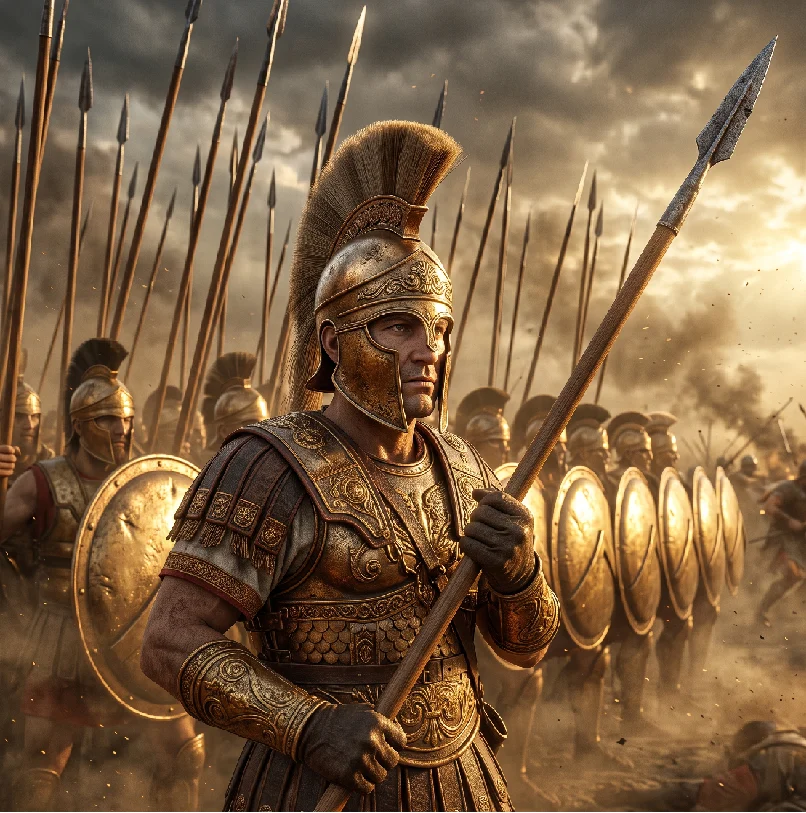
The tactical centerpiece of the Macedonian Empire was the reorganized phalanx, equipped with a revolutionary weapons system that rendered traditional bronze-armored shield walls obsolete.
Traditional Greek hoplites carried eight-foot spears wielded with a heavy concave shield (aspis). The Macedonian phalangite, termed a pezhetairos (foot companion), operated an entirely different kit:
-
The Sarissa: A two-handed pike measuring between 18 and 21 feet (5.5 to 6.5 meters), constructed from dense cornel wood, featuring a heavy leaf-shaped iron head and a bronze counterbalance spike (sauroter) for planting in the earth.
-
The Pelte Shield: A lightweight circular shield measuring roughly two feet in diameter, slung across the left shoulder by a leather strap to free both hands for manipulating the massive pike.
-
The Linothorax: A body cuirass constructed of layered linen glued with animal paste, providing flexible protection against missile fragments without the dead weight of solid bronze breastplates.
-
The Phrygian Helmet: A beaten-bronze helmet shaped to deflect downward strikes while offering an open face for unobstructed vision and auditory reception of trumpet calls.
Deployed in dense blocks of 256 men known as a syntagma, the formation stood sixteen ranks deep. The first five ranks projected their sarissas horizontally beyond the front line, creating a bristle of iron points that impaled charging infantry and cavalry long before enemy blades could reach Macedonian flesh.
The rear eleven ranks held their pikes angled upward at forty-five degrees, forming a dense canopy that deflected descending arrows and javelins. This moving fortress formed the operational backbone of the Macedonian Empire.
Operational mobility [Internal Link: Classical Logistics and Imperial Expansion] relied on disciplined marching cadences, enabling these unwieldy pike formations to advance across rough terrain without fracturing cohesion.
The Hammer and the Anvil: Combined Arms Doctrine
A sarissa phalanx on its own was rigid, vulnerable on its flanks, and easily disordered by broken ground. The military supremacy of the Macedonian Empire was achieved through an integrated combined-arms ecosystem known as the “Hammer and Anvil” doctrine.
The doctrine operated as a synchronized machine with distinct tactical roles:
-
The Anvil: The deep ranks of the heavy phalanx advanced relentlessly to engage and lock down the center of the hostile battle line, absorbing the enemy’s attention and physical energy.
-
The Flank Hinge: Elite hypaspists—lightly equipped veteran foot guards—and Cretan archers screened the gap between the heavy pikes and the cavalry, preventing agile opponents from rolling up the exposed flank of the phalanx.
-
The Hammer: The Companion Cavalry (Hetairoi), composed of Macedonian aristocrats armed with the nine-foot xyston cornel-wood lance, deployed in flexible wedge formations.
Alexander the Great personally led this mounted strike force. Once the enemy center committed its reserves against the steady pressure of the phalanx, the cavalry identified or created a structural seam in the hostile line.
Riding at a gallop, the wedge driven by the Companion Cavalry smashed through that gap, pivoting to hammer the pinned enemy line in the flank and rear. This integrated tactical model enabled the Macedonian Empire to dismantle vast numerical majorities across every major theater of war.
Logistical Realities and Strategic Speed
The lightning marches of the Macedonian Empire were made possible by discarding traditional logistical practices. Ancient armies typically moved alongside thousands of slow, ox-drawn baggage wagons filled with heavy tents, cooking cauldrons, and camp followers.
Alexander adopted the logistical doctrine established by his father:
-
Ox carts were banned; pack horses and mules carried only non-negotiable items such as spare iron, medical gear, and heavy bolts for torsion catapults.
-
Soldiers carried their own weapons, bedding, and up to ten days of grain rations in canvas shoulder satchels.
-
The marching column was accompanied by royal surveyors (bematists), who measured marching distances, mapped water sources, and recorded daily mileage with astonishing accuracy.
-
The army relied on coastal fleets to transport bulk grain, keeping the ground force operating within striking distance of the Mediterranean and Persian Gulf shores.
By stripping the army of non-essential baggage, the forces of the Macedonian Empire covered twenty-five to thirty miles a day over mountain passes and deserts. Hostile commanders regularly found their positions turned before their scouts could report the Macedonian departure.
Engineering corps solved terrain obstacles with equal speed. During the Siege of Tyre (332 BCE), Macedonian engineers constructed a half-mile causeway from mainland Phoenicia to the island fortress, mounting torsion siege engines on transport galleys to batter down hundred-foot stone walls.
The Climax at Gaugamela: Anatomy of an Imperial Breakthrough
The decisive confrontation that secured the absolute hegemony of the Macedonian Empire took place on the dusty plains of Gaugamela in October 331 BCE. Persian King Darius III had assembled a massive coalition force of cavalry, scythed chariots, and Indian war elephants on ground specially leveled to maximize mobility.
The battlefield geometry tested the limits of Macedonian operational command:
-
Alexander deployed his forces in an echeloned formation with angled flank guards, creating a flexible defensive rectangle capable of resisting complete encirclement.
-
As the battle opened, Alexander led his cavalry diagonally to the right across the field, drawing the elite Persian left-wing cavalry away from their main body.
-
When Persian scythed chariots charged the center, Macedonian light infantry stepped aside, opening lanes through the lines where drivers and horses were picked off by archers.
-
Darius committed his central cavalry reserve to fill the developing void on his left, creating a sudden, fatal tear in the Persian infantry line.
Alexander executed an instant tactical pivot. Forming the Companion Cavalry and four battalions of hypaspists into a colossal wedge, he charged straight into the opening toward Darius’s royal chariot.
The sudden shock of the charge shattered the Persian royal guard. Darius turned his chariot and fled the field, triggering a total collapse of imperial morale. The victory at Gaugamela handed the heartland of the Macedonian Empire to the young conqueror.
Imperial Fusion: Governing the Multi-Ethnic World
The expansion of the Macedonian Empire forced a profound evolution in administrative policy. Alexander recognized that an empire encompassing dozens of languages, faiths, and customs could not be governed through simple military occupation.
Rather than imposing a monolithic Macedonian culture, he initiated a policy of imperial fusion:
-
He retained the Achaemenid satrapy system, confirming loyal Persian and Bactrian nobles in regional governorships.
-
He adopted elements of Persian court protocol (proskynesis), signaling to eastern subjects that their traditions were respected by the new sovereign.
-
At the Susa weddings in 324 BCE, Alexander arranged the marriage of eighty Macedonian senior officers to high-ranking Persian and Median noblewomen, solidifying an integrated ruling aristocracy.
-
Tens of thousands of young Persian youths—the Epigoni—were trained in Greek letters and equipped with the sarissa to serve alongside European veterans.
This administrative pragmatism transformed the Macedonian Empire from a conqueror’s domain into a global commonwealth. Trade surged along newly mapped caravan routes, linking the markets of the Aegean directly with those of Central Asia.
Strategic integration [Internal Link: Classical Greek Defensive Strategy] laid the groundwork for an enduring cultural synthesis that outlasted the Macedonian royal lineage.
Archaeological Evidence and Physical Record
Modern archaeological investigations have confirmed the sophistication and material reality of the Macedonian Empire. Excavations at Aigai (modern Vergina) in northern Greece revealed the unlooted royal tombs of Philip II and his family.
Among the spectacular artifacts recovered from these subterranean crypts:
-
Iron and gold-plated cuirasses demonstrating an unmatched level of advanced fourth-century BCE metallurgy.
-
The gilded royal larnax containing the cremated bones of the king, adorned with the sixteen-pointed Macedonian sun symbol.
-
Intricately forged iron sarissa heads and bronze butt-spikes matching the exact weapon dimensions recorded in classical texts.
-
Painted architectural friezes showing realistic depictions of Macedonian hunting and combat gear.
Across the Near East and Central Asia, urban excavations continue to unearth the physical footprint of the empire. At Alexandria on the Oxus (modern Ai-Khanoum in Afghanistan), archaeologists uncovered a complete Hellenistic city complete with a gymnasium, theater, Corinthian capitals, and Greek inscriptions carved on stone plinths.
These physical relics demonstrate that the Macedonian Empire was not a fleeting military expedition, but an expansive civic and architectural movement that planted the urban institutions of Europe in the heart of Asia.
Geopolitical Aftermath: The Wars of the Diadochi and the Hellenistic Dawn
The sudden death of Alexander in Babylon in 323 BCE, at the age of thirty-two, plunged the Macedonian Empire into chaos. Leaving behind no adult heir, his dying words allegedly passed the supreme command “to the strongest” (tôi kratistôi).
His senior generals—the Diadochi—divided the realm into warring factions during four decades of civil conflict:
-
The Ptolemaic Kingdom: Centered on Egypt, this dynasty ruled from the newly founded metropolis of Alexandria, fostering the Great Library and dominating Mediterranean trade.
-
The Seleucid Empire: Spanning the vast Asian territories from Syria to Bactria, this realm maintained the administrative machinery of the ancient Near East under a Greco-Macedonian military elite.
-
The Antigonid Dynasty: Holding Macedonia and asserting periodic control over the fractious city-states of Greece.
Despite this political fragmentation, the cultural legacy of the Macedonian Empire proved permanent. The conquests launched the Hellenistic period, diffusing the Greek language (Koine), commercial coinage, and artistic traditions across the known world.
In ancient Gandhara (modern Pakistan and Afghanistan), the collision of traditions birthed Greco-Buddhist art, where statues of the Buddha were sculpted with Classical Greek drapery and facial aesthetics. Centuries later, the legal, administrative, and urban structures established under the Macedonian Empire provided the foundational blueprint that enabled the expansion of the Roman Empire across the Mediterranean basin.
Frequently Asked Questions
What was the Sarissa and why was it so effective?
The sarissa was a heavy two-handed pike measuring between 18 and 21 feet long, crafted from flexible cornel wood and fitted with an iron head and bronze counterweight. It was effective because its extreme reach allowed the first five ranks of a phalanx to project their points forward, skewering charging infantry and cavalry long before enemy weapons could strike the front line.
How did the Hammer and Anvil tactic work in practice?
The tactic combined fixed defensive mass with high-mobility shock cavalry. The dense Macedonian sarissa phalanx acted as the “anvil,” marching forward to pin the enemy’s main battle line. The Companion Cavalry, led by Alexander, functioned as the “hammer,” galloping around the engaged forces to strike the exposed enemy flanks or rear.
Why did the Macedonian Empire fracture so quickly after Alexander’s death?
The Macedonian Empire fractured because Alexander died suddenly without naming a clear successor or establishing institutional mechanisms for imperial continuity. His leading generals, known as the Diadochi, possessed large veteran armies and territorial commands, leading them to carve the empire into rival personal dynasties through forty years of civil war.