
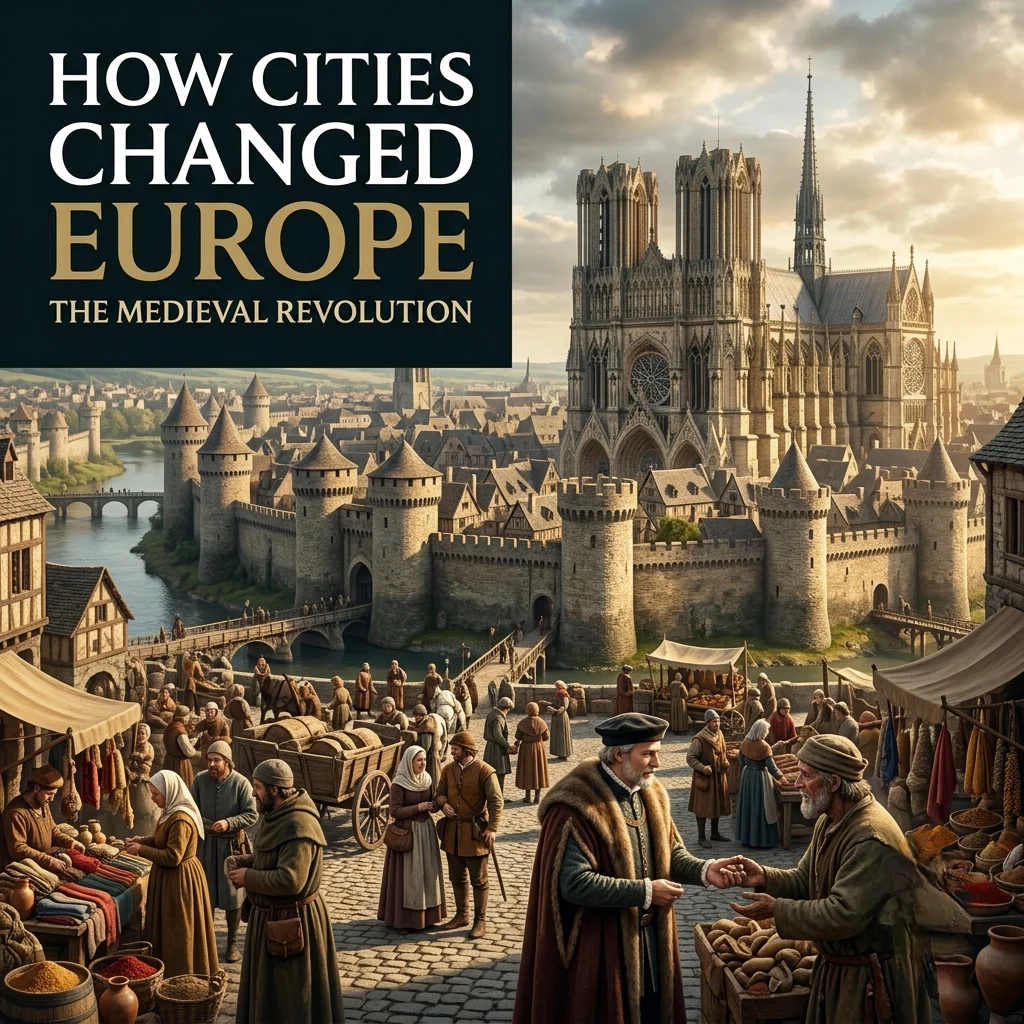
Medieval Cities: The Urban Revolution That Forged Europe
Behind high stone ramparts and toll gates, Medieval Cities quietly disassembled the feudal order of Europe. Between the eleventh and fourteenth centuries, these fortified settlements transformed from isolated agrarian strongholds into thriving engines of commerce, craft specialization, and legal autonomy. While kings clashed on open fields, the merchants and burghers of Medieval Cities engineered an economic and administrative revolution that redefined the continent.
The rise of Medieval Cities was not an overnight upheaval. It was an incremental accumulation of market privileges, guild statutes, and maritime trade routes. By establishing self-governing councils and monetized economies, Medieval Cities broke the agrarian monopoly of the landed nobility, laying the institutional foundations of the modern world.
Europe Before Urban Rebirth: Fragmented Manors
Following the fragmentation of the Western Roman Empire in the fifth century, the urban network of Western Europe suffered catastrophic decay. Ancient Roman municipal centers lost their tax bases, monumental aqueducts fell into disrepair, and populations retreated into the agrarian countryside.
For centuries, survival centered around the self-sufficient feudal manor:
-
Manorial estates operated on subsistence agriculture with minimal long-distance trade.
-
Wealth remained tied to landed estates, which supported armored shock knights and local barons.
-
Peasant serfs were legally bound to the soil, obligated to surrender labor and grain in exchange for protection from marauding Norse or Magyar bands.
-
Barter systems dominated daily exchanges, as circulating gold and silver coinage grew increasingly scarce outside monastic and royal treasuries.
Yet classical urban geography never vanished completely. Residual settlements persisted around episcopal cathedral seats, while new nuclei formed along navigable rivers, Roman road intersections, and the protective walls of ducal castles. These fortified outposts, known in Germanic dialects as burgs, provided the physical seeds from which Medieval Cities eventually sprouted.
Catalysts of Growth: Agriculture, Demographics, and Waterways
The demographic expansion that filled Medieval Cities began in the soil. Starting around the year 1000, Europe experienced the Medieval Warm Period, bringing longer growing seasons and milder winters that stabilized cereal harvests across the northwest.
Agrarian engineering accelerated this productivity:
-
The Heavy Wheeled Moldboard Plow (Carruca): Fitted with an iron coulter and share, this implement turned the dense, clay-rich soils of northern Europe that had resisted lighter Mediterranean scratch plows.
-
The Three-Field Crop Rotation: Alternating autumn wheat, spring legumes, and fallow pasture increased arable land usage from fifty to sixty-six percent while fixing nitrogen in depleted soil.
-
The Horse Collar and Iron Horseshoes: Shifting pulling strain from the windpipe to the skeletal shoulders allowed horses to plow three times faster than traditional ox teams.
These agricultural surpluses broke the subsistence ceiling. Rural manors generated excess grain, wool, and dairy products that required central markets. Peasants who were no longer needed for field labor migrated toward expanding settlements, transforming humble trading villages into dynamic Medieval Cities.
Navigable waterways formed the natural circulatory system of this urban revival. Because overland cartage was slow and plagued by mud, towns situated on the Rhine, Danube, Seine, and Thames functioned as inland ports. Heavy bulk goods—grain, timber, millstones, and barrels of wine—moved along river corridors directly into the quays of expanding Medieval Cities.
The Market Economy: Specialization Over Subsistence
Inside the marketplace of Medieval Cities, the economic structure of Europe broke free from localized feudal barter. The open market square (Marktplatz) operated as an exchange engine where agricultural goods were converted into silver coin.
Market days brought rural farmers and urban craftsmen into mutual dependency:
-
Rural producers exchanged raw fleeces, hides, and grain for manufactured iron horseshoes, linen garments, and ceramic cookware.
-
Urban money changers sat behind wooden benches (banca, the root of modern “bank”), testing silver coinage alloys, converting regional currencies, and charging standard exchange fees.
-
Municipal weigh stations ensured fair transactions using certified civic balances, establishing public confidence in local commercial weights.
This monetization incentivized labor specialization across Medieval Cities. A craftsman no longer had to plow fields, weave his own wool, and butcher his own livestock. He could dedicate sixteen hours a day to mastering a single specialized craft: blacksmithing, tanning, armoring, shoemaking, or glassblowing.
This economic division of labor stimulated regional production corridors. Flanders became the textile workshop of northern Europe, importing raw English wool and refining it through urban dye-works into fine broadcloth traded across the Mediterranean.
Market mechanics and municipal coordination [Internal Link: Trans-Eurasian Medieval Trade Networks] demonstrated that regional prosperity depended on secure roads, uniform weights, and predictable contract enforcement.
Guilds: The Craft Guilds of Medieval Cities
Economic life within Medieval Cities was rigorously organized by trade guilds (confraternities). Far from operating as modern free-market enterprises, these associations functioned as legally sanctioned monopolies designed to control output, maintain quality standards, and eliminate unregulated competition.
A craftsman’s progression through the guild system followed a strict institutional pipeline:
-
The Apprentice: A boy contracted by his parents to a master craftsman for three to seven years, receiving food, clothing, and trade instruction without wages.
-
The Journeyman: Having completed his training, the craftsman earned day wages (journée), traveling between different workshops to refine his skills and save capital.
-
The Master: To open an independent workshop, the journeyman had to present a “masterpiece” to guild elders, proving technical mastery while paying substantial entry fees.
Guild regulations governed every aspect of workshop production:
-
Work was strictly prohibited after sunset, as flickering tallow candles caused fires and degraded manufacturing quality.
-
Wardens conducted unannounced inspections of workshops, burning substandard cloth or confiscating adulterated bread loaves in the public square.
-
Fixed pricing prevented price gouging and undercutting, ensuring every certified master maintained a respectable livelihood.
The craft guilds of Medieval Cities also functioned as vital mutual-aid societies. Guild treasuries paid for the burials of impoverished members, provided pensions to widows, and funded dedicated altars inside local parish churches.
Fortifications and the Legal Wall: Urban Freedom
The most prominent physical feature of Medieval Cities was the stone defensive wall. Ranging from twenty to forty feet in height, these stone barriers featured projecting flanking towers, crenellated parapets, and fortified gatehouses (barbicans).
Yet stone walls were as much a legal boundary as a military shield:
-
Passing through the city gate meant stepping out of feudal common law and entering urban statutory jurisdiction.
-
Municipal gates were guarded by civic watches that checked visitors, collected customs duties, and locked the portcullis at sunset.
-
The German legal maxim “Stadtluft macht frei” (“City air makes you free”) became customary law across Central Europe; if a runaway serf resided within Medieval Cities for a year and a day without being claimed by his lord, he became legally free.
This legal autonomy was codified through royal and ducal charters. Town councils purchased charters of franchise from monarchs who were eager for immediate cash loans to wage foreign campaigns.
These charters granted Medieval Cities the right to operate independent courts, elect their own magistrates (burgomasters or mayors), form citizen militias, and levy municipal excise taxes. The burghers of Medieval Cities became a self-conscious political class—the bourgeoisie—who owed their privileges to written municipal statutes rather than aristocratic birth.
The physical engineering of curtain walls and gate defenses [Internal Link: Medieval Defensive Fortifications] proved that municipal independence required an unyielding physical bastion capable of repelling hostile feudal levies.
Civic Defense and the Militia in Medieval Cities
The autonomy of Medieval Cities was backed by real military force. Independent burghers could not rely on royal armies or noble knights for defense; they defended their own ramparts.
Every guild was assigned an operational combat station along the curtain wall:
-
The blacksmiths’ guild manned arrow-slits beside the main gate, armed with heavy poleaxes and iron maces.
-
The shoemakers and tailors manned intermediate towers, equipped with powerful spanning crossbows and pavise shields.
-
Wealthy merchant patricians formed small detachments of armored cavalry, providing a mobile reserve to counter breaches.
At the Battle of the Golden Spurs (1302) outside Kortrijk, urban militias of Flemish weavers, butchers, and cobblers stood shoulder-to-shoulder with steel-tipped pikes (goedendag). The militia routed an elite host of French noble knights, demonstrating that organized infantry from Medieval Cities could dismantle aristocratic shock cavalry on the battlefield.
The Great Trade Corridors: Hanseatic League and Italian Communes
As commercial profits expanded, Medieval Cities formed international economic cartels that transcended territorial kingdoms. Two maritime networks dominated European commerce at opposing ends of the continent.
In the north, the Hanseatic League (Hansa) unified over one hundred German and Baltic trading towns, including Lübeck, Hamburg, Danzig, and Cologne:
-
The League maintained permanent foreign trading depots (Kontore) in London, Bruges, Bergen, and Novgorod.
-
Sturdy, deep-bellied cargo ships known as cogs hauled vast bulk shipments of salted Baltic herring, Russian furs, Prussian timber, and Swedish copper.
-
The Hansa maintained its own fleet of warships, enforcing trade embargoes and crushing Scandinavian kings who attempted to levy arbitrary transit tolls across the Sound.
In the south, northern Italian city-states—primarily Venice, Genoa, Pisa, and Florence—dominated Mediterranean trade:
-
Venetian and Genoese galley convoys sailed to Constantinople, Alexandria, and the Levant, exchanging European silver, wool, and weapons for Asian silks, spices, and perfumes.
-
Florence developed the gold florin, an unadulterated coin containing 3.5 grams of pure gold that became the standard international currency of Europe.
-
Italian merchants invented modern mercantile tools: double-entry bookkeeping, maritime cargo insurance, and negotiable bills of exchange (lettere di cambio).
These commercial networks turned Medieval Cities into sovereign maritime republics that dictated international diplomacy, financed royal dynasties, and transformed merchant families like the Medici into rulers of states.
The Intellectual Awakening: Cathedrals and the Rise of Universities
The concentration of wealth inside Medieval Cities sparked an intellectual and architectural revolution. In the twelfth century, the construction of monumental Gothic cathedrals became the defining civic project across northern Europe.
Master masons pushed engineering boundaries with pointed arches, ribbed vaults, and flying buttresses:
-
Flying buttresses transferred the immense outward thrust of stone ceilings to exterior piers, allowing walls to be opened with vast expanses of stained glass.
-
Cathedrals like Chartres, Notre-Dame de Paris, and Cologne required generations of sustained civic funding, employing hundreds of stonecutters, carpenters, and glaziers.
-
These soaring stone monoliths proclaimed the civic pride, economic wealth, and religious devotion of Medieval Cities.
Simultaneously, education migrated out of isolated rural monasteries into urban university centers:
-
The University of Bologna (1088) emerged as the European center for the study of Roman civil law and canon law.
-
The University of Paris (c. 1150) became the capital of Christian scholastic theology and Aristotelian philosophy under scholars like Thomas Aquinas.
-
Oxford and Cambridge developed institutional centers for natural philosophy and mathematical science in England.
These urban universities were self-governing guilds of scholars (universitas). Students and masters traveled freely across borders, creating an international Latin-speaking intellectual elite that staffed royal chanceries, legal courts, and municipal administrations across Medieval Cities.
Crisis and Metamorphosis: The Black Death and Its Aftermath
The urban golden age was shattered in the autumn of 1347. Carried along maritime trade routes from the Black Sea by merchant galleys, the bacterium Yersinia pestis—the Black Death—swept into the ports of Sicily, Genoa, and Venice.
Densely packed and lacking sanitary sewers, Medieval Cities became ideal transmission zones:
-
Between thirty and sixty percent of urban populations died within weeks of infection.
-
Narrow timber houses, polluted public wells, and open drainage gutters accelerated the spread of pneumonic and bubonic plague.
-
Civic governance collapsed temporarily; magistrates fled, courts closed, and corpses were stacked in mass trenches outside the walls.
Yet the demographic catastrophe triggered profound structural transformations across Medieval Cities:
-
The acute labor shortage doubled and tripled wages for surviving artisans and day laborers.
-
Feudal serfdom disintegrated across Western Europe as peasants abandoned rural estates to demand paid wage contracts in towns.
-
Wealth became concentrated through inheritance, fueling a surge in luxury consumption, art patronage, and architectural renovations.
Rather than destroying urban society, the trauma of the plague accelerated modernization. Medieval Cities instituted municipal boards of health, quarantine protocols, and clean water management, emerging from the fourteenth-century crisis as more resilient civic institutions.
Archaeological Evidence: Unearthing the Medieval Street
Modern urban archaeology provides an empirical, unvarnished look at everyday life within Medieval Cities. Excavations beneath contemporary European cities—such as London, York, Paris, and Lübeck—dismantle artistic romanticism, exposing the material realities of urban life.
Excavated physical remains provide rich technical data:
-
Waterfront Revetments: Timber quays and brushwood jetties recovered from the Thames and the Trave rivers show how towns gradually reclaimed land from watercourses to expand dock space.
-
Leather Artifacts: Preserved waterlogged leather turnshoes, scabbards, and belts illustrate changing fashion trends and master leather-crafting techniques.
-
Faunal Deposits: Massive bone pits excavated near guild quarters reveal the urban diet: juvenile cattle, sheep, swine, and marine fish, supplemented by seasonal fruits and cereal grains.
-
Skeletal Stress Profiles: Forensic analysis of parish cemeteries reveals chronic occupational stress: spinal osteoarthritis in stonemasons, heavy metal poisoning in bronze casters, and healed parry fractures in city watchmen.
These physical relics confirm that Medieval Cities were dynamic industrial hives. Scribes sat at desks, tanners worked hide vats, and blacksmiths swung hammers over anvils, producing a material culture that gradually tied regional trade networks into an integrated continental economy.
The Enduring Legacy of Europe’s Urban Centers
By the fifteenth century, the transformative work of Medieval Cities was complete. They had broken the rigid social hierarchy of feudalism, establishing a tripartite society composed of nobles, clerics, and burghers.
The enduring achievements of this urban revolution shaped the modern world:
-
Representative Governance: Town councils, municipal charters, and burgher delegations to national parliaments laid the institutional groundwork for modern constitutional systems.
-
Commercial Capitalism: Double-entry bookkeeping, corporate liability, credit systems, and maritime insurance founded modern commercial finance.
-
Institutional Higher Education: The university system, with its degree accreditations and faculty structures, remains the universal global model of higher learning.
-
The Renaissance Catalyst: The wealth accumulated within the merchant houses of Florence, Bruges, and Venice funded the monumental artistic and philosophical revival of the fifteenth century.
The knights in their stone keeps and the serfs in their muddy fields have faded into history. But the vibrant, noisy, self-governing world of Medieval Cities remains alive in every European square, municipal council, and university quadrangle, standing as the true cradle of the modern West.
Frequently Asked Questions
What was the legal status of citizens living in Medieval Cities?
Citizens living in Medieval Cities enjoyed distinct legal privileges granted by royal or ducal charters of franchise. Unlike rural serfs, urban burghers were legally free, owned property, were tried in their own municipal courts, and elected civic magistrates to manage local taxation and administration.
How did guilds regulate trade in Medieval Cities?
Guilds regulated trade by maintaining a strict legal monopoly over specific crafts within a city. They established fixed prices, controlled work hours, inspected product quality, set training standards for apprentices and journeymen, and supported sick members and widows through mutual-aid funds.
Why did Medieval Cities grow so rapidly after the year 1000?
Cities grew rapidly due to agricultural innovations—such as the heavy wheeled plow, horse collars, and three-field crop rotation—which created substantial food surpluses. This allowed growing rural populations to migrate to towns, where expanding river and maritime trade routes created new employment in craft production and commerce.