
Ancient Cities: How Writing Built the Urban World
Long before libraries or digital archives existed, early human settlements confronted an unprecedented institutional crisis. As agrarian villages expanded into dense ancient cities, the sheer volume of civic information quickly overwhelmed human biology. Memory alone could no longer track grain stockpiles, land boundaries, labor levies, or commercial contracts.
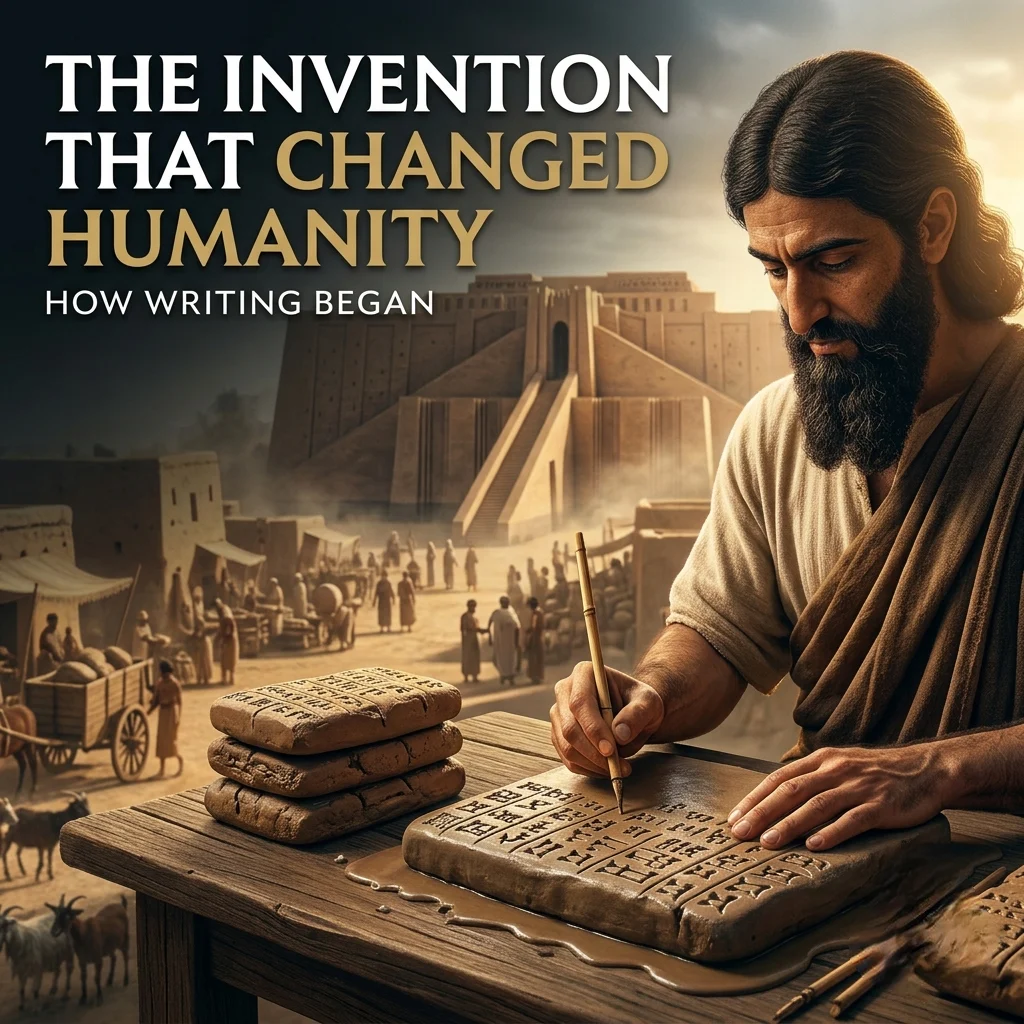
To overcome this cognitive bottleneck, scribes in southern Mesopotamia pressed sharpened reeds into river mud. That breakthrough transformed ancient cities from fragile urban experiments into durable hubs of civilization. By outsourcing human memory onto durable clay tablets, urban rulers established the administrative machinery that sustained statecraft for millennia.
The Pre-Literate Plain: Hydraulic Ecology and Settlement Growth
The geographic cradle that birthed the earliest ancient cities occupied the lower floodplains of the Tigris and Euphrates rivers. This environment offered extraordinary agricultural fertility alongside brutal physical constraints. The arid climate received negligible annual rainfall, rendering rain-fed dry farming completely impossible.
Survival demanded complex hydraulic manipulation:
-
Communal digging of arterial irrigation canals connecting river channels to arid back-swamps.
-
Construction of raised levees, sluice gates, and retention basins to control violent spring floods.
-
Systematic drainage projects to prevent lethal salt crystallization in irrigated topsoil.
-
Intensive monoculture cultivation of drought-tolerant six-row barley and date palms.
These engineering requirements forced dispersed kin groups to consolidate their labor into centralized settlements. By the fourth millennium BCE, small agricultural villages were eclipsed by sprawling nucleated centers.
A rural village operated through informal peer accountability and spoken agreements. In contrast, complex ancient cities concentrated tens of thousands of residents who shared no ancestral kinship. Spoken promises failed when dealing with unfamiliar merchants, impersonal temple estates, and rotating state work gangs. The emerging urban reality required an objective record.
Uruk and the Fourth Millennium Urban Revolution
Around 3200 BCE, the settlement of Uruk expanded into the preeminent metropolis of the ancient Near East. Enclosed by massive baked-brick ramparts attributed in epic tradition to Gilgamesh, Uruk spanned over 250 hectares, sheltering an estimated population exceeding forty thousand inhabitants.
Uruk was not simply an overgrown village; it was the architectural template for future ancient cities:
-
Monumental limestone and mudbrick complexes, such as the Eanna precinct dedicated to the goddess Inanna.
-
Walls decorated with vibrant geometric mosaics formed by thousands of baked, colored clay cones.
-
Residential districts segregating specialized craft quarters for metalworkers, potters, and textile weavers.
-
Massive civic storehouses designed to centralize agricultural surpluses extracted from regional agrarian peripheries.
The daily metabolism of Uruk generated an immense volume of administrative data. Temple overseers had to calculate seed yields, allocate standard daily ration bowls (bevel-rimmed bowls) to workers, and verify livestock herds leased to tenant pastoralists.
Written records emerged not as a vehicle for artistic expression or religious storytelling, but as an accounting technology. The earliest administrators were mathematicians and accountants resolving practical logistical equations. Writing functioned as the vital operating software for early ancient cities.
The Material Foundation: River Clay and the Reed Stylus
Writing in southern Mesopotamia succeeded because it utilized two ubiquitous local resources: alluvial river silt and giant river reeds (Arundo donax). Papyrus and parchment were foreign imports or expensive luxuries, but clay cost nothing and lay in unlimited quantities along canal banks.
The technology of writing on clay developed through standardized physical procedures:
-
Scribes washed and levigated raw river clay to remove coarse pebbles and organic vegetation.
-
The refined clay was kneaded into convex, hand-sized rectangular pillows or circular disks.
-
While the clay remained damp and pliable, the scribe pressed the triangular edge of a cut reed stylus into the surface, forming distinct wedge-shaped impressions.
-
Finished tablets dried beneath the sun into hard, permanent records, or were baked in kilns during palace fires, inadvertently preserving entire state archives for millennia.
This distinctive script is called cuneiform, derived from the Latin cuneus, meaning “wedge.” It was not a single language, but an adaptable writing system used over three thousand years to transcribe unrelated languages, including Sumerian, Akkadian, Elamite, and Hittite.
The durability of clay transformed ancient cities into enduring repositories of civic knowledge. Unlike organic media that rotted in humid soil, buried clay archives survived intact, providing modern archaeologists with deep insights into everyday municipal life.
Archival discoveries [Internal Link: Classical Logistics and Imperial Expansion] confirm that long-distance trade depended heavily on standardized written manifests and durable record-keeping media.
Bureaucracy, Token Systems, and Proto-Cuneiform
The invention of script in early ancient cities was preceded by thousands of years of primitive tactile accounting. Starting in the Neolithic era, farmers and traders tracked commodities using miniature geometric clay tokens representing sheep, jars of oil, and bushels of grain.
By the late Uruk period, administrators refined this physical tracking into a sophisticated accounting system:
-
Clay Envelopes (Bullae): Tokens representing a commercial shipment were sealed inside hollow spherical clay envelopes stamped with official cylinder seals.
-
External Impressed Signs: To check the contents of a bulla without breaking the shell, clerks pressed the tokens onto the exterior damp clay before sealing.
-
Flat Accounting Tablets: Scribes soon realized that the interior physical tokens were redundant; pressing two-dimensional pictographs directly onto flat clay tablets conveyed identical legal data.
-
Abstract Phoneticism: Pictographic drawings representing physical items evolved into abstract wedge clusters representing phonetic syllables and complex grammatical concepts.
This transition from physical tokens to abstract script marked a profound cognitive shift. For the first time, administrators manipulated symbolic numerical data independently of physical commodities.
The early clay tablets recovered from Uruk IV and III show that over eighty-five percent of all recovered texts deal exclusively with municipal accounting: grain distributions, beer rations, textile quotas, and land surveys. The foundational identity of ancient cities was anchored in fiscal accountability.
The Scribal Caste: Education and Social Hegemony in Ancient Cities
Literacy in the Near East was never an egalitarian skill shared by the common public. It was a guarded, elite monopoly exercised by a specialized caste of professional scribes (dubsar).
Scribes trained for years within formal institutional academies known as the Edubba (“tablet house”):
-
Sign Memorization: Apprentices spent years mastering hundreds of distinct cuneiform signs, learning their variable syllabic, phonetic, and ideographic meanings.
-
Lexical Lists: Students copied vast thematic encyclopedias listing every known stone, plant, animal, city, and profession to standardize imperial terminology.
-
Mathematical Mensuration: Advanced pupils calculated canal dirt volumes, brick quantities, field surface areas, and interest accruals on outstanding grain loans.
-
Bilingual Translation: Scribes learned to write the archaic liturgical Sumerian alongside the spoken Semitic Akkadian dialects.
Graduates of the Edubba held the keys to administrative power across ancient cities. They managed royal chanceries, oversaw tax assessments, directed building projects, and served as diplomatic envoys to foreign courts.
This scribal elite reinforced urban class hierarchies. Wealth and status belonged to those who could decode the tablet; the illiterate peasant remained dependent on the scribe to register land deeds, compute taxes, and petition the palace for legal redress.
Civic Administration and the Law in Ancient Cities
As decentralized settlements matured into autonomous city-states, written text moved from warehouse accounting into municipal governance and statutory law. The rulers who governed ancient cities recognized that written edicts conferred a permanent, objective authority that spoken decrees could never match.
Early reform texts, such as the edicts of Urukagina of Lagash (c. 2350 BCE), utilized writing to curb predatory aristocratic exploitation:
-
Royal edicts abolished exorbitant funeral fees extorted by temple priests from impoverished citizens.
-
Protected widows, orphans, and smallholders from having their livestock seized by military commanders.
-
Established standardized silver weights to regulate market transactions and protect illiterate peasants from short-weight fraud.
This tradition of codification culminated in famous monuments like the Laws of Ur-Nammu and the Code of Hammurabi of Babylon (c. 1750 BCE). Carved onto seven-foot diorite stelae erected in public squares, these statutory compendiums combined legal provisions with royal propaganda.
The monument depicted the king receiving the rod and ring of justice directly from Shamash, the sun god. By carving laws into stone, ancient cities declared that civic justice was immutable, universal, and immune to the arbitrary whims of local magistrates.
+-------------------------------------------------------------------------------+
|                       EVOLUTION OF MESOPOTAMIAN WRITING                       |
|                                                                               |
|  [Neolithic Clay Tokens]                                                      |
|           |                                                                   |
|           v                                                                   |
|  [Sealed Clay Bullae & Cylinder Seals]                                        |
|           |                                                                   |
|           v                                                                   |
|  [Proto-Cuneiform Pictographs on Clay] (c. 3200 BCE, Uruk IV)                 |
|           |                                                                   |
|           v                                                                   |
|  [Phonetic Wedge-Script / Cuneiform]   (Sumerian & Akkadian, c. 2600 BCE)     |
|           |                                                                   |
|           +-----------------------+-----------------------+                   |
|           |                       |                       |                   |
|           v                       v                       v                   |
|  [Fiscal Accounting & Taxes]   [Statutory Law Codes]   [Epic Literature]      |
+-------------------------------------------------------------------------------+
Commercial Networks: Long-Distance Trade Contracts
Mesopotamia was rich in grain, wool, and clay, but entirely devoid of stone, timber, and metal ores. To acquire hard copper from Oman, cedar beams from Lebanon, lapis lazuli from Afghanistan, and tin from Central Asia, ancient cities constructed long-distance trade corridors.
Writing was the engine that made long-distance commerce viable across hazardous distances:
-
Promissory Notes and Bills of Lading: Caravan leaders carried clay tablets enclosed in sealed clay envelopes recording investment values and transit insurance.
-
Cylinder Seals: Officials and merchants wore carved stone cylinders suspended around their necks, rolling them across wet clay to imprint personal signatures that validated transactions.
-
The Kültepe Archives: Over twenty thousand tablets discovered at Kanesh in modern Turkey reveal an extensive commercial network operated by Old Assyrian merchants trading tin and textiles for Anatolian silver.
-
Contractual Dispute Arbitration: Preserved correspondence shows merchants suing partners across hundreds of miles, presenting archived receipts to municipal assemblies to recover defaulted debts.
Writing eliminated the tyranny of distance. An investor sitting in his courtyard in Ur or Assur could finance a donkey caravan operating a thousand miles away, secure in the knowledge that every bolt of textile and ounce of silver was legally bound by sealed documentation.
Commercial developments in antiquity [Internal Link: Nomadic Equestrian Warfare Mechanics] illustrate that trade corridors across deserts required continuous legal and economic coordination between urban hubs and mobile pastoralists.
The Literary Awakening: From Rations to Epic Immortality
Centuries after writing was developed for accounting, scribes adapted the script to preserve imaginative literature, religious hymns, and existential philosophy. The citizens of ancient cities understood that while mudbrick palaces eventually dissolved, words inscribed on clay possessed enduring life.
The supreme masterpiece of this tradition is the Epic of Gilgamesh:
-
Originating as independent Sumerian poems celebrating the legendary ruler of Uruk, the tales were synthesized into the unified twelve-tablet Standard Babylonian version by the scholar Sîn-lēqi-unninni.
-
The epic addresses themes that resonate with modern readers: the agony of mortal death, the beauty of male friendship, the limits of imperial hubris, and the search for purpose.
-
Gilgamesh’s ultimate consolation lies not in escaping mortality, but in the enduring permanence of the brick ramparts and written culture he leaves behind for future generations.
In the southern city of Ur, writing recorded the earliest named author in human history: Enheduanna (c. 2300 BCE). Daughter of Sargon of Akkad and high priestess of the moon god Nanna, Enheduanna composed temple hymns and devotional poetry dedicated to Inanna.
Her signed works reveal an artist who understood that writing was not an administrative chore, but a medium of immortal self-expression. Through her inscribed tablets, her personal voice and religious devotion survived long after the ziggurats of her home crumbled into dust.
Archaeological Discoveries: The Buried Archives of Mesopotamia
The modern understanding of how writing transformed ancient cities rests on archaeological excavations conducted across Iraq, Syria, and Turkey over the past two centuries. Unlike classical parchment or papyrus scrolls that decayed, clay archives survived beneath tell mounds.
Significant excavations have transformed ancient historical research:
-
The Royal Library of Ashurbanipal at Nineveh: Discovered by Austen Henry Layard in the nineteenth century, yielding over thirty thousand clay tablets covering medicine, astronomy, omens, grammar, and literature.
-
The Ebla Archives in Syria: Uncovering thousands of administrative tablets detailing palace budgets, trade treaties, and diplomatic letters from the third millennium BCE.
-
The Ur Excavations: Sir Leonard Woolley’s expeditions uncovered thousands of legal deeds, domestic leases, and school practice tablets embedded in residential alleyways.
Forensic examination of clay compositions using portable X-ray fluorescence (pXRF) allows modern researchers to identify the exact clay beds used to make individual tablets. By matching clay sourcing with letter contents, archaeologists trace diplomatic routes and trading expeditions across thousands of miles.
The material record reveals that writing was an everyday tool embedded in the infrastructure of ancient cities. It sat on the merchant’s desk, recorded the temple storehouse inventory, and documented the boundary stones (kudurru) that demarcated agrarian real estate.
Geopolitical Aftermath: The Enduring Legacy of Written Civilizations
The development of written administration in the ancient cities of Mesopotamia changed the trajectory of human civilization. When regional kingdoms coalesced into universal superpowers—the Akkadian, Babylonian, and Assyrian empires—they built their hegemony directly upon the scribal systems inherited from early city-states.
The long-term institutional impacts of this information revolution include:
-
Administrative Continuity: Conquering dynasties absorbed the existing scribal chanceries, allowing imperial taxation, surveying, and justice to function smoothly across dynastic changes.
-
Scientific Transmission: Mesopotamian base-sixty mathematics and empirical astronomical observation sheets were translated into Greek, providing the foundations for Hellenistic geometry, navigation, and time measurement.
-
The Precedent of Codified Law: The concept that justice should exist as an accessible, written civic covenant shaped the legal traditions of the Levant, Greece, and Rome.
-
Diffusion of Literacy: Simplified cuneiform scripts, such as the Ugaritic alphabet, catalyzed the development of the Phoenician alphabet, the ancestor of the Greek, Latin, and modern scripts.
The mudbrick ramparts of the earliest ancient cities have weathered into silent mounds of dust along the Euphrates. Yet the invention forged within their streets remains the bedrock of modern society.
Every contract we sign, every law we record, every book we preserve, and every digital file we store traces its lineage back to the anonymous accountants of Mesopotamia, who pressed cut reeds into wet clay to ensure that human knowledge outlived the mortal mind.
Frequently Asked Questions
Why did ancient cities invent writing instead of rural villages?
Ancient cities invented writing because their sheer size and economic complexity created more information than the human brain could reliably remember. While small villages relied on personal memory and oral agreements, large urban centers had to coordinate resources, track thousands of ration allocations, survey property lines, and manage trade among unfamiliar citizens.
Was cuneiform an individual language?
No, cuneiform was not a spoken language; it was a flexible writing system. Scribes used cut reed styluses to press wedge-shaped signs into damp clay. Over three thousand years, this script was used to record distinct spoken languages, including Sumerian, Akkadian, Elamite, Hurrian, and Hittite.
What kind of records make up the majority of excavated Mesopotamian tablets?
Over eighty-five percent of all excavated clay tablets are economic and administrative records rather than myths or literature. Scribes recorded daily grain receipts, livestock inventories, tax assessments, ration allotments for municipal workers, land lease contracts, and commercial shipping manifests.