
Battle of Cannae: The Ancient Masterclass in Annihilation
On August 2, 216 BCE, the scorching summer heat of Apulia set the stage for the Battle of Cannae. Nearly 86,000 soldiers raised by the Roman Republic faced a coalition force of 50,000 veterans along the winding banks of the Aufidus River. Within six hours, that parched plain transformed into an open-air slaughterhouse.
The Battle of Cannae stands as one of the bloodiest single days of combat in human civilization. It was not merely a defeat for Rome, but a total collapse of its prevailing military doctrine. By evening, thousands of aristocratic commanders, consuls, and common foot soldiers lay dead in wind-blown dust.
The Road to the Aufidus: Escalation in Southern Italy
Two years of devastating battlefield embarrassments preceded the clash at Cannae. Disasters at the Trebia River and Lake Trasimene had stripped Rome of entire armies and shattered its reputation for invulnerability. The senate briefly adopted a strategy of evasion and delay under the dictator Quintus Fabius Maximus.
Yet delay tasted like cowardice to an aggressive Roman electorate eager for a swift, decisive confrontation. In the spring of 216 BCE, voters elected Gaius Terentius Varro and Lucius Aemilius Paullus as consuls. The senate authorized an unprecedented mobilization, pooling eight enlarged legions and allied contingents into a single massive host.
The operational objective was straightforward: meet the invading multi-ethnic force in open country and pulverize it through overwhelming numerical mass. The target had seized a vital grain magazine at the citadel of Cannae, cutting off Roman supply lines to the fertile southern coast.
Rome’s dual-consul system dictated that command alternated daily between the aggressive Varro and the cautious Paullus. On August 2, with the red flag raised outside Varro’s tent, the decision to engage was finalized. The armies marched toward the Aufidus, initiating the deadly sequence known as the Battle of Cannae.
Logistical Scale and Military Hardware
The logistical challenge of feeding, watering, and deploying over 130,000 men and 16,000 horses along an arid river basin in August was monumental. Heat exhaustion and dehydration posed acute threats hours before the first spear was cast.
Roman heavy infantry relied on equipment manufactured to standard citizen-soldier patterns:
-
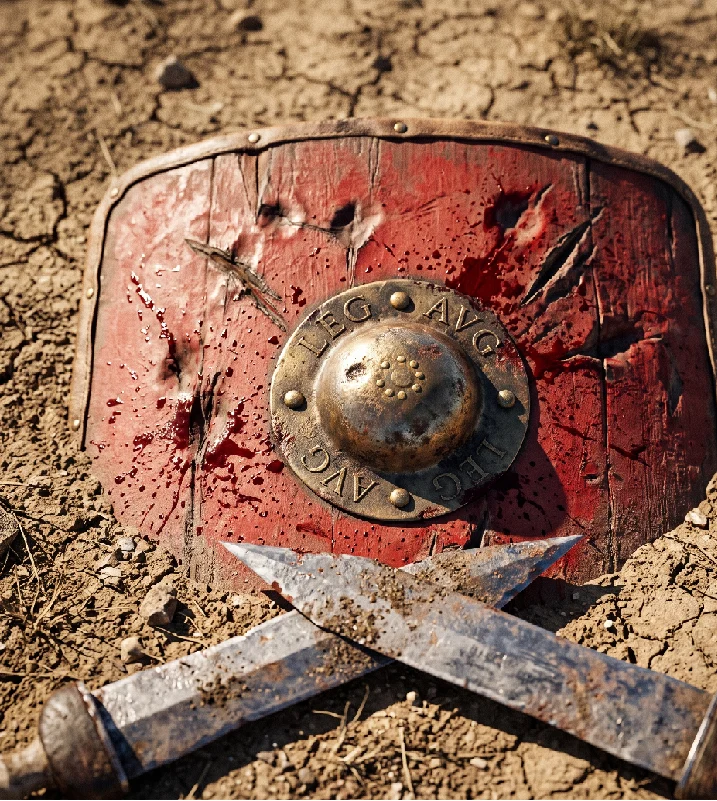
Scutum: A curved, semi-cylindrical plywood shield, reinforced with leather and an iron boss, standing roughly 120 cm high and weighing up to 10 kg.
-
Pilum: A heavy javelin measuring two meters with a soft iron shank engineered to bend on impact, neutralizing enemy shields.
-
Gladius Hispaniensis: A double-edged cut-and-thrust short sword with a blade length of 60 to 68 cm, lethal in tight quarters.
-
Lorica Hamata: Chainmail armor worn by wealthier hastati and principes, weighing approximately 10 to 15 kg.
Opposing them stood a varied confederation of Spanish, Celtic, and North African troops. The Iberian infantry carried short slashing falcatas and heavy sinew-bound caetrae. Celtic warriors fought stripped to the waist, wielding broad double-edged iron cutting swords designed for overhead slashing.
The elite African veterans presented a completely different visual profile. Having stripped armor and weapons from fallen foes at Trebia and Trasimene, they marched equipped in captured Roman mail and iron helmets. This created a uniform appearance that would sow lethal confusion during the Battle of Cannae.
Commanders also calculated environmental conditions. The scorching Volturnus wind blew from the south, driving dense grit and dust directly into the eyes of the advancing Roman soldiers.
Tactical deployment [Internal Link: Republican Infantry Formations] dictated that Roman maniples close their traditional gaps, forming an exceptionally dense wall of shields and iron.
The Master Plan: Anatomy of an Inverted Front
The tactical disposition chosen by the Carthaginian general on that morning decided the outcome of the Battle of Cannae. Aware that his center could not resist the sheer physical momentum of eighty thousand advancing Romans, he constructed a deliberate trap.
He arrayed his troops along the riverbank with the river securing his right flank. In the center, he placed alternating companies of Celtic and Iberian infantry in a convex crescent curving out toward the Roman vanguard. The apex of this crescent protruded directly into the path of greatest danger.
Behind this curved line, positioned quietly on the extreme left and right wings, stood the disciplined African heavy infantry. They formed deep, narrow columns held completely out of initial contact.
The cavalry disposition was equally intentional:
-
On the Carthaginian left wing, near the riverbank, Hasdrubal commanded 6,500 heavy Spanish and Celtic cavalry.
-
On the Carthaginian right wing, out on the open dusty plain, Maharbal led 3,500 agile Numidian light horsemen.
-
The Roman cavalry was divided unevenly, with only 2,400 citizen horsemen on their right and 4,000 allied horsemen on their left.
The geometric design of the Battle of Cannae was an exercise in calculated structural elasticity. The convex crescent was never intended to hold its ground permanently. It was built to absorb impact, bend under pressure, and draw the enemy forward into a tightening pocket.
The Clashing Wings and the Crushing of Roman Cavalry
The battle began with a sharp exchange between light infantry skirmishers. Balearic slingers launched lead bullets and fist-sized stones, fracturing shields and skulls across the Roman front lines before sprinting back through the ranks.
Immediately following the skirmish, Hasdrubal launched a brutal cavalry charge on the narrow strip between the infantry line and the riverbank. This was not a fluid skirmish; it was a tight, savage cavalry brawl. Men dismounted in the press to pull opposing riders to the ground with daggers.
Within twenty minutes, the outnumbered Roman cavalry under Paullus was shattered. Survivors broke and fled upriver, chased down without mercy by Spanish horsemen. Hasdrubal reformed his squadrons, rode behind the Roman infantry formations, and struck the rear of the Roman allied cavalry holding the opposite flank.
Maharbal’s Numidians had already kept the allied cavalry off-balance through fluid feints, mock retreats, and constant javelin harassment. Caught between Maharbal’s skirmishers and Hasdrubal’s heavy cavalry, the Roman allied horse broke into panic.
The Carthaginian cavalry had achieved complete local superiority within the opening phase of the Battle of Cannae. With both Roman mounted wings eradicated, Hasdrubal turned his combined cavalry units back toward the center of the battlefield.
The Trap Springs: The Mechanics of Encirclement
While the cavalry fought on the flanks, the central infantry collision began with terrifying force. Tens of thousands of Roman legionaries, packed shoulder to shoulder, pressed forward with their shields. Their mass pushed the protruding Iberian and Celtic crescent backward step by step.
Believing victory was already within their grasp, the Roman rear ranks surged forward, packing tighter to reinforce the momentum. The deep, heavy Roman column drove through the center, exactly as anticipated.
Gradually, the convex crescent flattened. Under the relentless weight of the Roman advance, the line did not break; it bowed inward, turning from a convex curve into a deep concave bowl.
The Roman infantry poured deeper into this widening pocket, their flanks compressing as men crowded inward toward the retreating center. As the center gave ground, the two stationary blocks of elite African veterans remained completely unengaged on the perimeter.
Then came the order that sealed the Battle of Cannae. The African infantry pivoted ninety degrees inward, locking shields and charging directly into the exposed, disorganized flanks of the packed Roman column.
Simultaneously, Hasdrubal’s victorious heavy cavalry slammed into the Roman rear lines. The opening closed. The pocket became a closed perimeter, trapping tens of thousands of Roman legionaries in a cauldron of bronze, iron, and dust.
The Grinding Slaughter Inside the Pocket
Trapped in the center, the Roman soldiers suffered the agony of absolute compression. The perimeter shrank with every passing minute, pressing men so close together that they could neither raise their shields nor draw their swords.
Surrounded on all sides, the outer rim of the Roman force was cut down systematically, while men in the center waited hours for their turn to die. Dust kicked up by thousands of thrashing boots choked off vision and breath.
Archaeological evidence and historical records confirm that men in the center buried their heads in loose sand, committing suicide to escape the terror and suffocation. As the ring contracted, the fight ceased to be a tactical maneuver and became an execution.
Lucius Aemilius Paullus, already wounded early by a slinger’s bullet, refused an offer of a horse to flee the carnage. He died fighting alongside his remaining retainers in the central press. Marcus Minucius Rufus, the former Master of the Horse, fell beside him.
Eighty senators and prominent magistrates perished on the field that afternoon. By five in the afternoon, the perimeter had shrunk to a small mound of corpses. The Battle of Cannae had claimed an entire generation of Roman military leadership.
Casualties and Battlefield Archaeology
The scale of slaughter at the Battle of Cannae has few parallels in military history. Modern demographic reconstructions based on Polybius indicate that between 55,000 and 70,000 Roman soldiers died on the field.
Roughly 10,000 men were captured, mostly from camp guards and isolated garrisons, while only 14,000 escaped, including young Publius Cornelius Scipio. The Carthaginian coalition sustained approximately 5,700 to 8,000 casualties, mainly among the Celtic warriors who bore the initial brunt of the Roman frontal assault.
Artifacts recovered from the general vicinity of Canosa di Puglia reveal the physical brutality of the engagement:
-
Iron sword tips bent at right angles from striking heavy bone and iron bosses.
-
Fragmented bronze Montefortino helmets split clean through the crown by downward slashing strikes.
-
Skeletal remains showing severe decapitation and limb-severing trauma characteristic of the falcata.
The Carthaginian soldiers collected thousands of gold rings from the fingers of dead Roman equestrians and patricians. These rings were shipped to Carthage and poured out in the senate house as tangible proof of total victory.
The psychological shock sent waves of hysteria across the Italian peninsula. In Rome, the senate resorted to archaic religious rites, burying two Gauls and two Greeks alive in the Forum Boarium to appease the gods.
Long-Term Strategic Consequences
Despite the unprecedented catastrophe of the Battle of Cannae, the strategic outcome of the war did not tilt permanently in Carthage’s favor. Maharbal famously urged an immediate march on Rome, claiming that within five days they would feast in the Capitoline.
Yet the Carthaginian army lacked siege equipment, reliable logistical lines, and fresh reinforcements from home. Marching 250 miles north through hostile territory to assault the fortified city walls of Rome was operational suicide.
Instead, the victory triggered widespread defections among Rome’s southern Italian allies. Capua, the second city of Italy, opened its gates, followed by several Samnite clans and cities in Lucania and Bruttium.
Rome adapted with ruthless flexibility. The senate forbade the word “peace,” refused to ransom the captured prisoners, and lowered the minimum age for military service. They mobilized teenagers, convicts, and two legions of freed slaves equipped with ceremonial weapons taken from temples.
Rome shifted away from large set-piece battles on the Italian mainland. Instead, they reverted to Fabius’s war of attrition, slowly isolating defecting cities while taking the offensive abroad.
Thirteen years later, at the [Internal Link: Battle of Zama Tactical Breakdown], Scipio applied the hard lessons learned at the Battle of Cannae, using superior Numidian cavalry to destroy the Carthaginian army and conclude the conflict.
Frequently Asked Questions
Why did Rome suffer such devastating casualties at the Battle of Cannae?
Rome suffered catastrophic losses because their dense, compressed formations eliminated tactical mobility. When the Carthaginian wings and cavalry sealed the pocket, the Roman legionaries were packed so tightly that they could neither use their weapons effectively nor escape the perimeter.
How did the Carthaginian cavalry dominate the Battle of Cannae?
Hasdrubal’s heavy cavalry held a local numerical advantage against the Roman cavalry along the Aufidus riverbank. After routing the Roman right wing, Hasdrubal rode behind the lines to sweep away the Roman left wing, completely liberating his cavalry to attack the Roman infantry from the rear.
What was the lasting impact of the Battle of Cannae on military tactics?
The Battle of Cannae became the premier historical model for total tactical encirclement and annihilation. Military academies continue to analyze its geometry, and commanders throughout modern warfare have repeatedly attempted to replicate its decisive trapping maneuvers