
Battle of Mohi: The Steppe Trap That Shattered Europe
On April 11, 1241, along the marshy banks of the Sajó River, European military chivalry confronted the lethal precision of the east. The Battle of Mohi pitted the royal army of Hungary against veteran steppe tumens in a catastrophic test of arms. Within thirty-six hours, an entire kingdom lost its ruling elite, its professional army, and its territorial security.
The Battle of Mohi remains a masterclass in operational deception and psychological warfare. Behind a seemingly impenetrable barrier of chained supply carts, the defenders believed their heavy armor and missile crossbows held the advantage. That misplaced confidence turned the plain into an inescapable slaughter pen.
The Strategic Preliminaries: The Encroaching Storm
The political crisis that precipitated the Battle of Mohi began decades earlier on the Eurasian steppe. Following the subjugation of the Russian principalities, eastern scouting corps probed the passes of the Carpathian Mountains. The flight of roughly forty thousand Cuman refugees into Hungarian territory aggravated the geopolitical friction.
King Béla IV accepted the pagan Cumans to bolster his royal host against rebellious barons, but the decision provoked domestic outrage. Hungarian magnates distrusted the nomads and suspected them of espionage. When nobles assassinated the Cuman khan Köten in Buda, the enraged Cumans rampaged southward, pillaging the countryside and abandoning the kingdom on the eve of invasion.
Deprived of light cavalry screens, the crown scrambled to assemble feudal levies. Calls for defensive mobilization went out across the realm, yet internal political resistance delayed the gathering. Many aristocratic magnates dragged their feet, resentful of royal efforts to reclaim crown lands.
Despite these divisions, the royal host formed an impressive, heavily equipped assembly outside Pest. Elite formations included the Templar Knights under their master Rembald de Voczon, alongside seasoned retinues commanded by Archbishop Ugrin Csák and Duke Kálmán. This force marched northeastward to confront the invading army at the Battle of Mohi.
The opposing commander chose his ground with meticulous care. Rather than engaging the formidable European knightly formations on wide, flat ground, the invaders lured the royal army toward a narrow crossing on the Sajó River.
Logistical Realities and Weaponry on the Sajó
Feeding and managing tens of thousands of mounted troops in early spring presented severe logistical strains. The defending forces relied on traditional feudal supply lines: oxen-drawn baggage wagons carrying grain, salted pork, iron horse harnesses, and field tents. The muddy spring thaw slowed their march to a crawl.
The defenders brought standard high-medieval arms designed for close-quarter kinetic shock:
-
Arming Sword and Lance: Heavy ash lances measuring 3.5 to 4 meters paired with cruciform double-edged steel swords optimized for cleaving armor.
-
Hauberk and Great Helm: Heavy riveted iron mail coats worn over padded gambesons, topped by cylindrical flat-topped iron helmets with narrow eye slits.
-
Composite Crossbow: Heavy wood and horn spanning crossbows firing steel-tipped bolts capable of penetrating iron armor at sixty meters.
-
War Horses (Destriers): Heavy, powerful stallions trained for direct, concentrated charges into infantry lines.
The steppe army deployed a completely different logistical and tactical model. Every warrior maintained four to five sturdy steppe ponies, allowing rapid strategic mobility without outrunning supply trains. Dried curd, cured meat (borts), and mare’s milk sustained riders across vast distances without cumbersome baggage columns.
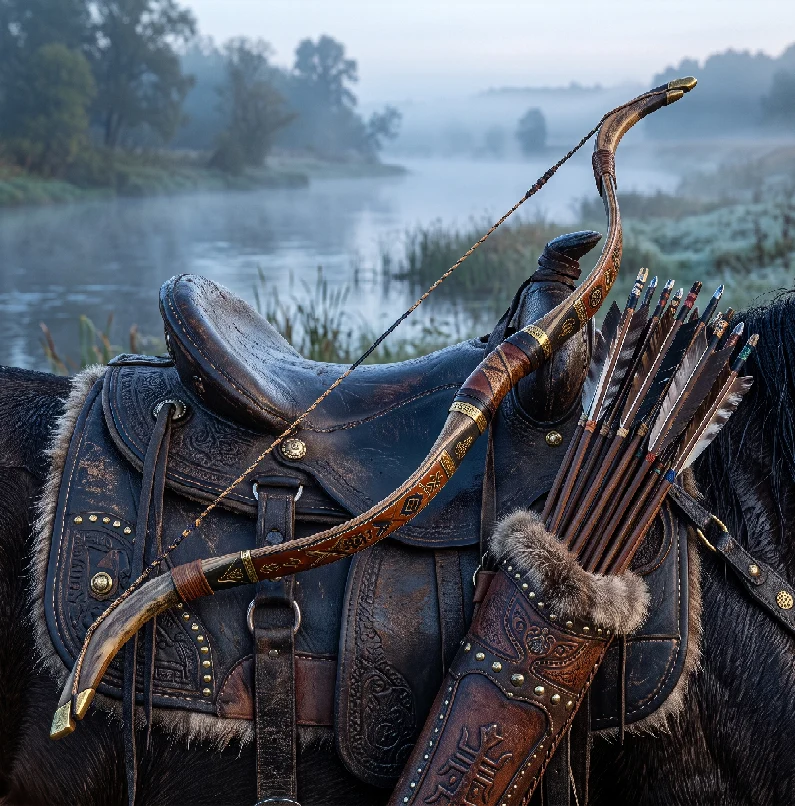
Their primary offensive asset was the composite recurve bow:
-
Steppe Composite Bow: Constructed from horn, sinew, wood, and fish glue, possessing draw weights between 100 and 160 pounds.
-
Arrowhead Variety: Heavy square-sectioned bodkin tips for piercing mail alongside wide, razor-sharp broadheads for unarmored flesh and horses.
-
Light Lamellar Armor: Overlapping plates of lacquered leather or hardened iron laced together with silk cords, granting exceptional mobility.
-
Siege Artillery: Chinese-engineered torsion catapults and tension stonethrowers transported in pieces and assembled on site.
The contrasting arms directly influenced operational thinking during the Battle of Mohi. The defenders sought a localized, high-impact melee where their superior physical weight could crush opposition. Their adversaries intended to avoid close contact entirely until long-range missile attrition broke enemy cohesion.
Early strategic maneuvers [Internal Link: Medieval Defensive Fortifications] highlighted how traditional static encampments often proved vulnerable when confronting dynamic missile artillery.
The Bottleneck: Defending the Sajó Bridge
The physical landscape of the Mohi plain heavily shaped the opening engagements. The Sajó River was swollen with melted snow, creating a cold, wide barrier surrounded by marshes, reed beds, and soft mud. Only a single wide wooden bridge spanned the deep river at the village of Mohi.
Recognizing the strategic importance of the crossing, the defenders seized the bridgehead. Duke Kálmán and Archbishop Ugrin Csák led an advance strike force across the river under the cover of night, surprising an enemy detachment attempting a crossing.
The heavy knights drove the forward scouts back into the darkness with severe casualties. Confident that the single bridge was secure, the Hungarian leaders returned to the western bank, leaving a garrison of crossbowmen and armored men-at-arms to guard the approach.
On the flat plain behind the bridge, the royal army constructed an enormous defensive redoubt: the laager, or wagon fortress. Hundreds of heavy transport wagons were arranged in an intricate circle, chained wheel-to-wheel, and reinforced with pavise shields and wooden stakes.
The encampment gave the royal commanders an overwhelming sense of security. Trapped within this dense wooden circle, however, tens of thousands of soldiers and horses were packed so tightly that maneuvering between tents was nearly impossible.
The stage for the catastrophe of the Battle of Mohi was set by this static, overcrowded defensive perimeter. What the defenders viewed as an impregnable fortress was, to their opponents, an immobile, target-rich enclosure.
The Morning Crossing: Diverting the Bridgehead
At dawn on April 11, the primary clash at the Battle of Mohi opened with a ferocious bombardment. Rather than charging the narrow bridge directly against entrenched crossbowmen, the steppe engineers positioned seven heavy stone-throwing engines along the eastern bank.
A relentless hail of rock, incendiary naphtha pots, and heavy iron-tipped bolts rained down upon the bridge guards. The explosive concussion and concussive missile barrages shattered the wooden breastworks and panic-stricken crossbow detachments.
Simultaneously, smoke screens produced by burning chemical mixtures blinded the Hungarian defenders, preventing accurate return fire. Under this covering barrage, elite horse archers stormed across the wooden bridge, cutting down the garrison and establishing a firm bridgehead on the western bank.
Duke Kálmán and Archbishop Ugrin rallied their armored cavalry and charged the bridge once more. The initial clash was savage. Heavy lances punched through light lamellar coats, and Hungarian steel drove the advance units back toward the river lip.
Yet the sheer volume of missile fire restricted any counter-crossing. More enemy units crossed the bridge, widening the perimeter yard by yard. Even as the defenders committed more heavy cavalry to contain the breach, the royal army focused its entire attention exclusively on the bridge.
This intense tactical focus on the bridge was precisely what the opposing high command had planned. The bridge assault was a calculated diversion, designed to fix the Hungarian reserve in place while the decisive maneuver unfolded miles away.
Subutai’s Envelopment: The Downstream Flanking Strike
While combat raged at the bridge, the veteran strategist Subutai executed the pivotal maneuver of the Battle of Mohi. During the freezing hours before dawn, Subutai had marched several tumens southward through dense woods and marshes to locate an alternative crossing.
Finding the waters too deep to ford, his engineers worked silently in the dark, cutting timber to construct a makeshift wooden bridge and stringing pontoon rafts across the swollen current. By mid-morning, Subutai’s divisions had crossed undetected behind Hungarian lines.
Subutai swung his mounted host northward, emerging directly onto the southern flank and rear of the royal camp. The sudden appearance of thousands of horsemen out of the marshes threw the Hungarian high command into absolute panic.
Archbishop Ugrin Csák and Duke Kálmán disengaged from the bridge and galloped back toward the main camp, only to find the plain engulfed in swirling clouds of dust and arrow fire. The perimeter had been totally bypassed.
The tactical geometry of the Battle of Mohi collapsed instantly:
-
The bridgehead was lost, allowing fresh enemy formations to pour across from the east.
-
Subutai pressed hard from the south and west, sealing off the flanks.
-
Royal troops panicked and retreated into the confines of the wagon laager, jamming the narrow access gates with panicked horses and infantry.
The wagon fortress, intended as a safe retreat, became an open trap. The royal army was paralyzed by its own structural bulk.
The Wagon Ring as an Open Slaughterhouse
Encircled on all sides, the defenders found themselves subjected to continuous, mechanized missile bombardment. The attackers refused to engage in hand-to-hand combat. Instead, they rode around the wagon perimeter at a safe distance, discharging thousands of armor-piercing bodkin arrows into the densely packed crowd.
Catapults hauled across the river hurled burning pitch, large stones, and severed heads directly into the royal camp. Tents caught fire, and horses broke loose from their tether lines, trampling wounded soldiers beneath their hooves.
The scene inside the wagon ring at the Battle of Mohi quickly descended into madness:
-
Thick smoke from burning canvas choked off breath and obscured all command flags.
-
Crossbowmen lacked room to span their weapons or find clear sightlines through the panicked crowd.
-
Nobles argued bitterly, with some accusing the king of incompetence while others refused to mount up without clear orders.
Duke Kálmán, though heavily wounded by arrows, led a desperate sortie of knights against the surrounding ring, but the attackers parted before the charge and peppered the knights with arrows from both flanks. His force was driven back into the burning camp.
Archbishop Ugrin Csák fell amid the debris, pierced by multiple shaft wounds. The Templar contingent fought to the last man near the center of the camp, refusing to yield ground until their formation was completely obliterated.
By midday, the ground inside the wagon ring was covered with a knee-deep layer of corpses, dead livestock, and shattered equipment. The defensive coherence of the royal host was broken.
The Feigned Retreat and the Open Corridor Trap
Seeing that the defenders were physically broken and mentally unhinged, the attackers deployed the most psychologically devastating tactic of the Battle of Mohi: the intentional gap.
The encircling cavalry deliberately opened an apparent corridor of retreat to the west, toward Pest. There were no enemy units visible along this road, leading the desperate Hungarian troops to believe an escape path had been overlooked.
Small groups of foot soldiers threw down their weapons and dashed through the gap. When no one attacked them, a mass exodus began. The defenders abandoned the wagon fortress entirely, streaming through the opening in an undisciplined, disordered mob that stretched for miles.
The open corridor was a deliberate execution path. Light cavalry units shadowed the fleeing soldiers along the flanks, riding parallel through the tall grass and woods.
Once the fugitives were strung out along the muddy road, exhausted, unarmed, and completely disorganized, the trap snapped shut:
-
Mounted archers rode alongside the running men, picking them off at point-blank range with arrows.
-
Lancer detachments charged into the flanks of the column, cutting down thousands from behind without sustaining a single casualty.
-
Fleeing soldiers were herded into adjacent bogs and swamps, where heavy mud dragged them down to be speared from the banks.
The slaughter continued for two days across forty miles of countryside. Contemporary chroniclers recorded that the roads were white with the bones of dead soldiers, marking the tragic culmination of the Battle of Mohi.
Archaeological Records and Demographic Destruction
The physical aftermath of the engagement wiped out the military apparatus of medieval Hungary. Forensic examinations and archaeological surveys conducted around the modern village of Muhi reveal the immense density of the destruction.
Excavations have uncovered mass burial pits containing skeletal remains with devastating trauma patterns:
-
Iron arrowheads embedded deep within thoracic vertebrae and pelvic bones, fired with enough velocity to punch clean through leather and mail.
-
Skulls split by curved saber strikes delivered from horseback at full gallop.
-
Charred fragments of wagon hardware, bronze fittings, and melted livery confirming widespread conflagration across the camp site.
Contemporary records, such as Master Roger of Torre Maggiore’s Carmen Miserabile, recount that almost the entire administrative and ecclesiastical leadership of the kingdom died on the field. Out of tens of thousands of combatants, barely a fraction escaped.
King Béla IV narrowly survived by fleeing on a fast horse into the mountains, pursued relentlessly across Slovakia toward Austria. Duke Kálmán escaped with mortal wounds, succumbing to his injuries shortly after reaching safety in Croatia.
The demographic impact extended far beyond the battlefield. Following the Battle of Mohi, the victorious tumens swept across the Great Hungarian Plain unchecked, burning villages, systematically executing populations, and leaving the kingdom in absolute ruin.
Tactical lessons from this operational disaster [Internal Link: Evolution of Horse Archer Tactics] forced European kingdoms to reconsider their overreliance on static heavy infantry and uncoordinated cavalry charges.
Geopolitical Aftermath: The Transformation of Hungary
The destruction wrought by the Battle of Mohi permanently altered the social and political architecture of Central Europe. For an entire year, the occupying forces controlled everything east of the Danube, subjecting the region to systematic taxation, raiding, and depopulation.
Then, in early 1242, the invaders abruptly packed their camps, crossed the Danube back to the south, and withdrew across the Balkans toward the Volga. The death of the Great Khan Ögedei in Karakorum required the high command to return eastward for the election of a successor.
When King Béla IV returned to his devastated kingdom, he found a wasteland. Nearly a third of the Hungarian population had died from violence, famine, and disease during the occupation.
Determined to prevent a repeat of the disaster at the Battle of Mohi, Béla IV launched a complete transformation of royal defense policy:
-
He abandoned traditional reliance on open-field peasant levies, encouraging barons to construct stone fortifications on defensible crags.
-
He granted vast estates to noble families on the strict condition that they maintain heavily armored cavalry contingents.
-
He welcomed foreign settlers, including German miners and craftspeople, to rebuild deserted urban centers with fortified walls.
This massive building program earned Béla IV the title of the “Second Founder of the State.” When another invasion force returned forty-four years later in 1285, the kingdom’s new stone fortresses and disciplined defensive doctrine completely checked the invaders, proving that the terrible lessons of the Battle of Mohi had been thoroughly absorbed.
Frequently Asked Questions
Why did the Hungarian wagon fortress fail at the Battle of Mohi?
The wagon fortress failed because it was far too small for the massive royal army, creating catastrophic internal overcrowding. Once surrounded, the defenders had no room to maneuver, deploy their heavy cavalry, or coordinate their missile fire. The dense circle of wagons simply transformed into an immobile target for long-range siege catapults and massed archery.
What role did the wooden bridge on the Sajó River play in the battle?
The wooden bridge served as the focal point for a deliberate tactical diversion. While the defending forces concentrated all their heavy armor and elite missile troops to hold that single crossing against explosive catapult barrages, flanking detachments crossed the freezing river downstream on pontoon bridges, encircling the camp completely.
How did King Béla IV escape the slaughter?
King Béla IV escaped due to the sacrifice of his personal bodyguard, who fought desperately to buy him time to mount a swift courser. The king fled northwest through the rugged Carpathian foothills, narrowly evading pursuing scouts before finding temporary refuge in Austria and eventually on the fortified Dalmatian islands.