
Battle of Agincourt: When Rain and Iron Broke France
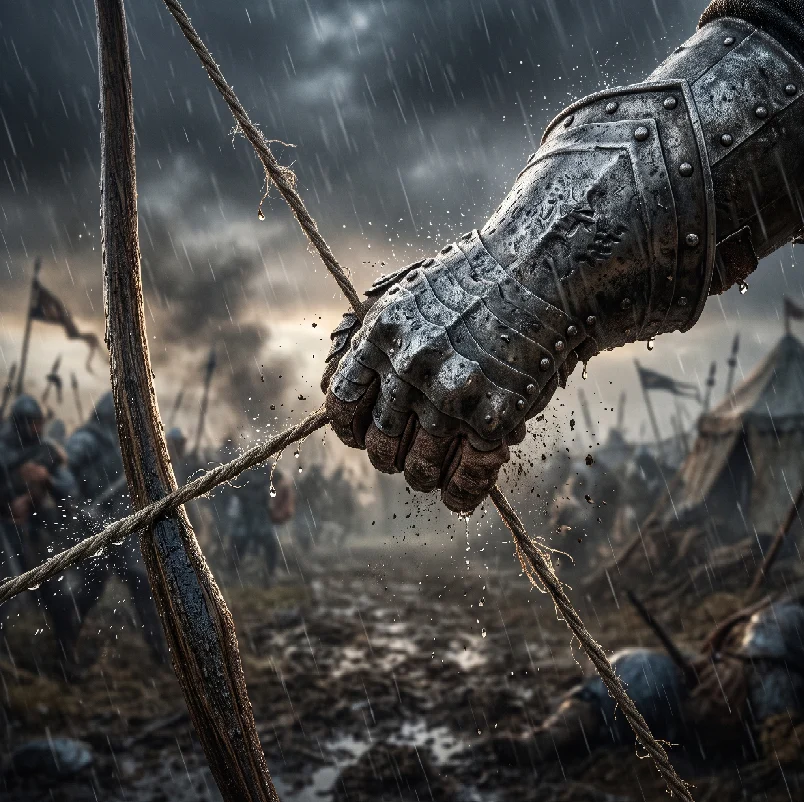
On the cold morning of October 25, 1415, St. Crispin’s Day, two armies faced each other across a narrow corridor of freshly ploughed farmland near the village of Maisoncelle. The Battle of Agincourt was about to unfold under a gray, drizzling autumn sky. On paper, the English force was trapped, starving, riddled with illness, and vastly outnumbered.
By sunset, that sodden expanse of northern French clay became an open tomb for thousands of elite knights. The Battle of Agincourt dismantled the established tenets of aristocratic warfare, proving that massed discipline and defensive terrain could overcome the most formidable armored host in Christendom.
The Road to Maisoncelle: Hunger, Sickness, and Pursuit
The campaign leading up to the Battle of Agincourt began with ambitious strategic goals that quickly unraveled into an agonizing march of survival. The English crown landed near the mouth of the Seine in mid-August, laying siege to the fortified port of Harfleur. While the town eventually capitulated after five grueling weeks, the cost to the English expeditionary force was ruinous.
Dysentery, recorded in contemporary chronicles as the bloody flux, tore through the English camps. Hundreds of seasoned soldiers died in their tents, while thousands more were evacuated back across the Channel as non-combatants. Rather than retreating to England with his shrunken host, the king chose an aggressive display of royal defiance, marching northeast toward English-held Calais.
The march turned into a desperate running trial. French forces shadowed the column, destroying bridges, damming river crossings, and clearing crops from surrounding estates. Forced into extensive detours along the Somme River, the English marched on short rations of raw turnips and foul water.
When the English column finally forced a crossing at Béthencourt, a massive French royal army intercepted them. Commanded by Constable Charles d’Albret and Marshal Boucicaut, the French host barred the direct road to Calais between the dense woodlands of Agincourt and Tramecourt. The clash was unavoidable; the Battle of Agincourt would decide whether the English crown lived or perished on French soil.
Logistical Realities and Weaponry on the Field
Equipping and maintaining thousands of men during prolonged offensive operations across Picardy severely strained both factions. The English army traveled light out of sheer necessity, having abandoned heavy wagon trains to preserve marching speed.
The standard English tactical array paired dismounted men-at-arms with massive wings of yeoman archers:
-
The War Bow: Carved from seasoned yew staves measuring six feet in length, possessing draw weights between 100 and 150 pounds.
-
Type 16 Bodkin Arrows: Slender, hardened steel tips designed to puncture mail links and bypass overlapping plate joints at long range.
-
Mailed Arming Gear: English men-at-arms wore breastplates over hauberks, but many had discarded heavy leg protection to walk through deep mud.
-
Improvised Melee Arms: Archers carried lead-weighted mallets, sidearms, skinning knives, and short falchions suspended from rope girdles.
The French contingent arrived with the most sophisticated plate defense in Europe, but their logistical arrangement was fractured by aristocratic rivalry:
-
White Harness Plate: High-carbon steel plates forged in Milanese and German workshops, offering superior protection against slashing blows.
-
Couching Lances: Heavy ash lances measuring over four meters, intended for mounted shock charges or cut down for infantry melees.
-
Armored Barding: Limited iron plates and padded gambesons worn by elite warhorses to absorb arrow strikes.
-
Crossbow Batteries: Mercenary Genoese crossbowmen firing heavy square-headed quarrels from composite wood-and-sinew mechanisms.
The physical terrain of the Battle of Agincourt transformed these technological choices into fatal burdens. Days of unceasing rain had saturated the deep, loamy soil, turning ploughed fields into a thick mire that reached past the shins of marching infantry.
Early strategic maneuvers [Internal Link: Hundred Years War Strategic Maneuvers] emphasized mobility, yet the narrow defile at Maisoncelle completely eliminated the opportunity for wide outflanking charges.
The Narrow Defile: Analyzing the Bottleneck
The field of engagement was barely 750 yards wide, framed by thick coppiced woods of beech and oak trees. This claustrophobic funnel prevented the French from deploying their numerical mass effectively.
King Henry V positioned his men across the narrowest gap. He placed dismounted men-at-arms in three central divisions, flanked by chevron-shaped formations of archers that projected outward into the mud. In front of each archer stood an angled wooden stake, six feet long, sharpened at both ends and driven into the frozen earth.
These wooden stakes, known as caltrops or herces, acted as a lethal physical barrier against mounted shock charges. They protected the lightly armored archers from being overrun by the French cavalry vanguard.
Across the field, the French high command clustered their troops into exceptionally deep, crowded lines:
-
A massive mounted vanguard of knights and dismounted men-at-arms crowded the frontline.
-
An equally dense main battle division followed immediately behind, pressing against the vanguard.
-
The mercenary crossbowmen were placed behind the mounted wings, where they had no direct line of sight to fire upon the English ranks.
The French plan depended on overwhelming force, but the geography of the Battle of Agincourt worked against them. There was no space to maneuver, no flank to turn, and no room to retreat once the forward momentum carried men into the narrow center.
The Opening Volleys and the Failed Cavalry Charge
By mid-morning on October 25, neither army had initiated contact. Both sides waited across a thousand yards of silence, listening to the wind and rain. Recognizing that his exhausted soldiers could not stand indefinitely in the freezing mud without food, the English king ordered his lines forward.
The English archers pulled up their wooden stakes, advanced to within three hundred yards of the French lines, and redrove the wooden palisade into the wet ground. Once secured, they loosed an initial ranging volley.
The sky blackened as thousands of heavy arrows arced into the air and crashed down into the French ranks. The sudden storm of iron galvanized the French into a hasty, uncoordinated response.
A mounted cavalry vanguard under the Duke of Brabant and local lords charged across the field to run down the archers. It was an instant operational disaster. The heavy warhorses churned the soaked clay into liquid grease, slipping and exhausting themselves within the first hundred yards.
As the horses slowed, the arrow storm intensified. While plate armor often deflected arrows at extreme angles, the unarmored heads, necks, and flanks of the warhorses took the full force of the bodkin points. Terrified, bleeding horses reared, threw their riders into the mud, and wheeled back directly through their own advancing infantry lines.
The panicked horses broke the cohesion of the French vanguard before the foot soldiers even reached the English line. The opening phase of the Battle of Agincourt established the tactical rhythm that would dominate the entire day: chaos, compression, and loss of momentum.
The Crush of Men-at-Arms: An Armored Deathtrap
Seeing the mounted cavalry disintegrate, the main French infantry division advanced on foot. Thousands of heavy men-at-arms, clad in eighty pounds of plate armor, dragged their feet through calf-deep mud under a relentless downpour of steel bodkin arrows.
To protect their faces, the knights lowered their visors. This action severely restricted their breathing and reduced their field of vision to narrow horizontal slits. Choking for air, blind to obstacles, and slip-sliding in deep ruts, the men-at-arms were exhausted before they struck the English line.
When the French finally made contact with the English men-at-arms, the impact pushed the thin English line back several paces. But the sheer weight of numbers behind the French front line proved fatal.
Troops behind pressed forward relentlessly, packing the forward ranks so tightly against English swords and axes that the knights could not swing their arms or draw their daggers. The Battle of Agincourt ceased to be a fluid tactical encounter and became a lethal crush of human bodies.
Men tripped over fallen comrades, plunged face-down into liquid clay, and were unable to rise under the dead weight of their iron armor and the trampling boots of the men behind them. Hundreds of elite French nobles suffocated quietly in the mud without ever suffering a cut from an enemy weapon.
The Archers Join the Melee: The Slaughter at the Stakes
As the French center stalled in the mud, the English archers exhausted their quivers of arrows. Sticking their bows upright in the soft ground, the archers drew short swords, lead mallets, and skinning knives, sweeping into the flanks of the immobilized French host.
Unlike the heavily armored men-at-arms, the archers were unencumbered by steel leg armor, often fighting barefoot or in linen shirts for better footing. They moved with swift agility across the churned surface of the mud, circling the trapped French knights like wolves.
Archers used lead-weighted mallets to cave in thin helmet crowns, hook visors open, and plunge narrow daggers through armpit joints and groin lames. The heavy plate that protected the knights from distance missiles became an iron cage that guaranteed their destruction.
Within an hour, piles of dead and dying men grew six feet high in front of the English positions. English soldiers clambered atop these heaps of fallen armor to strike downward at fresh French ranks still attempting to press into the defile.
The entire second division of the French army, demoralized by the sight of the slaughter and unable to push through the mountains of dead, wavered and began to disintegrate. The tactical cohesion that had held the French royal army together evaporated completely.
The Controversial Execution of Prisoners at the Battle of Agincourt
In the final stages of the engagement, an unexpected development threatened the English victory. A local French nobleman, Ysambart d’Agincourt, gathered local peasants and mounted retainers, raiding the lightly guarded English baggage train in the rear.
Simultaneously, remnants of the French third division appeared to be reforming for a renewed assault on the English lines. The English king found himself in an operational nightmare: his own men were vastly outnumbered by thousands of French prisoners who had surrendered during the melee.
Fearing that the prisoners would pick up discarded weapons from the ground and attack his exhausted soldiers from behind, the king issued an absolute command. He ordered his men to execute their aristocratic captives immediately.
The order horrified many English gentlemen, not out of humanitarian mercy, but because executing noble captives destroyed the prospect of collecting immense ransom payments. When his knights hesitated, the king assigned a squad of two hundred archers under an esquire to carry out the executions.
Hundreds of elite French nobles were throat-slit or clubbed to death before the king called a halt to the killing, satisfied that the French rear guard had fully dispersed. While modern observers view the act as an atrocity, contemporary chroniclers viewed it as a brutal, pragmatic calculation necessary to secure the survival of his army.
Archaeological Records and Casualty Evidence
Modern forensic archaeology and contemporary administrative rolls provide a sobering picture of the carnage at the Battle of Agincourt. Historical consensus estimates total French fatalities between 6,000 and 10,000 men, with the overwhelming majority drawn from the noble and knightly classes.
Three royal dukes—Antoine of Brabant, Edward of Bar, and John of Alençon—died on the field, alongside Constable Charles d’Albret, the Grand Master of Crossbowmen, and over ninety senior barons. The French administrative state in northern France was decapitated in an afternoon.
By contrast, English fatalities numbered between 400 and 600 men. Among the prominent English dead were Edward, Duke of York, who suffocated in his armor during the central press, and the young Earl of Suffolk.
Excavations around modern Azincourt and nearby ossuaries have yielded poignant material evidence of the engagement:
-
Fragmented iron plate retaining circular indentations and microscopic punctures characteristic of high-velocity bodkin penetration.
-
Mass burial trenches demonstrating severe crushing trauma to thoracic ribs and pelvises, consistent with trampling in heavy armor.
-
Skeletal trauma to cranial bones indicating point-blank concussive blows delivered by iron hammers and lead mallets.
The recovery of personal seals, rings, and religious pendants alongside these remains underscores the elite aristocratic composition of the French army that perished in the mud.
Tactical evolutions from this period [Internal Link: Late Medieval Missile Artillery Innovations] catalyzed the development of thicker, rounded breastplates designed specifically to deflect missile points rather than absorb kinetic shock directly.
Geopolitical Aftermath: The Path to the Treaty of Troyes
The geopolitical consequences of the Battle of Agincourt shattered the balance of power in Western Europe. The capture and death of so many royal commanders paralyzed the French central government, allowing the English army to complete its march to Calais unmolested.
Over the next five years, English armies launched a systematic conquest of Normandy. Rouen, Caen, and surrounding strongholds fell one by one, bringing northern France under direct English administrative rule for the first time in generations.
The political vacuum provoked a vicious civil war between two powerful French factions: the Burgundians and the Armagnacs. When the Dauphin Charles’s retainers murdered Duke John the Fearless of Burgundy during peace negotiations in 1419, the Burgundians formed a formal military alliance with England.
This diplomatic triumph led directly to the Treaty of Troyes in 1420. Under its terms:
-
King Charles VI of France disinherited his own son, the Dauphin Charles, naming the English king as his true heir and regent.
-
The English king married Catherine of Valois, daughter of the French monarch, uniting the royal lineages.
-
The crowns of England and France were slated to unite under a single sovereign upon the death of Charles VI.
Although the unexpected death of the English king in 1422 left his infant son to inherit a divided empire, the victory at the Battle of Agincourt transformed what was originally an isolated raid into one of the most remarkable military triumphs in European history.
Frequently Asked Questions
Why did the French cavalry fail so catastrophically at the Battle of Agincourt?
The French cavalry failed because the terrain was unsuitable for mounted shock tactics. Continuous rain had turned the ploughed clay into deep, sticky mud that quickly exhausted the horses. Furthermore, the English archers had planted sharp wooden stakes across their lines, which impaled charging horses and deflected them directly into their own advancing infantry.
What kind of arrows were used during the Battle of Agincourt?
English and Welsh archers primarily fired Type 16 bodkin arrows. These featured long, slender, square-sectioned points made from hardened steel designed specifically to penetrate chainmail links and exploit the narrow seams and joints of steel plate armor.
Why did Henry V order the execution of French prisoners?
The king ordered the execution of the prisoners because he feared a two-front battle. Remnants of the French third battle were rallying to attack his rear, while a local raiding party struck his baggage camp. With his small, exhausted force heavily outnumbered by the captured French nobles in their midst, he eliminated the threat of an armed prisoner revolt