
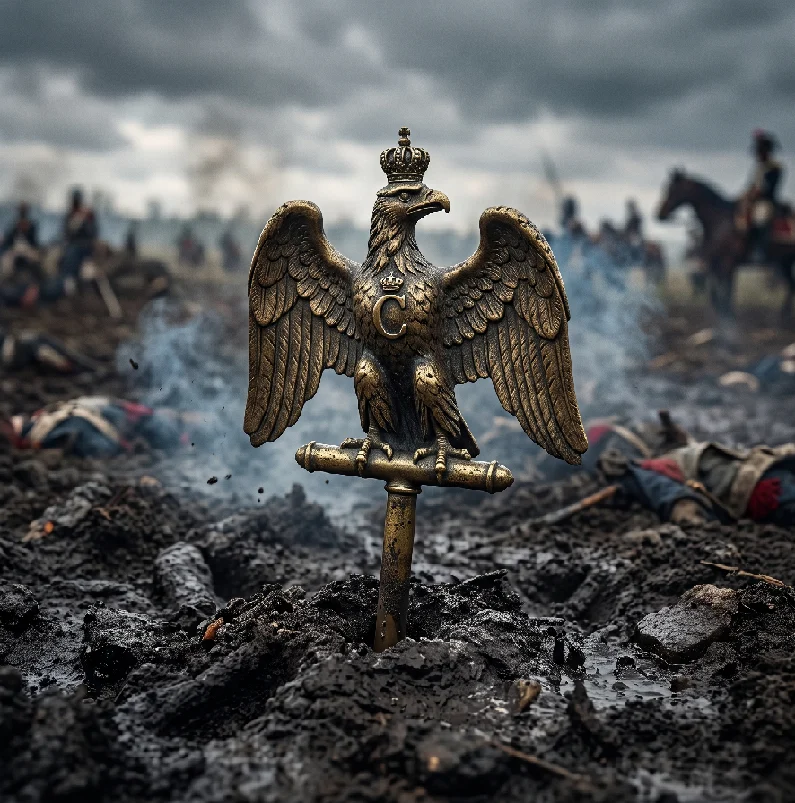
Battle of Waterloo: The Muddy Crucible of 1815
On the damp morning of June 18, 1815, across a shallow valley south of Brussels, two great armies squared off for the Battle of Waterloo. A torrential overnight storm had transformed the wheat fields and sunken roads of Flanders into a churned sea of black mud. Over 140,000 men gathered within an area barely two miles wide to settle the mastery of Western Europe.
The Battle of Waterloo was never a foregone conclusion. It hung on micro-decisions, damp gunpowder, physical endurance, and the arrival of promised reinforcements across waterlogged tracks. When the cannonade finally subsided in the twilight, twenty-three years of continuous European conflict came to an abrupt, violent close.
The Strategic Crisis: The Hundred Days and the Low Countries
The road to the Battle of Waterloo opened when an exiled emperor escaped the Mediterranean island of Elba in March 1815. Marching to Paris without firing a shot, he rapidly reconstituted the French army. Across the capitals of Europe, allied monarchs outlawed him as an international fugitive, forming the Seventh Coalition to mobilize against his restored regime.
Recognizing that he could not win a protracted multi-front war against combined British, Prussian, Austrian, and Russian numbers, the French commander chose the offensive. His operational goal was to drive a wedge between the two nearest coalition armies stationed in southern Belgium before they could link up.
On June 16, he struck at Ligny, battering the Prussian forces while holding the Anglo-Allied vanguard at Quatre Bras. Yet the victory remained incomplete. The Prussian formations withdrew north toward Wavre along roads parallel to their British allies, maintaining operational communication rather than fleeing eastward.
Capitalizing on this tactical retreat, the Anglo-Allied army pulled back to a carefully pre-surveyed defensive position on the ridge of Mont-Saint-Jean. The stage was set for the Battle of Waterloo, where a defensive shield had to hold long enough for Prussian relief to arrive.
Logistical Realities, Ordnance, and Infantry Weaponry
The wet summer weather of 1815 dictated operational mobility and the mechanics of killing. Thousands of horses, baggage caissons, and heavy artillery pieces tore through country lanes, creating traffic jams that delayed supply convoys and ammunition trains.
Infantry tactics rested upon standard flintlock smoothbore muskets:
-
Pattern 1797 “Brown Bess”: A British .75-caliber flintlock musket capable of firing three rounds per minute, notoriously inaccurate past one hundred yards but devastating in massed volleys.
-
Charleville Model 1777: The French .69-caliber musket, lighter and more precise than its British counterpart, delivering a slightly higher muzzle velocity.
-
Baker Rifle: Issued to the British 95th Rifles, featuring spiraled barrel rifling that enabled aimed, lethal fire up to three hundred yards.
-
Field Artillery: French 12-pounder “belles filles” alongside standard 6-pounder guns, firing solid iron round shot, explosive shells, and canister balls.
The deep mud neutralized the primary weapon of French tactical doctrine: the artillery bounce. Under normal conditions, solid cannonballs skipped along hard turf, tearing through multiple infantry ranks. At the Battle of Waterloo, soft clay swallowed shot on initial impact, drastically reducing the kill zone of French battery bombardments.
Infantry logistics required each soldier to carry sixty rounds of ball cartridge, a canvas knapsack, camp kettles, and dry rations of hard biscuit and salted beef. Soaked paper cartridges caused misfires, forcing infantrymen to constantly pick clean the flashpans and touchholes of their flintlocks.
Operational maneuvers [Internal Link: Peninsular War Light Infantry Innovations] had honed Allied defensive fire discipline, giving the defensive line a distinct edge in counter-volley combat.
The Ridge of Mont-Saint-Jean: Engineering the Ground
The selection of the battlefield proved a masterclass in topographical exploitation. The Anglo-Allied position occupied the crest of Mont-Saint-Jean, a low east-west ridge bisected by the paved Brussels highway.
Behind the ridge lay a reverse slope. The Allied commander stationed his primary infantry battalions, cavalry reserves, and artillery limbers on the downward slope facing away from the enemy. This reverse-slope deployment protected the troops from the direct sightlines of French forward batteries and minimized casualties from artillery fragmentation.
Three advanced strongpoints anchored the forward line:
-
Château d’Hougoumont: A fortified manor house and walled garden situated on the extreme right flank, surrounded by thick orchards and brick walls.
-
La Haye Sainte: A solid stone farmhouse sitting right along the central highway, functioning as the central bastion of the Allied position.
-
Papelotte and La Haye: A cluster of small farming hamlets protecting the vulnerable eastern flank, where contact with the Prussians was anticipated.
These outposts were converted into miniature fortresses. Soldiers loopholed masonry walls, erected wooden timber barricades, and cleared firing lanes through hedgerows. If the forward bastions held, they would channel advancing French columns into interlocking arcs of fire, decisively shaping the opening phases of the Battle of Waterloo.
Midday Thunder: The Delay and the Clash at Hougoumont
The opening salvos of the Battle of Waterloo were delayed until eleven-thirty in the morning. French artillery officers had advised their commander that the saturated mud would hinder the movement of heavy guns and extinguish the skip of cannonballs. This four-hour delay granted the approaching Prussian corps priceless time to traverse muddy defiles.
Fighting began with an assault against Hougoumont. What began as a secondary diversionary attack swiftly expanded into an all-consuming meat grinder. French infantry divisions under Prince Jérôme plunged into the orchards, driving back Nassau light troops through dense tree cover.
Coldstream Guards and Scots Guards held the walled courtyard with desperate tenacity. When a massive French detachment forced open the heavy wooden gates, a handful of British officers and men slammed the timber doors shut by sheer physical force, trapping and eliminating the French soldiers who had breached the interior.
For eight uninterrupted hours, nearly fourteen thousand French soldiers expended their energy against Hougoumont’s brick walls, held by fewer than three thousand defenders. The diversionary assault became a tactical sinkhole that drained French assault reserves throughout the Battle of Waterloo.
D’Erlon’s Massive Assault and the Allied Heavy Cavalry
At one o’clock in the afternoon, French heavy batteries opened a colossal barrage along the Allied center. Eighty guns hammered the ridge, filling the valley with a blinding fog of acrid white sulfur smoke.
Through this smoke emerged the sixteen thousand infantrymen of d’Erlon’s I Corps, marching forward in massive battalion columns. These packed formations presented enormous forward weight, but lacked lateral firepower. They swept past the outer gardens of La Haye Sainte and reached the crest of Mont-Saint-Jean.
Just as the French infantry crested the ridge, Allied infantry rose from the tall rye grass. At a range of barely twenty paces, British regiments unleashed a crashing series of disciplined volleys that ripped through the leading ranks of the French columns.
As the French wavered, the British heavy cavalry brigade—including the Scots Greys—surged through the intervals in the infantry line. Their charge smashed into d’Erlon’s disorganized infantry, sabering foot soldiers and capturing two imperial eagle standards.
Carried away by adrenaline, the British cavalry charged up the opposite slope to attack the French grand battery. Isolated, disorganized, and exhausted, they were countercharged by French lancers and cuirassiers, suffering over fifty percent casualties in their chaotic retreat back across the valley.
The Great Cavalry Charges: Thunder on the Plateau
By mid-afternoon, smoke obscured the Allied ridge. Mistaking the movement of wounded men and ammunition wagons for an Allied retreat, Marshal Ney ordered a massive cavalry strike against the Allied center.
Between three-thirty and five o’clock, Ney launched nearly ten thousand armored horsemen across the mud. Waves of cuirassiers, dragoons, and lancers galloped up the slope, their steel breastplates glinting through the gunsmoke.
Anticipating the cavalry strike, Allied battalions formed hollow squares. Four ranks deep, with bayonets planted in the mud and locked outward, these human fortresses proved utterly impenetrable to horses, which naturally refused to impale themselves on rows of steel points.
The Cavalry Crucible at the Battle of Waterloo
-
Over twelve distinct cavalry charges crested the ridge without capturing a single unbroken Allied square.
-
French riders galloped helplessly around the squares while Allied soldiers fired into their dense, swirling flanks.
-
French horse artillery failed to accompany the cavalry to blast open gaps in the Allied squares at point-blank range.
-
Allied gunners abandoned their cannon on the crest to shelter inside the infantry squares, then ran back out to fire canister shot as the cavalry fell back down the slope.
Despite the heroic expenditure of horseflesh and riders, Ney’s unsupported cavalry failed to break the center during the Battle of Waterloo. The ridge remained firmly in Allied hands.
The Prussian Arrival: Pressure on Plancenoit
While cavalry churned the ridge into mud, an existential crisis erupted on the French right flank. The lead elements of the Prussian IV Corps under Bülow emerged from the Paris woods around four-thirty in the afternoon.
The Prussian advance struck directly toward the village of Plancenoit, threatening the primary French line of retreat along the Charleroi highway. The Battle of Waterloo had become an urgent two-front engagement.
The combat inside Plancenoit was savage and unyielding. Troops fought hand-to-hand with bayonets, musket butts, and bare hands inside the churchyard and stone cottages. The village changed hands several times in the course of two hours.
To stave off encirclement, the French commander was forced to divert the Young Guard and two battalions of the Old Guard away from the central front to recapture Plancenoit. This diversion stripped the French army of its strategic reserve at the precise moment the Allied center was on the verge of fracturing.
Around six-thirty, Ney finally captured the fortified farm of La Haye Sainte after its King’s German Legion garrison ran out of ammunition. French horse artillery deployed within sixty yards of the Allied center, shredding nearby battalions with close-range canister shot. The Anglo-Allied line was stretched to the point of breaking.
The Fall of the Imperial Guard and the Final Rout
With the Prussian pressure temporarily contained at Plancenoit, the French emperor gathered his ultimate reserve: nine battalions of the Middle and Old Guard. These veteran soldiers, who had never suffered defeat, marched up the slope of Mont-Saint-Jean in the gathering dusk.
They advanced in dense squares, their tall bearskin caps adding to their towering silhouette. But the Allied reverse-slope tactic held one final surprise.
Lying prone in the ditch behind the crest were the British Foot Guards. When the French columns crested the ridge, the order rang out to stand up. Hundreds of British guardsmen rose as one, forming a four-deep firing line that poured continuous, devastating point-blank volleys into the French front ranks.
Simultaneously, the 52nd Light Infantry pivoted out of line to deliver crushing enfilading volleys into the exposed flank of the Guard column. The invincible vanguard staggered, halted, and retreated down the slope.
A cry of disbelief rippled through the French army: “La Garde recule!” (The Guard is retreating!). That single phrase shattered French morale. What had been an orderly army instantly transformed into a panicking, stampeding mob.
The Allied commander rode to the crest of the ridge, raised his hat in the fading light, and signaled a general advance. The entire Allied line surged down the slope, bayonets fixed, while Prussian cavalry smashed through the eastern flank. The Battle of Waterloo concluded in a total, irreversible rout.
Forensic Archaeology and Casualty Realities
The cost of that single day was staggering. Nearly 50,000 men and 15,000 horses were killed or wounded within an area of three square miles.
Excavations and recent historical surveys reveal the grimmest realities of the engagement:
-
Over sixty percent of wounds recorded in field hospital ledgers resulted from solid shot and canister balls, which ripped limbs and severed torsos instantly.
-
Mass burials near Hougoumont and Plancenoit show skeletal remains bearing profound saber cuts to the skull, sustained during the pursuit.
-
Teeth from fallen young soldiers were systematically looted by camp followers to be sold across Europe for false dentures, known for decades as “Waterloo teeth.”
Recent battlefield archaeology has confirmed the relative absence of mass graves on the central ridge. Historical evidence indicates that thousands of metric tons of human and equine bones were excavated in the 1830s and ground into phosphate fertilizer for industrial agriculture.
The high-intensity artillery combat [Internal Link: Napoleonic Artillery Tactics and Ballistics] proved that concentrated firepower on restricted terrain achieved kill ratios unknown in previous centuries.
Geopolitical Aftermath: The Congress of Vienna and the Pax Britannica
The Battle of Waterloo permanently dismantled the French imperial system and reshaped the political landscape of Europe for a century. The defeated emperor returned to Paris, abdicated four days later, and was permanently exiled to the remote South Atlantic island of Saint Helena.
The Bourbon monarchy was restored to Paris under Louis XVIII. The Allied powers convened to enforce the agreements of the Congress of Vienna, establishing the “Concert of Europe” to suppress revolutionary uprisings and maintain a strict balance of great-power influence.
For Great Britain, the victory at the Battle of Waterloo initiated an era of undisputed global maritime and commercial supremacy known as the Pax Britannica. With its chief continental rival humbled and exhausted, the British Empire expanded its colonial and economic dominance across the nineteenth century.
The plain of Waterloo remains a landscape preserved in memory. The monumental Lion’s Mound, built in the 1820s, looks down upon the quiet farmhouses of Hougoumont and La Haye Sainte, marking the spot where the modern world was forged in blood and mud.
Frequently Asked Questions
Why did the French delay their attack at the Battle of Waterloo?
The French commander delayed the attack until midday because heavy rainstorms the previous night had left the ground saturated with mud. Soft soil severely hindered the movement of artillery batteries, prevented horse-drawn caissons from maneuvering, and eliminated the lethal skipping effect of solid iron cannonballs.
What was the tactical significance of Hougoumont?
Hougoumont anchored the right flank of the Anglo-Allied defensive line. By holding its walled gardens and farm buildings, Allied troops prevented the French from outflanking their positions on Mont-Saint-Jean. The defense of Hougoumont also tied down an entire French corps in costly, unproductive assaults throughout the day.
How did the arrival of the Prussian army decide the outcome?
The Prussian army under Field Marshal Blücher struck the right flank of the French army at Plancenoit, forcing the French command to divert its infantry reserves away from the primary assault on the British line. This simultaneous flank pressure destabilized the French positions and enabled the final collapse of their army.