
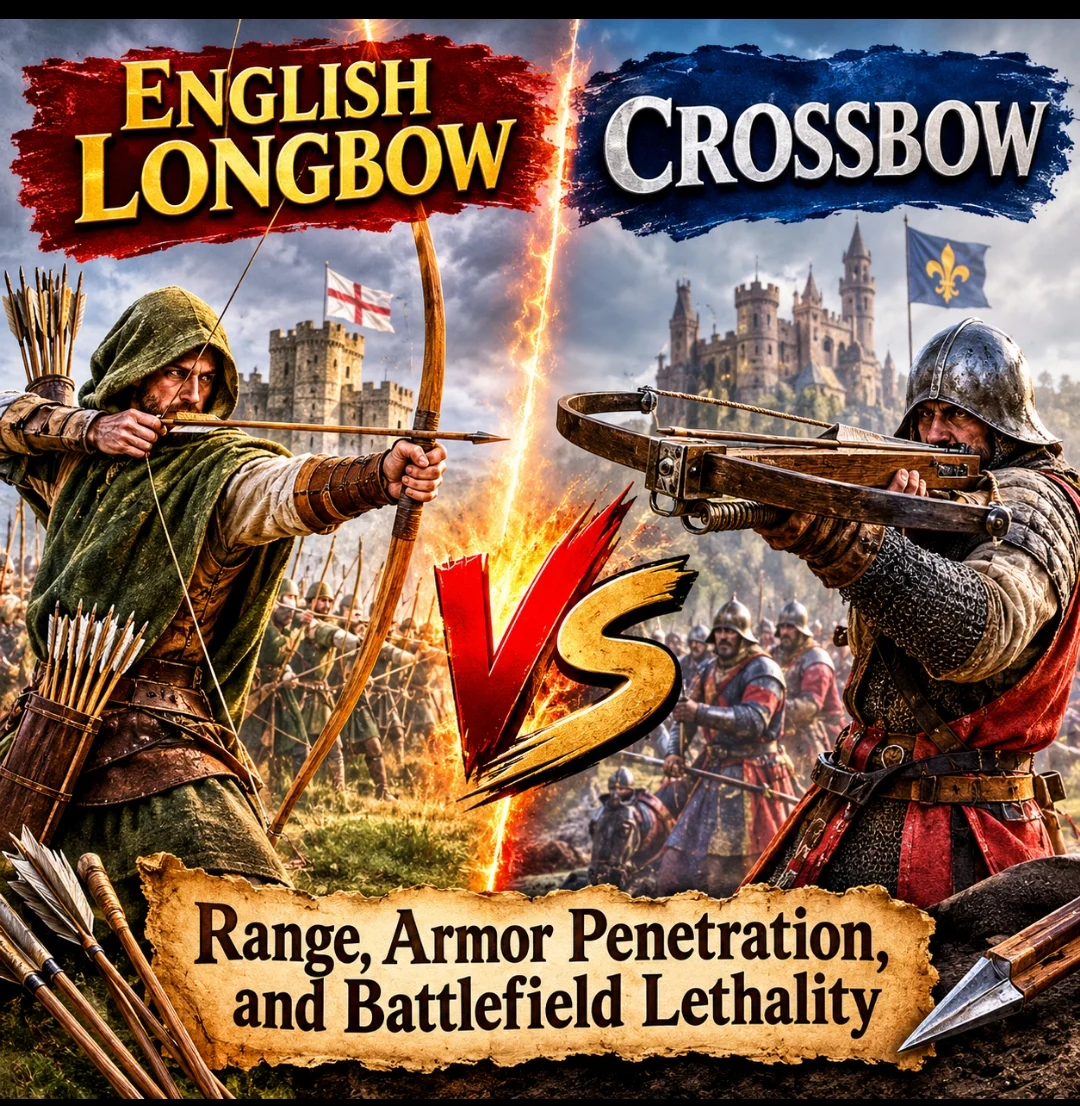
English Longbow vs Crossbow: Range, Armor Penetration, and Battlefield Lethality
The medieval battlefield witnessed a technological rivalry that shaped European warfare for centuries: the English Longbowbbbwhttps English Longbow versus the Crossbow.
Both weapons transformed military tactics, but they represented two very different approaches to ranged warfare. The English longbow relied on the physical strength and lifelong training of its archer, while the crossbow used mechanical power to launch heavy bolts with considerable force.
During the Hundred Years’ War, these weapons demonstrated their strengths and weaknesses in some of Europe’s most famous battles. Their effectiveness depended on range, training, firing speed, battlefield conditions, and the development of medieval armor.
1. Mechanical Design and Draw Weights
The English longbowThe English longbow was traditionally manufactured from yew wood, a material valued for its natural combination of flexibility and strength.
Its outer sapwood provided resistance to tension, while the darker inner heartwood handled compression. Together, these properties allowed the bow to store considerable energy when drawn.
English war bows were commonly around six feet long, although dimensions varied. Many military bows required draw weights exceeding 100 pounds, with some estimates reaching considerably higher figures.
Operating such a weapon required exceptional physical conditioning. Archers developed their strength through years of regular practice, making longbow training a demanding lifelong commitment.
The crossbow followed a different engineering principle. Instead of relying entirely on the user’s physical strength, it stored energy in a rigid bow mounted horizontally on a stock.
Early crossbows used wooden and composite construction, while later medieval examples increasingly incorporated steel prods. Powerful examples required specialized mechanical devices to draw the string.
However, draw weight alone does not determine a weapon’s effectiveness. The length of the power stroke, efficiency of energy transfer, bolt weight, and projectile velocity all influenced battlefield performance.
2. Rate of Fire and Reloading Mechanisms
One of the greatest advantages of the English longbowEnglish longbow was its firing speed.
A highly trained English archer could potentially release around 6 to 12 arrows per minute under favorable conditions. The actual rate depended on fatigue, distance, accuracy requirements, and battlefield circumstances.
The crossbow was generally slower to reload, particularly when using powerful steel prods. Its firing rate depended heavily on the spanning mechanism.
- Stirrup and Belt Hook: Allowed the crossbowman to use body weight to draw the string.
- Goat’s Foot Lever: Provided mechanical assistance and made drawing stronger crossbows easier.
- Cranequin: Used a geared mechanism to span powerful crossbows.
- Windlass: Employed pulleys and a crank to draw extremely powerful crossbows.
A typical military crossbowman could fire considerably fewer bolts per minute than a skilled longbowman.
This difference became particularly important during prolonged engagements, where sustained volleys could disrupt enemy formations and pressure advancing troops.
3. Ballistic Range and Maximum Lethal Distance
Range is one of the most frequently debated aspects of the longbow-versus-crossbow comparison.
Both weapons could launch projectiles over considerable distances, but maximum flight distance should not be confused with effective battlefield range.
English longbows were capable of impressive shooting distances. Under favorable conditions, reconstructed military bows have demonstrated ranges of several hundred yards when fired at elevated angles.
However, such distances were not necessarily useful for accurately striking individual enemy soldiers.
Crossbows also demonstrated considerable range. Powerful examples could launch heavy bolts over long distances, while their relatively stable stocks provided an aiming advantage for individual shots.
Ultimately, neither weapon possessed a universal range advantage. Their practical effectiveness depended on construction, projectile design, and shooting conditions.
4. Armor Penetration: Bodkin Arrows vs Heavy Crossbow Bolts
Armor penetration remains one of the most controversial aspects of medieval weapons research.
English longbow arrows often used narrow, pointed heads designed for military purposes. Some bodkin-style arrowheads featured relatively narrow profiles that could concentrate force against certain protective materials.
Crossbow bolts, commonly called quarrels, were often shorter and heavier than longbow arrows.
Their mass and construction could make them particularly dangerous against lightly armored troops and certain types of protective equipment.
However, neither weapon could reliably penetrate every form of medieval armor.
Against mail armor, padded garments, and less sophisticated protection, both weapons could cause serious injuries.
By the fifteenth century, wealthy knights increasingly wore carefully shaped steel plate harnesses. The quality, thickness, curvature, and metallurgical properties of the armor significantly influenced its resistance to projectiles.
A direct hit did not automatically mean penetration. Even when an arrow or bolt failed to pierce the plate, the impact could still injure the wearer or damage equipment.
The most accurate conclusion is that armor penetration depended on the specific weapon, projectile, distance, impact angle, and armor quality.
5. Tactical Deployments: Crécy and Agincourt
The Battle of Crécy (1346)
The Battle of Crécy demonstrated the tactical importance of disciplined English archers.
English forces used defensive positions and terrain to their advantage. Their longbowmen delivered repeated volleys against advancing French troops.
The French army faced serious difficulties as mounted knights and infantry struggled to advance under missile fire.
The battle demonstrated that coordinated archery, defensive positioning, and battlefield discipline could challenge traditional cavalry tactics.
The Battle of Agincourt (1415)
Agincourt became another defining moment in the history of the English longbow.
The French army advanced through a narrow and muddy battlefield, where movement became increasingly difficult.
English archers played a major role in disrupting the French advance. Their arrows, combined with difficult terrain and the pressure of close combat, contributed to the French defeat.
Agincourt demonstrated that military success depended on more than the individual strength of a weapon. Terrain, leadership, coordination, and battlefield conditions could determine the outcome of an engagement.
The Crossbow on Medieval Battlefields
Crossbows were widely used throughout medieval Europe, particularly by continental European armies and city militias.
Genoese crossbowmen gained a reputation as skilled professional soldiers and were employed in numerous military campaigns.
Crossbows were also valuable in defensive warfare, especially during sieges, where soldiers could fire from protected positions.
Their relatively straightforward basic operation made them useful for armies that could not maintain the same level of specialized physical training required by English longbowmen.
6. Longbow vs Crossbow: Direct Comparison
English Longbow
- Power Source: Human muscular strength.
- Construction: Traditionally yew wood.
- Projectile: Long wooden arrow.
- Firing Speed: Generally faster.
- Training: Extensive physical conditioning and practice.
- Reloading: No mechanical spanning device required.
- Battlefield Strength: Sustained volleys and high missile volume.
- Main Limitation: Demanding physical training and considerable ammunition requirements.
Medieval Crossbow
- Power Source: Mechanical energy stored in the bow.
- Construction: Wood, composite materials, or steel.
- Projectile: Short, relatively heavy bolt.
- Firing Speed: Generally slower.
- Training: Easier to learn basic operation, although skilled shooting still required practice.
- Reloading: Often required mechanical spanning equipment.
- Battlefield Strength: Powerful individual shots and practical use in defensive positions.
- Main Limitation: Slower reloading, particularly with powerful models.
7. Tactical Failures and Common Misconceptions
Several popular assumptions about medieval missile weapons deserve closer examination.
Myth 1: The longbow could penetrate every suit of plate armor.
This is incorrect. High-quality plate armor could resist many arrow impacts, depending on the circumstances.
Myth 2: The crossbow was always more powerful.
Not necessarily. Draw weight is only one factor in projectile performance. Power stroke, efficiency, and projectile characteristics also matter.
Myth 3: Crossbows required no training.
Although basic operation was easier to learn, effective battlefield shooting still required practice, coordination, and experience.
Myth 4: The longbow was always superior because it fired faster.
A faster firing rate was a significant advantage, but it did not make the longbow the ideal weapon for every military situation.
Myth 5: Maximum range represented effective battlefield range.
A projectile traveling hundreds of yards did not necessarily have the accuracy or impact performance required to defeat an enemy at that distance.
8. Expert Research Insights: What Made Each Weapon Effective?
The longbow and crossbow should be understood as complementary military technologies rather than direct replacements for one another.
The English longbow excelled when armies could deploy large numbers of trained archers and maintain sustained missile fire.
Its effectiveness depended on years of preparation, organized formations, sufficient ammunition, and favorable tactical conditions.
The crossbow offered a different military advantage. It allowed armies to field powerful missile weapons without requiring every soldier to undergo the same prolonged physical conditioning as an English war archer.
It was particularly useful in fortifications, sieges, and situations where carefully aimed shots were more important than maintaining a continuous stream of projectiles.
As protective equipment improved, battlefield effectiveness increasingly depended on combined-arms tactics, rather than expecting a single missile weapon to defeat every opponent.
9. Frequently Asked Questions
Which was more powerful, the English longbow or the crossbow?
There is no universal answer. Powerful crossbows could store substantial energy, while longbows benefited from a much longer power stroke. Actual projectile performance depended on the weapon’s construction and ammunition.
Which weapon fired faster?
The English longbow generally had a higher firing rate. Skilled archers could release several arrows for every bolt fired by a crossbowman.
Could a longbow penetrate medieval plate armor?
Some arrows could penetrate certain armor under favorable conditions, but high-quality plate armor was highly resistant to many projectile impacts.
Why did medieval armies continue using crossbows?
Crossbows offered powerful shots, relatively accessible basic training, and practical advantages in defensive warfare. They remained valuable even when faster missile weapons were available.
Were English longbowmen better than Genoese crossbowmen?
Both groups had important military traditions. Their effectiveness depended on equipment, training, leadership, battlefield positioning, and the circumstances of each engagement.
Which weapon was more effective during the Hundred Years’ War?
The English longbow became particularly influential in major English victories such as Crécy and Agincourt. However, the crossbow remained an important weapon across medieval Europe.
10. Historical Legacy: Two Weapons That Changed Medieval Warfare
The rivalry between the English longbow and the medieval crossbow reveals how technological innovation can transform military strategy.
The longbow demonstrated the extraordinary battlefield potential of disciplined soldiers trained to deliver sustained volleys.
The crossbow demonstrated how mechanical engineering could make powerful missile weapons accessible to a wider range of military forces.
Neither weapon was universally superior. Each represented a different solution to the same military challenge: delivering lethal force across a battlefield.
Their history reminds us that medieval warfare was shaped not only by weapons themselves but also by the people who used them, the armies that organized them, and the conditions under which battles were fought.
The Longbow vs Crossbow debate is ultimately a story of engineering, training, and battlefield strategy — two remarkable weapons that helped shape the history of medieval EuropeDiscover the differences between the English longbow and medieval crossbow, comparing range, firing speed, armor penetration, and battlefield effectiveness.