
0Damascus Steel: Ancient Metallurgy and Legendary Blades
Damascus steel remains one of the greatest metallurgical triumphs of the ancient and medieval worlds. Across the battlefields of the Levant, European crusaders encountered weapons that defied Western understanding of iron craftsmanship. Swords forged from authentic Damascus steel possessed a lethal balance of razor sharpness and shock-absorbing flexibility.
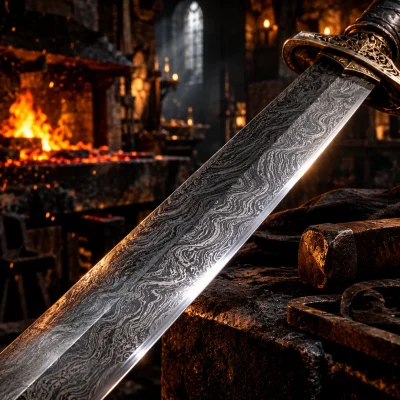
These curved blades could slice through heavy textiles without snagging, deflect direct blows from European iron weapons, and rebound without taking permanent bends. Beyond their physical performance in combat, the blades displayed shimmering, swirling surface patterns resembling flowing water or rippled silk.
The artisans of Syria, Persia, and the broader Islamic world guarded these manufacturing processes with extreme secrecy. By the early nineteenth century, the traditional techniques required to forge true Damascus steel had vanished from global arsenals. Reconstructing the trade networks, thermodynamic conditions, and micro-chemical structures behind these blades reveals how ancient artisans outpaced early modern chemistry by over a millennium.
Crucible Origins: From Indian Wootz to Syrian Forges
The name Damascus steel reflects commerce rather than mining geography. The raw materials used to craft these legendary blades did not originate in Syria. The metallurgical foundation was crucible steel ingots called wootz, manufactured primarily in southern and central India and Sri Lanka.
As early as 300 BC, Indian metallurgists developed closed-crucible smelting systems that generated levels of heat and purity unattainable in European bloomery furnaces. These regional craftsmen loaded porous clay crucibles with selected iron ores, dried wood chips, charcoal, and leaves from carbon-heavy flora like Cassia auriculata.
They sealed the vessels with airtight clay lids to prevent atmospheric oxygen from oxidizing the charge. The workers then placed dozens of these sealed capsules into stone furnaces powered by forced-draft bellows, maintaining steady operating temperatures exceeding 1,200°C.
Inside the high-temperature environment of the crucible, the iron melted and absorbed carbon from the charred organic matter. This reaction reduced brittle iron oxides and separated liquid slag from the metallic mass. The glass added to the charge formed a protective liquid layer, shielding the molten metal from furnace gases.
When the smelting cycle ended, furnace hands allowed the crucibles to cool at deliberate, painstakingly slow rates over several days. The internal thermal conditions permitted carbon to segregate into distinct crystalline structures. Workers then broke the clay shells open, extracting dense, rounded cakes of hyper-eutectoid crucible steel known as wootz.
+-------------------------------------------------------------------------+
|                  Wootz Crucible Smelting Process                        |
|                                                                         |
|  [ Iron Ore + Plant Carbon + Glass Flux ]                               |
|                     │                                                   |
|                     ▼                                                   |
|  [ Sealed Airtight Clay Crucible ]                                       |
|                     │                                                   |
|                     ▼                                                   |
|  [ Forced-Draft Furnace (Exceeding 1,200°C) ]                           |
|                     │                                                   |
|                     ▼                                                   |
|  [ Slow Controlled Cooling: Ferrite & Cementite Separation ]            |
|                     │                                                   |
|                     ▼                                                   |
|  [ High-Carbon Wootz Ingot -> Forged into Damascus Steel ]              |
+-------------------------------------------------------------------------+
These raw wootz cakes traveled across established maritime passages in the Indian Ocean, sailing up the Persian Gulf and Red Sea before entering overland caravan routes. Caravans delivered the ingots to manufacturing hubs in Damascus, Isfahan, and Aleppo.
Master metalsmiths in Syria learned that reheating wootz required narrow, unforgiving thermal windows. Striking the ingot at bright orange or white heat caused the metal to crumble immediately.
Working the steel at lower cherry-red heats allowed the smiths to draw out the metal while preserving its unique carbon microstructure. Because Damascus was the primary trade nexus where European merchants, diplomats, and crusading armies bought these finished weapons, the distinctive alloy became known globally as Damascus steel.
Microscopic Chemistry: Impurity Fingerprints and Nanotubes
For centuries, European guilds believed the secret to Damascus steel lay solely in folding techniques. Blacksmiths across the Rhine and Danube tried to recreate the blades by pattern-welding strips of soft iron and hard steel.
While pattern-welding produced striking geometric ripples, it lacked the microscopic composition and cutting endurance of crucible steel. Authentic Damascus steel derived its strength from trace elements embedded in specific iron ore beds.
Advanced spectrometric analyses of historic artifacts—including those documented in External Link: Britannica Metallurgical Analysis of Damascus Steel{target=”_blank”}—confirm that wootz steel contained precise trace impurities:
-
Vanadium, Tungsten, and Molybdenum: Present in microscopic fractions, often between 0.001% and 0.005%, these carbide-forming elements proved critical for thermal carbide segregation.
-
High Carbon Concentrations: Levels consistently hovered between 1.2% and 1.8%, an amount that would make standard bloomery steel brittle and unworkable.
-
Cementite Particle Arrays: Microscopic layers of ultra-hard iron carbide ($Fe_3C$) clustered in planar sheets within a ductile, shock-absorbing pearlite matrix.
In 2006, researchers at the University of Dresden conducted high-resolution transmission electron microscopy on an authentic seventeenth-century Persian saber. The team made a startling discovery: carbon nanotubes and cementite nanowires ran throughout the steel matrix.
During the repeated cycles of low-heat forging and cooling, trace vanadium impurities segregated into parallel sheets. These chemical boundaries guided the precipitation of cementite particles into neat bands, while organic compounds within the crucible fostered the growth of cylindrical carbon nanotubes.
+---------------------------------------------------------------+
|         Microscopic Cross-Section: Damascus Steel             |
+---------------------------------------------------------------+
|  Soft, Ductile Pearlite Matrix (Absorbs Mechanical Shocks)    |
|  ══════════════════════════════════════════════════════════   |
|  Ultra-Hard Iron Carbide ($Fe_3C$) Banding + Nanotubes        |
|  ══════════════════════════════════════════════════════════   |
|  Alternating Ferrite-Pearlite Layer (Prevents Full Cleaving)  |
+---------------------------------------------------------------+
This microscopic matrix gave Damascus steel its balance of hardness and resilience. As the softer iron matrix wore down slightly through continuous use, the harder cementite arrays remained exposed along the edge.
This wear pattern produced micro-serrations, transforming the blade edge into a microscopic saw. The weapon could slice deep into leather, textile padding, and flesh while the softer surrounding iron absorbed mechanical shock, preventing the blade from fracturing under impact.
Tactical Dominance: Damascus Steel in Medieval Warfare
The appearance of Damascus steel across Near Eastern battlefields transformed close-quarters cavalry combat. European armies relied on heavy shock tactics, deploying mounted knights armed with straight double-edged broadswords designed to crush defensive armor through mass and blunt force.
Islamic armies developed tactics centered on mobility, fluid horse-archery, and rapid counter-charges. The light, curved blades of the East, such as the Persian shamshir and Ottoman kilij, favored drawing cuts over heavy cleaving blows.
When wielded by mobile horsemen, a curved saber of Damascus steel concentrated kinetic force onto a small, sliding contact point along the target. The razor-sharp cementite edge could easily slice through padded wool gambesons and split the riveted rings of standard mail armor.
Unlike softer European iron swords that dulled quickly after striking metal, blades crafted from Damascus steel retained their sharp edges through sustained engagements. Warriors rarely needed to carry secondary replacement weapons into battle.
+----------------------+-----------------------+-----------------------+
| Performance Metric   | True Damascus Steel   | European Pattern Iron |
+----------------------+-----------------------+-----------------------+
| Carbon Percentage    | 1.2% to 1.8%          | 0.3% to 0.7%          |
| Edge Retention       | Exceptional (Vickers  | Moderate; requires    |
|                      | hardness > 600 HV)    | constant field honing |
| Structural Ductility | High; internal bands  | Brittle if quenched;  |
|                      | disperse fractures    | bends if untreated    |
| Micro-Structure      | Natural cementite     | Mechanical weld lines |
|                      | arrays with nanotubes | without carbide bands |
+----------------------+-----------------------+-----------------------+
These blades proved equally effective on defense. A cavalryman parrying an incoming heavy blade needed a weapon that would neither bend out of shape nor shatter upon impact.
A sword made from authentic Damascus steel dispersed kinetic shock throughout its interior pearlite matrix. The blade flexed slightly under stress, protected by its alternating layers of hard carbide and softer iron, and returned straight without permanent warping.
This resilience gave cavalry forces a distinct advantage during chaotic skirmishes. A shattered blade meant certain death, but a warrior carrying Damascus steel could trade blows with heavy weaponry and keep fighting.
The psychological impact of these weapons proved just as formidable as their physical performance. The distinct, shimmering grain on the blade’s surface—referred to as the johar or watering—became an unmistakable symbol of authority and martial prestige.
Soldiers viewed the swirling patterns as proof of authentic crucible origins and lethal reliability. Dynastic rulers, senior emirs, and elite units, much like the royal retinues of the ancient Mediterranean, considered these blades irreplaceable heirlooms.
Possessing a certified weapon forged from genuine Damascus steel projected high social standing, military influence, and tactical capability on the battlefield.
Preserving Historic Arms: Parallels to Mediterranean Militaries
The logistical effort required to produce and distribute crucible steel highlights how states organized military equipment in the ancient world. Elite units throughout antiquity relied on specialized regional supply chains to acquire top-tier gear.
The Roman imperial army, for instance, sourced weapons through state-run armories, equipping shock infantry with advanced mail defenses like [Internal Link: The Lorica Hamata].
Centuries later, Islamic empires built international supply corridors to move raw Indian wootz into Syrian production centers.
Both systems demonstrate how successful military powers integrated specialized metallurgists, secured maritime routes, and provided elite soldiers with equipment superior to their adversaries’ weapons.
The Vanishing Art: Why the Crucible Tradition Disappeared
By the close of the eighteenth century, the production of authentic Damascus steel began to decline, and by the mid-1800s, the traditional process had vanished entirely.
The disappearance of this ancient manufacturing method puzzled historians and metallurgists for generations. Modern archival research and mineral surveys reveal that the loss was not caused by a single event, but by the collapse of an interconnected production chain.
[Depletion of Indian Ore Veins] ───┐
                                   ├──► [Systemic Collapse of Damascus Steel]
[Severed Indian Ocean Trade Lines] ──┤
                                   │
[Breakdown of Master Lineages] ─────┘
Three primary factors caused the loss of authentic Damascus steel:
1. Exhaustion of Key Indian Iron Ore Beds
The crucial driver of the crucible technique was the presence of trace elements within the iron ores of southern India, particularly in regions like Telangana and Kodumanal. These mineral deposits naturally contained microscopic amounts of vanadium, molybdenum, and tungsten.
By the late eighteenth century, miners had exhausted these specialized iron veins. When smiths tried to process ores from alternative deposits, the steel lacked the critical carbide-forming elements required to produce the characteristic banded cementite patterns.
2. Disruption of Global Trade Corridors
The expansion of colonial powers across the Indian subcontinent disrupted ancient commercial networks. The British East India Company secured monopolies over shipping routes, imposed heavy taxes on domestic smelting furnaces, and dismantled traditional trade conduits running from the Indian Ocean to the Persian Gulf.
Deprived of their steady supply of Indian wootz ingots, bladesmiths in Syrian and Persian workshops could no longer obtain the raw materials needed to manufacture Damascus steel.
3. Loss of Master-Apprentice Guild Knowledge
Crucible smelting and low-heat forging were craft secrets passed down orally through apprentice lineages. Ancient smiths did not possess optical pyrometers, thermocouple gauges, or written chemical charts.
Instead, they judged heat cycles by the color of the glowing metal, the smell of furnace fumes, and the sound of hammer strikes. When trade interruptions halted wootz imports for multiple generations, master smiths died without passing their skills to younger apprentices.
Later blacksmiths who attempted to work with new iron ingots found that the metal cracked apart under the hammer. Without the trace elements that made the original alloy ductile at low temperatures, they abandoned the process entirely.
Modern Pattern Welding vs. Historic Damascus Steel
A common point of confusion among modern knife collectors and historical enthusiasts is the difference between antique crucible steel and modern pattern-welded products.
Most modern blades sold commercially as Damascus steel are not produced from wootz crucibles. Instead, modern manufacturers rely on mechanical pattern welding, a technique dating back to Celtic, Roman, and Viking traditions.
In the modern pattern-welding process, a knifemaker stacks alternating plates of high-carbon steel and high-nickel alloy into a billet. The maker heats the stacked block inside an forge, applies flux to prevent oxidation, and forge-welds the layers together with a hydraulic press or power hammer.
The smith twists, ladders, or grooves the layered bar, draws it out into a blade shape, and immerses the finished steel into a bath of ferric chloride acid. The acid eats away the carbon steel faster than the nickel-bearing alloy, creating a stark, high-contrast surface pattern.
+---------------------------------------------------------------+
|               Crucible Steel vs. Modern Layering              |
+-------------------------------+-------------------------------+
| Historical Wootz Damascus     | Modern Commercial Pattern-Weld|
+-------------------------------+-------------------------------+
| Pattern arises internally     | Pattern created by forge-     |
| through slow crystallization  | welding alternating plates of |
| of micro-carbides in a single | contrasting industrial alloys |
| crucible ingot.               | together under a power hammer.|
+-------------------------------+-------------------------------+
| Microscopic saw-tooth edge    | Edge uniform; cutting ability |
| driven by natural cementite   | determined by the baseline    |
| arrays and carbon nanotubes.  | performance of used steels.   |
+-------------------------------+-------------------------------+
Modern pattern-welded blades are functional, durable cutting tools, but their internal structure is distinct from historical crucible steel. Modern knives achieve decorative rippling through mechanical lamination, whereas historic Damascus steel developed its watered pattern from internal crystal segregation during slow crucible cooling.
Recent metallurgy allows researchers to produce high-performance powdered alloys, yet the ancient ability to cultivate nanoscale carbon tubes using clay crucibles, green leaves, and charcoal remains a marvel of early engineering.
The Enduring Legacy of Ancient Specialized Warfare
The history of crucible blades shows that technological superiority in pre-modern warfare relied on materials science as much as battlefield tactics. Just as classical Persian commanders organized elite divisions like those explored in [Internal Link: Persian Immortals Tactics], medieval Islamic rulers maintained specialized forces equipped with superior arms.
Mastering crucible steel gave these armies a tangible tactical edge. Understanding how Damascus steel was forged and used provides valuable insight into how ancient societies developed, protected, and ultimately lost their military technologies.
Frequently Asked Questions
What made authentic Damascus steel superior to European iron weapons?
Historical crucible steel combined a high carbon content (1.2% to 1.8%) with structural flexibility. This balance produced an edge that maintained sharpness through extended combat while resisting chipping. Microscopic bands of hard iron carbide provided a micro-serrated cutting edge, while the surrounding pearlite iron absorbed mechanical shock without snapping.
Can modern blacksmiths replicate genuine Damascus steel?
Modern metallurgists have synthesized wootz-type steel in controlled laboratory environments by introducing minute amounts of vanadium and carefully monitoring cooling cycles. However, the majority of commercially available blades marketed today as Damascus steel are pattern-welded metals, created by forge-welding alternating layers of modern alloys rather than casting crucible ingots.
Why did historical production of Damascus steel come to an end?
Production ended in the nineteenth century due to three linked developments: the depletion of specific Indian iron ore beds containing essential trace impurities, the collapse of Indian Ocean trade routes under European colonial monopolies, and the break in master-apprentice traditions that cost blacksmiths their knowledge of specific low-temperature forging windows.