
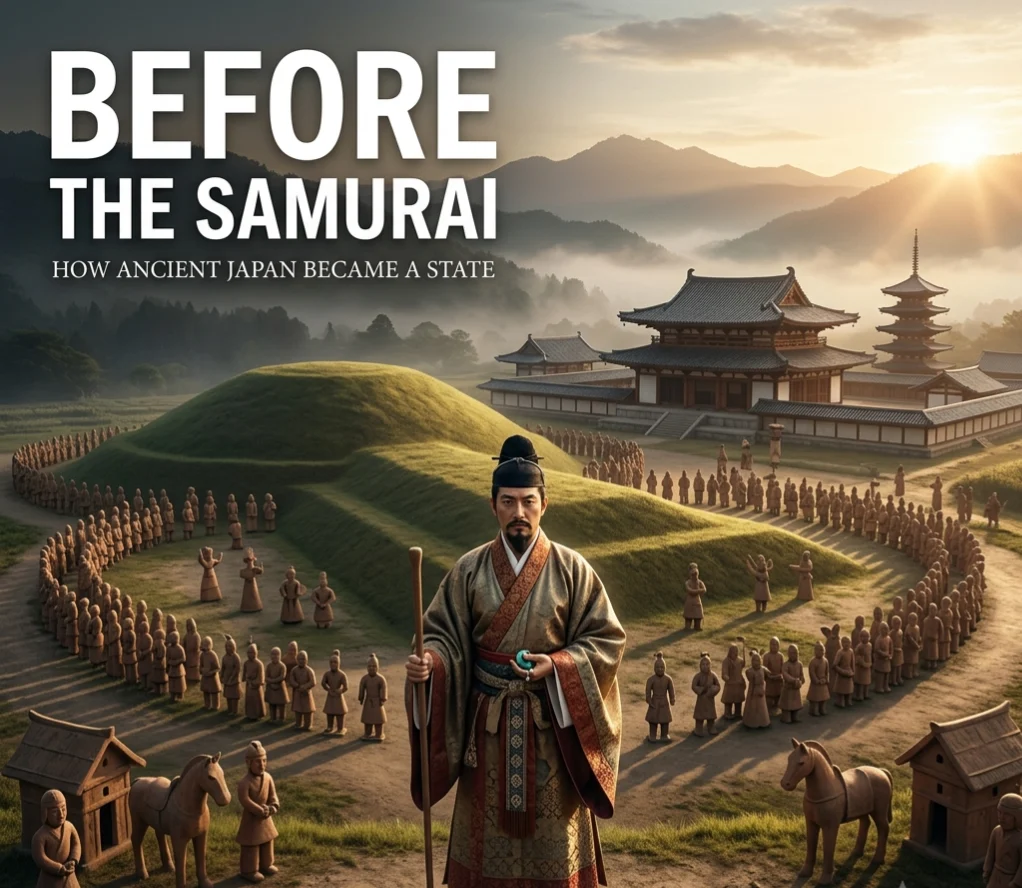
Ancient Japan: The Sacred Rise of a Centralized State
Centuries before mounted warriors and feudal warlords dominated the archipelago, Ancient Japan underwent an institutional revolution that permanently unified its scattered clans. The foundational identity of the country was forged not by armored bushido knights, but through the patient construction of a bureaucratic empire.
The transformation of Ancient Japan required a massive shift from decentralized chieftain confederacies into an organized imperial state. By adopting continental writing systems, codifying statutory law, and mobilizing thousands of laborers to raise monumental earthworks, early monarchs established an enduring imperial lineage that outlasted every subsequent warrior regime.
The Landscape Before Centralization: Regional Clan Autonomy
Before the rise of a single sovereign court, Ancient Japan was a fragmented network of autonomous regional clans known as uji. Each uji claimed descent from a distinct ancestral deity (ujigami), governing localized agrarian settlements along fertile river valleys.
Political authority was inseparable from lineage ritual:
-
The clan patriarch (uji no kami) served simultaneously as military commander and chief high priest, mediating directly between divine spirits and the living community.
-
Hereditary occupational corporations (be) were attached to dominant clans, supplying blacksmiths, weavers, potters, and farmers bound to familial service.
-
Warfare was frequent and deeply personal, characterized by sudden raids and skirmishes over wet-rice paddies and coastal fishing grounds.
-
Bronze mirrors, ritual bells (dōtaku), and iron blades functioned as diplomatic prestige gifts rather than standardized market currencies.
These fragmented communities lacked centralized legal codes or permanent municipal capitals. Authority was strictly territorial, bounded by physical geographic barriers that divided Honshu into competitive, defensible river plains.
To transform this fractious archipelago into a cohesive nation, one lineage had to establish spiritual and logistical supremacy over its rivals. That consolidation began in the Kinai basin, setting the stage for the emergence of the Yamato court.
The Kofun Revolution: Monumental Earthworks of Ancient Japan
The physical consolidation of Ancient Japan became visible during the Kofun period, spanning roughly from the third century to the sixth century CE. The era takes its name from the colossal earthen burial mounds constructed for deceased monarchs and regional magnates.
These tombs were not simple graves, but engineered territorial landmarks:
-
Keyhole Architecture (Zenpō-kōen-fun): Tumuli engineered with a square front and a rounded rear, surrounded by wide defensive water moats.
-
The Daisen Kofun: The monumental tomb attributed to Emperor Nintoku in Sakai, measuring nearly five hundred meters in length and covering more land area than the Great Pyramid of Giza.
-
Mass Labor Mobilization: Constructing an elite kofun required moving millions of cubic feet of soil and stone, demanding the coordinated labor of thousands of workers over decades.
-
Grave Goods: Chambers within the mounds contained iron lamellar armor, straight single-edged swords (chokutō), gilt-bronze crowns, and cast bronze mirrors imported from Han and Wei dynasty China.
Surrounding the terraces of these earthen mounds stood thousands of terracotta cylinders and sculptures known as haniwa. These hollow clay figures represented armored foot soldiers, cavalry horses with iron stirrups, shamans, grain storehouses, and water birds.
The widespread construction of identical keyhole mounds across Honshu and Kyushu confirmed the expanding authority of Ancient Japan. Regional chieftains adopted the Yamato burial geometry voluntarily or through coercion, acknowledging their incorporation into a unified ceremonial hierarchy.
Engineering advancements [Internal Link: Classical Logistics and Imperial Expansion] demonstrated that state formation across antiquity consistently depended on mobilizing mass agrarian labor for monumental construction.
Continental Connections: The Inflow of Technology and Iron
The evolution of Ancient Japan did not occur in geographic isolation. The archipelago maintained continuous maritime contacts with the Korean peninsula—particularly the kingdoms of Baekje and Gaya—and continental China.
Waves of skilled immigrant clans, known collectively as toraijin, settled in the Yamato basin, bringing advanced technical expertise:
-
High-Fire Ceramics (Sueki): Dense, gray stoneware fired in oxygen-reducing tunnel kilns (anagama) at temperatures exceeding 1,100 degrees Celsius.
-
Hydraulic Civil Engineering: Techniques for constructing stone-lined irrigation reservoirs, canals, and elevated dikes that maximized wet-rice production.
-
Advanced Iron Metallurgy: High-grade bloomery iron production, which supplied early military forces with durable tools and standardized armor plates.
-
The Written Word: Classical Chinese characters (kanbun), which provided the initial medium for keeping royal inventories, tax registers, and genealogical records.
These immigrant technicians were organized by the Yamato rulers into specialized administrative units. By controlling the distribution of imported iron ingots and continental craft skills, the central court achieved material supremacy over peripheral clan rivals.
Diplomatic missions crossed the rough waters of the Tsushima Strait regularly. The Yamato court dispatched military aid to its continental ally Baekje, receiving in return scholars, scribes, physicians, and metallurgists who accelerated the institutional development of Ancient Japan.
Religious Metamorphosis: Buddhism and Political Conflict
In 552 CE, King Seong of Baekje sent a bronze statue of the historical Buddha along with sacred sutras to the court of Yamato. This diplomatic gift ignited an intense political conflict that fundamentally altered the ideological foundation of Ancient Japan.
The debate over the new continental faith pitted two powerful court factions against each other:
-
The Soga Clan: Influential court administrators with close ties to continental immigrant lineages, who championed Buddhism as a modern ideology of universal statecraft and international prestige.
-
The Mononobe and Nakatomi Clans: Traditional military and ceremonial lineages who opposed foreign deities, arguing that adopting Buddhism would provoke the wrath of the native kami (local spirits).
This ideological rift was ultimately resolved through military action. In 587 CE, at the Battle of Shigisan, the Soga forces crushed the Mononobe military faction, securing the institutional survival of Buddhism in Ancient Japan.
Rather than replacing native spiritual beliefs, Buddhism merged with indigenous ancestor worship to form a complementary religious system. Shinto rites maintained ritual purity and local agricultural fertility, while Buddhist philosophy provided universal cosmic laws, moral order, and sophisticated temple architecture.
Under royal patronage, magnificent wooden temple complexes arose across the Yamato landscape. Hōryū-ji, founded by Prince Shōtoku in 607 CE, still preserves the oldest surviving wooden architecture on earth, physical proof of the sophisticated carpentry and engineering mastery achieved during the consolidation of Ancient Japan.
Prince Shōtoku and the Ideology of Centralization
The quest for political stability in Ancient Japan reached its initial philosophical expression under the regency of Prince Shōtoku (574–622 CE). Serving under his aunt, Empress Suiko, Shōtoku sought to elevate the sovereign above the squabbling interests of aristocratic clans.
In 603 CE, the court enacted the Twelve Level Cap and Rank System:
-
Hereditary clan status was bypassed in favor of individual merit, ethical character, and court service.
-
Officials were awarded silk caps of distinct colors corresponding to Confucian virtues: virtue, benevolence, propriety, sincerity, justice, and knowledge.
-
Rank belonged strictly to the individual bureaucrat and could not be automatically inherited by descendants.
This was complemented in 604 CE by the promulgation of the Seventeen-Article Constitution. This text was not a modern legal statute, but a moral and administrative manifesto blending Confucian ethics with Buddhist metaphysics.
The document instructed officials to revere the Three Treasures of Buddhism, resolve disputes through open consensus, and recognize the supreme, undivided authority of the throne. Shōtoku declared that in a properly ordered state, the monarch is the sole master of the realm, and the people are subjects of the sovereign rather than property of local clans.
To assert international parity, Shōtoku dispatched official embassies directly to the court of Sui China in 607 CE. The famous diplomatic dispatch opened with the bold assertion: “From the sovereign of the land where the sun rises, to the sovereign of the land where the sun sets.” For the first time, Ancient Japan articulated an independent imperial identity equal to that of the Chinese Emperor.
The Taika Reforms of 645 CE: Structural State Building in Ancient Japan
The growing power of the Soga clan eventually threatened the imperial throne itself. By 645 CE, Soga no Iruka was exercising autocratic influence over the court, alienating rival nobles and imperial princes.
In a dramatic palace coup known as the Isshi Incident, Prince Naka no Ōe and Nakatomi no Kamatari assassinated Iruka before the throne. This political purge cleared the way for the Taika (“Great Change”) Reforms, the legal revolution that formally codified the centralized institutions of Ancient Japan.
The Taika edicts replaced decentralized clan ownership with universal public law:
-
Abolition of Private Estates: All agricultural land and enslaved labor holdings (be) formerly owned by clans were confiscated and declared public property (kōchi kōmin) of the imperial throne.
-
Standardized Census Allocation: Under the Handen Shūju system, arable land was surveyed and redistributed equally to peasant households based on family size every six years.
-
Uniform National Taxation: In exchange for land grants, farmers paid three standardized taxes: grain (so), local artisanal products such as silk and iron (chō), and mandatory labor service (yō).
-
Provincial Administrative Grid: The country was divided into sixty-six formal provinces (kuni), subdivided into districts (gun) and villages (ri), governed by imperial magistrates dispatched directly from the court.
These structural edicts transformed the loose Yamato confederacy into the ritsuryō state—a legalistic administrative empire operating under written penal laws (ritsu) and administrative regulations (ryō).
Legal and administrative evolutions [Internal Link: Imperial Bureaucracy in Antiquity] underscored how early dynastic regimes consistently employed uniform taxation codes to neutralize the power of provincial landed aristocracies.
Tactical Weapons and Warfare of the Ritsuryō Era
The military structure of Ancient Japan during the seventh and eighth centuries was organized around a national peasant conscription system, completely distinct from the later private warrior bands of the samurai.
Under the Taihō Code of 701 CE, one-third of all eligible adult male peasants between the ages of twenty and sixty were conscripted into regional military regiments (gundan):
-
The Peasant Infantry: Conscripts were trained to fight in disciplined formations, armed with ash-shafted thrusting pikes (yari) and iron-headed spears.
-
The Static Crossbow (Oyumi): Massive, tripod-mounted siege crossbows capable of hurling heavy bolts into attacking cavalry lines, operated by specialized artillery squads.
-
Composite Longbows: Asymmetrical wooden longbows wrapped with cane and silk cords, firing reed arrows tipped with barbed iron points.
-
Tankō Armor: Heavy iron cuirasses forged from solid plates riveted together, designed to shield foot soldiers from frontal spear thrusts and arrows.
-
Keikō Armor: Flexible, hanging lamellar cuirasses composed of hundreds of individual lacquered iron plates laced with silk cords, adapted for cavalry mobility.
This standing army faced its greatest external test in 663 CE at the Battle of Baekgang along the coast of Korea. A Yamato expeditionary fleet sent to restore the fallen kingdom of Baekje was annihilated by a coordinated Tang Chinese and Silla naval force, losing hundreds of ships to fire ships in a single afternoon.
The catastrophic defeat triggered an immediate defensive mobilization across Ancient Japan. Fearing an imminent Tang invasion, the court constructed massive stone-walled mountain fortresses, such as Kaneda Castle on Tsushima Island, and established the Sakimori—coastal border guard regiments stationed along the beaches of northern Kyushu.
+---------------------------------------------------------------------------------+
|                       POLITICAL EVOLUTION OF ANCIENT JAPAN                      |
|                                                                                 |
|  [Fragmented Uji Chieftains]  (Regional Clans, Shinto lineage shrines)          |
|             |                                                                   |
|             v                                                                   |
|  [Kofun Monumental Era]       (3rd-6th C: Keyhole tumuli, Yamato hegemony)      |
|             |                                                                   |
|             v                                                                   |
|  [Continental Integration]    (552 CE: Buddhism arrives, Chinese writing)       |
|             |                                                                   |
|             v                                                                   |
|  [Taika Legal Revolution]     (645 CE: Public land, census, ritsuryō codes)     |
|             |                                                                   |
|             +-------------------------+-------------------------+               |
|             |                         |                         |               |
|             v                         v                         v               |
|  [Nara Imperial Capital]    [Provincial Kokubun-ji]   [National Conscription]   |
+---------------------------------------------------------------------------------+
Heijō-kyō: The Monumental Splendor of Nara
A centralized state required an imposing, permanent political capital to display its sovereign authority. In 710 CE, Empress Genmei transferred the court to Heijō-kyō (modern Nara), initiating the monumental peak of the classical era of Ancient Japan.
Nara was laid out on a rigid, rectangular grid pattern modeled directly after the Tang dynasty capital of Chang’an:
-
A massive central boulevard, Suzaku Avenue, divided the metropolis into eastern and western administrative sectors.
-
The northern terminus was crowned by the Heijō Palace enclosure, containing the imperial residence, chanceries, and assembly halls.
-
Over one hundred thousand residents inhabited the planned city, including aristocrats, scribes, monks, artisans, and merchant guilds.
To spiritually protect the state from epidemics, famines, and rebellions, Emperor Shōmu ordered the construction of Tōdai-ji in the eighth century. Inside the Great Buddha Hall—one of the largest wooden buildings ever constructed—artisans cast the Daibutsu, an enormous bronze statue of Vairocana Buddha standing over fifteen meters high and containing hundreds of tons of copper, tin, and gold.
Shōmu went further, decreeing the construction of provincial monasteries (kokubun-ji) and nunneries (kokubun-ni-ji) in every province across Ancient Japan. This sacred network bound peripheral administrative districts directly to the ritual authority of the Nara court, turning religion into an instrument of national defense.
Archaeological Evidence: The Scribes and Wooden Slips
Our modern understanding of the administrative mechanics of Ancient Japan has been revolutionized by urban archaeological excavations within the Nara basin. While historical texts like the Kojiki (712 CE) and Nihon Shoki (720 CE) present idealized imperial mythologies, everyday material culture exposes the raw administrative reality.
The most transformative discovery was the recovery of tens of thousands of mokkan—thin wooden slips used for writing before paper became cheap and abundant:
-
Tax Shipment Tags: Wooden slips tied to bundles of dried abalone, rice, salt, and silk fabrics excavated from palace storehouses, recording the tax obligations of specific villages down to the precise date.
-
Administrative Notes: Scraps containing official reprimands, medical prescriptions, guard duty rosters, and practice calligraphy written by junior scribes.
-
Court Rations: Slips documenting beer, melon, and fish rations distributed to laborers building the Tōdai-ji temple complex.
Excavations at the Asuka Palace site have also uncovered complex water clocks (rokoku), stone turtle monuments, and advanced drainage channels, demonstrating the mathematical precision governing everyday court life.
The archaeological record proves that the bureaucracy of Ancient Japan was not a ceremonial fiction. It was an active, record-keeping machine that monitored population shifts, agricultural yields, and material logistics with forensic discipline.
Why the Conscript Army Collapsed: The Seeds of the Samurai
The centralized administrative model of Ancient Japan contained internal economic flaws that eventually caused its military framework to unravel. By the late eighth century, the universal conscription system was collapsing under severe social strain.
The reasons for this military breakdown were structural:
-
Peasant Exhaustion: Peasant conscripts were forced to provide their own weapons, food rations, and travel gear, driving thousands of farming families into debt and desertion.
-
Ineffective Infantry: Untrained peasant foot soldiers proved ineffective against the mounted guerrilla tactics of the Emishi, the indigenous tribal peoples of northern Honshu.
-
Privatization of Land (Shōen): To encourage the reclamation of wasteland, the court passed laws in 743 CE granting permanent tax-exempt status to newly cleared agricultural fields.
-
The Rise of Private Estates: Wealthy Buddhist temples and aristocratic families like the Fujiwara consolidated vast tax-exempt private estates (shōen), depriving the imperial treasury of land and tax revenues.
In 792 CE, the imperial government abandoned national peasant conscription, replacing it with the Konryo system, which recruited local aristocratic elites who could afford their own horses and armor.
Regional lords began hiring private armed retainers to protect their tax-exempt estates from bandits and rival clans. Over the next three centuries, these localized elite horse-archers coalesced into a distinct martial class—the samurai.
When the warrior clans seized national governance in 1185 CE to establish the Kamakura Shogunate, they did not create a new country from scratch. They seized control of the unified legal, geographical, and institutional state that Ancient Japan had spent five centuries constructing.
The Enduring Legacy of the Early Japanese State
The profound transformations achieved by Ancient Japan established the political and cultural bedrock of Japanese civilization. The centuries between the Kofun mounds and the Nara capital forged the institutions that survived every subsequent civil war and feudal uprising.
The lasting achievements of this formative era include:
-
The Imperial Continuity: The concept of an unbroken, sacred imperial lineage descending from the sun goddess Amaterasu was codified in the chronicles of the early court, creating a political institution that remains the oldest continuous hereditary monarchy in human history.
-
The Synthesis of Faiths: The harmonious integration of native Shinto rituals with continental Buddhist philosophy established the unique dual-spiritual identity that characterizes Japanese culture to this day.
-
The Written Cultural Tradition: Adapting Chinese characters to transcribe the native Japanese language gave birth to the literary traditions that produced the Man’yōshū poetry anthology and, eventually, classical court literature.
-
Geopolitical Consolidation: The provincial borders established under the ritsuryō legal system defined the territorial identity of Japan’s prefectures for over a millennium.
The popular image of Japanese history often begins with flashing katanas and feudal castles. Yet those warrior governments were merely the late stewards of a civilization built by early architects, scribes, priests, and legal reformers.
By mastering the arts of monumental engineering, continental diplomacy, and institutional governance, Ancient Japan built the unified state that made everything that followed possible.
Frequently Asked Questions
What was the significance of the Kofun burial mounds in Ancient Japan?
The Kofun burial mounds were monumental earthen tombs constructed for early rulers and regional elites between the third and sixth centuries. Their massive scale and standardized keyhole architecture demonstrated the expanding authority of the Yamato court, reflecting an organized state capable of mobilizing mass labor and resources across vast territories.
How did the Taika Reforms change Ancient Japan?
The Taika Reforms of 645 CE dismantled the private clan ownership of land and labor, transferring all agricultural estates to the imperial throne. The reforms introduced universal national taxation, census surveys, redistributed farmland to peasants, and established a centralized bureaucratic government modeled on Tang Chinese statutory law.
Did the samurai exist during the early centralization of Ancient Japan?
No, the samurai emerged much later. During the early centralization era, the state relied on a national conscription army of peasant foot soldiers commanded by court-appointed nobles. The private warrior class known as the samurai did not develop until the tenth and twelfth centuries, after the collapse of the national conscription system led landowners to hire private armed retainers.