
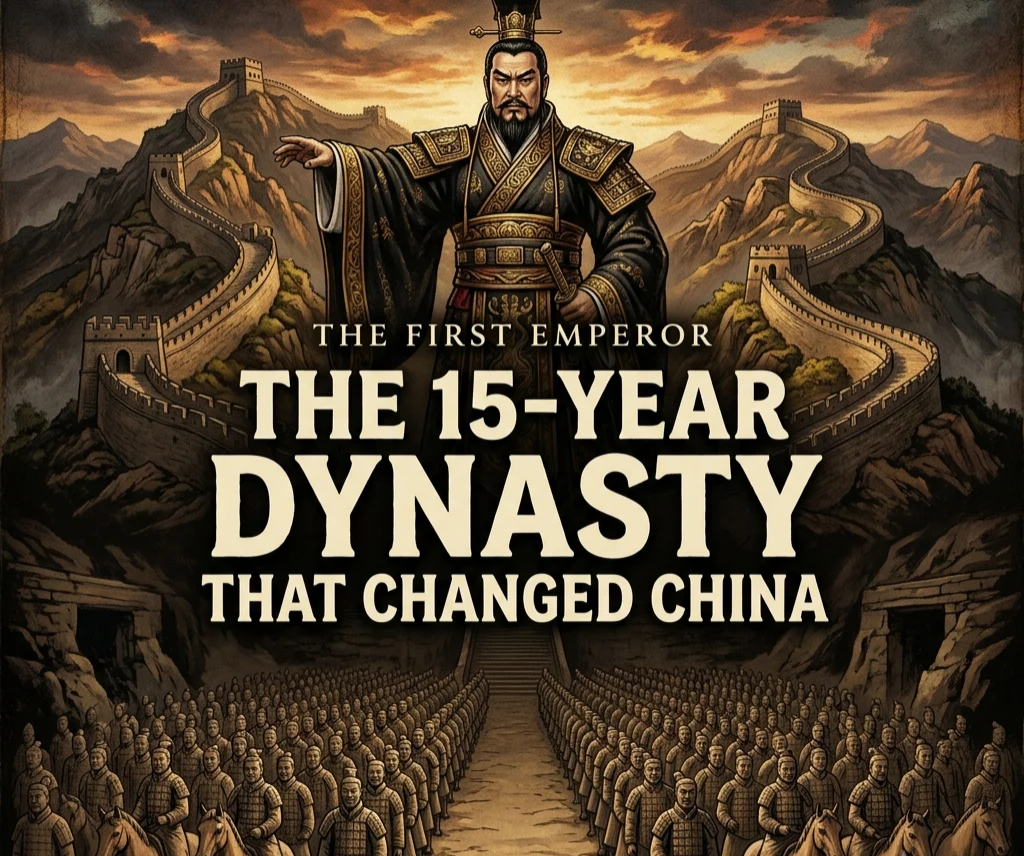
Ancient China: How Fifteen Years of Qin Rule Remade History
In 221 BCE, the political landscape of Ancient China crossed an irreversible threshold. After centuries of ceaseless interstate slaughter, the western state of Qin conquered the last of its regional rivals. Its ruler, Ying Zheng, claimed the title of Qin Shihuangdi, declaring himself the First Emperor and establishing the first centralized empire in Chinese history.
Although this regime maintained supreme power over Ancient China for barely fifteen years, its administrative innovations outlived the dynasty itself. By dismantling hereditary feudalism, standardizing communication, and instituting an uncompromising legal code, the Qin established the institutional skeleton that guided two millennia of dynastic statecraft.
The Fractured World: The Warring States Furnace
Before imperial consolidation, Ancient China was a violently fractured realm. Following the collapse of royal authority during the Eastern Zhou dynasty, local aristocratic lords declared themselves independent kings. The subsequent Warring States period (475–221 BCE) pitted seven major powers against one another: Qin, Chu, Qi, Yan, Han, Wei, and Zhao.
Interstate warfare ceased to be a ceremonial contest among aristocrats in chariots:
-
Chariots were replaced by mass peasant infantry armed with mass-produced bronze and iron crossbows.
-
Armies swelled from thousands of noble retainers to campaigns mobilizing hundreds of thousands of conscripted foot soldiers.
-
Fortified earth walls were raised across regional frontiers to deter lightning cavalry incursions from neighboring kingdoms.
-
Agrarian production was directly weaponized, as states reorganized peasant village life to maximize grain extraction for the frontline.
This prolonged military pressure forced kingdoms across Ancient China to innovate administrative systems. Survival demanded absolute efficiency. The state that mobilized more grain, registered more tax-paying households, and drilled more peasant infantry was the state that expanded its borders.
Among these competing kingdoms, the state of Qin occupied an ideal geographic redoubt in the Wei River valley. Shielded by natural mountain passes and anchored by fertile loess soils, Qin cultivated an unyielding militarized society that prepared to conquer the known world.
Shang Yang and the Legalist Blueprint in Ancient China
The engine behind Qin’s ascent within Ancient China was constructed a century before the First Emperor’s birth. Around 356 BCE, the statesman Shang Yang instituted sweeping administrative reforms rooted in the pragmatic philosophy of Legalism (Fajia).
Legalism rejected Confucian ideals of moral benevolence and ritual propriety, viewing human nature as selfish and manageable only through transparent laws and ruthless penalties:
-
Abolition of Aristocratic Privilege: Hereditary noble titles were stripped of power; status, land grants, and slaves were awarded exclusively through individual battlefield performance.
-
The Military Merit System: A twenty-rank military hierarchy rewarded soldiers with land, tax exemptions, and promotion based directly on the number of severed enemy heads collected during combat.
-
Mutual Surveillance Units (Baojia): Households were grouped into units of five and ten families who were legally obligated to police one another; failing to denounce a criminal brought execution by waist-chopping.
-
Agrarian Focus (Nongzhan): Society was channeled exclusively into two state-sanctioned professions: farming to fill grain depots and fighting to expand borders.
These radical policies transformed Qin into a relentless war machine. By eliminating idle aristocrats and tying personal economic survival to martial lethality, Qin marshaled human resources at a level unprecedented in Ancient China.
Administrative standardization [Internal Link: Imperial Bureaucracy in Antiquity] proved that an empire could conquer diverse regions only by replacing local traditions with centralized statutory governance.
How Long Did the Qin Dynasty Last?
The Qin Dynasty lasted for only 15 years, spanning from 221 BC to 206 BC. Despite its remarkably brief reign, it became one of the most influential eras in Chinese history by unifying the Warring States and establishing China’s first imperial empire under Qin Shi Huang.
Weaponry, Logistics, and Military Hardware
The armed forces that unified Ancient China operated with industrial standardization. While rival states relied on artisanal weapon smiths, Qin state arsenals implemented standardized parts and mass manufacturing.
The core arsenal of the Qin soldier reflected rigorous mechanical efficiency:
-
The Standardized Bronze Crossbow: Fitted with precision-cast bronze trigger mechanisms manufactured to interchangeable tolerances, firing iron-headed bolts capable of piercing heavy lamellar armor at two hundred yards.
-
Long Bronze Swords: Measuring between eighty-five and ninety-five centimeters, forged with high-tin bronze cores and low-tin edges, giving infantry exceptional reach in close melee.
-
The Pi Spear: A long, double-edged dagger-blade mounted on a three-meter bamboo shaft, functioning as a hybrid thrusting pike and slicing weapon.
-
Lacquered Leather Armor: Composed of hundreds of overlapping rawhide lamellae coated in toxic tung-oil lacquer, resisting moisture and deflecting arrow strikes.
Logistical engineering matched this weapons production. In 256 BCE, Qin water engineer Li Bing constructed the Dujiangyan irrigation system on the Min River in Sichuan. By dividing the river current without a solid dam, the system eliminated seasonal flooding while channeling water into arid paddies.
The resulting agricultural abundance turned the Chengdu plain into the breadbasket of Qin. Secure food reserves allowed Qin to sustain field operations lasting years, starving out opposing cities across Ancient China.
+---------------------------------------------------------------------------------+
|                       QIN REORGANIZATION OF ANCIENT CHINA                       |
|                                                                                 |
|  [Warring States Chieftains]  (Seven autonomous kingdoms, feudal militias)      |
|             |                                                                   |
|             v                                                                   |
|  [Legalist Reformations]      (Shang Yang: Military merit, mutual policing)     |
|             |                                                                   |
|             v                                                                   |
|  [Imperial Unification]       (221 BCE: Defeat of rival kingdoms, First Emperor)|
|             |                                                                   |
|             +-------------------------+-------------------------+               |
|             |                         |                         |               |
|             v                         v                         v               |
|  [Junxian Commandery Grid]   [Script & Weight Reform]   [Terracotta Mausoleum]  |
+---------------------------------------------------------------------------------+
Dismantling Feudalism: The Junxian Administrative System
Following the final conquest of Qi in 221 BCE, the First Emperor rejected the counsel of traditional advisers who urged him to award conquered kingdoms as personal fiefs to his royal sons. Prime Minister Li Si argued that granting autonomous territories would replicate the bloody conflicts of the past.
The emperor adopted the Junxian system, transforming the administrative geography of Ancient China:
-
The empire was partitioned into thirty-six (later forty-two) administrative commanderies (jun), subdivided into counties (xian).
-
Each commandery was governed by three centrally appointed bureaucrats: a civil governor (shou), a military commandant (wei), and an imperial inspector (jian) who monitored administrative loyalty.
-
Officials served on fixed terms, drew state salaries, and were transferred regularly to prevent them from establishing personal power bases.
-
Local defensive walls and city fortifications within former enemy kingdoms were demolished to prevent provincial rebellions.
This bureaucratic overhaul stripped regional aristocrats of hereditary power. Over 120,000 noble families from across the conquered kingdoms were forcibly relocated to the capital at Xianyang, where they lived under constant imperial surveillance.
Power in Ancient China no longer stemmed from noble birth or regional lineage. It flowed outward from the central desk of the emperor, communicated through written dispatches and executed by appointed bureaucrats.
Absolute Standardization Across Ancient China
To integrate disparate territories into a cohesive imperial economy, the Qin state executed an unprecedented standardization program across every facet of daily life. Before unification, each kingdom maintained its own scripts, currencies, road gauges, and volume measurements, complicating trade and governance.
The imperial standardization program unified these divergent systems:
-
The Small Seal Script (Xiaozhuan): Li Si synthesized regional writing styles into a standardized, simplified script comprising uniform strokes, ensuring that imperial decrees were understood across the empire.
-
The Ban Liang Coin: Regional spade, knife, and shell currencies were abolished in favor of a circular copper coin with a square central hole, symbolizing earth and heaven.
-
Standardized Weights and Measures: The state cast standardized bronze balance weights and volume vessels, distributing them to provincial markets to ensure uniform taxation.
-
Wheel-Axle Gauges: Cart axles were fixed to a uniform width of six Chinese feet (roughly 1.4 meters), ensuring that wagons moved smoothly within the standardized wheel ruts carved into imperial highways.
This was not bureaucratic housekeeping; it was a psychological and political revolution. A peasant in the southern forests of Chu and a merchant on the northern plains of Yan used identical coins, read identical characters, and complied with identical weights.
By eliminating local economic friction, Ancient China transformed from an abstract cultural realm into an integrated national market.
Monumental Engineering: Walls, Canals, and the Imperial Straight Road
The administrative discipline that reorganized society also transformed the physical environment of Ancient China. Mobilizing hundreds of thousands of conscripted laborers and convicts under penal sentence, the Qin initiated extraordinary infrastructure projects.
To defend against nomadic Xiongnu horse-archers from the northern steppe, General Meng Tian commanded an army of three hundred thousand men to link and extend preexisting defensive barriers. The resulting Qin Great Wall stretched thousands of li across ridges and deserts, constructed from packed loess soil tamped into dense timber frames (hangtu).
Simultaneously, the state constructed monumental transportation arteries:
-
The Imperial Straight Road (Zhidao): A paved highway measuring nearly eight hundred kilometers, running from the capital region across the Ordos Loop to the northern frontier, allowing cavalry reinforcements to deploy in days.
-
The Lingqu Canal: Excavated in modern Guangxi, this thirty-four-kilometer waterway connected the Xiang River and the Li River, linking the Yangtze and Pearl River basins to support military campaigns against the Baiyue tribes of the south.
These public works demanded an immense human toll. Hundreds of thousands of laborers died from malnutrition, exhaustion, and accidents, breeding deep resentment among peasant populations.
Engineering mobilization [Internal Link: Classical Siege Craft Innovations] demonstrated that ancient states often collapsed under the economic strain of monumental building programs.
Intellectual Suppression: The Burning of Books
The rapid imposition of Legalist totalitarianism provoked sharp opposition from traditional scholars who revered early Zhou feudal traditions. In 213 BCE, during an imperial banquet, conservative scholars publicly criticized the centralization of the state, urging the emperor to restore feudal fiefdoms.
Li Si countered with an uncompromising proposal: intellectual conformity was essential to political survival. The emperor approved an imperial decree outlawing independent historical analysis:
-
All historical chronicles other than the official annals of Qin were gathered and burned.
-
Copies of the Confucian Classic of Poetry and Classic of History held by private individuals were confiscated and incinerated in public squares.
-
Technical texts concerning agriculture, medicine, divination, and forestry were officially preserved.
-
Unauthorized discussion of traditional philosophies was punished by execution, while those using the past to criticize the present were put to death alongside their entire families.
Subsequent Han dynasty histories recorded that the following year, the emperor ordered 460 scholars buried alive (kengru) after alchemists fled the court with royal funds. While modern historians recognize that later Han writers had political motives to exaggerate Qin atrocities, the physical suppression of dissent was an established fact.
By attempting to control history, the Qin state sought to erase political alternatives from the cultural memory of Ancient China.
The Underground Empire: The Mausoleum and the Terracotta Army
Nowhere was the cosmic ambition of the First Emperor projected more vividly than within his monumental burial complex at Mount Li near modern Xi’an. The emperor viewed his sovereign authority not as a mortal office, but as a cosmic mandate that extended into the afterlife.
In 1974, local farmers digging a well uncovered the perimeter of this complex, exposing the Terracotta Army:
-
Over eight thousand life-sized terracotta figures arranged in combat formations inside four massive subterranean timber-roofed vaults.
-
The assembly includes heavy infantry, kneeling crossbowmen, cavalry riders with harnessed mounts, chariot teams, and high-ranking officers.
-
Individual figures feature distinct facial structures, hairstyles, and armor studs, reflecting the diverse multi-ethnic composition of the imperial army.
-
Traces of microscopic egg-tempera paint prove that the soldiers were originally painted in vibrant purple, green, blue, and crimson pigments.
The main burial mound remains unexcavated, protected by environmental concerns and historical warnings. Ancient historian Sima Qian recorded that the subterranean palace houses mechanical rivers of liquid mercury flowing into a miniature ocean, beneath a domed bronze ceiling inlaid with pearls representing celestial constellations.
Modern soil core sampling across the tumulus has verified anomalous concentrations of mercury, confirming the baseline accuracy of ancient historical records. The necropolis stands as a physical testament to the material power that dominated Ancient China.
Collapse and the Han Legacy
The centralized structure of the Qin empire contained a fatal vulnerability: it was designed to function under the unyielding willpower of its creator. When Qin Shihuangdi died suddenly in 210 BCE while touring eastern provinces in search of elixirs of immortality, the imperial court collapsed into palace intrigue.
Chief Eunuch Zhao Gao and Prime Minister Li Si concealed the emperor’s death, forging a royal suicide order to eliminate the competent crown prince Fusu. They installed the weak younger son Huhai as Second Emperor (Qin Er Shi).
Within months, the empire erupted into rebellion:
-
In 209 BCE, two conscript officers, Chen Sheng and Wu Guang, delayed by heavy rains that washed out roads, faced automatic execution for missing their military reporting deadline under Qin law.
-
Realizing they had nothing to lose, they raised a peasant insurrection, sparking coordinated uprisings across the conquered territories.
-
Aristocratic leaders from the former Warring States mobilized local militias, turning peasant revolts into a full civil war.
-
By 206 BCE, rebel forces under Liu Bang entered the capital at Xianyang, accepting the surrender of the last Qin ruler and ending the dynasty after fifteen years.
Following four years of civil war, Liu Bang founded the Han dynasty (202 BCE–220 CE). The Han emperors publicly denounced Qin tyranny, adopting Confucian ethics as the official state ideology to project moral benevolence.
Yet behind this ethical facade, the Han preserved the core institutions developed by Qin:
-
They retained the Junxian system of centrally appointed governors and commanderies.
-
They preserved standardized small seal characters, bimetallic coinage, and road dimensions.
-
They expanded the centralized civil service and Legalist administrative machinery.
The dynasty died in violence, but its institutional skeleton survived. The Qin proved that a centralized empire could govern millions of disparate citizens across vast geography, establishing the political template that defined Ancient China for two millennia.
Frequently Asked Questions
How long did the Qin Dynasty rule Ancient China?
The Qin Dynasty ruled unified Ancient China from 221 BCE until its collapse in 206 BCE, lasting approximately fifteen years. Despite this brief lifespan, its administrative and legal structures laid the foundation for subsequent imperial dynasties.
What was the Junxian system introduced by the First Emperor?
The Junxian system was a centralized administrative network that replaced hereditary feudal fiefs with commanderies (jun) and counties (xian). Each district was governed by centrally appointed bureaucrats who served fixed terms, preventing regional aristocrats from establishing independent personal power bases.
Did Qin Shi Huang build the entire Great Wall of China?
No, the First Emperor did not build the Great Wall from scratch. Various independent Warring States had already constructed frontier earth walls. General Meng Tian linked, repaired, and expanded these preexisting northern ramparts using packed-earth construction to defend against nomadic Xiongnu incursions