
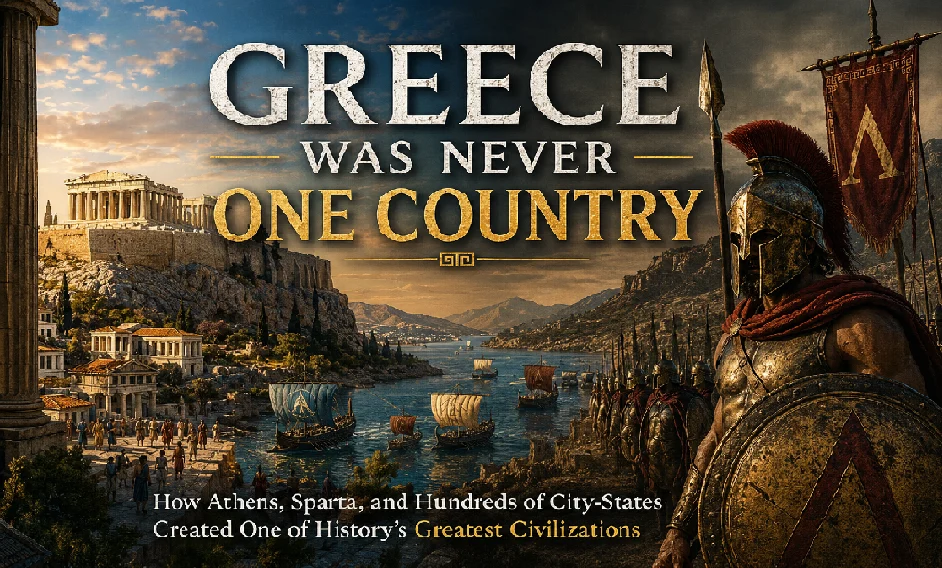
Greek City States: The Rivals That Forged a Golden Age
In classical antiquity, the Aegean basin developed without an emperor, a central tax treasury, or an imperial capital. Instead, the Greek City States formed a decentralized constellation of hundreds of fiercely independent communities, known individually as the polis. From coastal Anatolia to the Peloponnese and Magna Graecia, these sovereign poleis developed their own laws, mints, militaries, and civic identities.
The Greek City States proved that a shared, transformative civilization did not require an overarching nation-state. Their relentless political competition and martial friction catalyzed rapid innovation across philosophy, civic governance, metallurgy, and strategy. Divided by limestone mountain ranges and bound by maritime sea lanes, these urban laboratories created the intellectual and institutional bedrock of the Western world.
The Collapse of the Palaces and the Dawn of the Polis
The geopolitical landscape of the Greek City States emerged from the ashes of the Late Bronze Age Collapse. Around 1200 BCE, the fortified palaces of Mycenae, Tiryns, and Pylos burned, taking with them their centralized redistribution economies, Linear B scribal systems, and kingly monopolies (wanax).
Centuries of regional depopulation and localized farming followed, often categorized as the Greek Dark Ages. By the eighth century BCE, a profound renaissance took root across the Aegean basin:
-
Demographic Recovery: Population expansion outpaced traditional agrarian valleys, forcing communities to reclaim marginal scrublands.
-
The Phoenician Transmission: Hellenic traders adapted the West Semitic consonantal alphabet, introducing vowels to create a phonetic script capable of recording civic decrees and epic poetry.
-
The Homeric Legacy: The crystallization of the Iliad and Odyssey provided a shared panhellenic mythology, instilling a martial aristocratic ethos centered on personal honor (time) and heroic excellence (arete).
Rather than rebuilding Bronze Age bureaucratic palaces, Greek communities consolidated their surrounding farmland into the institutional framework of the polis. The physical landscape dictated this institutional model. Rugged mountain ridges separated mainland Greece into isolated pockets of arable land, encouraging local autonomy while the Aegean Sea provided natural transit corridors for overseas trade and colonial expansion.
The Civic Anatomy: Understanding the Classical Polis
To define the Greek City States merely as physical cities misses their revolutionary legal essence. A polis was not an assemblage of masonry ramparts and stone temples; it was an association of citizens (politai) bound by a sovereign constitutional charter.
Every autonomous community incorporated distinct structural zones:
-
The Acropolis: A fortified limestone citadel serving as a sacred sanctuary, treasury, and final defensive redoubt during military sieges.
-
The Agora: The urban marketplace and civic heart where merchants exchanged goods, courts convened, and citizens gathered for political assembly.
-
The Chora: The agricultural hinterland of peasant villages, olive groves, and pastureland whose harvest fed the urban center.
-
The Asty: The residential settlement of private stone and mudbrick dwellings surrounding the public civic core.
The political taxonomy of the Greek City States showed extraordinary variety. Aristotle surveyed 158 distinct municipal constitutions in his Politics, categorizing governance into monarchies, oligarchies, tyrannies, and democracies.
A citizen in Corinth viewed himself as entirely distinct from an inhabitant of Thebes or Aegina. Wars over border ridges, grazing rights, and trade tariffs were continuous. Yet while these city-states jealously guarded their independence, they recognized a common Hellenic kinship distinct from the non-Greek-speaking world, which they termed barbaroi.
Institutional evolution [Internal Link: Classical Greek Defensive Strategy] proved that localized municipal defense relied on tight coordination between citizen-soldiers and urban fortifications.
Athens: The Democratic Experiment and Imperial Naval Power
Athens developed the most radical political experiment among all the Greek City States. Rather than preserving hereditary aristocratic control, the Athenian polis gradually expanded civic franchise to encompass all adult free male citizens, regardless of wealth.
This democratic evolution unfolded through deliberate legislative crises:
-
Solon’s Reforms (594 BCE): Abolished debt slavery (seisachtheia), standardized weights, and divided citizens into four income classes based on agricultural yield (medimnoi), granting poorer citizens voting rights in the assembly (ekklesia).
-
Cleisthenes’ Revolution (508/7 BCE): Reorganized Attica into ten artificial tribes composed of thirty cross-regional districts (trittyes), breaking traditional aristocratic voting blocs and establishing the Council of 500 (boule).
-
The Ephialtic Reforms (462 BCE): Stripped the aristocratic Areopagus council of political vetoes, transferring judicial authority to popular citizen juries (dikasteria).
Athenian direct democracy operated without elected representatives. In the Pnyx, thousands of eligible male citizens met forty times a year to vote directly on foreign alliances, military budgets, and naval dispatches. To protect the constitution from aspiring despots, the assembly held annual votes to ostracize and banish controversial statesmen for a decade.
This political revolution coincided with a naval transformation. Following the discovery of rich silver veins at Laurion, statesman Themistocles persuaded the assembly in 483 BCE to construct two hundred advanced triremes—oared warships equipped with bronze battering rams.
The rowers who manned these galleys were drawn from the thetes, the poorest landless citizen class. By powering the Athenian navy, poor citizens acquired political leverage, firmly cementing radical democracy at home while converting the defensive Delian League into an overseas maritime empire across the Aegean.
Sparta: The Lycurgan Mirage and the Helot Foundation
While Athens prioritized naval power and civic speech, Sparta chose an opposite institutional path among the Greek City States. Known to contemporaries as Lacedaemon, Sparta constructed a rigid, hyper-militarized caste system dedicated entirely to combat readiness.
The mythical lawgiver Lycurgus codified this communal framework:
-
The Dual Kingship: Two hereditary kings from the Agiad and Eurypontid houses exercised supreme military command on campaign and performed royal sacrifices.
-
The Gerousia: An aristocratic council of elders consisting of twenty-eight citizens over the age of sixty, elected for life, paired with the two monarchs to filter legislation.
-
The Ephorate: A board of five annually elected magistrates (ephors) who held executive authority, audited the kings, and managed foreign diplomacy.
-
The Apella: The general assembly of Spartan citizen peers (Spartiates), which approved or rejected proposals without debate.
The survival of this martial aristocracy rested on systemic state subjugation. Having conquered neighboring Messenia in the eighth century BCE, the Spartans enslaved the indigenous population, reducing them to agricultural serfs known as helots.
Helots outnumbered Spartan citizens by a ratio of ten to one, bound to state agricultural plots (kleroi) to deliver grain, wine, and cheese. This economic foundation freed Spartan male citizens from manual labor, allowing them to participate in the agoge—a brutal state-run education system beginning at age seven that conditioned boys to endure cold, starvation, and physical combat.
Spartan citizens functioned as a full-time standing army of heavy infantry hoplites, transforming their landlocked valley into an invincible fortress that disdained stone ramparts, boasting that Sparta’s true walls were the breasts of its men.
Hoplite Warfare Across the Greek City States
The primary military mechanism linking the Greek City States was the hoplite phalanx. Far from relying on disorganized individual skirmishing, Hellenic warfare was an exercise in collective discipline, bronze weight, and biomechanical shove (othismos).
The equipment of the classical Greek hoplite was an expensive, privately financed panoply:
-
The Aspis: A concave wooden shield measuring three feet across, faced with thin bronze sheeting, featuring an internal forearm strap (porpax) and an edge grip (antilabe) that covered the left side of the bearer and the right side of his neighbor.
-
The Dory: An ash-wood thrusting spear measuring eight to nine feet, tipped with an iron leaf-shaped point and balanced by a bronze butt-spike (sauroter).
-
The Corinthian Helmet: Beaten from a single sheet of bronze, protecting the cheeks and nose while restricting hearing and peripheral vision.
-
The Breastplate: Solid cast-bronze bell cuirasses or layered linen corslets (linothorax) glued with animal resins to deflect missile strikes.
Formed eight ranks deep, the phalanx functioned like an iron-faced bulldozer. When two opposing citizen armies collided, frontlines shoved against enemy shields, aiming spear strikes over rims toward exposed throats and groins.
Casualties during the organized melee were modest, rarely exceeding five percent for the victor. The catastrophic slaughter occurred only when one formation buckled, cast aside their heavy shields, and fled across the rough terrain, pursued by light skirmishers.
+---------------------------------------------------------------------------------+
|                       INSTITUTIONAL DIVERGENCE OF POLEIS                        |
|                                                                                 |
|  [Agrarian Hellenic Settlements] (8th Century BCE Post-Mycenaean Recovery)      |
|             |                                                                   |
|             v                                                                   |
|  [Crystallization of the Polis] (Autonomous Laws, Agora, Acropolis, Chora)      |
|             |                                                                   |
|             +-------------------------+-------------------------+               |
|             |                         |                         |               |
|             v                         v                         v               |
|  [Democratic Maritime Athens]   [Oligarchic Martial Sparta]   [Trading Poleis]  |
|  - Ekklesia Assembly            - Lycurgan Agoge              - Corinth, Thebes |
|  - Trireme Naval Fleets         - Helot Agrarian Serfdom      - Colonization    |
|  - Imperial Delian League       - Peloponnesian League        - Coinage Hubs    |
+---------------------------------------------------------------------------------+
Hegemonic War: Persian Invasions and the Peloponnesian Cataclysm
External existential threats periodically forced the Greek City States into fragile tactical alliances. In 490 and 480–479 BCE, the Achaemenid Persian Empire launched massive amphibious expeditions to annex the European mainland.
At Marathon, Salamis, and Plataea, coordinated Greek forces defeated superior Persian hosts:
-
Athenian hoplites crushed Persian wings at Marathon in 490 BCE through calculated double envelopments.
-
Spartan rear-guards delayed hundreds of thousands of imperial troops at Thermopylae in 480 BCE, securing time for southern defense.
-
The combined Greek naval fleet outmaneuvered and shattered the Phoenician-Persian armada in the narrow straits of Salamis.
Yet common victory could not eliminate the internal rivalries dividing the Greek City States. Athens transformed the anti-Persian Delian League into a coercive empire, extracting annual silver tribute from allied islands to finance imperial fleets and public monuments like the Parthenon.
Alarmed by rising Athenian maritime hegemony, Sparta and its Peloponnesian League declared war in 431 BCE, initiating the twenty-seven-year Peloponnesian War.
Documented meticulously by Thucydides, the conflict consumed the Greek world:
-
Athens retreated behind its Long Walls, using naval supremacy to import Black Sea grain while Spartan armies burned the fields of Attica.
-
A virulent plague struck overcrowded Athens in 430 BCE, killing a third of its population, including Pericles.
-
The catastrophic Athenian expedition to Sicily (415–413 BCE) resulted in the destruction of entire fleets and the enslavement of thousands of Athenian prisoners in the quarries of Syracuse.
By 404 BCE, financed by Persian gold, the Spartan commander Lysander captured the remaining Athenian fleet at Aegospotami, starving Athens into surrender and dismantling its empire.
Panhellenism: The Cultural Glue of a Divided Civilization
If the Greek City States never formed a unified nation, what made them Greek? Cultural unity operated through shared religious architecture, dialectical language, and panhellenic institutions that transcended municipal borders.
The supreme expressions of this cultural cohesion included:
-
The Olympic Games: Held every four years at the sanctuary of Zeus in Olympia, where a sacred truce (ekecheiria) halted regional warfare across all participating poleis.
-
The Delphic Oracle: The sanctuary of Apollo at Delphi, where city-states dispatched formal embassies to consult the Pythia on military campaigns, colonial departures, and constitutional reforms.
-
Sanctuary Neutrality: Religious complexes like Delos, Nemea, and Isthmia functioned as international banking hubs, festival centers, and places of diplomatic arbitration.
Theater was an equally powerful cultural bridge. The dramatic festivals of the City Dionysia in Athens welcomed visitors from across the Aegean, staging tragedies by Aeschylus, Sophocles, and Euripides that explored universal human dilemmas: the tension between divine justice and civic statute, the cruelty of hubris, and the devastating costs of war.
Trade networks reinforced this cultural matrix. Merchant freighters carried Attic oil, Corinthian pottery, Chian wine, and Thracian timber across the Mediterranean, tying peripheral colonial settlements back to the mainland core.
Classical trade and manufacturing [Internal Link: Classical Greek Armor Fabrication and Metallurgy] demonstrated how commercial exchange stimulated metallurgical expertise across regional workshops.
Archaeological Evidence: Unearthing the Classical Polis
Modern excavations across Greece and the Mediterranean have reconstructed the material reality of the Greek City States, stripping away literary romanticism to expose civic life.
Archaeological excavations provide rich empirical verification:
-
The Athenian Agora: Excavations led by the American School of Classical Studies have unearthed official bronze juror tickets (pinakia), stone ballot-allotment machines (kleroterion), and thousands of pottery sherds (ostraka) scratched with the names of banished statesmen like Themistocles and Aristeides.
-
The Laurion Silver Mines: Deep subterranean galena galleries in southern Attica containing the chisel marks of thousands of enslaved miners whose labor financed the classical Athenian navy.
-
Spartan Sanctuary Deposits: Excavations at the Sanctuary of Artemis Orthia in Sparta uncovered thousands of miniature lead votive figurines, depicting armored warriors and grotesque masks associated with youth initiation rites.
Forensic examination of skeletal remains from battle sites like Chaeronea reveals devastating trauma inflicted by iron spearheads and cavalry slashing blades, confirming the brutal close-quarter physics documented in classical histories.
These material findings demonstrate that the Greek City States were not philosophical utopias, but highly competitive municipal regimes that balanced democratic ideals with coercive imperial extraction and chattel slavery.
Geopolitical Sunset: From Hegemony to Macedonian Subjugation
The endless civil conflicts of the fourth century BCE permanently exhausted the military manpower of the Greek City States. Spartan dominance proved brief and tyrannical, dismantled in 371 BCE at the Battle of Leuctra when the Theban general Epaminondas deployed a deep fifty-man phalanx to crush the elite Spartan royal vanguard.
Theban hegemony proved equally fleeting. By mid-century, the fractured poleis lacked the demographic and economic reserves needed to resist outside powers.
To the north, the kingdom of Macedon under Philip II developed an advanced combined-arms military engine:
-
The sarissa pike phalanx, measuring eighteen feet in length, outdistanced traditional hoplite spears.
-
The Companion Cavalry provided high-velocity shock attacks against exposed infantry flanks.
-
Hydraulic siege artillery allowed Macedonian armies to batter down previously impregnable municipal stone ramparts.
At the Battle of Chaeronea in 338 BCE, Philip and his eighteen-year-old son Alexander destroyed the combined allied armies of Athens and Thebes. Philip formed the League of Corinth, subordinating the Greek City States to Macedonian military command.
The era of autonomous municipal sovereignty came to a close. Philip’s conquests, followed by Alexander’s sweep through the Persian Empire, transformed the classical world from an arena of independent poleis into expansive Hellenistic territorial kingdoms, and eventually paved the way for absorption into the Roman Empire.
Yet the institutional legacy of the Greek City States proved immortal. The questions formulated within their open assemblies and public agoras—concerning citizenship, the separation of powers, trial by jury, and constitutional legitimacy—survived the fall of their city walls, providing the enduring political vocabulary that continues to shape modern governance.
Frequently Asked Questions
What was the difference between a polis and a modern city?
A polis was not merely an urban center of buildings and streets; it was an independent, sovereign political community. It included the fortified urban core (asty) and its surrounding agricultural farmland (chora), governing itself under its own laws, religious traditions, foreign policies, and military institutions without answering to a national capital.
How did Athens and Sparta differ in their political structures?
Athens developed a radical direct democracy where all adult free male citizens voted on laws, finances, and declarations of war in the assembly (ekklesia). In contrast, Sparta was an oligarchic military state governed by two hereditary kings, a council of aristocratic elders (gerousia), five executive magistrates (ephors), and a small elite class of full-time professional soldiers supported by enslaved agrarian serfs (helots).
What united the Greek City States if they lacked a central government?
Despite continuous military competition, the Greek City States were bound by a common Hellenic cultural identity. They shared the Greek language, Homeric epic literature, and the Olympian religious pantheon, gathering regularly at neutral panhellenic sanctuaries for athletic and religious festivals like the Olympic Games and consulting the Delphic Oracle on critical matters of state.