
Boston Molasses Flood 1919: Anatomy of an Industrial Disaster
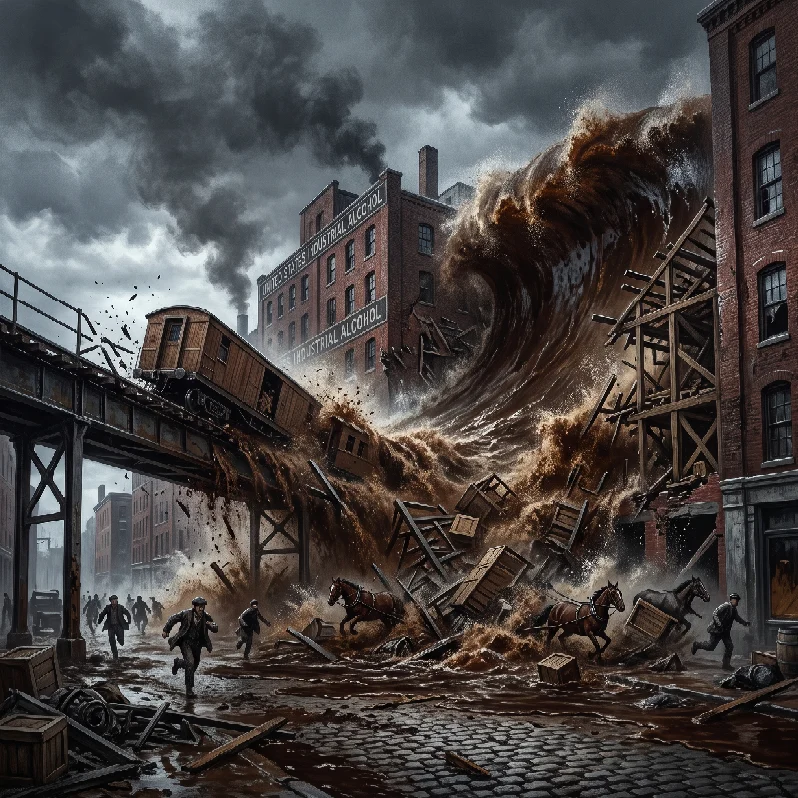
The Boston molasses flood 1919 remains one of the most unusual and lethal structural collapses in American municipal history. On the unseasonably mild afternoon of January 15, 1919, a colossal industrial container burst in Boston’s densely populated North End, releasing an unstoppable, suffocating torrent across waterfront streets.
Rather than a slow culinary trickle, the incident unleashed a towering, lethal wall of liquid moving at highway speeds. The devastating blast of the Boston molasses flood 1919 flattened buildings, fractured elevated rail tracks, killed twenty-one people, and permanently altered the legal standards of corporate accountability.
The Boiling Cauldron: The Boston Molasses Flood 1919 Tank Construction
To understand the scale of the failure, one must evaluate the economic motives driving the United States Industrial Alcohol Company (USIA) and its local subsidiary, the Purity Distilling Company. By 1915, the First World War raged across Europe, driving an insatiable international demand for industrial alcohol.
Ethanol was an indispensable reagent for manufacturing smokeless powder, cordite, and artillery munitions. Molasses was the primary source material: fermenting and distilling Caribbean cane molasses yielded high-purity industrial alcohol at high profit margins.
Anticipating American military involvement and racing against the impending ratification of the Eighteenth Amendment, which promised nationwide alcohol prohibition, USIA executives rushed construction on a massive storage depot at 529 Commercial Street.
       [USIA Executive Board]
                 │
   (Demand for Wartime Munitions Alcohol)
                 │
                 ▼
       [Commercial Street Tank: Built 1915]
       • Height: 50 Feet | Diameter: 90 Feet
       • Capacity: 2.5 Million Gallons
       • Construction Overseer: Arthur P. Jell (Treasurer)
       • Qualified Structural Engineer: NONE
The construction effort was rushed from day one. Company treasurer Arthur P. Jell was tasked with overseeing the project. Jell had no formal engineering background, possessed no architectural training, and could not interpret technical mechanical blueprints.
Urged by corporate executives to complete the structure before arriving transport ships docked, Jell bypassed basic safety protocols. The steel shell was erected directly adjacent to residential tenements and maritime piers, resting on an inadequate concrete foundation that failed to anchor the structure against lateral stresses.
Metallurgy, Rivets, and Structural Vulnerabilities
The physical specifications of the container revealed fatal engineering compromises long before the catastrophe occurred. Towering fifty feet into the air with a diameter of ninety feet, the cylinder was designed to hold over 2.5 million gallons of fluid.
Yet the steel plates utilized to construct the wall rings were dangerously thin:
-
Inadequate Shell Thickness: The lower steel bands measured between 0.67 and 0.75 inches thick, roughly half the minimum thickness required by established hydraulic pressure formulas.
-
Brittle Bessemer Steel: Metallurgical analysis conducted decades later confirmed that the structure utilized low-carbon Bessemer steel with elevated levels of sulfur and manganese, making the metal brittle and prone to micro-fractures in cold climates.
-
Under-Engineered Fasteners: The plates were joined using soft steel rivets laid out in double-lap and triple-lap joints that suffered severe shear stress around punched rivet holes.
┌────────────────────────────────────────────────────────┐
│ Upper Ring Plate: 0.31 Inches (Severe Strain)          │
├────────────────────────────────────────────────────────┤
│ Middle Ring Plate: 0.50 Inches (Inadequate)            │
├────────────────────────────────────────────────────────┤
│ Lower Ring Plate: 0.67 Inches (50% Below Safety Margin)│
└────────────────────────────────────────────────────────┘
          ▲
          │ [Tensile Stress Exceeds Metal Yield Point]
══════════════════════════════════════════════════════════
Concrete Base Footing (Poorly Cured, Shifting Soil)
From its maiden filling in 1915, the container leaked continuously. Brown syrup seeped through the seams and weeping rivets, pooling around the base where neighborhood children collected it in pails.
When employees reported structural groaning to management, corporate officials took no corrective action. Instead of draining the structure and reinforcing the sheared joints, the company painted the exterior dark brown to camouflage the leaks from city inspectors.
The Rupture: The Boston Molasses Flood 1919 Unfolds
At approximately 12:40 PM on January 15, 1919, atmospheric conditions acted as the final physical trigger. The temperature in Boston had climbed rapidly from two degrees below zero Fahrenheit to an unseasonal forty-three degrees.
Only two days earlier, a steamship arrived from Puerto Rico, pumping 1.3 million gallons of freshly boiled, warm molasses into the container. This warm liquid mixed with an older, cold deposit resting at the bottom of the tank:
[Warm Caribbean Molasses (+1.3M Gallons)]
                 │
                 ▼  (Thermal Expansion & Fermentation)
[Cold Residual Slurry at Tank Base]
                 │
                 ▼  (Internal Carbon Dioxide Gas Buildup)
[Catastrophic Hoop Stress Spike: Rivets Shear Instantaneously]
The thermal shock triggered rapid thermal expansion and accelerated internal fermentation, producing carbon dioxide gas that increased pressure against the walls. The internal hoop stress exceeded the yield point of the brittle Bessemer steel plates.
Witnesses on Commercial Street heard a sound like rolling machine-gun fire as thousands of rivets sheared simultaneously. Seconds later, the lower steel rings tore apart, unleashing 2.3 million gallons of dark, viscous fluid.
       [Point of Rupture: 12:40 PM]
                    │
   ┌────────────────┴────────────────┐
   ▼                                 ▼
[Hydraulic Shockwave]      [Thermal Viscosity Trap]
• 12,000 Tons Liquid Mass  • 15–25 Foot Wave Height
• 35 MPH Forward Speed     • Non-Newtonian Shear Thickening
• Elevated Rail Snapped    • Suffocation & Blunt Trauma
The fluid mass struck the street as a dark tsunami between fifteen and twenty-five feet tall, hurtling forward at an estimated thirty-five miles per hour. Weighing over twelve thousand tons, the wave exerted tremendous kinetic force against surrounding structures.
The outward surge tore the steel uprights of the Boston Elevated Railway, snapping overhead girders and causing a passenger train to tilt over sagging tracks. A nearby engine house was swept clean off its foundation and deposited into Boston Harbor, while timber tenement homes collapsed under the initial wave front.
Non-Newtonian Physics and the Viscosity Trap
The lethal nature of the Boston molasses flood 1919 stemmed directly from the complex fluid dynamics of molasses. Molasses is a non-Newtonian, shear-thinning fluid whose physical properties change depending on temperature and applied stress.
When the container ruptured, the immense kinetic energy temporarily decreased the fluid’s resistance to flow, allowing the twelve-thousand-ton wave to travel outward at high speed.
However, as the wave spread across cobblestone streets and struck winter air, its fluid mechanics reversed:
[Ambient Winter Air: Freezing Pavement]
                 │
                 ▼
[Rapid Fluid Temperature Drop]
                 │
                 ▼
[Viscosity Spikes Exponentially]
                 │
                 ▼
[Fluid Sets like Quicksand / Suction Mire]
As the liquid lost heat, its viscosity rose sharply. Molasses cools into an adhesive sludge that resists movement.
Victims caught in the flow could not swim through the medium:
-
Suffocation Hazards: The viscous mass coated human airways, filling the lungs and suffocating victims within minutes of immersion.
-
Adhesive Drag: Movement inside the cooling slurry required enormous physical exertion; every struggling motion exhausted survivors while pulling them deeper into the debris-laden mire.
-
Crushing Weight: Horses hauling delivery wagons were trapped in place, their legs pinned by the heavy sludge, forcing police officers to euthanize dozens of animals trapped along the piers.
Rescue teams from the nearby naval ship Nantucket and municipal services quickly converged on Commercial Street. Rescuers were forced to lay timber planks across the brown mud to reach survivors, spending hours pulling victims from beneath splintered timbers and shattered brickwork.
| Disaster Metric | Measured Value | Historical Significance |
| Total Fluid Volume | 2.3 million US gallons | Largest industrial foodstuff spill in urban history |
| Wave Height | 15 to 25 feet | High enough to engulf second-story residential windows |
| Peak Surge Speed | 35 miles per hour | Far faster than human running speed |
| Total Human Fatalities | 21 deaths | Direct result of blunt trauma and respiratory suffocation |
| Injuries Requiring Treatment | Over 150 individuals | Wounds, hypothermia, chemical burns from fermentation |
| Estimated Property Losses | $100 million (modern equivalent) | Total destruction of commercial blocks and waterfront rail |
For an overview of how ancient empires managed massive urban logistics and structural containment, review the [Internal Link: Achaemenid Persian Empire Royal Engineering] that stabilized municipal infrastructure across classical capitals.
The Investigation: Anarchy Claims vs. Engineering Truth
In the hours following the Boston molasses flood 1919, USIA executives moved quickly to divert public scrutiny. The company claimed that foreign anarchists had planted an explosive device inside the container, seeking to exploit the anti-immigrant sentiment and labor unrest of the First Red Scare.
The company insisted that since anarchists had targeted public officials in other cities, the explosion was a deliberate act of domestic sabotage rather than structural failure. The incident led to one of the longest, most extensive civil court actions ever mounted in Massachusetts legal history.
       [The Legal Impasse (1920–1925)]
                      │
  ┌───────────────────┴───────────────────┐
  ▼                                       ▼
[Corporate Defense Strategy]      [The Claimants' Case]
• Allege Italian Anarchist Bomb   • Prove Criminal Engineering Neglect
• Exploit Red Scare Hysteria      • Demonstrate Inadequate Steel Gauges
• Shift Blame to Terrorism        • Expose Ignored Leak Warnings
Appointed to untangle the contradictory claims, Special State Auditor Hugh W. Ogden oversaw three years of witness testimony and scientific evaluations. Over 1,500 witnesses took the stand, producing twenty thousand pages of court transcripts.
Ogden commissioned metallurgical examinations and hydraulic tests from faculty at the Massachusetts Institute of Technology, establishing a key legal precedent for forensic engineering in American jurisprudence:
Demolition Chemistry Dismissed
Chemical testing uncovered zero trace residues of dynamite, nitroglycerin, or blasting powder within the wreckage or adjacent soil.
The Physics of Rivet Failure
Testing demonstrated that the rivets failed in sequence due to sheer hydraulic overload rather than a localized, high-velocity chemical detonation.
Proof of Prior Neglect
City records confirmed that the structure had operated at near-capacity despite continuous leaks, confirming that corporate leadership knew the container was failing long before the disaster occurred.
In his final report, completed in April 1925, Ogden ruled decisively against USIA. The company was found guilty of negligence and ordered to pay over $628,000 in damages—equivalent to tens of millions of dollars today.
Scientific Legacy and Fluid Dynamics
The mechanical dynamics of the Boston molasses flood 1919 continue to serve as a baseline case study in modern physics, chemical engineering, and materials science laboratories. Modern researchers have reanalyzed the disaster using digital modeling and environmental wind tunnels to map non-Newtonian flow vectors.
Researchers from Harvard University demonstrated that the spread of the fluid matched boundary layer theory. The rapid forward progress of the wave was sustained because cold winter air chilled only the top layer of the syrup, forming a thin crust that insulated the warmer, moving core underneath.
                 [Harvard Fluid Dynamics Model]
┌─────────────────────────────────────────────────────────────┐
│ Chilled Surface Crust (Rapid Heat Loss to Winter Air)       │
├─────────────────────────────────────────────────────────────┤
│ Warmer, Low-Viscosity Core (Sustains 35 MPH Forward Drive)  │
├─────────────────────────────────────────────────────────────┤
│ High-Friction Cobblestone Floor (Creates Violent Drag Wave) │
└─────────────────────────────────────────────────────────────┘
This thermal dynamic allowed the fluid to travel hundreds of yards without losing momentum, demolishing municipal rail trestles like an ocean wave.
Only when the fluid expanded, lost internal heat, and stopped moving did its viscosity skyrocket, converting the fluid from a destructive wave into an adhesive quagmire.
Civil Engineering Reforms Across America
The lasting impact of the Boston molasses flood 1919 was institutional rather than physical. Prior to the incident, private corporations in Massachusetts were free to build industrial storage tanks without municipal review, architectural licenses, or state inspections.
The disaster forced local and national governments to rethink public safety regulations:
-
Mandatory Professional Engineering Seals: Massachusetts enacted statutes requiring all architectural plans, industrial storage units, and commercial buildings to bear the certification seal of a state-licensed professional engineer.
-
Independent Structural Reviews: Municipal planning boards were granted legal authority to demand third-party structural calculations before approving high-capacity tanks.
-
Hydrostatic Water Testing: Industrial codes mandated that newly erected containers undergo full-capacity hydrostatic water tests to verify weld integrity and structural stability before commercial use.
        [Pre-1919 Building Culture]
  • No mandatory state engineering certification
  • Private corporations self-inspected structures
  • Building plans approved on financial metrics alone
                 │
                 ▼  (1919 Disaster Catalyzes Reform)
        [Post-1925 Structural Standard]
  • Mandatory Professional Engineer (PE) license seals
  • Municipal sign-off on all large industrial vessels
  • Required hydrostatic testing before commercial filling
These regulatory changes served as the blueprint for modern building codes across the United States, shifting municipal oversight from reactive cleanups to proactive prevention.
To understand how ancient military engineers managed complex load factors in defensive lines, explore our detailed analysis of the [Internal Link: Roman Frontier Engineering at Vindolanda] to see how structural integrity shaped antiquity.
The Long Clean-Up and Waterfront Transformation
Cleaning up the disaster required months of continuous labor. Over three hundred relief workers, firefighters, and municipal laborers worked across the North End, spraying millions of gallons of saltwater pumped from Boston Harbor to dissolve the dried syrup.
Fresh water proved ineffective against the stubborn sugar layer; the natural salinity of ocean water helped break down the adhesive compound. The water across Boston Harbor remained a cloudy brown through the summer of 1919.
                   [The Cleanup Campaign]
                             │
     ┌───────────────────────┼───────────────────────┐
     ▼                       ▼                       ▼
[Saltwater Pumping]     [Sand Scrub Teams]      [Disinfectant Crews]
Harbor pumps break      Pavement scrubbed       Hydrated lime spread
down dried sugar bonds  with abrasive grit      to counter sour odor
The neighborhood bore physical reminders of the flood for years:
-
Secondary Contamination: Pedestrians tracking through the North End carried syrup on their boots onto streetcars, subway seats, telephone booths, and living room carpets across Greater Boston.
-
Persistent Odors: Local residents reported that on sweltering July afternoons, the sweet, heavy scent of fermented molasses rose from the cobblestone joints for decades.
-
Urban Rebirth: The devastated parcel at 529 Commercial Street was never rebuilt as an industrial depot; the city eventually redeveloped the parcel into a municipal recreational complex known today as Langone Park.
The Boston molasses flood 1919 remains a sobering reminder of what happens when corporate haste overrides basic physical laws. Through its human toll and hard-won legal victories, the tragedy proved that public infrastructure must be anchored by rigorous engineering standards rather than executive shortcuts.
Frequently Asked Questions
What caused the Boston molasses flood 1919?
The Boston molasses flood 1919 was caused by catastrophic structural failure driven by gross corporate negligence. The steel container was constructed out of brittle Bessemer steel plates that were roughly half the thickness required to contain 2.3 million gallons of fluid. On the day of the disaster, unseasonably warm weather combined with a fresh delivery of warm molasses triggered thermal expansion and gas buildup, causing the rivets to shear and the steel rings to tear open.
How fast did the molasses wave travel during the disaster?
Scientific estimates and eyewitness accounts confirm that the initial wave surged outward at thirty-five miles per hour. Reaching heights between fifteen and twenty-five feet, the twelve-thousand-ton fluid wave carried enough kinetic energy to knock buildings off their foundations, smash passenger rail tracks, and overturn heavy vehicles.
What legal precedents emerged from the Boston molasses disaster?
The six-year legal battle led by Auditor Hugh W. Ogden established early legal frameworks for modern corporate liability and forensic engineering testimony. The findings forced municipal governments across the United States to implement strict building regulations, including mandatory plan certification by licensed professional engineers and required safety testing before commercial use.