
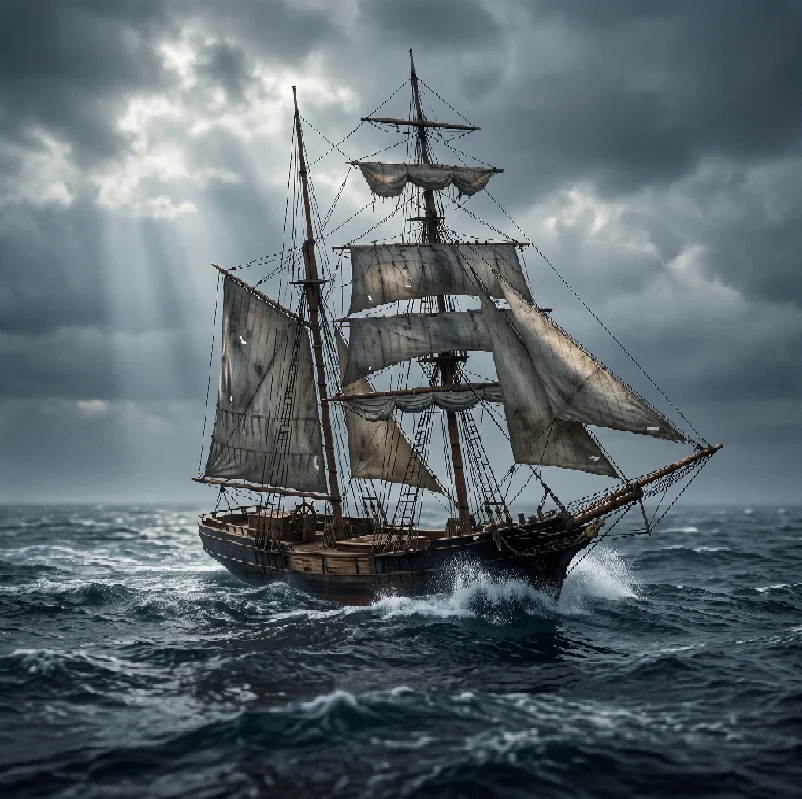
Abandoned Ship Atlantic 1872: The True Fate of the Mary Celeste
The discovery of an abandoned ship Atlantic 1872 encounter remains the benchmark of maritime mysteries. On December 5, 1872, the British merchant brigantine Dei Gratia came upon a two-masted vessel drifting aimlessly through rolling ocean swells between the Azores archipelago and mainland Portugal.
When sailors boarded the vessel, they stepped into a scene of complete desertion. The brig Mary Celeste was sailing under partial canvas, intact, stocked with provisions, and fully seaworthy, yet every soul on board had vanished. Over a century and a half later, the strange circumstances of this abandoned ship Atlantic 1872 continue to challenge historians, naval architects, and forensic investigators
The Atlantic Sighting: The Dei Gratia Intercepts the Mary Celeste
Midday on December 5, 1872, Captain David Morehouse stood on the quarterdeck of the Dei Gratia, steering east-southeast toward Gibraltar. Roughly six hundred miles west of the Portuguese coast, the lookout spotted a vessel yawing erratically across the port bow.
Its heading was inconsistent, with sails set on alternating tacks that caused the ship to wallow in the ocean troughs. Watching through his glass, Morehouse recognized the silhouette of the Mary Celeste.
She had slipped out of New York Harbor on November 7, eight days ahead of the Dei Gratia. Morehouse knew her master, Captain Benjamin Spooner Briggs, as an abstemious, seasoned New England seafarer with a sterling reputation for navigational prudence.
Morehouse hailed the vessel repeatedly across the water, but received no response. Only the slap of wet canvas, the groan of timber rigging, and the wash of waves broke the silence.
Sensing immediate distress, Morehouse lowered a boat and dispatched his first mate, Oliver Deveau, along with second mate John Wright, to board the silent vessel and render assistance.
                  [New York Harbor Departure]
             (Mary Celeste departs Nov 7, 1872)
             (Dei Gratia departs Nov 15, 1872)
                           │
                           ▼
          [Mid-Atlantic Crossing / Heavy Gales]
                           │
                           ▼
     [Nov 25: Final Log Entry near Santa Maria, Azores]
                           │
                           ▼
    [Dec 5: Sighting of Abandoned Ship Atlantic 1872]
       (Dei Gratia intercepts yawing derelict)
Boarding the Derelict: The Initial Inspection
Climbing the damp tumblehome onto the main deck, Oliver Deveau found no signs of violence. The brig had not run aground, suffered an explosion, or caught fire.
The ship was entirely deserted:
-
The Crew Quarters: In the forecastle, the sailors’ sea chests sat neatly lined against the bulkheads, dry and unopened. Pipes, plugs of chewing tobacco, and oilskin coats remained behind—personal gear no mariner would willingly leave behind.
-
The Master’s Cabin: In Captain Briggs’s stateroom, personal items sat in place. His wife Sarah’s harmonium and sewing machine remained undisturbed, along with toys belonging to their two-year-old daughter, Sophia.
-
Provisions and Cargo: The ship’s galley held over six months of uncontaminated food, salted beef, flour, and fresh drinking water in casks. The main hold contained 1,701 wooden barrels of commercial denatured alcohol.
-
Structural Integrity: The vessel had taken roughly three and a half feet of water in the bilge, but for a wooden brig of 282 tons that had endured stormy Atlantic seas, this was manageable volume easily handled by regular bilge pumps.
                    [Vessel Assessment]
┌───────────────────────────┬───────────────────────────────────┐
│ Hull Condition            │ Sound, seaworthy, wood unbreached │
│ Bilge Water Depth         │ ~3.5 feet (within pump limits)    │
│ Cargo Capacity            │ 1,701 casks of industrial alcohol │
│ Galley Stores             │ 6 months of fresh food and water  │
│ Missing Gear              │ Lifeboat, chronometer, sextant    │
└───────────────────────────┴───────────────────────────────────┘
The sole missing elements told a clear story: the ship’s only lifeboat, a small yawl lashed across the main hatch, was gone. The master’s navigational tools, including the brass marine sextant, the marine chronometer, and the ship’s official registration papers, had been removed.
On the mate’s desk lay the ship’s slate logbook. The final entry, logged at 8:00 AM on November 25, placed the vessel six miles north of Santa Maria Island in the Azores, nine days and hundreds of miles west of where the Dei Gratia found her.
Anatomy of the Brigantine Mary Celeste
To evaluate why a seasoned crew would abandon a sound hull, one must examine the construction and history of the vessel itself. Built in 1861 at Spencer’s Island, Nova Scotia, the ship was originally registered as the Amazon.
Her early career was marked by severe misfortune:
[1861: Launched as the Amazon in Nova Scotia]
  │
  ├── First Captain falls ill and dies during maiden run
  ├── Collides with fishing gear and runs aground in Maine
  ├── Suffers severe structural fire in foreign docks
  │
  ▼
[1868: Wrecked in Cape Breton Storm & Salvaged]
  │
  ▼
[1869: Rebuilt, Reregistered as Mary Celeste in New York]
  │
  ▼
[1872: Re-rigged as Brigantine with Expanded Cargo Hold]
Purchased by a New York merchant consortium led by James H. Winchester, the vessel was rebuilt, re-rigged as a half-brig (brigantine), and registered as the Mary Celeste. The refit added a second deck, deepened the main cargo hold to carry bulk liquids, and replaced frame timbers with dense white oak.
When Captain Briggs took command, purchasing a one-third share, he supervised the loading of 1,701 barrels of raw industrial alcohol destined for Genoa, Italy. The alcohol, distilled from grain and wood stocks, was intended for fortifying commercial wines and industrial processing.
The cargo was sealed inside heavy red-oak barrels, bound with iron hoops, and packed into the unventilated lower hold. Red oak, while structurally sound, is far more porous than white oak.
As the ship sailed through shifting temperatures in the Atlantic, this choice of wood would play a central role in the events that followed.
Admiralty Court Inquest: The Solly-Flood Interrogation
Oliver Deveau and two crew members from the Dei Gratia navigated the waterlogged brig into the British harbor of Gibraltar, arriving on December 13, 1872. Under maritime law, the crew was entitled to a substantial salvage award based on the value of the ship and cargo.
Instead of a routine salvage payment, they faced a hostile legal inquiry. Frederick Solly-Flood, the Queen’s Proctor and Attorney General of Gibraltar, viewed the discovery of this abandoned ship Atlantic 1872 with profound suspicion.
A rigid bureaucrat, Solly-Flood suspected that Captain Morehouse and Captain Briggs had conspired to commit insurance fraud, or that the crew of the Dei Gratia had murdered the original crew at sea to claim salvage money:
          [Frederick Solly-Flood (Queen's Proctor)]
                             │
     ┌───────────────────────┼───────────────────────┐
     ▼                       ▼                       ▼
[Theory 1: Mutiny]      [Theory 2: Collusion]   [Theory 3: Piracy]
Crew killed Briggs;     Morehouse & Briggs fake  Riffian pirates raid;
fled in lifeboat        loss for salvage award  slay all on board
     │                       │                       │
     └───────────────────────┼───────────────────────┘
                             ▼
  [Forensic Reality: Zero Blood, Zero Struggle, Intact Cargo]
Solly-Flood ordered extensive forensic examinations of the vessel by naval surveyors:
The Sword Examination
Inspectors found an antique ceremonial sword under Captain Briggs’s berth showing dark brownish stains. Solly-Flood claimed this was human blood, but chemical testing by medical analyst Dr. J. Patron confirmed the residue was boiled furniture varnish and iron rust.
Cut Marks on the Bow
Surveyors noted shallow gouges along the wood cutwater on both sides of the bow, which the prosecution argued were deliberate cuts made to simulate storm damage. Naval architects proved these marks were natural seasoning fissures caused by grain contraction under sea salt and waves.
Bloodstains on Deck Planks
Dark spots on the top deck planks were declared to be bloodstains by prosecutors. Chemical analysis proved the spots were spilled cooking fat and wine stains.
After three months of hearings, the court found zero evidence of foul play. The Admiralty Court awarded the salvors roughly £1,700—a fraction of the ship’s full value—demonstrating that court officials remained suspicious of the abandoned ship Atlantic 1872, even though they could prove no crime.
To understand how ancient logistics managed maritime transport and secure naval stores, explore our research on [Internal Link: Achaemenid Persian Empire Royal Engineering] across historical coastal networks.
Deconstructing the Myths of the Abandoned Ship Atlantic 1872
Over the following decades, yellow journalism transformed the historical facts into a sensationalist legend. Writers invented details to make the mystery seem inexplicable.
Much of this mythology began with an 1884 short story titled “J. Habakuk Jephson’s Statement,” written by a young Arthur Conan Doyle and published anonymously in the Cornhill Magazine.
Doyle altered the ship’s name to the Marie Celeste and invented several dramatic details:
-
The Warm Breakfast: The myth that boarding parties found warm bacon, steaming cups of tea, and half-eaten eggs on the cabin table is entirely false. Oliver Deveau testified that the galley fire was cold, cooking pots were secured, and no food was laid out.
-
The Missing Longboat: Popular retellings claimed the ship’s lifeboats were hanging undamaged in their davits. In reality, the ship carried only one small yawl, which was missing from its chocks on the main hatch.
-
The Undisturbed Pipe Tobacco: While personal tobacco was left behind, it did not indicate supernatural disappearance; sailors in an emergency evacuated immediately without gathering personal gear.
[Sensationalist Myths (Conan Doyle, 1884)]
• Renamed ship "Marie Celeste"
• Steaming cups of tea & warm breakfast
• Lifeboats hanging in davits
• Ghostly, supernatural evacuation

                    VS

[Documented Court Evidence (Gibraltar, 1872)]
• Original name: Mary Celeste
• Cold galley stove, no meals set
• Single yawl lifeboat missing from hatch
• Orderly evacuation prompted by sudden emergency
Sensationalists also proposed giant squid attacks and strange disappearances in the Bermuda Triangle. Yet the ship was hundreds of miles away from the Sargasso Sea and Bermuda.
Furthermore, cephalopod attacks leave visible damage to rigging and rails, whereas the Mary Celeste showed no deck damage.
| Popular Myth | Historical Fact (Admiralty Records) | Analytical Significance |
| Ship found under full, billowing sail | Found under partial, mismatched canvas | Proves sail handling during an earlier squall |
| Half-eaten breakfast on table | Cold galley, provisions secured in store | Contradicts claims of instantaneous abduction |
| Mutinous crew murdered officers | Crew were experienced, family-known mariners | Eliminates violent rebellion hypothesis |
| Bloodstains on decorative sword | Laboratory proven as antique furniture varnish | Disproves homicide arguments made in court |
| Ship abandoned in calm seas | Atlantic gales recorded throughout late November | Confirms rough seas, high anxiety, and shifting water |
The Scientific Core: The Alcohol Vapor and Pressure Explosion
Modern maritime historians, forensic engineers, and naval scientists have largely coalesced around a compelling thermodynamic explanation for the abandoned ship Atlantic 1872.
The cargo held 1,701 barrels of alcohol. When the ship docked in Gibraltar, workers unloaded the casks and discovered that nine barrels were empty.
       [Porous Red-Oak Barrel Staves]
                     │
                     ▼  (Atlantic Temperature Shifts)
[Volatile Alcohol Vapors Bleed into Unventilated Hold]
                     │
                     ▼
[Vapors Mix with Trapped Air: Highly Explosive Gas]
                     │
                     ▼  (Friction Spark or Static Flash)
[Low-Intensity Pressure Blast: Hatches Blown Open]
Red-oak staves allow alcohol vapors to bleed through the wood grain far more easily than dense white oak. Over eighteen days at sea, moving from cold New York waters to warmer Atlantic latitudes, the cargo expanded, releasing concentrated ethanol vapors into the sealed, unventilated hold.
Forensic experiments conducted by combustion scientists at the University of Leeds tested this scenario:
Low-Temperature Vapor Ignition
A spark caused by rubbing iron barrel hoops, or static friction from shifting casks, can ignite concentrated alcohol vapors without producing a high-temperature fire.
Acoustic Flash
This reaction produces a pressure wave and a flash of flame. It generates a loud acoustic boom and blows off the main hatch cover, but extinguishes itself quickly without scorching damp oak timbers.
The Captain’s Perspective
To Captain Briggs, a devout, non-drinking man unfamiliar with bulk industrial chemicals, a rumble from the hold followed by blowing hatch covers and alcohol fumes would seem like an imminent explosion.
Convinced that the cargo was about to detonate, Briggs faced a life-or-death operational decision.
He had his wife, his infant daughter, and seven crew members aboard. Staying on an iron-bound vessel loaded with 1,700 casks of volatile alcohol seemed like suicide.
[Captain Briggs: Threat Assessment]
• Loud detonation from below
• Strong ethanol fumes pouring from hold
• Imminent total explosion suspected
                 │
                 ▼
[Order: Immediate Temporary Evacuation]
• Launch small yawl into water
• Secure 400-foot towline (painter) to ship stern
• Evacuate crew and family to trailing boat
• Wait safely behind ship until vapors clear
Briggs ordered the small yawl launched immediately. In their haste, the crew grabbed only essential navigation tools: the sextant, chronometer, and ship’s papers.
They did not intend to abandon the ship permanently. Briggs planned to trail safely behind the brig on a long towline until the fumes dissipated and the danger passed.
To examine how medieval mariners combined flammable chemicals with naval warfare, explore our study on [Internal Link: Greek Fire Byzantine Chemical Weapon] to see how pressurized mixtures transformed naval combat.
Oceanography and the Fatal Towline Failure
The ultimate tragedy of the abandoned ship Atlantic 1872 was determined by Atlantic weather and fluid dynamics. If the crew had taken to the yawl on a trailing towline, why did they not climb back aboard?
The Mary Celeste was trailing her main peak halyard—a heavy 400-foot rope—from the stern when the boarding party found her. Deveau noted that this line was trailing through the water, broken and frayed at its far end.
  [Mary Celeste Under Sail]
             │
             │   (400-Foot Trailing Halyard Towline)
             │
             ▼
    [Small Yawl Boat]  ◄─── (Carrying 10 Passengers)
             │
             ▼  (Sudden Atlantic Squall Strikes)
    [Towline Snaps Under Shock Load / Knots Slip]
             │
             ▼
[Brig Surges Eastward / Oar-Powered Yawl Left Behind]
The sequence of events was likely driven by a sudden squall:
-
Sudden Weather Front: Meteorological records confirm heavy storms passed through the Azores between November 25 and 28.
-
Mass Disparity: The Mary Celeste, a 282-ton brig with trimmed sails, gained sudden forward momentum in a gust. The small yawl, weighed down with ten passengers in heavy chop, exerted massive drag on the towline.
-
Line Failure: The sudden shock snapped the halyard or ripped the stern cleat from the yawl.
-
Separation at Sea: Even under partial canvas, a sailing brig moves at five to eight knots in a stiff breeze. A small wooden rowboat with oars could not catch a ship sailing away in heavy seas.
Exhausted, without food or fresh water, and adrift in an open boat in the central Atlantic, the ten passengers stood no chance. The small yawl would have swamped in heavy swells, sending Captain Briggs, his family, and his crew into the Atlantic depths.
The unmanned Mary Celeste continued on her heading for nine days, maintaining her course until her sails shifted and she began yawing across the path of the Dei Gratia.
The Aftermath: Salvage, Superstition, and Scuttling
The legal cloud cast by Frederick Solly-Flood damaged the reputation of the Mary Celeste. Sailors viewed the vessel as an unlucky, cursed ship, and merchants hesitated to charter her for valuable cargoes.
James Winchester sold the vessel at a significant loss. Over the next twelve years, the brig changed hands seventeen times, suffering continuous mechanical neglect and declining value:
[1873: Sold at heavy loss in Genoa]
  │
  ├── 17 Changes of Ownership in 12 Years
  ├── Rotting hulls, neglected rigging, and yellow fever outbreaks
  │
  ▼
[1885: Captain G.C. Parker takes command]
  │
  ├── Heavy insurance taken on junk cargo (cat food, rotten boots)
  ├── Intentionally run aground on Rochelais Reef, Haiti
  │
  ▼
[Wreck fails to sink; Parker prosecuted for maritime fraud]
In 1885, her final master, Captain G.C. Parker, attempted insurance fraud. Parker insured the ship for far more than its value, packed the hold with low-value freight, and ran her onto the Rochelais Reef off the coast of Haiti.
The ship refused to sink, remaining stuck on the coral shelf. Investigators discovered the fraud, and Parker was prosecuted in Boston, dying under mysterious circumstances before his trial concluded.
The abandoned hulk remained on the reef, pounded by waves until the Atlantic destroyed the last physical timbers of the vessel.
Historical Significance of the 1872 Derelict
The legacy of the abandoned ship Atlantic 1872 endures because it reflects the unyielding realities of the age of sail. The Victorian maritime economy relied on wooden hulls, hand-sewn canvas, and human judgment to move volatile industrial chemicals across open oceans.
Captain Briggs was not an incompetent mariner, nor was his crew mutinous. Confronted by what appeared to be an imminent chemical detonation, he chose what seemed like the safest tactical option to protect his family and crew.
The tragedy of the Mary Celeste was not caused by sea monsters, piracy, or the supernatural. It was a failure of communication between industrial cargo and human sailors, combined with sudden Atlantic weather that separated a small rowboat from its mothership.
The silent brig that crossed the path of the Dei Gratia stands as a reminder of the narrow margins between survival and tragedy on the open sea.
Frequently Asked Questions
What was the abandoned ship Atlantic 1872?
The abandoned ship Atlantic 1872 refers to the American merchant brigantine Mary Celeste. She was discovered on December 5, 1872, drifting between the Azores and Portugal, seaworthy and stocked with provisions, but completely deserted by her captain, his family, and the seven-man crew.
What happened to the crew of the Mary Celeste?
The crew and passengers evacuated the ship into its small yawl lifeboat, likely fearing that leaking alcohol vapors in the hold were about to cause a catastrophic explosion. After trailing the ship on a long rope, the towline likely parted during a sudden storm, leaving the small rowboat stranded at sea where all occupants perished.
Was there evidence of mutiny or piracy on board?
No. Formal inquiries conducted by the British Vice Admiralty Court in Gibraltar found zero evidence of violence, struggle, or theft. The ship’s cargo of 1,701 barrels of alcohol was intact, provisions were untouched, crew possessions remained in their chests, and suspected bloodstains proved to be furniture varnish and cooking oil.