
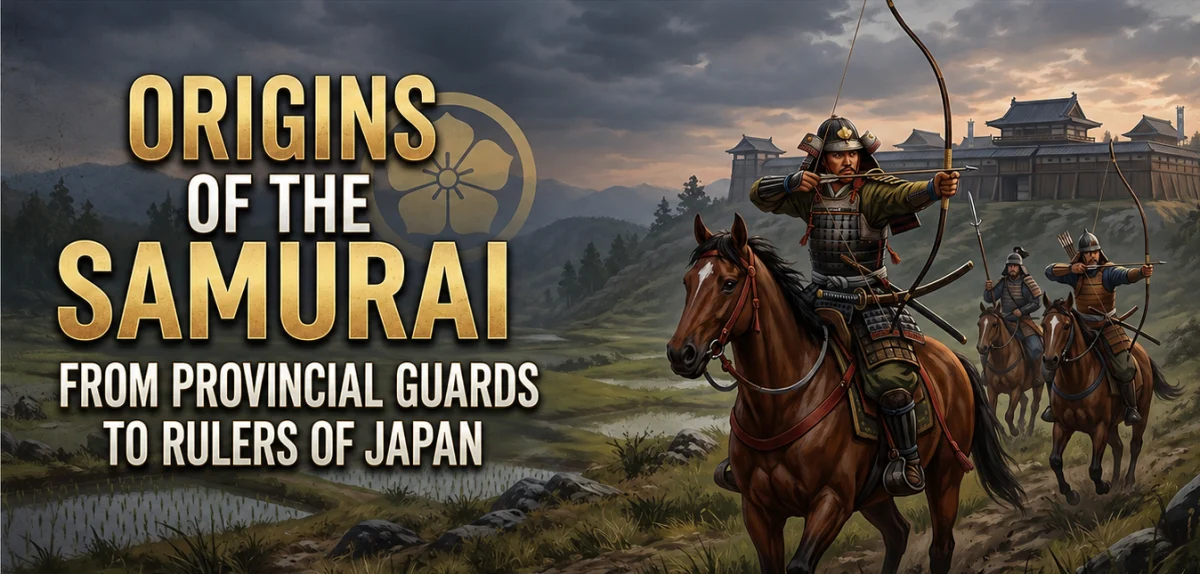
Origins of the Samurai: How Border Guards Won Japan
The authentic origins of the samurai contradict the romanticized legends of modern popular media. Popular imagination depicts an ancient class of noble, philosophically minded swordsmen who governed themselves by an unyielding ethical code. In historical reality, the origins of the samurai began in the blood, mud, and administrative chaos of Japan’s early medieval frontiers.
Rather than emerging as high-born aristocrats, the earliest warriors developed as pragmatic, hard-bitten horse archers. Conscripted or hired to suppress peasant tax revolts, guard distant private estates, and fight hostile frontier tribes, these provincial enforcers realized that armed might outweighed imperial decrees. Within four centuries, the origins of the samurai culminated in a systemic revolution that stripped the ancient Kyoto court of executive power and established military rule over Japan for nearly seven hundred years.
The Collapse of the Ritsuryō State and Peasant Conscription
To understand the institutional origins of the samurai, one must examine the monumental breakdown of the imperial conscription system. During the eighth century, the Nara and early Heian courts operated under the Ritsuryō system, a centralized legal and administrative apparatus borrowed directly from Tang Dynasty China.
Under this legal code, the imperial court attempted to maintain a vast peasant conscription army:
-
Every third adult male peasant between twenty and sixty was conscripted into provincial regiments (gundan).
-
Conscripts were trained as foot soldiers, armed with heavy wooden pikes, composite shortbows, and cumbersome iron breastplates (tankō).
-
Soldiers were forced to furnish their own clothing, food rations, and travel gear, marching hundreds of miles without state compensation.
The system proved to be an administrative and operational catastrophe. Conscripts lacked martial motivation, deserted in droves, and starved along transit routes. Furthermore, massed peasant infantry proved utterly useless against mobile, mounted enemies inhabiting the northern wilderness.
In 792 CE, Emperor Kanmu officially acknowledged the collapse of the peasant army, abolishing general military conscription across the provinces. To maintain local security, the court turned to the Kondei system (“Strong Youths”), commissioning wealthy provincial landowners who possessed horses, personal armor, and the leisure to practice equestrian archery.
This critical pivot marks the functional origins of the samurai. Military violence was privatized, passing from a national peasant draft into the hands of specialized provincial families.
The Emishi Wars: The Crucible of Northern Honshu
The technical and tactical origins of the samurai were forged during decades of savage frontier combat in northern Honshu. Between 774 and 811 CE, the Yamato imperial court launched consecutive military campaigns to subjugate the Emishi, the indigenous, non-Yamato populations inhabiting the rugged Tōhoku region.
The court dispatched large armies of southern peasant conscripts into the northern forests, expecting rapid submission. Instead, imperial forces suffered humiliating defeats at the hands of Emishi irregulars.
The Emishi fought with tactical doctrines that shocked Yamato commanders:
-
They operated as high-mobility horse archers, launching lightning ambushes from dense mountain passes.
-
They avoided pitched, open-field melees, withdrawing into trackless swamps the moment imperial formations attempted to organize.
-
They fired heavy arrows with exceptional accuracy while galloping at full speed across uneven terrain.
Recognizing that rigid infantry formations could not conquer northern Honshu, imperial commanders adopted the weaponry and tactical doctrines of their enemies. Provincial elites in eastern Japan mastered horse archery (yabusame), bred sturdier warhorses, and abandoned straight Chinese-style swords (chokutō) in favor of curved blades designed for downward cavalry slashing.
By the time the Emishi were subdued, a distinct, battle-hardened martial caste had crystallized across the Kantō plain. The tactical origins of the samurai were an exercise in battlefield adaptation: Yamato aristocrats survived by becoming the very horse archers they had been sent to destroy.
Tactical developments on the frontier [Internal Link: Sengoku Jidai Strategic Evolution] proved that regional warfare consistently favored mobile combined-arms tactics over static continental doctrines.
The Shoen System: Armed Stewards of Private Estates
While frontier combat created the military skill of early warriors, agrarian land privatization provided their economic foundation. Between the ninth and eleventh centuries, the fiscal architecture of Japan fractured under the expansion of shōen—tax-exempt private agricultural estates.
To encourage the reclamation of untamed wilderness, the imperial court passed laws granting permanent tax immunities to newly cultivated fields. Wealthy Buddhist monasteries and powerful court aristocrats in Kyoto rapidly consolidated thousands of independent farms into massive private estates.
This economic shift accelerated the origins of the samurai:
-
Absentee court nobles residing in Kyoto lacked the physical means to collect rents or police remote lands.
-
Provincial estate owners hired local warrior chieftains as estate managers (shōkan) and armed bailiffs to extract rice taxes by force.
-
Rival estates regularly clashed over irrigation rights, grazing meadows, and disputed boundary stones.
-
Independent smallholders surrendered their land deeds to local warlords in exchange for armed protection against predatory imperial tax collectors.
Provincial warriors were no longer seasonal mercenaries; they were armed landlords. They organized their sons, brothers, and local tenant farmers into cohesive private military bands known as bushidan.
The etymological origins of the samurai reflect this subservient administrative role. The term derives from the archaic classical Japanese verb saburau, meaning “to wait upon” or “to serve as an attendant.” The early warrior was defined by his functional duty to protect the wealth of aristocratic patrons.
+---------------------------------------------------------------------------------+
|                       STRUCTURAL ORIGINS OF THE SAMURAI                         |
|                                                                                 |
|  [Abolition of Conscription]  (792 CE: Peasant draft scrapped; Kondei emerges)  |
|               |                                                                 |
|               v                                                                 |
|  [The Emishi Frontier Wars]   (8th-9th C: Adoption of horse archery & tachi)    |
|               |                                                                 |
|               v                                                                 |
|  [The Shōen Land Crisis]      (10th-11th C: Rise of private estate enforcers)   |
|               |                                                                 |
|               +-----------------------+-----------------------+                 |
|               |                                               |                 |
|               v                                               v                 |
|  [Taira Clan (Heike)]                               [Minamoto Clan (Genji)]     |
|  - Western naval control                            - Eastern Kantō horsemen    |
|  - Kyoto court assimilation                         - Rugged martial ethos      |
|               |                                               |                 |
|               +-----------------------+-----------------------+                 |
|                                       |                                         |
|                                       v                                         |
|  [Genpei War (1180-1185)] ──> [Dan-no-ura Naval Clash] ──> [Kamakura Shogunate] |
+---------------------------------------------------------------------------------+
Imperial Blood on the Frontier: The Minamoto and Taira Lines
A critical turning point in the origins of the samurai occurred when the imperial bloodline itself migrated to the provinces. Japanese emperors fathered dozens of children with imperial consorts, creating an unsustainable fiscal burden on the central court treasury.
To reduce administrative costs, emperors executed a policy known as dynastic shedding (kōzoku kōka):
-
Junior princes and princesses several generations removed from the succession were stripped of royal status.
-
They were granted prestigious hereditary clan surnames, most notably Minamoto (also known as the Genji) and Taira (the Heike).
-
Cut off from state stipends, these former royals moved to the provinces to serve as provincial governors and establish regional landholdings.
These aristocratic exiles brought high-court pedigree to rugged provincial warbands. A local warrior band led by an ordinary chieftain commanded limited prestige; the same band commanded by a direct great-grandson of an emperor held legitimate authority.
In eastern Japan, the Minamoto established deep ties with the hardened horse archers of the Kantō plain. In western Japan and the Inland Sea, the Taira consolidated power over maritime trade routes and coastal garrisons.
The institutional origins of the samurai achieved critical mass through this fusion of royal lineage and provincial violence. Warriors possessed both the iron blades to enforce their will and the aristocratic ancestry required to challenge court supremacy.
Warfare, Arms, and Armor in the Origins of the Samurai
The battlefield gear of early medieval bushi reflected their specialized role as mounted shock archers. Popular culture emphasizes the katana, yet in the foundational era of the origins of the samurai, the sword was an auxiliary sidearm of last resort.
The primary weapons and protective kit included:
-
The Yumi: An asymmetrical composite longbow measuring over two meters in length, crafted from laminated strips of bamboo and wood glued with fish paste, featuring an off-center grip designed specifically for equestrian shooting.
-
The Tachi: A deeply curved cavalry sword suspended edge-downward from waist cords, designed to be drawn and swung in a continuous downward cutting motion from the saddle.
-
The Ō-yoroi (Great Armor): A rigid, box-shaped cuirass composed of thousands of individual iron and rawhide scales (kozane) laced with dyed silk cords (odoshi), weighing nearly thirty kilograms and suspended entirely from the shoulders.
-
The Sode: Massive rectangular shoulder plates functioning like dynamic pavilions, shifting forward to protect the warrior’s neck when turning away from incoming arrow volleys.
Early samurai combat was an exercise in synchronized equestrian archery. Mounted warriors circled opposing lines at distances of fifty to eighty yards, loosing armor-piercing chisel-point arrows (tagane-ya) into gaps beneath helmet rims and armpits.
Melees were personal and desperate. If unhorsed or out of arrows, warriors drew their curved tachi or closed for hand-to-hand grappling (kumi-uchi), using stout armor-piercing daggers (yoroi-dōshi) to deliver fatal thrusts to the throat.
Equestrian martial systems [Internal Link: Nomadic Equestrian Warfare Mechanics] demonstrated that across Eurasia, mounted missile superiority consistently dismantled centralized agrarian infantry armies.
The Kyoto Illusion: Aristocratic Decline in the Heian Period
Throughout the tenth and eleventh centuries, the civilian aristocracy in Kyoto, dominated by the imperial Fujiwara clan, lived in deliberate isolation from provincial realities. Courtiers devoted their days to poetry competitions, incense-blending contests, calligraphy, and elaborate Buddhist rituals.
The court viewed provincial bushi with undisguised contempt:
-
Aristocratic diaries referred to eastern warriors as azuma ebisu—uncouth, barbaric brutes from the east.
-
Court nobles viewed violence as spiritually polluting (kegare), delegating all military, policing, and execution tasks to provincial warriors.
-
Provincial taxes dried up as warrior-controlled shōen withheld revenue, leaving court palaces decaying and roads infested with highwaymen.
This aristocratic delusion collapsed during the mid-twelfth century. When succession crises split the imperial family, rival court factions realized they were powerless without calling upon the military strength of the Taira and Minamoto clans.
The Hōgen Rebellion of 1156 and the Heiji Rebellion of 1159 brought open warfare into the streets of Kyoto. Palaces were torched, imperial ministers were decapitated, and the court discovered that its sacred edicts were meaningless without warrior backing.
Following these clashes, Taira no Kiyomori seized control of the government, becoming the first military commander to hold the post of Grand Minister (Daijō-daijin). The origins of the samurai had reached the heart of imperial power.
The Genpei War: The Clash for National Hegemony
Taira no Kiyomori’s triumph contained the seeds of his clan’s destruction. Once established in Kyoto, the Taira adopted the luxurious habits, intermarriage politics, and artistic pursuits of the court nobility, alienating their rugged warrior retainers in the provinces.
In 1180, Prince Mochihito issued an imperial call to arms, urging the disenfranchised Minamoto clan to rise against Taira hegemony. This ignited the Genpei War (1180–1185), a five-year civil conflict that engulfed central and western Japan.
The war pitted two completely different military cultures against each other:
-
The Taira (Heike): Entrenched in Kyoto and the Inland Sea, culturally refined, reliant on naval fleets, and politically fragile.
-
The Minamoto (Genji): Mobilized across the Kantō plain under Minamoto no Yoritomo and his brilliant half-brother Yoshitsune, commanding disciplined, battle-hardened cavalry corps.
Through daring tactical maneuvers, Minamoto no Yoshitsune broke Taira lines at Ichinotani by riding cavalry down a precipitous cliff face, followed by an unexpected amphibious assault during a blizzard at Yashima.
The war reached its catastrophic conclusion on April 25, 1185, at the naval Battle of Dan-no-ura in the Shimonoseki Strait:
-
The Minamoto fleet outmaneuvered the Taira by exploiting shifting tidal currents.
-
Archery barrages targeted Taira helmsmen and rowers, paralyzing their ships.
-
Seeing that defeat was absolute, the Taira matriarch leaped into the sea with the eight-year-old Emperor Antoku and the sacred imperial sword, drowning rather than submitting to capture.
The Taira leadership was eradicated. The Minamoto stood alone as the undisputed military masters of Japan. The violent origins of the samurai had transitioned into absolute geopolitical supremacy.
1192 CE: The Founding of the Kamakura Bakufu
Minamoto no Yoritomo demonstrated a political genius that matched his brother’s battlefield talents. Having witnessed how the soft luxuries of Kyoto had corrupted the Taira clan, Yoritomo refused to establish his government in the imperial capital.
Instead, Yoritomo established his administrative headquarters far to the east in Kamakura, a coastal fishing village framed by steep hills and the sea:
-
The Bakufu: The military administration was designated as the Bakufu (literally “Tent Government”), signaling that it was an active military field headquarters rather than a civilian court.
-
The Gokenin System: Yoritomo established direct, personal feudal ties with his warrior vassals, guaranteeing their ancestral land holdings (chigyō) in exchange for military service and guard duty.
-
Shugo and Jitō: In 1185, Yoritomo coerced the imperial court into granting him the right to appoint military governors (shugo) and estate stewards (jitō) across all Japanese provinces, placing law enforcement and taxation directly under military oversight.
In 1192 CE, following the death of the retired emperor Go-Shirakawa, the imperial court formally capitulated to reality, bestowing upon Yoritomo the historic title of Sei-i Taishōgun (“Barbarian-Subduing Generalissimo”).
This act completed the foundational origins of the samurai. The emperor remained the sacred, divine sovereign of the state, but all administrative, fiscal, and military authority was transferred to the Shogun.
Feudal Japan was born. Law was no longer derived from complex Chinese bureaucratic statutes, but from unwritten warrior customs, oaths of personal fealty, and military force.
Archaeological Evidence: Unearthing the Early Bushi
Modern archaeological excavations across Japan have provided critical empirical data that strips away literary romanticism from the early warrior class. Excavations in Kamakura, Tohoku, and the Kanto plain confirm the material realities of the twelfth-century martial elite.
Key archaeological excavations have recovered vital data:
-
The Yuigahama Mass Graves: Excavations along the beach in Kamakura uncovered thousands of human skeletons dating to the wars of the thirteenth century; over seventy percent of identifiable trauma consists of crushing fractures to skulls caused by maces, stones, and arrows.
-
Arrowhead Metallurgy: Excavated bone specimens regularly reveal socketed iron bodkin arrowheads lodged directly into pelvic girdles and thoracic vertebrae, proving that long-range missile fire inflicted the overwhelming majority of battle casualties.
-
Horse Skeletal Remains: Excavated equine skeletons demonstrate that early medieval Japanese warhorses were compact, stocky ponies standing between twelve and fourteen hands high, built for mountain endurance rather than modern cavalry charges.
Excavations of early fortified warrior residences (bushi yashiki) show that chieftains lived in functional, defensible compounds surrounded by wooden stockades, earthen ramparts (dorui), and dry moats, far removed from the stone castles of later centuries.
The material record demonstrates that the origins of the samurai were rooted in physical survival and pragmatic fortification, confirming chronicle descriptions of an austere, heavily armed frontier society.
The Enduring Geopolitical Legacy of the Early Warriors
The historical origins of the samurai permanently transformed the social, legal, and political trajectory of Japan. By creating an administrative model rooted in military command rather than civil jurisprudence, early warriors built a durable framework that survived every subsequent civil war.
The lasting institutional legacies of this transformation include:
-
The Dual Structure of Power: The separation between the symbolic, sacred authority of the Emperor in Kyoto and the practical executive power of the Shogun became the defining constitutional pattern of Japanese history until the Meiji Restoration of 1868.
-
The Feudal Land System: The network of gokenin vassals and estate stewards (jitō) replaced ancient private estates, establishing the lord-vassal land tenure system that governed the Sengoku and Edo periods.
-
The Militarization of Culture: Martial values—discipline, family lineage honor, stoicism, and battlefield pragmatism—became the dominant cultural ethos of the ruling elite, deeply influencing Japanese art, literature, and philosophy.
-
Resilience Against Foreign Invasion: When the Mongol Empire attempted to invade Japan in 1274 and 1281, the centralized military machinery created by the Kamakura Bakufu mobilized coastal defenses that successfully checked the largest amphibious invasions in medieval history.
The popular modern myth of the samurai as a solitary romantic swordsman obscures their genuine historical greatness. They did not inherit power; they engineered it from the ground up through discipline, technical adaptation, and strategic calculation.
From their humble beginnings as horse archers patrolling violent river borders, the warriors who drove the origins of the samurai dismantled an ancient empire, proving that political legitimacy belongs to those who possess the strength, skill, and organization to defend it.
Frequently Asked Questions
What caused the origins of the samurai in early Japan?
The origins of the samurai were caused by the collapse of the imperial peasant conscription system in 792 CE, prolonged frontier warfare against the indigenous Emishi in northern Honshu, and the expansion of private tax-exempt agricultural estates (shōen). These factors forced court aristocrats and local landowners to hire private, armed horse archers to enforce order and collect taxes.
What was the primary weapon used during the origins of the samurai?
The primary weapon of the early samurai was the yumi, an asymmetrical composite longbow measuring over two meters in length. Early warriors were mounted archers who conducted warfare primarily from horseback; swords such as the curved tachi were auxiliary sidearms carried for close-quarter emergency defense.
When did the samurai officially take control of the Japanese government?
The samurai officially took control of the government in 1192 CE, when Minamoto no Yoritomo established the Kamakura Bakufu (military government) and received the title of Sei-i Taishōgun from the Emperor. This shifted national administration away from the civilian imperial court in Kyoto into the hands of the warrior class.