
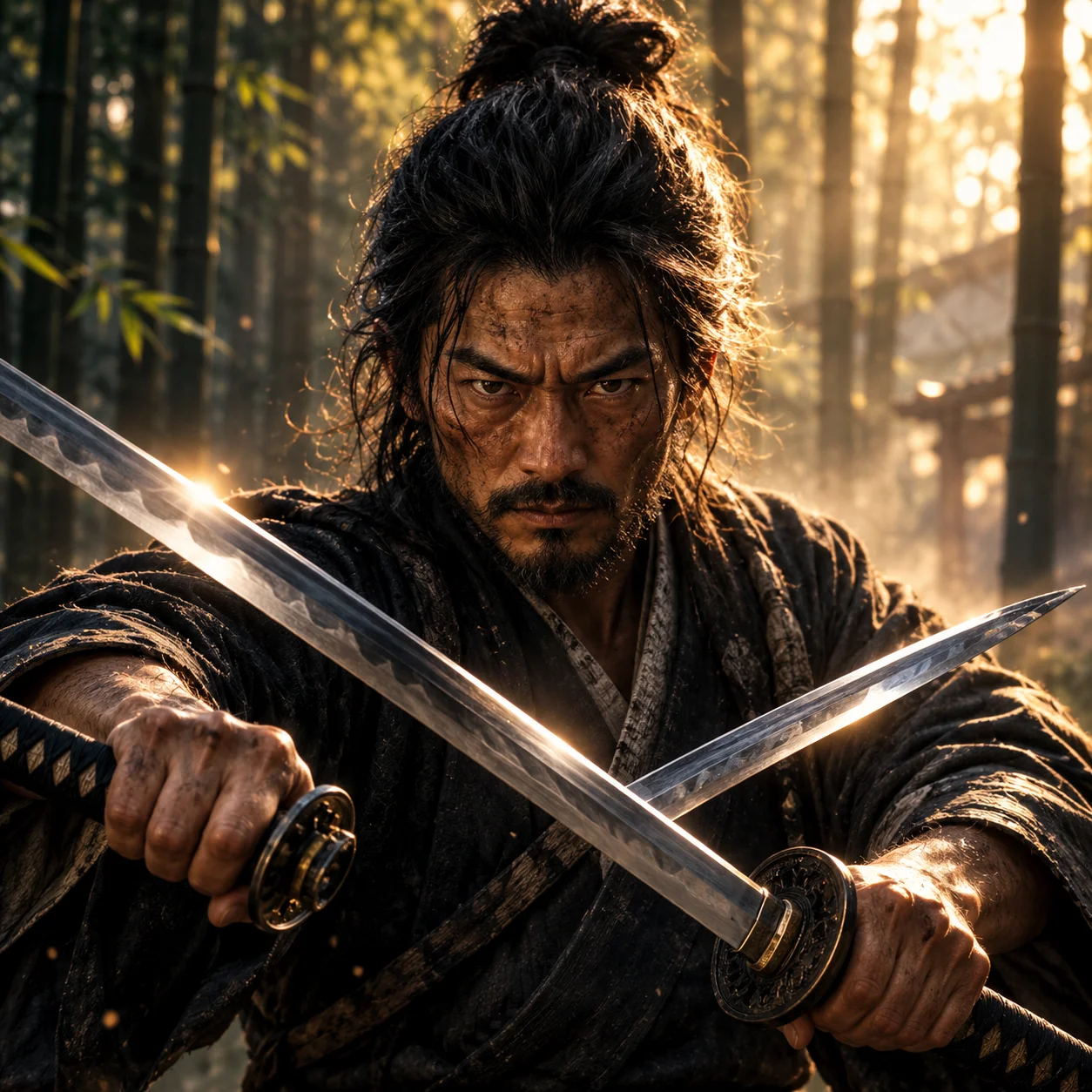
Miyamoto Musashi: The Two-Sword Technique and the Book of Five Rings
Few figures in martial history match the enduring reputation of Miyamoto Musashi. Undefeated across more than sixty mortal duels, the legendary master swordsman transformed practical combat into a comprehensive philosophical system.
Born in late-sixteenth-century Japan during the violent transition from civil war to centralized peace, Musashi stripped away ceremonial posturing in favor of ruthless efficiency.
His lifetime of warfare culminated in two permanent monuments: his dual-blade combat school, Niten Ichi-ryu, and his foundational treatise on strategy, The Book of Five Rings (Go Rin No Sho).
Examining the career of Miyamoto Musashi reveals how a wandering duelist moved beyond mechanical swordplay to master the psychological core of conflict itself.
The Making of a Kensei: Early Duels and the Warrior’s Pilgrimage
Miyamoto Musashi fought his first lethal engagement at the age of thirteen. He challenged Arima Kihei, a traveling samurai of the Shinto-ryu style, beating him to death with a wooden quarterstaff.
By sixteen, Musashi defeated Tadashima Akiyama in Tajima province, cementing his path as a wanderer embarking on musha shugyō—the severe martial pilgrimage undertaken by unattached samurai seeking tactical perfection.
Musashi stepped onto the wider stage of Japanese military history during the cataclysmic campaign that ended the Sengoku period, fighting amid the infantry ranks at the [Internal Link: Battle of Sekigahara Tactics].
Surviving the bloodbath, he refined his approach, realizing that standard battlefield methods often failed in unpredictable, single combat.
[Early Duels (Age 13-16)]
       │
       ▼
[Battle of Sekigahara (1600)] ──► Survives Mass Infantry Warfare
       │
       ▼
[Kyoto Arrival (1604)] ────────► Crushes the Yoshioka Clan (Ichijōji Stand)
       │
       ▼
[Ganryu Island (1612)] ────────► Defeats Sasaki Kojirō; Retires from Lethal Duels
In 1604, Musashi arrived in Kyoto to test his methods against the celebrated Yoshioka school, traditional fencing instructors to the Ashikaga shoguns. He defeated the clan head Yoshioka Seijūrō with a single blow from a blunt wooden sword (bokken), crippling him.
Days later, Seijūrō’s brother Denshichirō challenged Musashi to restore clan honor; Musashi disarmed him and struck him dead on the spot.
Desperate to salvage their reputation, the Yoshioka mobilized dozens of retainers armed with swords, bows, and matchlocks to ambush Musashi at the Ichijōji pine tree. Anticipating their trap, Miyamoto Musashi arrived hours early, hiding in the brush.
When the clan gathered, he sprinted from concealment, cut down their nominal leader, the twelve-year-old Matashichirō, and slashed his way through the perimeter to escape. The Yoshioka school was extinguished in a single morning.
Niten Ichi-ryu: Mechanics of the Two-Sword Technique
Traditional Japanese swordsmanship mandated a two-handed grip on a single long blade (katana). Miyamoto Musashi considered this practice restrictive, arguing that committing both hands to one weapon limited tactical freedom, especially in confined quarters or when handling a mount.
He established his own system, known originally as Enmei-ryu and later perfected as Niten Ichi-ryu (Two Heavens as One).
+---------------------------------------------------------------+
|               NITEN ICHI-RYU DUAL-BLADE DYNAMICS              |
+-------------------------------+-------------------------------+
| KATANA (Right Hand - Offense) | WAKIZASHI (Left Hand - Control)|
+-------------------------------+-------------------------------+
| - Primary cutting momentum    | - Deflection and trapping     |
| - Extended reach tracking     | - Short-range line-checking   |
| - Downward cleaving arcs      | - Rapid underhanded thrusts   |
+-------------------------------+-------------------------------+
The school called for wielding the katana in the dominant hand and the companion short sword (wakizashi) in the off-hand. The fighter did not wildly swing both weapons at once. Instead, Musashi used the blades asynchronously to control distance and timing:
-
Parry and Bind: The shorter wakizashi parried, deflected, or pinned an opponent’s incoming strike, sliding down the spine of their weapon.
-
Simultaneous Counter: With the opponent’s centerline compromised and their hands bound, the katana executed an immediate, fatal counter-cleave without needing to reset.
-
Spatial Clearance: In narrow hallways or against multiple opponents, the dual weapons allowed a fighter to cover two defensive arcs at once, keeping surrounding enemies from closing the distance.
Musashi taught that a warrior should practice wielding the long sword with one hand until it felt as light as a feather.
He maintained that dying with an unused secondary weapon still sheathed in one’s sash showed a failure of practical preparation. Every tool carried onto the field was meant to be used.
The Ganryu Island Showdown: Psychology Over Pure Technique
The most famous duel in the life of Miyamoto Musashi took place on April 13, 1612, on the barren shores of Funajima Island. His opponent was Sasaki Kojirō, known as “The Demon of the Western Provinces.”
Kojirō wielded an exceptionally long two-handed blade nicknamed the “Drying Pole” (Monohoshizao) and was celebrated for his Tsubame Gaeshi (Swallow Reversal), a lightning-fast downward strike followed instantly by an upward cut.
Musashi understood that confronting Kojirō on conventional terms played into his reach advantage. He turned to psychological warfare to break his opponent’s focus:
-
Deliberate Tardiness: Musashi arrived several hours late, leaving Kojirō waiting under a harsh sun, pacing the sand in growing frustration.
-
Improvised Weaponry: Instead of drawing his steel swords, Musashi spent the boat journey carving a heavy wooden blade from a broken oar, making it slightly longer than Kojirō’s sword.
-
Sun Positioning: Musashi waded ashore with the blinding morning sun directly at his back, forcing Kojirō to squint into the glare.
                  [ Kojirō: Impatient & Agitated ]
                               │
               (Blinded by Rising Morning Glare)
                               ▼
[ Sasaki Kojirō Charges ] ───────────► [ Slashes: Cuts Musashi's Headband ]
                                                     │
                                                     ▼
[ Musashi Jumps & Counters ] ◄─────── [ Heavy Oar Crushes Kojirō's Skull ]
When Kojirō drew his long sword and threw his scabbard into the surf, Musashi remarked, “You have already lost. Why else would you discard your sheath?”
Infuriated, Kojirō charged, unleashing his signature strike. The blade sliced clean through Musashi’s headband.
At the exact same fraction of a second, Musashi leapt upward and brought his heavy wooden oar down on Kojirō’s skull. Kojirō collapsed, dying on the sand.
Musashi bowed respectfully to the witnesses, returned to his rowboat, and departed. The encounter marked his final mortal duel; from that day on, Miyamoto Musashi dedicated his life to spiritual cultivation, governance, and strategy.
The Book of Five Rings: A Tactical and Philosophical Dossier
In 1643, sensing his health failing, Miyamoto Musashi retreated to Reigandō (Spirit Rock Cave) in the mountains of Kumamoto. Living as a hermit, he composed Go Rin No Sho (The Book of Five Rings) to preserve his lifelong martial knowledge for his student Terao Magonojō.
Rather than cataloging rigid physical forms, the work presents an analytical manual for outmaneuvering an opponent across both individual duels and large-scale warfare. Musashi structured his work around five elemental books:
+-------------------------------------------------------------+
|             THE ARCHITECTURE OF GO RIN NO SHO               |
+-------------------------------------------------------------+
|  EARTH BOOK  | Fundamentals, weapon utility, and direct path|
|  WATER BOOK  | Physical technique, posture, and fluidity    |
|  FIRE BOOK   | Timing, psychological aggression, and battle |
|  WIND BOOK   | Critical review of rival schools and errors  |
|  VOID BOOK   | Intuitive mastery beyond conscious technique |
+-------------------------------------------------------------+
1. The Ground Book (Earth)
Musashi outlines the fundamentals of the Way of Strategy (Heiho). He compares the strategist to a master carpenter, emphasizing that a commander must understand the strengths and limits of every worker and tool.
He warns against superficial embellishment, insisting that the only goal of swordsmanship is cutting down the adversary.
2. The Water Book
Water adapts to any vessel, whether a tiny drop or a vast ocean. Here, Musashi details physical stances, body mechanics, and visual perception.
He distinguishes between two types of vision:
-
Kan (Perception): Seeing into the opponent’s mind, intentions, and structural vulnerabilities.
-
Ken (Observation): Mere surface-level physical tracking of their weapons.
He urges martial artists to make their intuitive vision (Kan) sharp and their surface observation (Ken) secondary.
3. The Fire Book
Fire represents the heat of active combat. Musashi analyzes the dynamics of tempo, rhythm, and tactical initiative.
He presents three methods to forestall the enemy (Sen):
-
Attacking before the enemy moves (Ken no Sen).
-
Feigning weakness to strike as they attack (Tai no Sen).
-
Striking simultaneously when both clash (Tai Tai no Sen).
He also introduces “Crossing the Ford,” which means launching an offensive when an enemy is off-balance or passing through a bottleneck.
4. The Wind Book
Wind represents tradition and style. Musashi critiques other contemporary schools, targeting their dependence on overly long weapons, heavy stances, and flamboyant techniques.
He argues that obsessing over speed or brute strength reveals an underlying lack of balance. Real strategy remains simple, adaptable, and free of artificial rules.
5. The Book of the Void
The final, shortest section addresses Kū—the Void. Musashi defines the Void not as empty nothingness, but as pure awareness free from conscious hesitation.
When a warrior internalizes training so deeply that technique operates without conscious thought, they move with total spontaneity. The warrior acts without doubt, responding instantly to shifts in combat.
Strategic Comparison: Musashi’s Pragmatism vs. Classical Feudal Schools
The tactical doctrines developed by Miyamoto Musashi set him apart from traditional Japanese fencing systems:
| Strategic Vector | Miyamoto Musashi (Niten Ichi-ryu) | Classical Traditional Schools (Yagyū / Shinkage) |
| Core Philosophy | Utilitarian pragmatism; victory by any method | Esoteric rituals, strict form, aristocratic pedigree |
| Weapon Configuration | Katana and Wakizashi deployed together | Single Katana held with an orthodox two-handed grip |
| Psychological Stance | Aggressive demoralization, delay, environmental control | Formal martial etiquette, honor codes, fixed arenas |
| Terrain Application | Sun positioning, mud, bottlenecks, ambushes | Balanced indoor dojos and level outdoor courtyards |
| Scale of Application | Equal utility for individual duels and massed armies | Focus on personal dueling and judicial defense |
Later Life, Artistry, and Enduring Influence
In his later years, Musashi served as an artistic and military advisor to the Hosokawa clan in Kumamoto. Far from being an unrefined brawler, Miyamoto Musashi became an accomplished master of ink-wash painting (sumi-e), calligraphy, and metalwork.
His preserved paintings, such as Shrike Perched on a Dead Branch, are recognized as Japanese national cultural treasures, celebrated for their sharp, economical brushwork that mirrors the clean path of a sword.
                  [ Life of Miyamoto Musashi ]
                               │
      ┌────────────────────────┴────────────────────────┐
      ▼                                                 ▼
[ Lethal Warrior / Duelist ]                 [ Philosopher / Calligrapher ]
- Over 60 Duels Undefeated                  - Sumi-e Master (National Treasures)
- Pioneer of Dual-Blade Tactics             - Author of The Book of Five Rings
- Battle of Sekigahara Veteran              - Creator of Dokkōdō (21 Precepts)
Days before his death in May 1645, Musashi penned the Dokkōdō (“The Way of Walking Alone”), a collection of twenty-one precepts for living an austere, self-reliant life.
Among these rules, he recorded: “Accept everything just the way it is,” and “Do not regret what you have done.”
His combined contributions to martial strategy and philosophy established Miyamoto Musashi as Japan’s quintessential Kensei—a sword saint whose life bridged martial violence and meditative insight.
Frequently Asked Questions
Did Miyamoto Musashi ever lose a sword duel?
No. Historical records and his own writings document that Miyamoto Musashi remained undefeated throughout more than sixty mortal duels fought across the Japanese islands. His most famous victories occurred against the masters of the Yoshioka fencing school and the renowned swordsman Sasaki Kojirō on Ganryu Island.
What is the central message of The Book of Five Rings?
The core lesson of The Book of Five Rings is that true strategy is practical, free of superstition, and applicable to any competitive endeavor. Miyamoto Musashi emphasized mastering rhythm, anticipating an adversary’s psychology, controlling the physical environment, and acting without hesitation from a mindset of deep awareness.
Why did Miyamoto Musashi create the two-sword style?
Musashi created Niten Ichi-ryu because he believed gripping a sword with both hands limited mobility and left the secondary weapon wasted. By wielding the katana in one hand and the wakizashi in the other, a warrior could simultaneously parry incoming attacks and deliver lethal counter-strikes, while retaining balanced control in close-quarters skirmishes.