
Dancing Plague 1518: The Lethal Mania That Shook Strasbourg
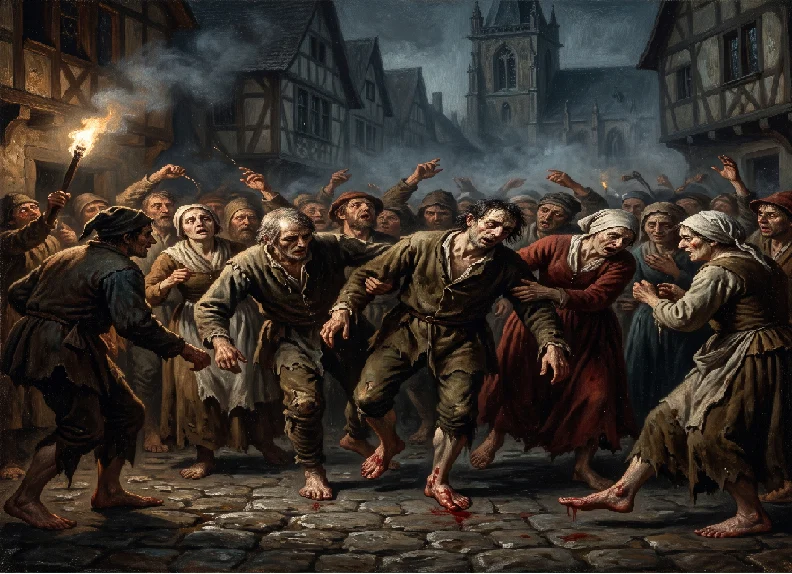
The summer air hung heavy over the narrow streets of Strasbourg in mid-July when Frau Troffea stepped out from her home and began to twist compulsively. Her sudden movement marked the violent ignition of the dancing plague 1518, an involuntary frenzy that trapped hundreds of citizens in lethal rhythmic convulsion. Within minutes, her boots struck the dirt with frantic precision. She wore no festive smile, and no musicians accompanied her manic footwork.
Her husband pleaded with her to return inside, yet her eyes remained fixed on nothing. Hours passed under the blistering Rhine sun while her movements grew wilder and her tunic soaked through with sweat. By dusk, her boots were shredded and her heels rubbed raw against the jagged cobblestones. When she finally collapsed from exhaustion, the respite proved fleeting; after barely two hours of fitful slumber, she stood up and resumed the manic routine.
Local magistrates initially treated her behavior as an isolated mental breakdown or domestic dispute. They could not foresee that her solitary torment would swiftly swell into the dancing plague 1518, one of the most documented and lethal social panics of the sixteenth century. Within days, neighbors gathered to watch in dread as Troffea danced through her third consecutive morning. The contagion soon leaped to those who watched her.
The Outbreak Spreads Through Strasbourg’s Alleys
Six days into Frau Troffea’s solo performance, her husband and local clerics bundled her into a wooden cart and hauled her thirty miles southwest toward the Vosges Mountains. They hoped a pilgrimage to a secluded mountain shrine would purge her troubled mind. By the time the cart clattered past the city ramparts, the damage was already done. More than thirty people across the Saint-Laurent parish had begun to mimic her violent, involuntary steps.
The terrifying momentum of the dancing plague 1518 quickly overwhelmed Strasbourg’s working-class quarters. Linen weavers, grain porters, tanners, and widowed mothers dropped their tools and domestic tasks to join the churning crowds. They gathered in open plazas, their limbs jerking violently to an internal tempo no spectator could hear. The mania spread from person to person along the trade arteries of the Ill River.
By early August, the civic council recorded that over a hundred men, women, and adolescents were caught in the frenzy. Witnesses documented harrowing scenes where dancers screamed in terror while their feet carried them onward. Mothers begged bystanders to hold their crying infants while their hips and knees buckled beneath them in relentless, spasmodic rhythm.
The social geography of the contagion was distinct: it struck the impoverished and the desperate with devastating precision. The affluent patricians living behind high stone walls observed the unfolding catastrophe from their upper-story balconies, horrified by the spectacle consuming the lower quarters. The dancing plague 1518 laid bare the profound psychological vulnerability of a city pushed past its breaking point by hunger and disease.
Civic Panic and the Humoral Diagnosis of Hot Blood
As dozens of new victims collapsed into the dust each day, the Strasbourg City Council, known as the XXI, convened an emergency tribunal. The magistrates sought immediate guidance from the faculty of medicine rather than handing the crisis to Church inquisitors. The doctors examined the dancers, noting their flushed faces, dilated pupils, and elevated body temperatures.
Drawing from Galenic traditions, the physicians determined that the victims suffered from an acute biological disorder rather than demonic possession. They formally diagnosed the condition as an overheating of the circulatory system. In their medical assessment:
-
An excess of burnt black bile mingled with agitated phlegm had settled in the cerebral ventricles.
-
The resulting vapor rose to the brain, driving the animal spirits into hyperactive agitation.
-
This combustible internal state induced spontaneous, violent choreic spasms throughout the muscular system.
The doctors concluded that natural bodily processes had to run their course. The afflicted could only recover if they expelled the toxic heat through sustained perspiration. To interrupt the dancing, the physicians warned, would cause the overheated humor to congeal around the heart, resulting in instantaneous death.
Guided by this catastrophic miscalculation, the magistrates resolved to facilitate the frenzy. They transformed the city into an open-air theater of forced exercise, turning the full administrative machinery of the municipality toward fueling the dancing plague 1518.
[Timeline of Civic Escalation]
Mid-July 1518: Frau Troffea initiates the dancing in central Strasbourg.
Late July 1518: Thirty citizens join; magistrates seek medical counsel.
Early August 1518: City erects public wooden stages at grain markets.
Mid-August 1518: Musicians hired; mortality climbs to fifteen deaths per day.
Late August 1518: Complete civic reversal; dancing banned, carts carry victims to Saverne.
Fueling the Fire: The Lethal Policy of State-Sponsored Music
Acting on medical advice, the magistrates cleared two central commercial centers: the horse market and the grain exchange at the Kaufhaus. Carpenters worked overnight to build massive wooden stages to keep the dancers off the dangerous cobblestones. The council sent bailiffs to hire every professional piper, trumpeter, and drummer within the district.
The civic government even recruited athletic laborers and blacksmiths to act as paid wardens. These men were instructed to catch falling dancers, steady their wavering hips, and keep them upright so the lethal sweat could continue flowing. The council believed that structured, rhythmic accompaniment would channel the chaotic spasms into an orderly cure.
The strategy backfired with catastrophic speed. The relentless blare of hornpipes and the thudding bass of field drums created a wall of sensory stimulation that echoed through the narrow streets day and night. Spectators who arrived out of morbid curiosity found themselves mesmerized by the rhythmic chaos, their eyes tracking the spinning bodies until their own legs twitched and gave way.
Rather than exhausting the affliction, the public staging normalized the mania and provided a communal theater for emotional collapse. Up to four hundred citizens eventually joined the ranks of the dancers. The physical toll escalated rapidly, turning public squares into slaughterhouses of cardiovascular collapse:
-
Victims suffered massive heart attacks, catastrophic strokes, and ruptured thoracic vessels.
-
Dehydration and heatstroke under the August sun claimed the lives of malnourished women and elderly laborers.
-
Foot wounds became septic as worn skin ground against wooden planks soaked in sweat and blood.
-
Contemporary chronicles recorded that mortality reached upwards of fifteen individuals per day during the height of the frenzy.
The horrific spectacle of the dancing plague 1518 finally forced the council to recognize the ruinous consequences of their medical experiment. The civic treasury was emptying, the city’s commercial life had ground to a complete standstill, and the stench of decay hung over the market squares.
Religious Despair and the Curse of Saint Vitus
In late August, the magistrates executed a frantic reversal of policy. They realized that human medicine had failed and that the contagion had spiraled beyond administrative control. The council abruptly banned all public dancing, shuttered the makeshift stages, and prohibited public music across the entire territory under severe financial penalties.
The city turned its eyes to the spiritual realm. In the popular imagination of the Upper Rhine, uncontrolled dancing was linked to Saint Vitus, an early Christian Sicilian martyr. Regional Catholic lore held that Vitus punished blasphemers and sinners by inflicting an incurable dancing curse upon them.
The people believed that only direct propitiation at the saint’s consecrated altar could lift the heavenly wrath. To understand the psychological power of this belief, historians often look to the earlier outbreaks of [Internal Link: Medieval Flagellant Movements] that swept the region during catastrophic famines. The citizens of Strasbourg viewed their predicament through this same lens of divine retribution.
The magistrates ordered the remaining dancers seized. Guards rounded up the survivors, bound their thrashing arms with hemp rope, and piled them into open farm wagons. The caravan set out on a three-day journey toward the jagged red-sandstone hills near Saverne, where a renowned grotto dedicated to Saint Vitus stood inside a mountain cavern.
The Ritual Cure in the Cavern of Saverne
Upon arriving at the mountain sanctuary, the exhausted victims were carried into the cool, dark recesses of the stone grotto. The priests of the shrine conducted a structured liturgical exorcism designed to calm the overstimulated nervous systems of the dancers:
-
Clerics unlaced the tattered, blood-caked shoes from each dancer’s swollen feet.
-
The victims were sprinkled with consecrated spring water drawn from the deep mountain aquifer.
-
Priests guided their swollen feet into small red slippers that had been blessed upon the holy altar.
-
Small cast-lead icons of Saint Vitus and the Virgin Mary were pressed into their trembling hands.
-
Latin prayers and solemn chants replaced the frenetic blare of city pipes.
Surrounded by quiet stone walls and reassured by the divine authority of the Church, the mental fever began to break. The physical transition from the sensory overload of Strasbourg’s markets to the dark, cool cave broke the hypnotic feedback loop.
One by one, the dancers sank to the cavern floor and slipped into deep, restorative sleep. Over the following two weeks, the manic behaviors diminished. Most survivors regained their faculties, though many remained permanently crippled by tendon damage, infected joint tissue, or severe cardiovascular trauma. By September, the dancing plague 1518 had finally burned itself out.
Psychological Shockwaves Across the Holy Roman Empire
The panic sent shockwaves along the Rhine basin, forcing neighboring free imperial cities to fortify their borders against travelers arriving from Strasbourg. Local town councils dispatched observers to monitor trade roads, fearing the contagion might spread through itinerant merchants or wandering pilgrims. The psychological fragility uncovered by the event echoed the tensions that fueled the [Internal Link: German Peasants War of 1525], where economic misery drove sudden, sweeping uprisings across the countryside.
[Structural Dimensions of the 1518 Crisis]
City Population: Approximately 20,000 to 25,000 residents
Estimated Peak Dancers: 400 individuals (~1.6% of the total urban population)
Duration of Outbreak: Approximately six weeks (mid-July through late August)
Primary Demographics: Destitute day-laborers, weavers, domestic servants, widowed women
Estimated Casualties: Between 50 and 100 individuals succumbed to exhaustion or cardiovascular failure
Debunking the Toxicological Myth of Ergot Poisoning
For decades during the twentieth century, popular accounts attributed the dancing plague 1518 to ergotism, commonly known as Saint Anthony’s Fire. Ergot is a toxic fungus (Claviceps purpurea) that infests damp rye, a primary staple grain of sixteenth-century European peasants. When ingested, ergot alkaloids produce vivid hallucinations, muscular convulsions, and acute psychotic episodes.
While the biological presence of ergot in early modern agriculture is well-documented, modern toxicologists and medical historians reject it as the primary catalyst for the Strasbourg epidemic. The chemical profile of ergotamine makes it an impossible candidate for sustained athletic exertion:
-
Ergot alkaloids act as powerful vasoconstrictors, severely restricting blood flow to the distal extremities.
-
Victims of convulsive ergotism suffer excruciating, burning cramps in their hands and feet, swiftly followed by dry gangrene.
-
Fingers and toes turn black, shrivel, and mummify due to complete tissue necrosis.
-
Individuals suffering from acute ergot poisoning can barely walk, let alone dance vigorously for hours without collapse.
Furthermore, ergotism does not discriminate by mental state or suggestibility; it strikes anyone who consumes contaminated flour. In Strasbourg, husbands watched their wives succumb while eating bread baked from the exact same rye sack. The selective demographic spread of the dancing plague 1518 rules out a purely biochemical poisoning event.
The Modern Consensus: Mass Psychogenic Illness and Severe Stress
The historical consensus identifies the event as a textbook manifestation of mass psychogenic illness, triggered by acute social trauma. The psychological terrain of Strasbourg in 1518 was primed for catastrophic collapse. The preceding decade had brought a relentless sequence of harvest failures, skyrocketing bread prices, and freezing winters that destroyed the Rhine vineyards.
Malnutrition was endemic among the urban poor, leaving their nervous systems frayed and their immune systems compromised. At the same time, outbreaks of syphilis—a terrifying new venereal plague sweeping across Europe—spread panic through the region. The citizens lived under an oppressive cloud of existential dread, convinced that the end of days was approaching and that divine punishment hung over their heads.
In psychological terms, mass psychogenic illness requires three conditions to ignite:
-
A population experiencing severe, prolonged communal distress and financial destitution.
-
A culturally sanctioned belief system that provides a clear script for physical symptoms.
-
A prominent initial catalyst that publicly demonstrates the scripted behavior.
Frau Troffea provided that catalyst. Her personal mental breakdown offered an outlet for the collective agony of the city’s underclass. Because every citizen grew up hearing terrifying tales of Saint Vitus cursing sinners with uncontrollable dancing, their traumatized subconscious seized upon that very template. The dancing plague 1518 was the agonizing physical manifestation of shared cultural despair, where minds pushed to the brink of survival used the language of dance to express an unbearable reality.
Historical Legacy of the Strasbourg Choreomania
The tragic events of that sweltering summer left an indelible mark on European social and medical history. The city council overhauled its public welfare programs in the aftermath, recognizing that starving populations presented an existential threat to civic stability. They tightened grain reserves, instituted new municipal oversight of bakeries, and cracked down on public begging.
The dancing plague 1518 also caught the attention of pioneering medical minds. The Swiss physician Paracelsus visited Strasbourg eight years after the outbreak to examine municipal records and interview surviving witnesses. He coined the term chorea lasciva to describe the condition, rejecting both humoral imbalances and supernatural curses in favor of emotional volatility and sensory contagion.
Today, the event stands as a stark reminder of the fragile boundary separating communal psychology from somatic expression. When extreme environmental pressures collide with shared spiritual terror, the human mind can compel the body to dance itself into an early grave. The lethal summer of the dancing plague 1518 remains one of history’s most striking portraits of psychological collapse, proving that cultural beliefs can shape physical reality with deadly precision.
Frequently Asked Questions About the 1518 Outbreak
What caused the dancing plague 1518?
The outbreak was caused by mass psychogenic illness triggered by starvation, epidemic disease, and religious terror. Chronic crop failures and poverty had destabilized Strasbourg’s population, making them vulnerable to mass hysteria centered on the local curse of Saint Vitus.
Did people actually die during the dancing plague 1518?
Yes, dozens of people died during the outbreak. The relentless, days-long physical exertion in the summer heat caused fatal heart attacks, strokes, severe dehydration, and cardiovascular collapse among dancers who were already weakened by chronic malnutrition.
Why did doctors prescribe more dancing as a cure?
Physicians operating under the classical humoral theory believed the affliction was caused by overheated blood. They reasoned that the only way to purge the combustible toxins from the body was through continuous sweating, leading magistrates to hire musicians and build stages that worsened the contagion.