
The Rosetta Stone: Decoding Ancient Egypt’s Sacred Past
For well over a thousand years, the monuments of the Nile stood in complete silence. Travelers stared at towering stone pillars, tomb walls, and temple gateways covered in intricate carvings of owls, beetles, snakes, and seated gods. Yet nobody could read what the stones said. The people who carved those symbols were gone, their spoken language had drifted, and the system used to record their sacred rites had slipped entirely out of memory.
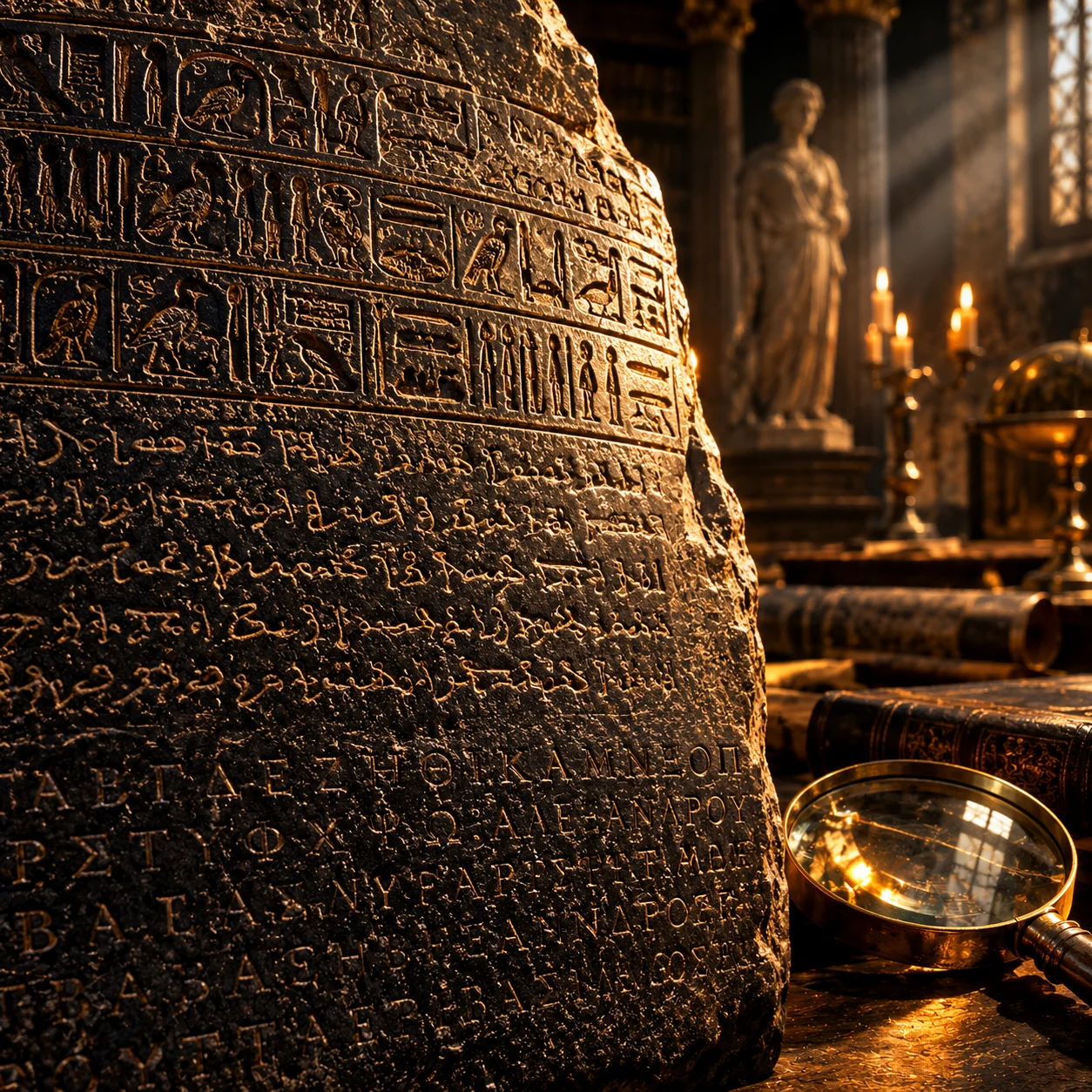
That silence broke in the summer of 1799 in a sleepy port town along the Nile Delta. French soldiers rebuilding an old fortification pried an odd, dark slab of granodiorite from a crumbling foundation. Carved across its chipped face were three distinct bands of writing. That slab was the Rosetta Stone.
By offering the same decree across two languages and three scripts, this single relic transformed modern archaeology. It bridged the modern world with an empire that had vanished centuries before. Understanding The Rosetta Stone: Decoding Ancient Egypt’s Sacred Past is not just an exercise in dusty linguistics. It is a study in political propaganda, intellectual rivalry, and how human curiosity pieced together a lost civilization from broken rock.
Table of Contents
What Is the Rosetta Stone?
The Rosetta Stone is an incomplete slab of dark granodiorite stone measuring roughly 44 inches tall, 30 inches wide, and 11 inches thick. Weighing around 1,680 pounds, it is not an entire monument by itself. It is a broken fragment of a much taller stele that once stood proudly inside an Egyptian temple.
The artifact contains an official decree issued at Memphis in 196 BCE on behalf of King Ptolemy V Epiphanes. At the time of the decree, Ptolemy V was a boy of about thirteen or fourteen years old, ruling over an unstable and fractured kingdom. The priests who backed him commissioned identical stones to be carved and placed in major temples throughout Egypt.
+-------------------------------------------------------------+
|               HIEROGLYPHIC SCRIPT (Top)                    |
|   Used for sacred, traditional, and divine state matters.   |
|   Read by high priests and scribes (14 broken lines left).  |
+-------------------------------------------------------------+
|                 DEMOTIC SCRIPT (Middle)                     |
|   The everyday administrative script of daily life.         |
|   Read by literate bureaucrats and citizens (32 lines).     |
+-------------------------------------------------------------+
|                  ANCIENT GREEK (Bottom)                     |
|   The administrative language of the ruling Ptolemaic court |
|   Read by government officials and rulers (54 lines).       |
+-------------------------------------------------------------+
Because scholars could already read Ancient Greek, the stone provided a translation key. If the Greek text matched the other two scripts, researchers finally possessed a comparative tool to decode Egyptian script. It served as a textual cipher, turning mysterious art into readable literature.
The Discovery at Rashid: An Accidental Miracle
In 1798, Napoleon Bonaparte invaded Egypt. He sought to disrupt British trade routes to India and establish a French presence in the Middle East. Napoleon brought not only soldiers, but also an expeditionary body called the Commission of Sciences and Arts of Egypt. This group included over 150 engineers, cartographers, botanists, and draftsmen.
In mid-July 1799, French troops under the engineering officer Pierre-François Bouchard were stationed near the port town of Rashid, which Europeans called Rosetta. They were strengthening the defenses of Fort Julien along the western branch of the Nile.
While tearing down a secondary wall built from medieval rubble, Bouchard’s men uncovered a large, dark stone built directly into the masonry. Bouchard looked closely at the polished front face. He noticed distinct bands of writing, including identifiable Greek characters.
Recognizing that the piece held potential historical value, Bouchard reported the find to French military officials. The stone was moved to Cairo, where French scholars made ink impressions and lithographic prints. Those paper copies proved crucial. When the British army defeated the French forces in Egypt in 1801, the ownership of antiquities became a primary diplomatic fight.
Under the Treaty of Alexandria, the British Crown took possession of the stone along with several other artifacts. In 1802, the British military transported the relic to Portsmouth aboard HMS Égyptienne. Later that year, it entered the British Museum in London, where it has remained on public display almost continuously ever since.
One Decree, Three Scripts: Analyzing the Inscriptions
The genius of the stone lies in its multilingual setup. The decree was intentionally composed to reach every layer of literate society in Ptolemaic Egypt.
1. Hieroglyphic Script
The top register features sacred hieroglyphs. This was the traditional writing system of the temples, used for formal inscriptions, divine honors, and religious texts. By 196 BCE, very few ordinary people could read this classical script. It was preserved almost exclusively by conservative temple priests. The top section suffered severe damage over time; only fourteen incomplete lines survive today.
2. Demotic Script
The middle band displays Demotic, a cursive script derived from northern forms of hieratic writing. Demotic served as the daily administrative script for legal contracts, trade documents, letters, and secular literature. It was faster to write and easier to learn than complex hieroglyphs. This middle section is the most complete of the three registers, preserving thirty-two lines.
3. Ancient Greek
The bottom register contains Ancient Greek, the official language of the royal court and governing elite. The Ptolemaic dynasty descended from Ptolemy I Soter, a Macedonian general who served with Alexander the Great. The Ptolemies ruled Egypt for nearly three centuries, speaking Greek and keeping state accounts in their native tongue. Fifty-four lines of Greek text remain, with the final twenty-seven lines chipped along the right edge.
Script Comparison Table:
+---------------+---------------------+------------------------+-------------------+
| Script        | Position on Stone   | Primary User Base      | Preservation      |
+---------------+---------------------+------------------------+-------------------+
| Hieroglyphs   | Top Section         | Priests, Sacred Texts  | Severely Broken   |
| Demotic       | Middle Section      | Everyday Bureaucrats   | Mostly Complete   |
| Ancient Greek | Bottom Section      | Ruling Greek Dynasty   | Partially Damaged |
+---------------+---------------------+------------------------+-------------------+
By placing these three scripts together, the young king’s advisors ensured that gods, priests, bureaucrats, and Greek officials could all read the royal decree. They could not have known that this administrative practicality would one day rescue their culture from obscurity.
The Race to Decipher the Past: Young vs. Champollion
The presence of the Greek text did not mean translation was instantaneous. Deciphering the symbols took more than two decades of intense study. For centuries, Western scholars had operated under a false assumption. Many believed hieroglyphs were purely symbolic pictures—allegories of philosophical and mystical ideas rather than representations of spoken sounds.
Two brilliant men led the effort to break that stubborn assumption.
Scholarly Rivalry:
+---------------------------+----------------------------------------------------------+
| Scholar                   | Key Contributions                                        |
+---------------------------+----------------------------------------------------------+
| Thomas Young (England)    | - Isolated phonetic signs inside cartouches.             |
|                           | - Proved Demotic derived from hieroglyphs.               |
|                           | - Treated hieroglyphs primarily as ideograms.            |
+---------------------------+----------------------------------------------------------+
| Jean-François Champollion | - Mastered Coptic, the spoken descendant of Egyptian.    |
| (France)                  | - Realized hieroglyphs mixed phonetic and symbolic signs.|
|                           | - Deciphered both foreign and native Egyptian names.     |
+---------------------------+----------------------------------------------------------+
Thomas Young’s Breakthroughs
Thomas Young was an English polymath celebrated for his work on the wave theory of light. Turning his attention to the Rosetta Stone around 1814, Young focused primarily on the Demotic text.
Young made two vital deductions:
-
Demotic script was not fundamentally different from hieroglyphs; it was an evolutionary, cursive variant of them.
-
Hieroglyphs contained phonetic sounds when spelling out foreign royal names.
Scholars had already noticed that certain hieroglyphic groups were encircled by oval rings known as cartouches. Young correctly guessed that these rings marked royal names. By comparing the Greek name Ptolemaios with the signs inside a specific cartouche, he identified several phonetic characters. However, Young stopped short. He believed phonetic spelling was an exception reserved solely for foreign Greek rulers who lacked traditional Egyptian symbols.
Jean-François Champollion’s Triumph
In France, a brilliant linguist named Jean-François Champollion took a different path. Champollion had a deep passion for languages from a young age. Most importantly, he had spent years mastering Coptic, an Afroasiatic language written with the Greek alphabet plus a few extra letters. Coptic, still used in the liturgical services of Egyptian Christians, was the direct linguistic descendant of the ancient Egyptian language spoken under the pharaohs.
Champollion knew that if he could read the sounds of hieroglyphs, the underlying language would sound very much like Coptic.
In 1822, Champollion studied copies of inscriptions from an obelisk at Philae, which featured cartouches for both Ptolemy and Cleopatra. By cross-referencing identical signs across the two names—such as the letters P, T, and L—he proved that Egyptian scribes had developed a consistent phonetic alphabet.
Cross-Referencing Cartouche Signs:
P-T-O-L-M-Y-S   [Ptolemy]
   | |   |
   | T-R |
K-L-E-O-P-A-T-R-A [Cleopatra]
The decisive breakthrough occurred on September 14, 1822. Champollion examined drawings sent from the rock-cut temple of Abu Simbel. He saw a cartouche containing a circular disk representing the sun god, an unidentified sign, and two repeated symbols representing an ‘S’.
Champollion knew from Coptic that the word for sun was Ra. He recognized the final signs as ‘S-S’. The middle sign looked like the Coptic verb mice, meaning “to give birth.” Putting the sounds together, he read: Ra-mes-su, or Ramesses.
This was not a foreign Greek conqueror. It was an ancient, native Egyptian monarch who ruled long before the Greeks arrived. Egyptian hieroglyphs had been phonetic all along.
Overcome by excitement, Champollion sprinted through the streets of Paris to the Académie des Inscriptions et Belles-Lettres, burst into his brother’s office, shouted “Je tiens mon affaire!” (“I’ve got it!”), and collapsed to the floor from exhaustion.
The Content of the Decree: Royal Politics and Propaganda
Pop culture often imagines the Rosetta Stone as a book of ancient magical spells, religious prophecies, or architectural secrets. In reality, the text is a calculated political press release.
When Ptolemy V took the throne, Egypt was in turmoil. Native rebellions raged in the south, economic troubles plagued the peasantry, and rival dynasties contested the kingdom’s borders. The monarchy needed the loyalty of Egypt’s most powerful social class: the temple priests.
Key Concessions in the Decree of Memphis (196 BCE):
1. Tax Relief: Forgave back taxes owed by temples and reduced naval grain levies.
2. Military Amnesty: Granted pardons to soldiers involved in recent civil conflicts.
3. Temple Endowments: Guaranteed annual silver and grain stipends directly to priesthoods.
4. Clerical Privileges: Excused priests from making annual journeys to Alexandria.
5. Divine Honors: Elevated Ptolemy V to equal status with traditional Egyptian gods.
In return for these financial gifts, the priests issued a formal decree of thanksgiving. They proclaimed Ptolemy V a living god, declaring that his statue should be set up in every temple alongside traditional deities. They also mandated that his name be honored during major feast days.
The stone closes with a strict administrative command: this decree must be carved into hard stone in three scripts—sacred hieroglyphic, administrative Demotic, and Greek—and set up publicly across the land. The very inscription that cracked open ancient Egyptian history was originally a royal tax bargain.
Why Egypt Lost the Ability to Read Its Own Words
To understand why decoding the stone was necessary, one must look at how the written language disappeared in the first place.
For over three millennia, hieroglyphs survived because temples remained active hubs of religious life. However, dramatic cultural shifts gradually dismantled that scribal tradition.
Timeline of Script Decline:
332 BCE    -> Alexander conquers Egypt; Greek becomes the language of government.
30 BCE     -> Egypt falls to the Roman Empire; Latin and Greek dominate administration.
391 CE     -> Emperor Theodosius I closes all pagan temples across the Roman Empire.
394 CE     -> The final known hieroglyphic inscription is carved at Philae.
452 CE     -> The last known Demotic inscription is carved at Philae.
When Christianity became the official religion of the Roman Empire, classical Egyptian religion was outlawed as paganism. The ancient temples were abandoned, converted into churches, or pulled down for building stone.
Because the hieroglyphic system was taught exclusively within temple scribal schools, the knowledge died with the priests. Egyptian Christians adopted the Greek alphabet, adding seven signs borrowed from Demotic to represent sounds unique to Egyptian. This created the Coptic script. Within two centuries, the ability to read the ancient monumental carvings had vanished from the earth.
The Long-Term Impact on Archaeology and Historiography
Champollion’s decipherment radically transformed how humanity understands world history. Before 1822, European historians relied almost entirely on Greek, Roman, and biblical accounts to understand Egypt. Those outside sources were often distorted by folklore, theological bias, and political prejudice.
Once the language could be read, the Egyptians were finally able to speak for themselves.
From Speculation to Science
Decoding the script turned archaeology from an amateur treasure hunt into an academic discipline. Instead of guessing the purpose of a tomb, excavators could read the epitaphs, genealogies, and inventories painted across the plaster walls.
Researchers realized that the Egyptians possessed complex philosophies, nuanced legal systems, sophisticated medical knowledge, and deeply human literature. They discovered love poetry, administrative complaints, labor contracts, and legal court transcripts from workers’ strikes.
Correcting the Biblical and Classical Chronology
The inscriptions allowed historians to assemble precise king lists. By comparing temple records from Abydos, Karnak, and Turin with Greek histories written by Manetho, scholars built an accurate chronological framework for ancient Mediterranean history. They could finally synchronize events across Mesopotamia, the Levant, Greece, and the Nile valley.
Ethical Debates: Repatriation and Museum Ownership
The Rosetta Stone sits in Room 4 of the British Museum, behind protective glass, drawing millions of visitors each year. Yet its presence there remains a source of heated international debate.
The Repatriation Debate:
+------------------------------------+------------------------------------+
| Arguments for Repatriation         | Arguments for Retention            |
| (Return to Egypt)                  | (Staying in London)                |
+------------------------------------+------------------------------------+
| - Taken under colonial conquest.   | - Acquired legally via the 1801    |
| - Key symbol of Egyptian identity. |   Treaty of Alexandria.            |
| - Belongs in the Grand Egyptian    | - Universal museum context lets it |
|   Museum alongside other relics.   |   sit alongside global cultures.   |
| - Moral responsibility to return   | - High international foot traffic  |
|   looted cultural property.        |   and long conservation history.   |
+------------------------------------+------------------------------------+
Prominent Egyptian archaeologists, including former antiquities minister Dr. Zahi Hawass, have long petitioned for the stone’s return. They argue that the artifact was surrendered to the British under wartime duress during the Napoleonic campaigns, without any input from native Egyptian authorities. With the opening of the Grand Egyptian Museum (GEM) near the Giza Pyramids, Egyptian institutions argue they have built world-class facilities to care for and display their most famous heritage items.
The British Museum maintains that the stone was acquired through formal legal treaties of its era. They argue that keeping the artifact in London allows it to be viewed freely by a global public alongside contemporary artifacts from Greece, Assyria, and Rome. This ethical debate continues to influence policies on how museums handle historical artifacts worldwide.
Actionable Lessons for History Enthusiasts and Researchers
If you are an educator, student, or history enthusiast studying historical texts, the story of the Rosetta Stone offers practical principles you can apply to your own research.
-
Learn the Descendant Languages First:
Champollion succeeded because he knew Coptic before tackling hieroglyphs. When deciphering unknown historical texts or learning old languages, study their modern linguistic descendants. Surviving daughter languages preserve vocabulary, sentence structures, and phonetics that unlock ancestral scripts.
-
Look for Parallel Texts (Bilinguals):
Progress in translation usually happens when you contrast the unfamiliar against the familiar. Whether you are working with family records in archaic scripts, ancient coins, or old administrative deeds, seek out official documents that were issued across multiple languages.
-
Examine Names and Proper Nouns:
Foreign names are often spelled out phonetically even within languages that rely heavily on symbols or ideograms. If you are struggling with a text, identify the proper nouns, kings’ names, or geographical locations first. They frequently yield your initial phonetic key.
-
Avoid Preconceived Ideas:
For centuries, scholars failed because they were convinced hieroglyphs could not represent sounds. Question your baseline assumptions before spending time analyzing data. When an approach repeatedly stalls, test whether your core premises might be fundamentally flawed.
Common Misconceptions About the Rosetta Stone
Despite its worldwide fame, many persistent myths surround the Rosetta Stone.
Myth 1: The Stone Is Made of Black Basalt
For decades, textbooks incorrectly described the Rosetta Stone as a slab of black basalt. When the artifact was cleaned in 1999 for its bicentennial exhibition, conservators removed layers of printer’s ink, wax coatings, and finger grease left behind by 19th-century scholars. The cleaning revealed its true mineral makeup: a compact, dark pinkish-gray igneous rock known as granodiorite.
Myth 2: It Contains Three Different Languages
The stone actually contains only two languages: Ancient Egyptian and Ancient Greek. The confusion arises because the Egyptian language is written using two distinct scripts on the stone: formal hieroglyphs and everyday Demotic cursive.
Myth 3: Deciphering the Stone Happened Overnight
Pop culture often treats Champollion’s breakthrough as an instant flash of genius. In reality, decipherment took twenty-three years of collective effort. It required contributions from Swedish diplomat Johan David Åkerblad, French scholar Antoine-Isaac Silvestre de Sacy, and English polymath Thomas Young. Champollion built directly upon their early phonetic identifications.
Myth 4: It Was an Ancient Magic Spell or Sacred Book
As noted earlier, the stone is an administrative and political document. It outlines tax cuts, priestly privileges, and royal honours. It reads far more like a modern legislative bill or council resolution than a book of occult mysticism.
Frequently Asked Questions
1. Where is the Rosetta Stone currently kept?
The stone is displayed in Room 4 of the British Museum in London, United Kingdom. It has been housed there since 1802, leaving only twice: once for storage in an underground railway station during World War I bomb raids, and once for display in Paris in 1972.
2. Can ordinary visitors view the Rosetta Stone?
Yes. The British Museum offers free general admission, and the Rosetta Stone is on permanent display on the ground floor. It sits inside a secured, climate-controlled glass case surrounded by information panels.
3. What do the surviving words actually say?
The text praises King Ptolemy V Epiphanes. It lists his pious deeds, describes his economic relief for the public, reduces temple taxes, and outlines how the priesthood will honor him in return throughout the temples of Egypt.
4. Who officially cracked the code of the Rosetta Stone?
Jean-François Champollion is officially credited with cracking the code in September 1822. However, English polymath Thomas Young laid significant groundwork by isolating phonetic characters inside the royal cartouches.
5. Why are large parts of the stone missing?
The stone was broken centuries ago, likely when the temple housing it was destroyed or repurposed for building materials during the Middle Ages. Bouchard found it reused as ordinary rubble in the foundations of Fort Julien.
6. Are there other copies of the Rosetta Stone decree?
Yes. Because the decree ordered copies to be placed in all major temples, archaeologists have discovered other stelae bearing the same text. These include the Decree of Canopus and the Stele of Damanhur, which helped fill in several damaged lines missing from the Rosetta Stone.
7. What is granodiorite?
Granodiorite is a coarse-grained, intrusive igneous rock similar to granite, but containing more plagioclase feldspar than orthoclase feldspar. It is durable, hard, and typically ranges from gray to pinkish-gray in color.
8. Why is it called the “Rosetta” Stone?
It is named after the French name for the city near its discovery site: Rashid (Rosetta), an Egyptian port city located roughly 40 miles east of Alexandria along the Nile Delta.
Preserving the Voice of the Ancients
The decipherment of the Rosetta Stone reminds us that human voices can endure across millennia, waiting for patience and curiosity to restore them. What seemed like decorative art on ruined palace walls turned out to be the complex written record of an ancient society.
By bridging Greek administration with ancient Egyptian scripts, the stone opened a path for ancient scribes, workers, poets, and queens to share their stories with the modern world. Today, as digital tools and multispectral imaging analyze forgotten manuscripts and faded inscriptions across the globe, the lessons learned from this stone remain as vital as ever. Deciphering the past requires not just intelligence, but humility, cross-cultural comparison, and an enduring respect for the words our ancestors left behind.
Discover More Ancient History:
Are you interested in ancient writing systems and archaeological discoveries? Explore our guides on early Mediterranean history, visit local museum exhibitions, or read through modern translations of original Egyptian literature to experience these recovered voices firsthand.