
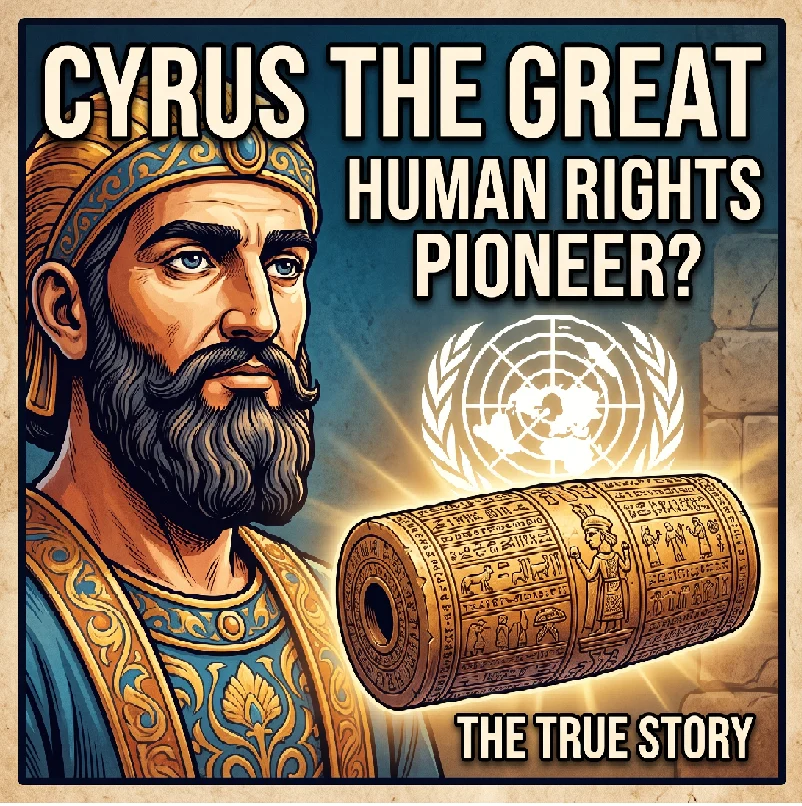
Achaemenid Persian Empire: The Real Statecraft of Cyrus the Great
The rise of the Achaemenid Persian Empire in the sixth century BCE fundamentally altered ancient geopolitical organization. When Cyrus II entered Babylon in 539 BCE, he established an administrative precedent that set his realm apart from every previous Near Eastern realm.
Rather than enforcing brutal subjugation, the Achaemenid Persian Empire combined pragmatic administrative autonomy, religious patronage, and strategic messaging. At the center of this historical legacy stands the Cyrus Cylinder, a baked-clay barrel discovered in the nineteenth century that modern commentators frequently celebrate as humanity’s earliest human rights charter.
The Geopolitical Climate Before the Achaemenid Persian Empire
For centuries before the Persian expansion, the Near East suffered under imperial models anchored to terror and scorched-earth policies. The Neo-Assyrian Empire built its dominance through systematic punitive campaigns, blinding captives, impaling local governors, and deporting entire populations across continents to destroy regional identity.
When the Neo-Babylonian Empire overthrew Assyria, it preserved those exact extraction methods. Nebuchadnezzar II repeatedly sacked rebellious provinces, leveling the city of Jerusalem in 586 BCE, destroying Solomon’s Temple, and dragging thousands of Judean elites into the Babylonian Captivity.
By 550 BCE, King Astyages ruled the Median Empire, keeping Persian tribes in a subordinate client status. Cyrus II, king of Anshan, launched an audacious revolt against his Median overlord.
Within two decades, Cyrus dismantled the Medes, absorbed the kingdom of Lydia under Croesus in western Anatolia, and marched his veteran armies east toward Central Asia. His victories consolidated the foundations of the Achaemenid Persian Empire, leaving only Babylon standing between Persia and universal hegemony over the fertile crescent.
                  [Neo-Assyrian Model]
              (Terror, Flaying, Mass Exile)
                           │
                           ▼
                 [Neo-Babylonian Model]
             (Corvée Labor, Temple Looting)
                           │
                           ▼
              [Achaemenid Persian Empire]
       (Local Autonomy, Cultural Restoration, Taxes)
The Fall of Babylon and the 539 BCE Campaign
The collapse of Babylon was orchestrated through domestic political alienation as much as military conquest. The last native Babylonian king, Nabonidus, alienated his subjects by neglecting Marduk, the patron deity of Babylon.
Nabonidus spent a decade in the Arabian desert oasis of Tayma, promoting the moon god Sin above Marduk and neglecting the vital Akitu (New Year) festivals. His son, Belshazzar, mismanaged domestic grain supplies, leaving urban populations starving and temples deeply resentful of the crown.
In the autumn of 539 BCE, the veteran Persian infantry and shock cavalry clashed with Babylonian forces at the Battle of Opis along the Tigris River:
-
Decisive Rout: The Persian vanguard shattered the Babylonian defensive lines, securing the strategic river crossing.
-
Diversion Logistics: Classical accounts record that Persian engineers partially diverted the Euphrates River into adjoining marshes, lowering the water level along the city’s aquatic gates.
-
Bloodless Entry: On October 29, 539 BCE, Persian field commander Gobryas marched his elite units directly into the capital without a protracted siege.
When Cyrus entered the gates weeks later, city residents welcomed the Persian monarch as a divine deliverer rather than a foreign invader.
Archaeological Discovery: The Cylinder Unearthed
In March 1879, an archaeological team led by Ottoman-born Assyriologist Hormuzd Rassam excavated the site of ancient Babylon under the auspices of the British Museum. Digging into the foundations of the Esagila temple, dedicated to Marduk, workers uncovered an intact clay cylinder measuring 22.5 centimeters in length.
Inscribed in forty-five lines of Akkadian cuneiform, the cylinder was an official building inscription. In Mesopotamian royal tradition, monarchs buried foundation deposits within walls and temple bases to record their restorations for posterity and divine judgment.
   ┌──────────────────────────────────────────────┐
   │ 45 Lines of Babylonian Cuneiform             │
   │ Clay Barrel Deposit (22.5 cm x 10 cm)        │
   │ Dedicated into Esagila Temple Foundation     │
   └──────────────────────────────────────────────┘
                          │
  ┌───────────────────────┼───────────────────────┐
  ▼                       ▼                       ▼
[Denunciation]        [Liberation]           [Restoration]
Nabonidus branded     Corvée labor ended;    Deported populations
as an impiety tyrant  peace proclaimed        returned with statues
Rather than a radical break with Mesopotamian traditions, the artifact followed established scribal conventions:
The Denunciation of Nabonidus
The initial lines condemn Nabonidus for religious negligence, accusing him of imposing heavy taxation and forcing citizens to labor under unbearable work quotas.
The Divine Mandate of Marduk
The text declares that Marduk surveyed the earth searching for a righteous king. He took Cyrus by the hand, calling him by name to rule as the legitimate sovereign over Sumer and Akkad.
The Restoration of Sanctuaries
Cyrus orders the immediate return of foreign cult statues that Nabonidus had confiscated and brought to Babylon. Sanctuaries from Nineveh to Susa received their ancestral icons back with royal subsidies to rebuild ruined shrines.
The Repatriation of Exiled Populations
The text explicitly decrees the release of displaced communities: “I gathered all their inhabitants and returned to them their dwellings.”
To read the exact primary translation of this historical decree, explore the The British Museum Collection Record for the Cyrus Cylinder (BM 90920).
Administrative Blueprint: How the Achaemenid Persian Empire Governed
The administrative structure of the Achaemenid Persian Empire balanced centralized military control with radical provincial cultural autonomy. Cyrus realized that ruling millions of subjects stretching across three continents through brute force was strategically impossible.
Instead of imposing Persian customs, language, or Zoroastrian religious tenets, the crown created the satrapy system. This system divided the empire into roughly twenty distinct administrative zones headed by a satrap, or regional governor.
                [The Persian King of Kings]
                             │
     ┌───────────────────────┼───────────────────────┐
     ▼                       ▼                       ▼
[The Satrap]        [The Military General]  [The Royal Secretary]
(Civil Administration, (Troop Levies, Forts)   (Audit, "King's Eye",
 Tax Assessment)                               Direct Palace Comms)
     │                       │                       │
     └───────────────────────┴───────────────────────┘
                             ▼
              [Autonomous Local Population]
         (Preserved Laws, Dialects, Cult Practices)
This tripartite division of provincial authority prevented treason:
-
Civil Governance: The satrap collected imperial taxes, judged legal disputes according to local codes, and maintained regional roads.
-
Military Garrisons: The garrison commander took orders directly from the Great King, ensuring provincial governors could not deploy royal troops for personal rebellions.
-
The Imperial Auditors: Traveling royal inspectors, known as the “Eyes and Ears of the King,” arrived unannounced with independent security forces to audit books, inspect harvest stores, and evaluate civic complaints.
In Babylon, Cyrus took the titles of local kingship, ritually grasping the hands of the statue of Marduk during New Year festivals. In Egypt, his successor Cambyses presented himself as a legitimate pharaoh honoring Apis bulls.
Across the Mediterranean, Darius supported the sanctuaries of Apollo. By styling the emperor as a protector of regional gods, the Achaemenid Persian Empire turned local priesthoods into vocal allies of the crown.
The Biblical Dimension: Cyrus and the End of Exile
The decrees of the Cyrus Cylinder align closely with the historical narratives preserved in the Hebrew Bible. The books of Ezra and Isaiah explicitly celebrate Cyrus as an agent of divine redemption.
In Isaiah 45:1, the prophet bestows the title of Mashiach (Messiah, or Anointed One) upon the Persian ruler, marking the only instance in the biblical canon where a non-Jewish foreign monarch receives that sacred designation.
586 BCE: Babylonian Destruction of Jerusalem
 │
 ├── 539 BCE: Fall of Babylon to Cyrus II
 │
 ├── 538 BCE: The Edict of Cyrus (Ezra 1:1–4)
 │
 └── 516 BCE: Completion of the Second Temple under Darius I
The Edict of Cyrus recorded in Ezra 1:1–4 allowed thousands of Jewish exiles to return from Babylon to Yehud Medinata (the province of Judah):
-
Gold and Silver Relics: Cyrus returned over five thousand ceremonial gold and silver vessels looted from the temple by Nebuchadnezzar.
-
Rebuilding Subsidies: Imperial coffers provided timber from Lebanese cedar forests and direct grants to construct the Second Temple foundations.
-
Security Escorts: Persian royal couriers guaranteed safe passage for returning families along imperial road systems.
This policy served imperial strategy. Rebuilding a loyal, stable Judean temple state established a dependable garrison hub near the contested border of Egypt, demonstrating how the Achaemenid Persian Empire blended practical security with religious tolerance.
Modern Symbolism vs. Ancient Reality: The Human Rights Debate
In October 1971, Mohammad Reza Pahlavi, the Shah of Iran, held the elaborate 2,500-year celebration of the Persian Empire at Persepolis. As part of that campaign, the Iranian government heavily promoted the Cyrus Cylinder as the world’s very first charter of human rights.
The United Nations adopted this interpretation, having the cuneiform text translated into all official languages, and today a replica of the cylinder sits in the second-floor hallway of the UN Headquarters in New York.
Modern Assyriologists and historians caution against reading modern democratic values into a sixth-century BCE royal inscription:
[The Modern Ideal: UN View (1971)]
• Universal individual rights
• Inherent human equality
• Freedom from state tyranny
• Universal democratic principles

                    VS

[The Historical Reality: 6th Century BCE]
• Traditional Mesopotamian royal foundation deposit
• Divine right of autocracy through Marduk
• Elite collaboration (Priesthoods, Aristocrats)
• Sustainable, centralized imperial taxation
Cyrus was not an enlightened democrat championing universal equality. He was an absolute monarch operating within the established idioms of ancient Near Eastern kingship.
The cylinder never mentions universal individual rights, personal liberties, or the abolition of private slavery. Its primary aim was to legitimize a foreign conqueror’s rule, secure the collaboration of the powerful Babylonian priesthood, and ensure that tax revenues flowed reliably to Persepolis.
Yet, stripping away modern political interpretations does not diminish the achievement. While the cylinder is not a modern bill of rights, it documents a monumental shift in imperial statecraft.
By replacing terror and systematic deportation with cultural tolerance, religious restoration, and local autonomy, Cyrus demonstrated that an empire survives far longer through cooperation than through the sword.
Weapons, Metallurgy, and Defensive Formations
The military dominance of the Achaemenid Persian Empire rested on an integrated tactical system suited to rapid movement across arid terrain. While the [Internal Link: Persian Immortals weapons tactics] elite guard formed the core of the royal household, the wider army integrated specialized units from across subject satrapies.
The standard infantryman, the spabara (shield-bearer), was trained for defensive missile combat:
-
Gerron Shields: Foot soldiers stood behind wicker shields (gerra) woven from river cane and wrapped in boiled leather, planted directly into the soil to form a physical wall against arrows.
-
Archery Formations: Behind the wall of shields, nine ranks of archers loosed heavy volleys of reed arrows fitted with bronze and iron points, raining missiles on oncoming columns up to two hundred meters away.
-
Short Melee Weapons: If the enemy penetrated the missile wall, Persian infantry drew the akinakes, a double-edged iron short sword, and six-foot thrusting spears.
       [Forward Line: Spabara Wall]
  (Large wicker/rawhide shields planted in soil)
                      │
  ┌───────────────────┴───────────────────┐
  ▼                                       ▼
[Archery Barrage: 9 Deep Ranks]   [Flank Protection: Armored Cavalry]
(Recurve horn/wood composite bows) (Iron javelins, scale armor)
The Persian cavalry formed the strike weapon of the imperial host. Equipping horses with padded armor and riding in deep formations, riders threw pairs of cornel-wood javelins (palta) before closing with heavy iron slashing sabers.
Against traditional infantry levies across Mesopotamia, this combined-arms synergy proved devastating, allowing the empire to annex neighboring states in single combat seasons.
The Logistical Engine of the Royal Road
An empire spanning three thousand miles required advanced communication infrastructure. Under Darius I, who expanded the administrative systems established by Cyrus, the crown laid the famous Persian Royal Road network.
Stretching more than 1,600 miles from the royal center at Susa to the Aegean coast at Sardis, this packed-gravel highway was guarded by military garrisons and equipped with 111 relay stations (chapar khaneh).
[Sardis: Aegean Coast]
        │
        ├── (1,600 Miles of Graded Highway)
        ├── (111 Chapar Khaneh Relay Stations)
        ├── (Armed Fortresses at River Crossings)
        │
[Susa: Imperial Palace Center]
The system used a sophisticated postal relay (pirradazis):
-
Fresh Mounts: Stables held fast Arabian and Nisaean horses fed on royal alfalfa stores.
-
Rapid Couriers: Imperial messengers rode day and night through dust, snow, and rain, carrying royal orders across the empire in seven days, a journey that took ordinary merchants ninety days on foot.
-
Commercial Integration: While built for military mobilization, the road facilitated unprecedented commercial trade, connecting Persian silver, Indian spices, Egyptian grain, and Greek olive oil across open markets.
This infrastructure turned the vast lands of the Achaemenid Persian Empire into a connected economic ecosystem. Uniform gold coinage, the daric, and silver sigloi circulated from the Mediterranean to the Indus Valley, backed by imperial treasuries.
| Governance Feature | Neo-Assyrian Model | Neo-Babylonian Model | Achaemenid Persian Empire |
| Conquered Populations | Mass deportation and forced dispersal | Punitive exile and urban enslavement | Repatriation, local autonomy, and resettlement |
| Regional Religions | Desecration of shrines, imposed gods | Temple looting, royal confiscation of cults | Restoration of temples, royal state subsidies |
| Administrative Control | Centralized military governors and terror | Heavy palace extraction and corvée labor | Satrapy system with separation of powers |
| Economic Spine | Plunder and tribute extortion | Temple extraction and corvée agriculture | Standardized currency, Royal Road network |
| Sovereignty Messaging | King as cosmic destroyer and flayer | King as absolute palace builder | King as protector of local deities and peace |
Decline, Collapse, and the Macedonian Conquest
The institutional flexibility that allowed the Achaemenid Persian Empire to conquer the known world eventually faced internal strain. During the fourth century BCE, the court was consumed by succession crises, palace assassinations, and corrupt regional satraps.
Satrapies like Egypt repeatedly rebelled, requiring costly reconquest campaigns that drained the imperial silver reserves held in Persepolis and Susa. The royal administration grew rigid, and provincial armies relied increasingly on Greek mercenaries rather than native training levies.
When Alexander the Great crossed the Hellespont in 334 BC, the tactical weaknesses of the late Persian system were exposed. The fluid missile doctrine of the Persian infantry, which had routed the armies of the sixth century, buckled against the impenetrable iron-tipped pikes of the [Internal Link: Argead dynasty sarissa phalanx] at the Granicus, Issus, and Gaugamela.
Battle of Gaugamela (331 BCE)
  ├── Persian Center: Chariots & Royal Guard (Darius III)
  ├── Macedonian Wedge: Alexander leading Companion Cavalry
  └── Tactical Result: Wedge punches through gap; Darius flees;
      Persepolis falls, ending two centuries of Achaemenid rule.
When Darius III was murdered by his own satrap, Bessus, in 330 BCE, the direct line of Achaemenid kings ended. Alexander himself paid homage at the simple stone tomb of Cyrus the Great at Pasargadae, ordering the tomb restored and punishing the looters who desecrated it.
Even in defeat, the administrative memory of the Persian kings survived. Alexander adopted Persian court customs, and the later Seleucid and Parthian empires retained the satrapy model as the only practical method to govern the vast Near East.
The Enduring Legacy of Cyrus the Great
The historical importance of Cyrus the Great does not rely on modern political labels. Framing the Cyrus Cylinder as a modern human rights charter obscures its true achievement: a masterpiece of pragmatic, sustainable imperial statecraft.
At a moment when imperial survival seemed to demand violence and cultural erasure, the Achaemenid Persian Empire introduced an alternative philosophy of power. Cyrus recognized that an empire thrives when subject peoples are permitted to worship their gods, speak their languages, and live unmolested in their homes.
By prioritizing cultural tolerance, regional autonomy, and infrastructure over terror, Cyrus built a state that united the ancient world and established a lasting model for imperial governance.
Frequently Asked Questions
What was the Achaemenid Persian Empire?
The Achaemenid Persian Empire was an ancient empire founded by Cyrus the Great in 550 BCE. Spanning from the Balkans and Egypt to the Indus River, it was the largest empire the ancient world had seen, famous for its administrative satrapy system, the Royal Road, and regional cultural autonomy.
Is the Cyrus Cylinder really the world’s first human rights charter?
No. In its historical context, the Cyrus Cylinder is an ancient Mesopotamian royal foundation deposit written in Babylonian cuneiform to legitimize Cyrus’s rule over Babylon. While modern institutions like the United Nations celebrated it in 1971 as a precursor to human rights due to its decrees ending forced labor and returning displaced peoples, it remains a work of imperial political statecraft rather than a modern egalitarian constitution.
Why did Cyrus the Great free the Jews from Babylon?
Cyrus allowed the Jewish people to return to Jerusalem as part of an empire-wide administrative policy of repatriating displaced populations and restoring local religious sanctuaries. By funding the reconstruction of the Second Temple and returning sacred vessels, Cyrus secured the loyalty of a key population near the strategically sensitive Egyptian frontier.