
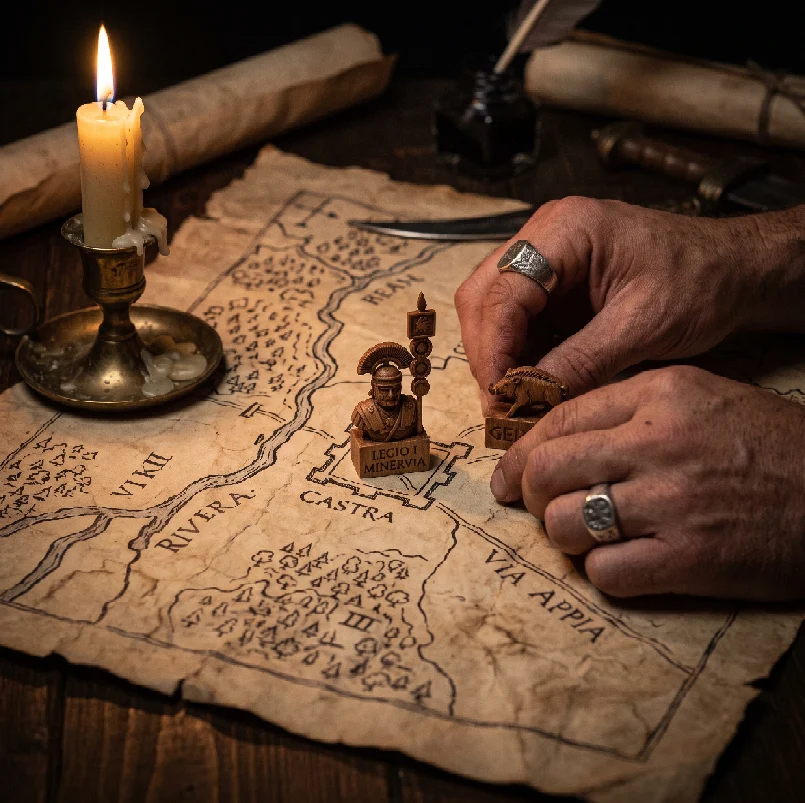
Military Strategy: The Tactical Engines of Empire
Mastering military strategy has determined the survival and ruin of great civilizations across the ancient and modern worlds. Raw numbers and physical courage regularly fell victim to calculated operational design. A commander who understood terrain, geometry, and supply could dismantle an enemy host double his size.
The practice of military strategy was never a static formula. It evolved as an adaptive science that synthesized metallurgy, troop psychology, engineering, and spatial coordination. Across every continent, dynasties rose or collapsed based on their capacity to turn abstract strategic thought into lethal frontline execution.
The Chessboard of Empires: Geometry Over Raw Mass
Early conflicts often resembled disorganized tribal melees dominated by individual heroics and chaotic brawling. As political entities coalesced into centralized states, military strategy replaced impulsive brawls with organized violence. Victory ceased to reward individual muscle and began favoring collective operational cohesion.
The battlefield became a giant calculating surface where commanders manipulated time and distance. Leaders recognized that positioning an army on the high ground, anchoring an exposed flank against an impassable river, or forcing an opponent through a narrow defile multiplied combat efficiency. Terrain was not merely a passive backdrop; it served as an active weapon.
Sun Tzu captured this foundational shift in ancient China, emphasizing that the highest form of generalship defeats the enemy’s plans before swords clash. He codified an operational philosophy centered on misdirection, terrain assessment, and economy of force. In Sun Tzu’s framework, combat was the final, regrettable phase of an intellectual duel.
Western antiquity developed an equally rigorous approach to military strategy. Greek poleis transformed agricultural citizens into disciplined phalanxes that operated as single, crushing organisms. The emergence of professional armies in the Mediterranean established doctrinal templates that shaped global operational doctrine for millennia.
Logistical Architecture: The True Currency of War
Amateurs focus entirely on battlefield maneuvers, while masters of military strategy obsess over supply wagons and grain silos. No army, regardless of its discipline or weapons, can fight while starving. Logistical paralysis has broken far more empires than enemy arrows or steel.
Feeding an army of thirty thousand men and ten thousand horses required monumental administrative organization:
-
Daily Caloric Intake: An active infantryman required roughly 3,000 to 3,600 calories daily, translating to two to three pounds of hard grain or biscuit.
-
Equine Forage: A single cavalry mount or draft horse consumed twenty pounds of dry forage and drank ten to twelve gallons of water every twenty-four hours.
-
Supply Wagon Limits: A standard two-ox cart carried approximately 1,000 pounds; on long marches through rough terrain, the oxen consumed their entire payload within ten days.
-
Water Transport: Operating away from reliable river systems required extensive columns of leather water bladders and barrel wagons.
Ancient commanders addressed these constraints through meticulous depot networks. Alexander the Great restructured Macedonian logistics by stripping his army of sluggish ox carts, forcing soldiers to carry their own gear and relying on maritime coastal shipping. His campaigns proved that superior logistical agility was the true engine of military strategy.
Roman legions codified this logistical discipline into an engineering science. Every legionary carried an entrenching tool, cooking pot, stakes, and several days of grain rations. The Roman road network (cursus publicus) and fortified granaries allowed the Republic and subsequent Empire to project power across vast distances with unmatched speed.
Operational planning [Internal Link: Classical Logistics and Imperial Expansion] proved that securing lines of communication determined whether a military campaign expanded an empire or starved in the wilderness.
Evolution of Tactical Doctrine: Phalanx to Maniple
The tactical component of military strategy underwent dramatic transformations as commanders solved specific technological and spatial problems. The classical Greek phalanx represented the initial triumph of collective mass. Eight to sixteen ranks of armored hoplites locked their bronze shields together, forming an unbroken wall fronted by heavy ash spears.
While nearly unstoppable on flat ground, the Greek phalanx suffered from fatal rigidity. It could not turn quickly to meet flank threats, and rough or broken terrain tore fatal gaps in its ranks. The Hellenistic sarissa phalanx developed by Philip II of Macedon stretched spear lengths to eighteen feet, creating an impenetrable bristling hedgehog, but retained the same operational inflexibility.
The Roman Republic revolutionized field doctrine by introducing the manipular system. Faced with the agile guerrilla tactics of the Samnites in the Apennine mountains, Rome abandoned the rigid phalanx in favor of a checkerboard deployment (quincunx):
-
Hastati: Young front-line infantry deployed in independent maniples of 120 men, armed with heavy scuta shields and throwing pila.
-
Principes: Veteran heavy infantry stationed behind the hastati to exploit breaches or reinforce wavering sectors.
-
Triarii: Hardened older soldiers kneeling in the third line, armed with thrusting spears to serve as an unbreakable rearguard.
This checkerboard arrangement represented a profound breakthrough in operational military strategy. Individual maniples could advance, retreat, pivot, or swap places through designated intervals without disrupting adjacent units.
The maniple combined the devastating mass of heavy infantry with the fluid responsiveness of modern small-unit tactics. It allowed Rome to conquer diverse adversaries, from the disciplined phalanxes of Macedonia to the ferocious warbands of Gaul.
The Art of the Trap: Cannae and the Annihilation Model
The ultimate expression of operational military strategy is the complete encirclement and destruction of an enemy force. Throughout antiquity, commanders sought the decisive triumph: trapping an opposing army so thoroughly that retreat became impossible.
The gold standard for this tactical ideal occurred at the Battle of Cannae in 216 BCE. Facing a massive Roman army of over eighty thousand men, the Carthaginian general executed an inverted convex crescent deployment. He placed his weakest Celtic and Iberian infantry in the protruding center while stationing veteran African infantry on the wings.
As the heavy Roman center surged forward, the Carthaginian center retreated under control, transforming from a convex curve into a deep concave bowl. The Romans crowded into this funnel, packing themselves so tightly that men could not draw their swords.
The Carthaginian wings then pivoted inward, while heavy cavalry swept around the rear to seal the escape route. The trap was absolute. Up to seventy thousand Roman legionaries were systematically eliminated within a few hours.
Cannae demonstrated the core paradox of tactical military strategy: an army can possess crushing numerical superiority and still find itself helpless if the adversary dictates the spatial boundaries of the engagement.
Combined Arms Integration: The Synthesis of Power
A sophisticated military strategy never relies on a single combat arm. True operational dominance emerges from combining disparate battlefield capabilities so that protecting against one threat exposes the enemy to another.
The integration of shock cavalry, missile troops, and heavy infantry transformed ancient and medieval warfare:
-
Missile Artillery: Ballistas, catapults, and massed archers suppressed enemy formations at long range, forcing them to disperse or advance prematurely.
-
Heavy Infantry: Formed an unbreakable defensive anchor that fixed the enemy army in place and absorbed kinetic shock.
-
Light Skirmishers: Screened deployments, harried supply columns, and prevented hostile scouts from reading the main battle line.
-
Shock Cavalry: Exploited torn formations, delivered crushing charges against exposed flanks, and pursued broken remnants to prevent regrouping.
Philip II and Alexander of Macedon mastered this combined-arms approach through the “hammer and anvil” principle. The heavy sarissa phalanx acted as the immovable anvil, holding the enemy host in a grinding frontal stalemate. Meanwhile, Alexander led the elite Companion cavalry—the hammer—in a lightning wedge charge against the enemy’s exposed royal flank.
Centuries later, the Eastern Roman Empire codified combined arms in treatises like the Strategikon of Emperor Maurice. Byzantine military strategy emphasized defensive preservation, integrating cataphract heavy cavalry with horse archers and engineer corps to counter diverse barbarian incursions with minimal expenditure of imperial blood.
Technical evolutions [Internal Link: Siege Craft and Engineering in Antiquity] underscored how integrating field fortification with rapid artillery deployment decided prolonged territorial campaigns.
Psychological Cohesion and Deception in Military Strategy
Combat is fundamentally a psychological contest between human nervous systems. Armies do not fight until every soldier is dead; they fight until their collective faith in victory dissolves. Therefore, the psychological dimension of military strategy often supersedes physical weaponry.
Sun Tzu noted that all warfare is based on deception:
-
When near, make the enemy believe you are far away.
-
When far away, make the enemy believe you are near.
-
Feign disorder to bait an overconfident opponent into an ambush.
-
Strike where the enemy is unprepared and appear where you are least expected.
Vegetius echoed these sentiments in late imperial Rome, urging generals to exhaust an opponent with maneuvers and starvation rather than risking open combat. He recognized that a cornered enemy fights with the ferocity of despair, advising commanders to always leave a routing opponent a visible escape route so they break formation rather than make a desperate last stand.
In practical military strategy, breaking the enemy’s chain of command causes instantaneous collapse. Targeting aristocratic officers, capturing regimental eagles, or spreading false rumors of a general’s death frequently caused entire armies to dissolve into blind panic within minutes.
Archeology of Warfare: Physical Relics of Strategic Command
The physical validation of historical military strategy survives across global landscapes in the form of ramparts, palisades, and mass graves. Modern forensic archaeology and aerial LiDAR scanning have revolutionized our understanding of how commanders shaped physical space.
Excavations at the siege of Alesia (52 BCE) provide tangible evidence of Julius Caesar’s engineering brilliance:
-
Circumvallation Lines: Eleven miles of outer ramparts, ditches, and watchtowers engineered to keep out Vercingetorix’s Gallic relief army.
-
Contravallation Lines: Ten miles of inner fortifications designed to trap the besieged Gallic forces within the hilltop oppidum.
-
Concealed Traps: Pits armed with sharpened oak stakes (cippi), sunken iron barbed hooks (stimuli), and waterlogged ditches designed to break cavalry charges.
Forensic analysis of recovered skeletal remains at sites like Visby (1361) and Towton (1461) reveals the terrifying efficiency of combined arms. Mass graves show that the majority of fatal trauma—such as horizontal cuts across the back of the skull—occurred when formations broke and men fled from mounted pursuers.
These material findings demonstrate that ancient treatises on military strategy were not theoretical vanity. They were precise, empirical operational manuals written to navigate the brutal biological realities of the battlefield.
Geopolitical Legacies: How Strategy Drew the Modern Map
The long-term geopolitical borders of the contemporary world are the direct architectural legacy of successful military strategy. Civilizations that developed adaptable military systems expanded their linguistic, legal, and cultural frameworks across entire continents.
Rome’s flexible manipular and cohortal systems enabled the integration of the Mediterranean basin into a single legal and economic sphere for centuries. The Pax Romana was not maintained by peaceful negotiation; it was built upon a military machine capable of deploying disciplined legions to any frontier threatened by revolt or invasion.
Similarly, the strategic mobilization developed by the Qin dynasty—rooted in strict Legalist administrative organization and standardized weapons production—unified fractured warring states into the enduring civilization of imperial China.
Conversely, societies that clung to obsolete doctrines perished. The classical Greek city-states, paralyzed by petty rivalries and rigid phalanxes, were swiftly absorbed by the flexible combined-arms armies of Macedonia and Rome. The inability to adapt strategic doctrine to emerging operational threats meant political extinction.
The enduring principles of military strategy remind us that war remains a severe, unforgiving school. Weapons, armor, and propulsion systems undergo continuous technological transformation, but the underlying spatial, logistical, and psychological realities of warfare remain fundamentally unchanged across the millennia.
Frequently Asked Questions
What is the difference between military strategy and military tactics?
Military strategy focuses on the high-level planning, resource allocation, and broad operational objectives required to win a war or campaign. Tactics deal with the immediate, localized maneuvers, weapon deployments, and combat actions executed on the battlefield to win specific engagements.
Why was logistics considered more important than tactics in ancient warfare?
Logistics was considered more important because an army deprived of food, clean water, and ammunition cannot fight effectively regardless of its tactical prowess. Maintaining functioning supply lines and secure foraging routes preserved the combat effectiveness of soldiers and prevented catastrophic collapse before reaching the battlefield.
How did the Roman maniple improve upon the Greek phalanx?
The Roman maniple improved upon the Greek phalanx by introducing operational flexibility and modular deployment. Arranged in a checkerboard pattern with open intervals, maniples could maneuver across uneven terrain, pivot to protect their flanks, and rotate fresh troops into the frontline without disrupting adjacent units.