
Ancient Egyptian Kingdoms: From Sacred Stone to Superpower
Long before Rome raised legions or classical Greece founded city-states, the Ancient Egyptian Kingdoms established antiquity’s most durable imperial civilization. Ribboned along the fertile silt of the Nile, this extraordinary state defied geographic isolation to construct a continental superpower. Over nearly three millennia, dynastic rule survived foreign invasions, internal collapses, and environmental disruptions to forge an enduring legacy of power and architectural scale.
The story of the Ancient Egyptian Kingdoms was never a static chronicle of unchanging ritual. Instead, it was an evolving dynamic defined by three magnificent imperial peaks: the Old, Middle, and New Kingdoms. Interspersed between these golden eras were catastrophic breakdowns known as Intermediate Periods. Yet after each fracture, royal authority reemerged with greater administrative discipline, architectural audacity, and lethal military organization.
The Three Golden Ages: From Monumental Isolation to Empire
The administrative evolution of the Ancient Egyptian Kingdoms followed three distinct institutional frameworks. Each era answered the political and economic crises of its predecessor, shifting the kingdom from a self-contained theocracy into an aggressive imperial empire.
The dynastic epochs unfolded across distinct strategic phases:
-
The Old Kingdom (c. 2686–2181 BCE): The age of monumental civil engineering and absolute divine kingship. Mobilizing hundreds of thousands of seasonal agrarian conscripts through bureaucratic planning rather than slave labor, rulers like Djoser, Sneferu, and Khufu transformed limestone quarrying and masonry architecture into an industry of state stability.
-
The Middle Kingdom (c. 2055–1650 BCE): The classical era of artistic refinement, administrative restructuring, and frontier fortification. Following the anarchic First Intermediate Period, Mentuhotep II reunified the fractured provinces. Pharaohs like Senusret III pushed southward into Lower Nubia, constructing massive mudbrick bastions along the river cataracts to secure raw gold veins and vital trade corridors.
-
The New Kingdom (c. 1550–1077 BCE): The era of aggressive foreign expansion. Galvanized by generations of subjugation under the Levantine Hyksos rulers, the Eighteenth and Nineteenth Dynasties transformed the military into a permanent standing war machine. Armies marched thousands of miles beyond their borders, establishing protectorates stretching from Nubia to the banks of the Euphrates River.
Across each epoch, the Nile River served as the ultimate economic engine of the Ancient Egyptian Kingdoms. Annual summer inundations deposited millions of tons of nutrient-rich volcanic silt along the floodplain, guaranteeing agricultural yields that sustained large standing garrisons, monumental construction projects, and centralized grain reserves.
When central governance collapsed during the Intermediate Periods, localized drought and fragmented provincial governors (nomarchs) triggered devastating regional famines. The ideological imperative of the Egyptian state became the maintenance of Ma’at—universal balance, truth, and cosmic order—which demanded unified, absolute kingship to ward off destructive chaos (Isfet).
Logistical Realities: Mastering the Nile Lifeline
Operating military campaigns across scorching desert frontiers pushed ancient logistics to its limits. The commanders of the Ancient Egyptian Kingdoms transformed river transport into an exact science.
The logistical framework rested upon specialized riverine fleets and coastal shipping:
-
Barge Fleets: Massive cedarwood and acacia transports moved grain, dried fish, livestock, and weaponry up and down the Nile, traveling against the current using prevailing northern winds and downstream with the river flow.
-
Coastal Sealanes: During Levantine campaigns, royal transport fleets shipped infantry divisions directly to ports along the Lebanese coast like Byblos, bypassing weeks of grueling desert marches across the Sinai.
-
Supply Depots: The crown established a network of fortified storehouses along the Ways of Horus, a militarized desert highway crossing the northern Sinai equipped with fortified water reservoirs and garrison outposts.
-
Trail Rations: Field soldiers carried linen shoulder sacks containing flat emmer-wheat bread, dried dates, onions, and salt-cured beef, supplemented by beer distributed in ceramic storage jars.
Water management governed all tactical movement. Marching columns kept close to riverbeds or tracked oases across the arid sands. An army deprived of water in the Sinai or the Negev perished within forty-eight hours, making hydrographic reconnaissance the primary task of Egyptian scout detachments.
Operational movements [Internal Link: Classical Logistics and Imperial Expansion] demonstrated that securing river transport was the single indispensable requirement for projecting royal power into the Levant.
The War Engine: Chariotry and the Composite Bow
The military doctrine of the Ancient Egyptian Kingdoms was revolutionized by foreign invasion. During the Second Intermediate Period, the Hyksos entered the Nile Delta from the Levant, bringing with them horse-drawn vehicles, composite bows, and advanced metallurgy.
Rather than succumbing to these foreign technologies, the rulers of Thebes adopted, refined, and turned them into instruments of conquest:
-
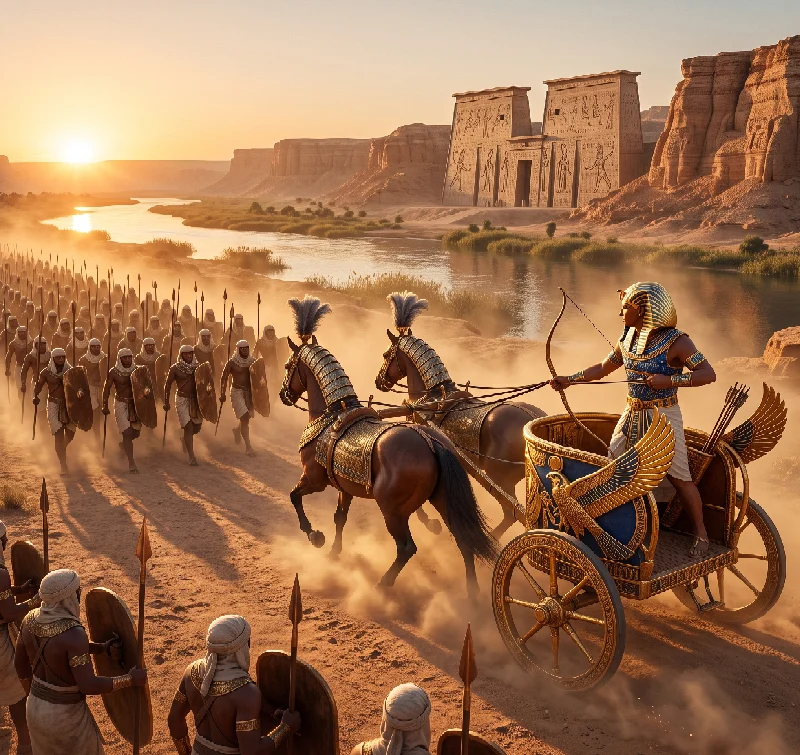
The War Chariot: Unlike the heavy, three-man shock carts fielded by the Hittites, the Egyptian chariot was an ultra-light, two-man firing platform. Constructed from heat-bent ash, elm, and rawhide, it weighed less than seventy pounds, allowing two crewmen to pick it up and carry it across rocky riverbeds.
-
Mobile Firepower: The chariot driver wrapped the leather reins securely around his hips, leaving both hands free to handle a shield and whip while the combatant discharged dozens of arrows from a stable platform at thirty miles per hour.
-
The Composite Recurve Bow: Crafted from laminated layers of animal horn, wood, and sinew glued with fish paste, these weapons possessed draw weights exceeding one hundred pounds, hurling bronze-tipped arrows through enemy armor at two hundred yards.
-
The Khopesh: When melee erupted, warriors drew the khopesh, a curved, sickle-shaped bronze sword measuring fifty to sixty centimeters. The curved outer blade delivered vicious slicing wounds, while the hooked tip was engineered to drag down enemy shields.
This integrated combined-arms model established the Ancient Egyptian Kingdoms as the preeminent military force in the Near East. Massed companies of archers softened opposing ranks from long distance, light chariots swept through disorganized flanks, and close-combat infantry moved in to secure the field with spears and sickle-swords.
Fortress Architecture and Frontier Security
Long before they conquered the Levant, the rulers of the Ancient Egyptian Kingdoms mastered defensive military architecture. During the Middle Kingdom, pharaohs constructed a formidable network of mudbrick fortresses along the Second Cataract of the Nile in modern Sudan.
The premier example of this defensive system was the fortress of Buhen:
-
Concentric Ramparts: A massive outer wall surrounded by a dry ditch and an inner stone-revetted wall rising over thirty feet high.
-
Arrow Slits and Bastions: Projecting semi-circular bastions fitted with double-tiered arrow slits allowed archers to pour overlapping crisscross fire into the ditch below.
-
L-Shaped Gatehouses: Heavily fortified gates compelled attacking forces to approach along narrow ramps while exposing their unshielded right flanks to defensive fire from towers.
-
Glacis Slopes: Smooth, inclined mudbrick ramps at the base of curtain walls prevented assault sappers from digging tunneling breaches or placing scaling ladders.
These fortresses secured the wealth of the southern territories. Thousands of pounds of raw Nubian gold, ebony, ivory, and incense flowed through Buhen directly into the royal treasuries of Thebes and Memphis.
The architecture was intentionally overwhelming. To local populations, these towering white-plastered bastions communicated the permanent, unshakable dominion of the Ancient Egyptian Kingdoms.
Monumental Engineering in the Ancient Egyptian Kingdoms
The organizational discipline that constructed massive border forts also raised the architectural marvels of the Nile Valley. A common misconception insists that the monumental stone pyramids of the Old Kingdom were built through the whips of enslaved captives.
Modern archaeological excavations at the workers’ village on the Giza Plateau tell a completely different story:
-
Skeletal Records: Skeletons recovered from the cemetery show signs of rigorous physical labor alongside professionally set fractures, amputations, and cranial surgeries, proving the laborers received the finest medical treatment available in antiquity.
-
Dietary Provisioning: Faunal analysis of butchered animal bones reveals workers consumed thousands of cattle, sheep, and goats daily, an elite protein-rich diet accompanied by unlimited beer rations.
-
Civic Rotation: The workforce was organized into rotating corvée squads known as phyles, staffed by seasonal peasant farmers during the Nile flood season when agriculture was impossible.
The construction of the Great Pyramid of Giza was not an act of tyrannical cruelty; it was a nationwide public works project. It unified disparate provinces around a shared religious task, binding the population to the institutional machinery of the state.
Through this centralized organization, the Ancient Egyptian Kingdoms transformed engineering into a durable instrument of cultural and political unity.
Imperial Expansion: Thutmose III and the Levantine Campaigns
The expansionist apex of the Ancient Egyptian Kingdoms arrived during the Eighteenth Dynasty under Thutmose III. Often remembered as the greatest military strategist in Egyptian history, Thutmose launched seventeen foreign campaigns over two decades, permanently expanding the borders of the realm.
His military masterpiece unfolded at the Battle of Megiddo in 1457 BCE:
-
The Mountain Gamble: Faced with three potential routes to confront a rebellious Canaanite coalition at Megiddo, Thutmose rejected two wide roads, choosing the narrow Aruna pass where troops marched in single file.
-
The Element of Surprise: Surprised by the daring maneuver, the allied Canaanite princes were caught completely off-guard when Egyptian units emerged directly outside the city gates.
-
The Route and Siege: Egyptian chariots broke the enemy vanguard on the plain, driving the fugitives behind the stone walls of Megiddo, which capitulated after a seven-month siege.
Thutmose did not annex Canaan through brutal extermination. Instead, he instituted a sophisticated policy of imperial assimilation. He took the eldest sons of local Levantine princes hostage back to Thebes, educating them in Egyptian royal schools, language, and culture.
When these princes returned to rule their ancestral cities, they ruled as loyal, Egyptian-educated vassals. Through this strategic diplomacy, the Ancient Egyptian Kingdoms controlled a vast empire using minimal permanent occupation garrisons.
The Climax at Kadesh: The Largest Chariot Clash
The ultimate clash between Bronze Age titans occurred in 1274 BCE on the Orontes River in modern Syria. Ramesses II marched four distinct army divisions—named after the gods Amun, Ra, Ptah, and Set—northward to wrest the strategic city of Kadesh from the Hittite Empire.
The resulting Battle of Kadesh was the largest chariot engagement ever recorded in the ancient world, featuring nearly six thousand combat vehicles:
-
The Intelligence Disaster: Bedouin nomads captured by Egyptian scouts claimed the Hittite army was far away in Aleppo. In reality, the Hittite king Muwatalli II was concealed behind the ruins of Kadesh.
-
The Ambush: As Ramesses established camp with the Amun division, 2,500 heavy Hittite chariots charged out of the woods, crashing through the marching Ra division and scattering it into the river.
-
The Counterstroke: Trapped and surrounded in his half-built camp, Ramesses rallied his personal guard, mounting his chariot to launch repeated counter-charges into the disordered Hittite ranks.
-
The Arrival of the Ne’arin: An elite Egyptian reserve force arrived along the coast just as the camp was on the verge of falling, hitting the Hittite flank and saving the royal division from annihilation.
While Ramesses returned home to carve triumphant victory accounts on temple walls across Egypt, the battle was an operational stalemate. Neither power could decisively dislodge the other from northern Syria.
The strategic deadlock led directly to the Egyptian-Hittite Peace Treaty in 1259 BCE. Inscribed on silver tablets and carved onto the walls of Karnak, it stands as the world’s first recorded international non-aggression pact, pledging mutual military defense and the extradition of political refugees.
Archaeological Records and Forensic Revelations
Modern archaeological science continues to recover the physical remnants of the Ancient Egyptian Kingdoms, separating historical reality from artistic propaganda. Excavations along desert battlefields and royal burial grounds provide tangible evidence of ancient combat trauma.
Forensic examinations of royal mummies reveal the violent costs of leadership:
-
Seqenenre Tao II: The mummy of this Seventeenth Dynasty pharaoh displays catastrophic axe and dagger wounds to the skull, sustained in close-quarter combat against the Hyksos invaders.
-
Skeletal Fractures: Excavated infantry remains from the Middle Kingdom tombs at Deir el-Bahari show fractured forearms (parry fractures), crushed ribs from mace strikes, and iron-tipped projectile points embedded in scapulae.
-
The Amarna Letters: Discovered in central Egypt, this archive of hundreds of cuneiform clay tablets reveals the diplomatic correspondence between Pharaoh Akhenaten and the kings of Babylon, Assyria, and the Hittites, documenting the complex geopolitical network that governed the Late Bronze Age.
At Tell el-Dab’a in the eastern Delta, archaeologists excavated the ancient Hyksos capital of Avaris. The discovery of severed right hands buried in pits outside royal palaces corroborates Egyptian inscriptions describing the military practice of collecting the hands of slain enemies to receive the “gold of valor” from the pharaoh.
These physical discoveries [Internal Link: Classical Greek Armor Fabrication and Metallurgy] verify that military survival in the ancient Near East was a brutal, physical competition decided by metallurgical superiority and organized violence.
Geopolitical Aftermath: The Sea Peoples and the Bronze Age Collapse
The stability of the Ancient Egyptian Kingdoms was shattered around 1200 BCE by the cataclysmic event known as the Late Bronze Age Collapse. Within a few decades, complex trade routes fractured, the Hittite Empire collapsed, Mycenaean Greece fell into ruins, and violent migrations swept across the Mediterranean basin.
A confederation of seafaring raiders, recorded by the Egyptians as the Sea Peoples, ravaged the coasts of Anatolia, Cyprus, and the Levant before descending upon the Nile Delta.
Ramesses III met this existential threat at the Battle of the Delta in 1177 BCE:
-
Egyptian galleys ambushed the incoming raider ships inside narrow, shallow river branches.
-
Coastal archers stationed along the banks subjected the enemy vessels to devastating suppressive volleys.
-
Egyptian ships used grappling hooks to capsize the invaders’ boats, dragging armored warriors into the mud to be speared.
Although the Ancient Egyptian Kingdoms successfully repelled the invasion and saved their homeland from total destruction, the economic cost was catastrophic. Disrupted silver trade routes, loss of Levantine tax revenues, and internal administrative corruption depleted the royal treasury.
The New Kingdom slowly fractured into regional dynasties. In subsequent centuries, Nubian pharaohs, Libyan warlords, Assyrian conquerors, and the Achaemenid Persian Empire took control of the Nile Valley, culminating in Egypt’s eventual absorption into the Roman Empire following the death of Cleopatra in 30 BCE.
Yet the foundational institutions created by the Ancient Egyptian Kingdoms never truly vanished. Their achievements in stone architecture, mathematical surveying, paper production, and public administration established the core institutional templates that enriched the classical civilizations of Greece and Rome, echoing across the modern world.
Frequently Asked Questions
Did slaves build the pyramids in the Ancient Egyptian Kingdoms?
No, historical and archaeological consensus confirms the pyramids were constructed by paid Egyptian conscripts and skilled seasonal laborers. Excavations at the workers’ cemetery on the Giza Plateau reveal clean medical care, protein-rich diets of meat and beer, and honorable burials, proving they were respected citizen-workers participating in rotating national labor service.
What was the military role of the Egyptian chariot?
The Egyptian chariot served primarily as a fast-attack, mobile firing platform rather than a heavy shock vehicle. Lightweight and exceptionally maneuverable, it carried a driver and an archer equipped with a composite recurve bow, allowing them to harass and break up enemy formations from long range while evading direct infantry contact.
What caused the eventual decline of the New Kingdom?
The decline of the New Kingdom was caused by the widespread Late Bronze Age Collapse, repeated incursions by the Sea Peoples, the loss of lucrative Levantine trade routes, and internal economic corruption. These mounting pressures bankrupted the royal treasury, causing central authority to fracture into rival regional dynasties.