
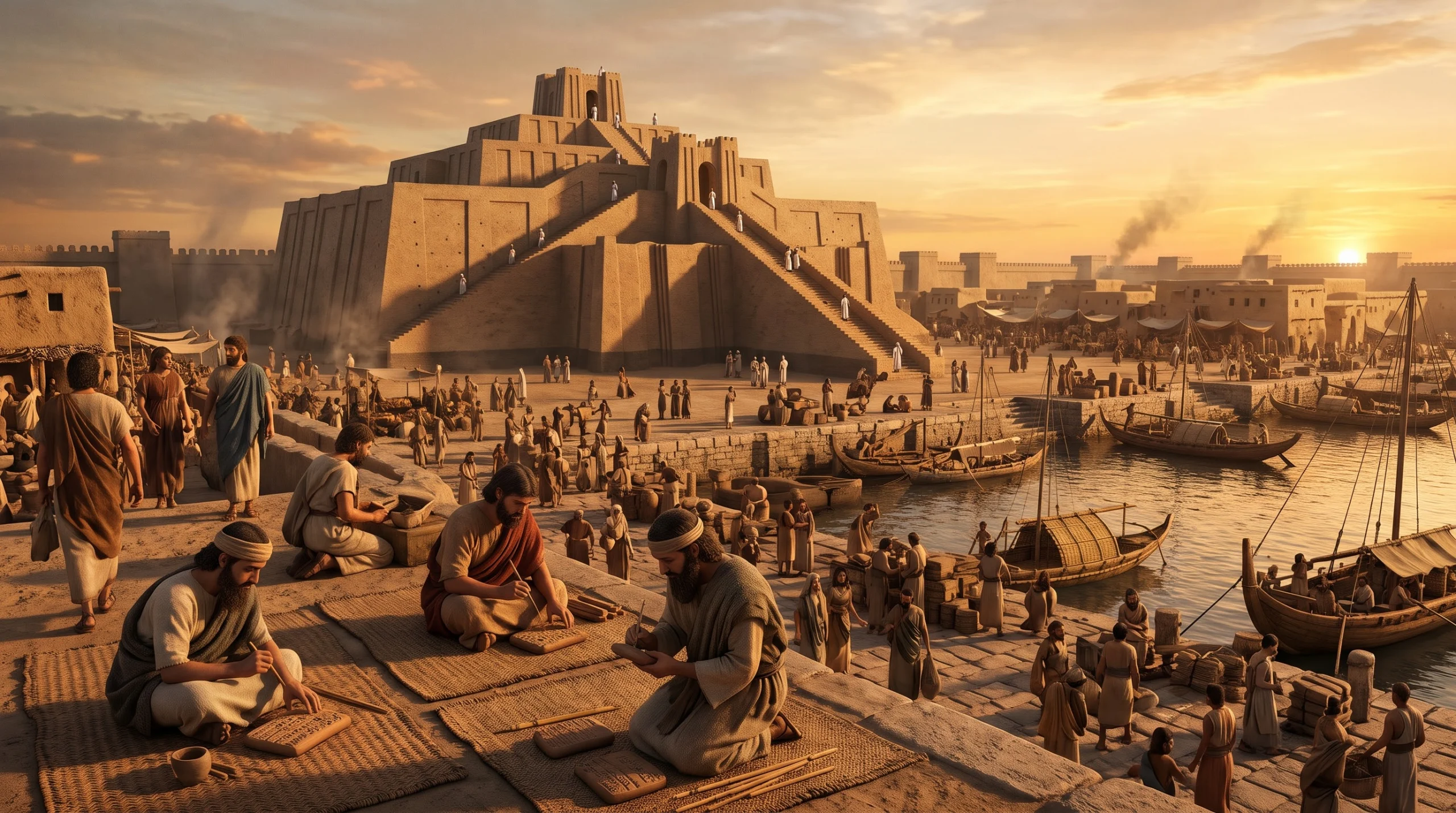
Long before Rome dominated the Mediterranean or Babylon erected its glazed walls, Uruk rose from the southern marshlands of Mesopotamia to redefine human organization. Emerging around 4000 BC along the ancient channels of the Euphrates River, this Sumerian powerhouse became the world’s first true megacity. Within its massive mudbrick ramparts, tens of thousands of residents pioneered monumental stone architecture, complex bureaucratic taxation, mass-produced pottery, and the earliest known writing system. Examining the rise, administrative machinery, and cultural legacy of Uruk reveals the exact moment humanity transitioned from scattered agrarian villages into centralized urban civilizationurban civilization.
Table of Contents
- The Urban Revolution: How Uruk Became the First Megacity
- Sacred Precincts: Eanna, Kullaba, and the White Temple
- The Invention of Cuneiform and Bureaucratic Accounting
- Gilgamesh, Kingship, and the Six-Mile Ramparts
- The Uruk Expansion: Trade Colonies Across the Near East
- Comparative Framework: Uruk vs. Early Mesopotamian Centers
- Archaeological Realities and Common Misconceptions
- Excavation Insights and Preservation Challenges
- Frequently Asked Questions
- Enduring Legacy of the Sumerian Metropolis
The Urban RevolutionThe Urban Revolution: How Uruk Became the First Megacity
Understanding the dominance of Uruk begins with the harsh ecology of southern Iraq during the fourth millennium BC. Southern Mesopotamia lacked timber, building stone, and metallic ores, yet possessed exceptionally fertile alluvial silt deposited by the Tigris and Euphrates rivers. By engineering coordinated networks of irrigation canals, drainage ditches, and earthen levees, early Sumerian communities generated massive agricultural surpluses of barley, dates, and sesame.
This reliable food surplus triggered an unprecedented demographic explosion between 3800 BC and 3100 BC—an era archaeologists designate as the Uruk Period. Smaller surrounding villages emptied as farmers, artisans, and laborers migrated into the urban core. At its zenith, Uruk encompassed nearly 5.5 square kilometers (over 1,300 acres) and housed an estimated 50,000 to 80,000 inhabitants, dwarfing every contemporary settlement on Earth.
Urban density forced radical social specialization. Freed from daily subsistence farming, residents organized into specialized guilds of copper smelters, textile weavers, stone carvers, canal engineers, and temple administrators. To feed this massive non-agricultural workforce, workshops produced millions of standardized beveled-rim bowls—crude, mass-manufactured clay vessels used to distribute daily rations of barley and beer to state laborers.
Sacred Precincts: Eanna, Kullaba, and the White Temple
Unlike modern cities organized around commercial markets or royal palaces, early Uruk revolved around twin religious precincts that governed both spiritual devotion and civic economy. The city originally formed through the merger of two distinct settlements: Kullaba, dedicated to Anu (the supreme sky god), and Eanna, the sacred district of Inanna, goddess of love, fertility, and warfare.
Within the Anu district stood the famous White Temple, perched atop a towering artificial mudbrick platform rising twelve meters above the flat alluvial plain. Coated in gleaming white gypsum plaster that reflected the blinding Mesopotamian sun for miles, this sanctuary served as the architectural forerunner of the classic stepped ziggurat. Only high priests and sacred attendants ascended its steep staircase to present offerings to the sky deity.
Meanwhile, the Eanna precinct functioned as the administrative engine of Uruk. Excavations uncovered monumental limestone temples, colonnaded courtyards, and massive mudbrick walls decorated with tens of thousands of baked clay cones. Artisans dipped the flat heads of these cones in red, black, and white pigments before pressing them into wet plaster, creating weatherproof geometric mosaics that resembled woven reed mats.
The Invention of Cuneiform and Bureaucratic Accounting
Managing grain reserves, livestock herds, textile workshops, and labor gangs for eighty thousand citizens overwhelmed human memory. Around 3200 BC, temple scribes inside the Eanna district of Uruk solved this logistical crisis by inventing the world’s earliest known writing system.
The evolution of Mesopotamian record-keeping progressed through distinct technical stages:
- Clay Tokens (Calculi): Small geometric clay shapes representing specific commodities—such as a cone for a measure of grain or a cylinder for a sheep—used in early accounting.
- Bullae Envelopes: Hollow clay balls sealed with cylinder stamps containing tokens inside to prevent fraud during shipment.
- Proto-Cuneiform Tablets: Flattened cushions of damp Euphrates clay impressed with a sharpened reed stylus, replacing physical tokens with drawn pictographs and numerical notches.
- Abstract Cuneiform Script: Over centuries, curved pictographs evolved into wedge-shaped (cuneiform) signs capable of recording phonetic Sumerian grammar, royal decrees, and epic poetry.
Roughly 85 percent of the earliest five thousand clay tablets unearthed at Uruk are mundane economic receipts documenting beer rations, copper deliveries, and silver expenditures. The remaining 15 percent consist of standardized lexical lists—dictionaries categorizing professions, birds, metals, and cities used to train apprentice scribes in rigorous temple academies.
Gilgamesh, Kingship, and the Six-Mile Ramparts
As rival Sumerian city-states such as Ur, Lagash, and Kish competed for water rights and arable land, governance inside Uruk shifted from priestly councils to secular warrior-kings (Lugals). Historical tradition and the Sumerian King List identify Gilgamesh, who ruled around 2700 BC, as the fifth king of the First Dynasty of Uruk.
While later Babylonian poets immortalized Gilgamesh as a demigod seeking immortality after the death of his companion Enkidu, archaeological surveys confirm the physical feat for which the epic praises him most: the city walls. Gilgamesh ordered the construction of an immense defensive perimeter stretching nearly 9.5 kilometers (almost 6 miles) around the urban core.
Reinforced by over nine hundred semicircular mudbrick bastions spaced at regular intervals, these ramparts protected temples, granaries, and residential quarters from nomadic raids and rival armies. Standing over ten meters high and several meters thick, the fortifications of Uruk remained an unmatched benchmark of military engineering across the ancient Near East for over a millennium [Internal Link: Ancient China: The Qin Dynasty and the First Emperor].
The Uruk Expansion: Trade Colonies Across the Near East
Because southern Iraq lacked raw timber, semi-precious stones, and metals, Uruk established an expansive commercial network that stretched over a thousand miles beyond its walls. During the fourth millennium BC, Sumerian merchants founded fortified trading enclaves and colonial outposts along the upper Euphrates in Syria, the foothills of Anatolia, and the Zagros Mountains of western Iran.
Sites such as Habuba Kabira in northern Syria functioned as complete Sumerian transplants, built with identical courtyard houses, beveled-rim ration bowls, and cylinder seal accounting systems. Through these colonies, merchants from Uruk traded finely woven woolen textiles and processed grain for Anatolian silver and copper, Lebanese cedar logs, and lapis lazuli mined in distant Afghanistan.
This commercial outreach spread urban administrative technology across the ancient world. Local elites in Elam (southwestern Iran) and northern Mesopotamia rapidly adopted Sumerian accounting methods, cylinder seals, and architectural layouts, igniting secondary urban revolutions across the Fertile Crescent [Internal Link: 7 Wonders of the Ancient World].
Comparative Framework: Uruk vs. Early Mesopotamian Centers
The following table contrasts the structural scale, technological innovations, and political roles of Uruk against other foundational cities of ancient Mesopotamia:
| City-State | Peak Era | Estimated Peak Population | Primary Historical Contribution |
|---|---|---|---|
| Uruk (Warka) | c. 3500–2700 BC | 50,000 – 80,000 | First true megacity, invention of cuneiform writing, Gilgamesh ramparts |
| Ur (Tell el-Muqayyar) | c. 2600–2000 BC | 65,000 | Royal Tombs treasures, Great Ziggurat of Ur, maritime Persian Gulf trade |
| Eridu (Tell Abu Shahrain) | c. 5000–3500 BC | 4,000 – 10,000 | Oldest Sumerian temple sequence, mythological origin of kingship |
| Babylon | c. 1790–539 BC | 150,000 – 200,000 | Hammurabi’s Law Code, Ishtar Gate, Neo-Babylonian imperial capital |
Archaeological Realities and Common Misconceptions
Several persistent myths obscure the true nature of early Sumerian urbanism:
Writing Invented for Literature and Poetry
Popular accounts often assume early scribes invented writing to preserve heroic myths or religious hymns. The archaeological record at Uruk proves the exact opposite. Writing emerged strictly as a bureaucratic accounting tool to track barley rations, sheep herds, and labor quotas; literary epics like the Epic of Gilgamesh were not committed to clay tablets until centuries after proto-cuneiform appeared.
Total Abandonment After the Bronze Age
Although Uruk lost political supremacy to Akkad, Ur, and Babylon during the third and second millennia BC, the city did not vanish. It remained a revered religious and scholarly center throughout the Assyrian, Neo-Babylonian, Achaemenid Persian, and Seleucid Greek eras, remaining continuously inhabited for nearly five thousand years until the Sassanian period (around 300–700 AD).
Stone Construction Like Egypt
Unlike Egyptian pyramids carved from quarried limestone and granite, virtually all monumental structures in Uruk were built from sun-dried or kiln-baked river mudbricks. Because mudbrick erodes rapidly without constant plaster maintenance, Sumerian builders periodically leveled aging temples and constructed larger sanctuaries directly atop the compressed rubble.
Excavation Insights and Preservation Challenges
Modern archaeological knowledge of Uruk (known locally in southern Iraq as Warka) stems from systematic excavations initiated by the German Oriental Society in 1912 and continued for decades by the German Archaeological Institute. These campaigns uncovered iconic masterpieces, including the Mask of Warka—a life-sized sculpted marble female face dating to 3100 BC—and the carved alabaster Warka Vase depicting ritual offerings to Inanna.
As documented in academic surveys and Encyclopaedia Britannica’s historical overview of Uruk, the city’s ultimate decline was driven by environmental shifts rather than a single military catastrophe. Over centuries, the main course of the Euphrates River migrated westward away from the city walls, starving its irrigation canals of water and turning surrounding farmlands into arid desert.
Preserving the vast mudbrick ruins of Uruk today presents acute conservation challenges. Wind erosion, seasonal winter rains, and soil salinization threaten exposed earthen walls, requiring ongoing non-invasive geomagnetic mapping and protective earthen capping to safeguard unexcavated sectors.
Frequently Asked Questions
Why is Uruk considered the first city in the world?
While older settlements like Jericho and Çatalhöyük existed as large agricultural villages, Uruk was the first to combine monumental public architecture, specialized labor guilds, centralized state bureaucracy, social stratification, and a population exceeding 50,000 people around 3500–3100 BC.
Where was the ancient city of Uruk located?
Uruk was located in southern Mesopotamia, roughly 250 kilometers (155 miles) south of modern Baghdad in Iraq’s Muthanna Governorate, near the ancient course of the Euphrates River.
What major inventions came from Uruk?
Innovations pioneered or standardized in Uruk include proto-cuneiform writing, cylinder seals for document authentication, mass-produced beveled-rim ration bowls, the potter’s wheel, monumental stepped temple platforms, and sexagesimal (base-60) mathematical accounting.
Was King Gilgamesh a real ruler of Uruk?
Most historians and Assyriologists consider Gilgamesh to have been an actual historical king who ruled Uruk around 2700 BC during the Early Dynastic II period, whose real-life construction of the city’s massive defensive walls later inspired mythological legends.
How did Uruk get its modern name, Iraq?
Many linguists and historians trace the modern name of the country “Iraq” directly back to the ancient Sumerian name “Uruk” (pronounced Unug in Sumerian and Uruk in Akkadian), reflecting the enduring cultural imprint of this foundational metropolis.
What happened to the people of Uruk?
As the Euphrates River gradually shifted its channel westward and soil salinization reduced agricultural yields, residents steadily migrated toward newer river cities. By the seventh century AD, following the Islamic conquest, the remaining settlement was completely abandoned.
Enduring Legacy of the Sumerian Metropolis
The historical trajectory of Uruk established the structural blueprint for modern urban life. Every metropolis today relies on administrative principles first tested along the banks of the southern Euphrates: written record-keeping, standardized weights and measures, municipal infrastructure, and specialized labor economies. Standing as the cradle of literacy and civic governance, Uruk transformed human society from isolated tribal communities into an interconnected world of cities, laws, and recorded history.