
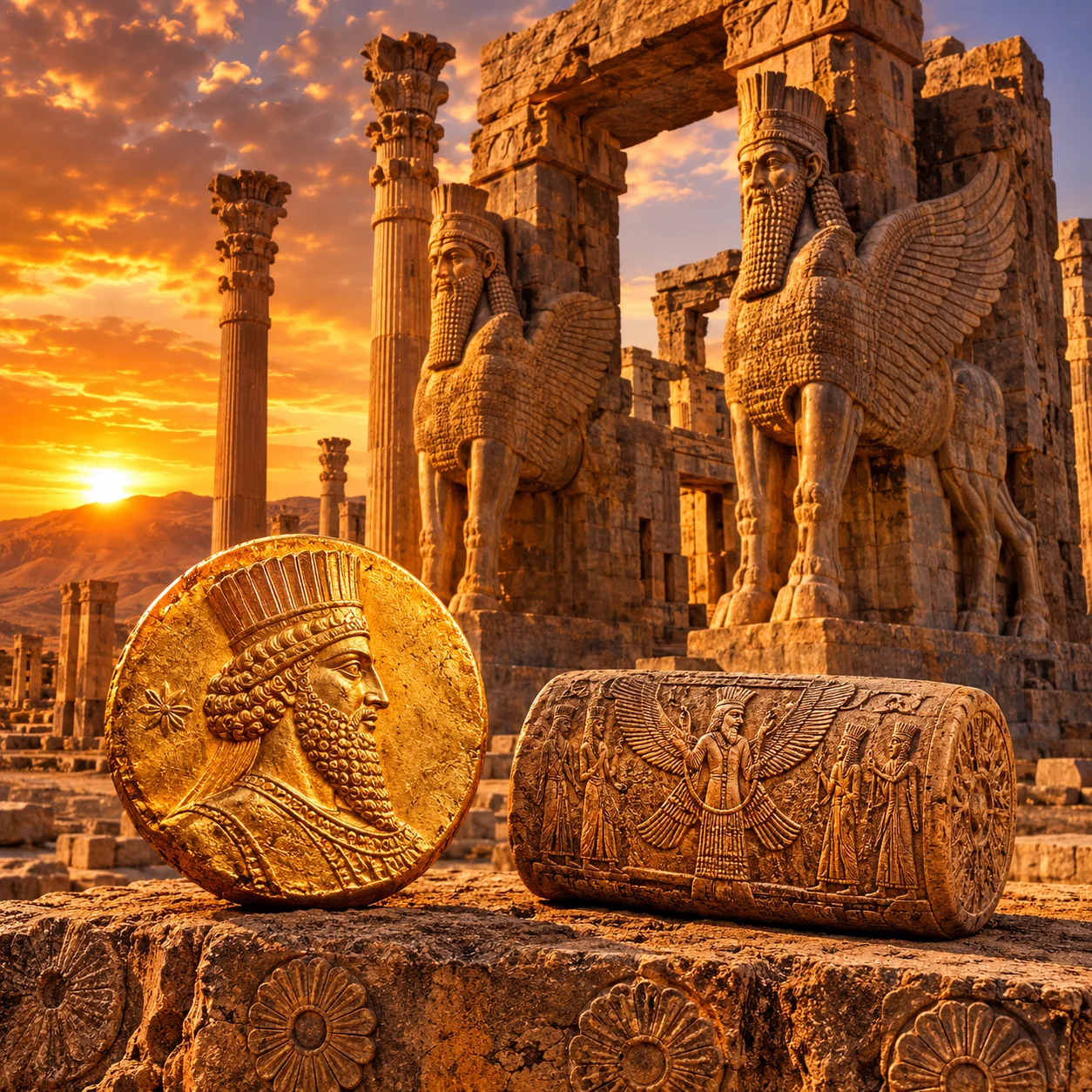
Achaemenid Empire: The Architectural Machinery of Persian Rule
In 539 BCE, when Cyrus the Great marched through the bronze gates of Babylon without pillage or slaughter, he established the political foundations of the Achaemenid Empire. Prior to this Persian expansion, the Near East was governed by brutal terror tactics, mass deportations, and ruthless subjugation, as typified by the Neo-Assyrian kings. The Achaemenid Empire introduced an entirely new imperial philosophy: governing a multi-ethnic realm not by extinguishing local customs, but by incorporating them into a disciplined, centralized bureaucratic machinery.
At its geopolitical zenith under Darius I, the Achaemenid Empire encompassed over 5.5 million square kilometers, stretching from the Indus River Valley to the cataracts of the Nile and the Thracian shores of Europe. It was the largest imperial hegemon the ancient world had ever witnessed, encompassing an estimated forty-four percent of the globe’s human population. The empire maintained stability across these vast territories not solely by the sword, but through an administrative framework centered on autonomous satrapies, the Royal Road communications network, standardized legal codes, and high-purity gold coinage.
Cyrus the Great and the Imperial Ideology of Tolerance
The origins of the Achaemenid Empire derived directly from the military daring and statecraft of Cyrus II, later remembered as Cyrus the Great. Ascending the Persian throne in 559 BCE as an obscure vassal to the Median king Astyages, Cyrus orchestrated a succession of rapid military campaigns that dismantled the Median Empire, conquered the wealthy Lydian kingdom of Croesus, and peacefully annexed the Neo-Babylonian Empire.
Cyrus departed radically from preceding imperial conquerors by implementing a revolutionary political strategy:
-
Religious Autonomy: Rather than enforcing the supremacy of the Persian god Ahura Mazda, Cyrus actively restored local religious cults, rebuilt damaged temples, and personally sacrificed to indigenous deities like Marduk in Babylon.
-
Repatriation of Captives: He reversed the Neo-Babylonian policy of forced displacement, famously permitting exiled populations—most notably the Judean community—to return to their ancestral homelands and reconstruct the Temple in Jerusalem.
-
Preservation of Local Elites: Rather than purging indigenous aristocratic hierarchies, Cyrus integrated Babylonian, Median, and Egyptian scribes and nobles into key regional governance roles.
The ideological foundation of this imperial charter was preserved on the Cyrus Cylinder, a barrel-shaped clay artifact inscribed in Akkadian cuneiform excavated from Babylon in 1879. The cylinder celebrated Cyrus not as a bloodthirsty foreign conqueror, but as a legitimate, divinely ordained liberator chosen to restore cosmic order, truth (arta), and fiscal peace across Mesopotamia.
By prioritizing cultural non-interference over heavy-handed cultural assimilation, Cyrus established an imperial equilibrium. Conquered peoples remained loyal to the Great King because the Achaemenid Empire protected their temples, preserved their civic traditions, and provided unprecedented commercial stability.
Darius the Great: Engineering the Satrapy Administration
While Cyrus was the sword that assembled the realm, Darius I (reigned 522–486 BCE) was the organizational mind that converted a chaotic frontier coalition into an enduring imperial apparatus. Following the bloody suppression of nineteen provincial revolts after the death of Cambyses II, Darius divided the entire Achaemenid Empire into approximately twenty to thirty administrative provinces known as satrapies.
Each satrapy was governed through a calculated system of institutional checks and balances designed to prevent provincial governors from amassing enough autonomous power to declare independence:
-
The Satrap (“Protector of the Realm”): Appointed directly by the Great King, often chosen from Persian and Median royal families. The satrap managed civil governance, levied taxes, maintained regional roads, and presided over high judicial courts.
-
The General of the Province: Military garrison commanders answered directly to the Great King in Susa, not to the civil satrap, ensuring that governors lacked immediate command over regional armed forces.
-
The Royal Secretary: A resident imperial scribe who audited official satrapy communications, monitored grain storage, and maintained a duplicate tax register dispatched to the imperial chancery.
-
“The King’s Eyes and Ears”: Independent royal inspectors accompanied by armed retinues, who arrived without warning in provincial capitals to audit treasury receipts, inspect agricultural output, and investigate judicial corruption.
Tribute within the Achaemenid Empire was completely standardized under Darius. Imperial surveyors calculated the agricultural fertility, mineral deposits, and trade volumes of each province, establishing an annual fiscal levy paid in refined silver bullion talents.
Babylon contributed the largest monetary and agricultural sum, paying one thousand silver talents alongside four months of palace food rations, while the satrapy of India delivered 360 talents of pure gold dust extracted from the Indus River sands.
Logistical statecraft and bureaucratic integration [Internal Link: Imperial Bureaucracy in Antiquity] proved that continental empires could only endure if tax obligations were predictable, codified, and anchored by regular provincial audits.
The Royal Road: The Highway That Shrank Continents
To govern an empire that spanned three continents, the Great Kings required rapid, uninterrupted communication between administrative capitals like Susa, Babylon, Ecbatana, and Persepolis. Darius answered this logistical demand by engineering the Royal Road, the premier arterial highway of the ancient world.
The primary route stretched 2,699 kilometers (1,677 miles) from the administrative center at Susa to the Aegean port city of Sardis in western Asia Minor:
-
Paved Infrastructure: The roadway was leveled, graded, and paved with dressed stone through swampy and mountainous terrain, with strategic river bridges constructed using timber caissons.
-
The Chapar Khaneh Postal System: One hundred and eleven royal post stations were spaced along the route at intervals of approximately twenty-five to thirty kilometers—the distance a healthy horse could gallop at full speed without collapse.
-
Relay Couriers (Pirradazish): Fresh, conditioned horses and elite riders waited day and night at every station. A dispatched imperial scroll was handed off continuously from rider to rider like a baton.
A journey from Sardis to Susa that required ninety days of rigorous foot marching for a military baggage train was routinely covered by royal couriers in seven to nine days.
The Greek historian Herodotus marveled at the speed of this Persian communications network in his Histories, penning the famous tribute:
“Neither snow nor rain nor heat nor gloom of night stays these couriers from the swift completion of their appointed rounds.”
The Royal Road did not simply convey administrative intelligence; it facilitated the movement of luxury commodities, military re-supply trains, and diplomatic delegations, binding the vast markets of the Achaemenid Empire into an integrated commercial zone.
+---------------------------------------------------------------------------------+
|                       THE SATRAPY SURVEILLANCE TRIANGLE                         |
|                                                                                 |
|                                [ THE GREAT KING ]                               |
|                                  /     |      \                                 |
|                                 /      |       \                                |
|          Direct Royal Directives       |        Surprise Audits & Inspections   |
|                               /        |         \                              |
|                              v         v          v                             |
|                        [SATRAP] <──> [GENERAL] <──> [KING'S EARS]               |
|                      (Civil Law)    (Garrisons)   (Royal Inspectors)            |
|                              ^         ^          ^                             |
|                               \        |         /                              |
|                                [ PROVINCIAL POPULATION ]                        |
|                                (Tribute, Grain, Recruits)                       |
+---------------------------------------------------------------------------------+
Imperial Economics: The Daric, Siglos, and Aramaic Literacy
The economic integration of the Achaemenid Empire was accelerated by the introduction of an imperial bimetallic currency system. Darius recognized that trade across Lydia, Phoenicia, Egypt, and Mesopotamia was choked by disparate, regional weighing standards and barter systems.
Darius standardized trade with two primary official coins:
-
The Daric: Struck from exceptionally pure gold (95.8% purity), weighing roughly 8.4 grams, stamped with the image of the Great King kneeling with a bow and spear. The daric became the undisputed international gold reserve currency across the Mediterranean.
-
The Siglos: A silver coin weighing 5.6 grams, circulating in everyday provincial markets; twenty silver sigloi were legally pegged to one gold daric.
Simultaneously, the empire solved its immense linguistic divisions by adopting Imperial Aramaic as the universal bureaucratic lingua franca. Aramaic possessed a simple twenty-two-letter consonantal alphabet written smoothly with ink on durable papyrus and parchment, completely out-competing the cumbersome clay cuneiform wedges of Mesopotamia.
An imperial decree issued at Susa in Old Persian was transcribed into Imperial Aramaic by royal scribes, galloped along the Royal Road, and read aloud by local interpreters in Greek, Egyptian, Hebrew, or Elamite across regional marketplaces within days.
Commercial highway security and infrastructure [Internal Link: Classical Logistics and Imperial Expansion] demonstrated that high-velocity state information processing prevented domestic insurrections from metastasizing into systemic civil wars.
Persepolis: The Monumental Theater of Tribute
While Susa handled everyday imperial administration and Ecbatana served as the cool summer residence, Persepolis (Parsa) was engineered as the sacred ceremonial heart of the Achaemenid Empire. Founded by Darius I around 518 BCE and expanded by Xerxes I and Artaxerxes I, the complex was a monumental celebration of imperial harmony.
Persepolis was built upon a massive forty-foot-high limestone terrace projecting from the base of the Mount of Mercy:
-
The Gate of All Nations: A colossal entrance portal flanked by towering winged bulls (lamassu) carved in stone, welcoming foreign embassies into the complex.
-
The Apadana (Audience Hall): A monumental hypostyle hall spanning sixty meters square, supported by seventy-two slender limestone columns standing twenty meters high, capped with sculpted double-bull capitals.
-
The Apadana Staircase Friezes: Magnificent, ultra-detailed stone bas-reliefs illustrating twenty-three distinct subject nations marching in peaceful, dignified procession to present gifts to the Great King.
The stone carvings capture the stunning diversity of the realm with anthropological precision: Medes in rounded felt caps carrying daggers, Armenians leading fine horses, Babylonians offering humped bulls, Bactrians presenting two-humped camels, and Nubians carrying jars of fragrant frankincense and elephant tusks.
Significantly, the Persepolis reliefs do not depict slaves being whipped or prisoners dragged in chains. The delegations are depicted as proud, honorable participants bearing gifts, holding hands with Persian courtiers who guide them respectfully into the presence of the monarch. Persepolis was imperial theater designed to project unified cosmopolitan order rather than tyrannical terror.
The Immortal Core: The Achaemenid Military Apparatus
The defensive and offensive muscle of the Achaemenid Empire was built upon a combined-arms system that united nomadic cavalry with massive infantry levies. In times of national mobilization, the empire could field hundreds of thousands of combatants drawn from over forty distinct nationalities.
At the heart of this military apparatus stood the royal household troops, celebrated by Herodotus as the “Ten Thousand Immortals” (Athanatoi):
-
The Composition: An elite corps of exactly ten thousand professional Persian, Median, and Elamite heavy infantrymen who served as the imperial standing army.
-
The Succession Principle: If a member was killed, fell sick, or was wounded, an elite reserve soldier stepped immediately into his place, keeping the regiment permanently at exactly ten thousand men.
-
Weaponry and Equipment: Armed with short composite bows, iron-tipped spears balanced with golden and silver pomegranates, short iron daggers (akinakes), and concealed scale armor covered by vibrant patterned tunics.
-
The Sparabara: Frontline infantry companies deployed large wicker shields (spara) woven from reeds and leather, forming an interlocking defensive wall from behind which rear archers unleashed high-volume arrow barrages.
The Persian army was optimized for wide, arid plains where vast clouds of cavalry could outflank enemy lines while massed archers suppressed opposing infantry formations from long distances.
However, this tactical system proved dangerously vulnerable when colliding with heavily armored Greek hoplites in the confined mountain passes of Greece [Internal Link: Classical Greek Defensive Strategy]. Wicker shields and short spears could not withstand the bronze-faced shock collisions of the Peloponnesian phalanx.
Archaeological Evidence: The Persepolis Fortification Archive
Modern historical understanding of the Achaemenid Empire was fundamentally transformed in 1933, when archaeologists from the Oriental Institute of the University of Chicago excavated tens of thousands of clay tablets embedded in the fortification walls of Persepolis.
The Persepolis Fortification and Treasury Archives provide an unprecedented look into daily imperial accounting between 509 and 457 BCE:
-
The Economic Record: Written predominantly in Elamite cuneiform, the tablets record grain rations, wine distributions, sheep allotments, and travel stipends for royal messengers, craft workers, and stone masons.
-
Proof of Paid Free Labor: The archives completely shattered the ancient Greek myth that Persepolis was constructed by enslaved captives; the records prove that every architect, plasterer, sculptor, and porter was a salaried, free laborer paid regular grain and silver wages.
-
Women in the Workforce: The tablets document female managers (aratashshara) leading large artisan workshops, receiving equal food rations to male supervisors, and enjoying paid maternity leave and subsidized wine rations following childbirth.
The clay tablets reveal a meticulously audited fiscal state where a single basket of pomegranates transported from Shiraz could not be moved without a signed cylinder seal impression from a royal bureaucrat.
The Sunset: Palace Intrigues and the Macedonian Thunderbolt
The structural fall of the Achaemenid Empire was driven by internal dynastic degeneration rather than administrative failure. Following the assassination of Artaxerxes I, the fourth century BCE was characterized by bloody palace coups, fratricide, corrupt eunuch ministers, and the chronic rebellion of peripheral satraps.
When Alexander the Great crossed the Hellespont in 334 BCE, the Persian throne was held by Darius III, a courageous soldier who inherited a demoralized military and fractured regional leadership:
-
The Granicus and Issus (334–333 BCE): Alexander shattered local satrapal forces at the Granicus River and outmaneuvered Darius III in the narrow coastal plain of Issus, capturing the royal family.
-
The Climax at Gaugamela (331 BCE): On a leveled plain in modern northern Iraq, Alexander deployed aggressive oblique cavalry wedges, piercing the center of the massive Persian line and driving Darius III from the field.
-
The Conflagration of Persepolis (330 BCE): Alexander marched into the heart of Persia, seizing the immense imperial treasuries before intentionally torching the royal palaces of Persepolis, avenging the Persian burning of Athens during the Greco-Persian Wars 150 years prior.
Following the murder of Darius III by his rebellious satrap Bessus, Alexander assumed the Persian diadem himself, marrying royal Achaemenid princesses and adopting Persian court customs.
The institutional framework proved so superior to anything the Greeks possessed that Alexander and his subsequent Seleucid successors retained the Achaemenid satrapy divisions, royal postal roads, and Aramaic scribal networks to govern their vast Hellenistic kingdoms.
The Enduring Legacy of the Persian Kings
The Achaemenid Empire established the blueprint for world empire that subsequent civilizations copied for millennia. By proving that diverse peoples could be united under a single government without obliterating their native cultural identities, the Persian monarchs demonstrated an unprecedented administrative maturity.
The lasting institutional contributions of this ancient superpower include:
-
The Model of Federal Autarky: The division of power between autonomous local satrapies and a centralized sovereign authority served as the institutional ancestor of modern federal state governance.
-
The Evolution of Postal Logistics: The relay system developed for the Royal Road formed the direct structural blueprint for the Roman Cursus Publicus, the Mongol Yam, and the modern postal service.
-
The Paradigm of Religious Pluralism: Cyrus’s philosophy of cultural tolerance established that long-term imperial longevity requires the active conciliation and protection of minority populations.
-
Architectural Synthesis: The hypostyle architecture and sculptural relief traditions developed at Persepolis and Pasargadae heavily influenced Hellenistic, Parthian, and Sasanian stonecraft across Eurasia.
Long after the palace halls of Susa dissolved into dust and the stone columns of Persepolis were blackened by Macedonian fire, the administrative genius of the Achaemenid Empire endured. It demonstrated that true imperial power belongs not to the tyrant who burns temples, but to the statesman who constructs roads, protects diverse faiths, and balances authority through the rule of law.
Frequently Asked Questions
What was the satrapy system in the Achaemenid Empire?
The satrapy system was the administrative framework of the Achaemenid Empire, engineered primarily by Darius I. The realm was partitioned into roughly twenty to thirty administrative provinces called satrapies, each governed by a royally appointed satrap who managed civil affairs and collected taxes, paired with an independent military commander and a royal secretary to ensure total loyalty to the Great King.
Why was the Royal Road so important to the Persian Empire?
The Royal Road was a paved highway stretching 2,699 kilometers from Susa to Sardis that allowed for the rapid transmission of imperial orders, tax receipts, and military troops across the Achaemenid Empire. Equipped with 111 post stations housing fresh horses and riders, royal couriers could travel the entire distance in seven to nine days, shrinking the vast empire into a cohesive administrative unit.
How did Cyrus the Great treat conquered nations?
Cyrus the Great practiced cultural, religious, and political tolerance toward conquered peoples, completely departing from the brutal deportation policies of the Assyrians and Babylonians. He repaired damaged temples, respected indigenous deities, allowed exiled communities like the Jews to return home, and integrated local aristocrats into regional administrative offices.