
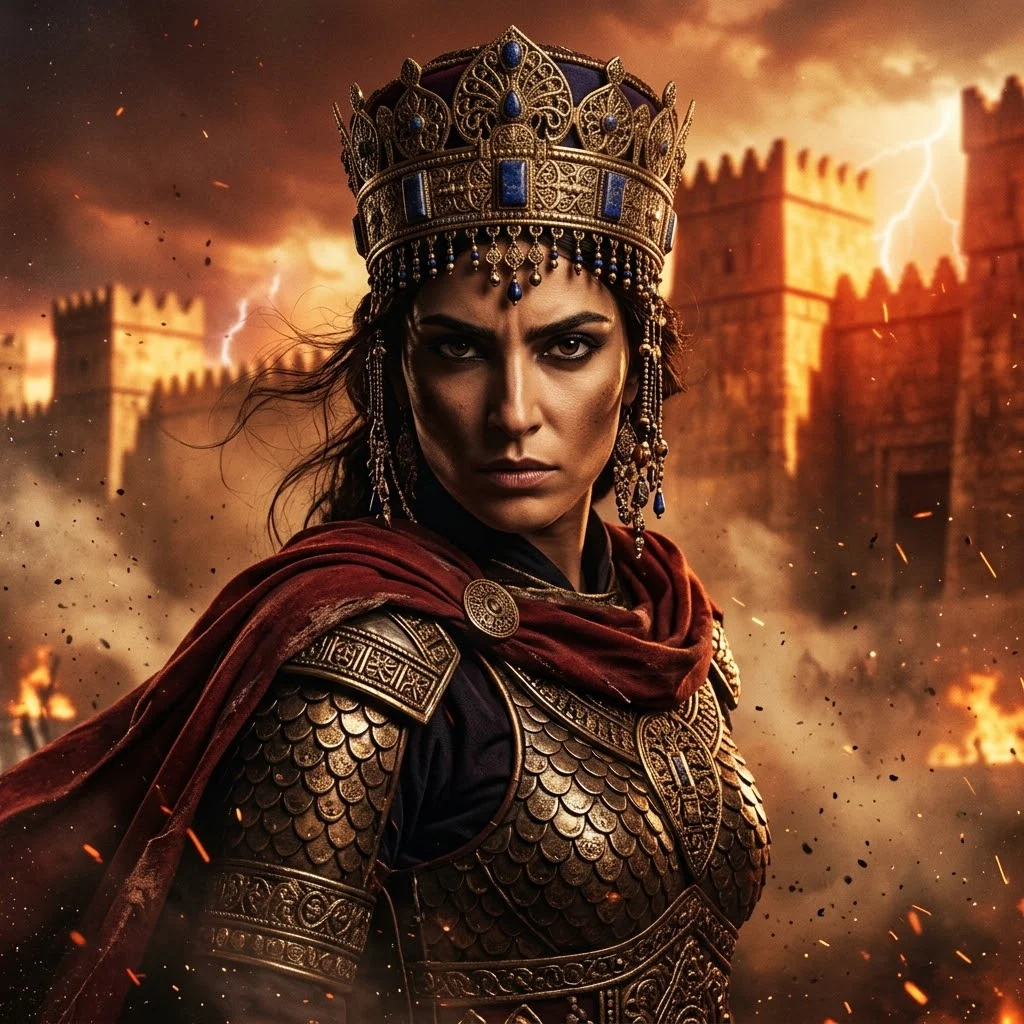
Queen Semiramis: The Legend and Reality of Babylon’s Warrior Monarch
Few figures cast a longer shadow across ancient Mesopotamian chronicles than Queen Semiramis. Classical writers celebrated her as an invincible conqueror who directed massive siege works, rode into open battle clad in soldier’s armor, and transformed Babylon into a fortified jewel of the ancient world.
Behind the dramatic folklore lies one of antiquity’s most unusual political realities: the life of the ninth-century BCE Assyrian queen Shammuramat. At a time when women rarely exercised sovereign administrative power, she ruled the world’s most ruthless military empire and preserved imperial stability through critical decades of rebellion.
The Myth of the Dove-Reared Empress
The mythological biography of Queen Semiramis took definitive shape centuries after her death through Greek historians like Ctesias of Cnidus and Diodorus Siculus. Their accounts wrapped her life in religious wonder and theatrical drama.
According to classical myth, Semiramis was the daughter of the Syrian fish-goddess Derceto and a mortal youth. Ashamed of the union, Derceto abandoned the infant on the rocky deserts near Ascalon. A flock of wild doves kept the child alive, stealing cheese from nearby shepherds and warming her with their wings until an imperial shepherd discovered her.
She grew into a woman of exceptional intellect and arresting beauty, eventually marrying Onnes, a royal officer under the Assyrian king Ninus. When Ninus laid siege to the fortress of Bactra and stalled against its defenses, Semiramis intervened directly.
She designed an agile, androgynous tunic that hid her identity and protected her skin from the harsh elements. Leading a select assault team up the sheer cliffs protecting the citadel, she breached the rear defenses, turning the tide of the campaign.
Enamored by her tactical brilliance, King Ninus demanded her as his bride, driving Onnes to suicide. Upon Ninus’s death, Semiramis inherited the crown, becoming sole master of an empire stretching from Egypt to the borders of the Indus Valley.
The Historical Core: Shammuramat of Assyria
Separating legend from historical fact reveals that the real counterpart to Queen Semiramis was Shammuramat, queen of the Neo-Assyrian Empire during the late ninth century BCE. She served as the principal consort of Shamshi-Adad V, who reigned from 824 to 811 BCE.
Assyria at this juncture was teetering on the edge of internal collapse. A prolonged, destructive civil war led by Shamshi-Adad’s elder brother had drained the royal treasury and shattered provincial stability. When Shamshi-Adad died in 811 BCE, his heir, Adad-nirari III, was too young to rule alone.
Shammuramat stepped forward to govern as regent. For five vital years, between 811 and 806 BCE, she held the throne against factional infighting and foreign encroachment.
Her public authority broke royal precedent in a civilization defined by rigid patriarchal militarism:
-
Inscribed Royal Stelae: Her name appears alongside her son’s on royal monuments at Ashur, an honor previously restricted to reigning male monarchs.
-
Direct Border Treaties: Boundary markers found in eastern Anatolia celebrate her alongside the king for expanding imperial frontiers against the kingdom of Urartu.
-
Dedication of Cultic Statues: Royal administrators routinely dedicated votive statues to regional gods to secure long life for both the king and his mother, recognizing her equal standing in imperial decisions.
       [Shalmaneser III]
               │
        [Shamshi-Adad V] ═══ [Shammuramat / Semiramis]
                             │  (Imperial Regent, 811–806 BCE)
                             │
                      [Adad-nirari III]
Military Doctrine and Frontier Campaigns
The Neo-Assyrian army of the early first millennium BCE was an unprecedented war machine. It relied on professional standing units, advanced metallurgical production, and strict logistical discipline. As regent, Shammuramat kept this aggressive military infrastructure active, understanding that any sign of internal weakness would invite immediate invasions from Urartu and the Zagros tribes.
Assyrian records confirm that the imperial army launched targeted campaigns across the Zagros Mountains into Media and southward toward Babylonia during her regency. Maintaining regular military pressure kept the empire’s vassal networks obedient and secured vital trade routes.
The tactical toolkit that enforced this dominance combined iron technology with disciplined maneuvers:
-
Cavalry Innovations: Assyrian horsemen were moving from two-man chariot teams to independent mounted units, shooting composite bows while riding at full gallop.
-
Combined-Arms Infantry: Spear-bearing infantries formed defensive walls using wicker body shields, while archers and slingers thinned oncoming enemy ranks.
-
Advanced Siege Engines: Batterheads clad in damp hide struck mudbrick and stone walls while assault towers sheltered sappers undermining foundation works.
Classical writers attributed these military systems directly to Queen Semiramis. In the legends, she personally directed campaigns against Egypt, Ethiopia, and the Indus Valley, leading her divisions on chariot and horseback.
Her legendary Indian expedition featured an inventive deception: knowing the Indian monarchs fielded war elephants, she had thousands of black oxen stitched into artificial elephant hides to intimidate the opposing vanguard. While this battlefield ruse belongs to myth, it reflects how ancient writers viewed her tactical ingenuity.
Engineering the Grandeur of Babylon
In Greek and Roman literature, Queen Semiramis is immortalized as the master architect who built Babylon. While historical records confirm that Nebuchadnezzar II directed the major building programs of the Neo-Babylonian Empire centuries later, earlier Mesopotamian rulers steadily fortified and expanded the capital along the Euphrates.
The legends celebrate her public works as high triumphs of engineering:
Fortifications and Ramparts
Her urban plans centered on defensive rings. Classical accounts describe her building towering outer walls constructed of baked brick bound with asphalt bitumen, an impermeable local mortar. Guard towers flanked the gates, broad enough atop for four-horse chariots to pass each other without slowing down.
River Redirection and Aqueducts
The Euphrates cut through the center of Babylon, presenting chronic flooding hazards. Semiramis reportedly built stone dikes and containment basins to redirect floodwaters away from residential quarters. She ordered the excavation of stone tunnels under the riverbed to connect her palaces, pioneering subterranean river crossings.
Civic Splendor and Palaces
Beyond defense, she focused on urban grandeur. She commissioned royal quarters framed by cast-bronze gates and covered in vibrant glazed ceramic brickwork. Her palace interiors held stone reliefs celebrating hunting triumphs, state ceremonies, and religious offerings to Marduk and Ishtar.
| Project Category | Engineering Technique | Practical Function |
| Defensive Perimeters | Baked mudbrick set in asphalt bitumen mortar | Protects against battering rams and water erosion |
| Water Management | Interlocking canals and stone-lined flood basins | Irrigates surrounding farmlands and controls spring river crests |
| River Transit | Sunken stone tunnels and masonry causeways | Allows rapid, covered passage across the Euphrates |
| Civic Architecture | Glazed, kiln-fired tiles and bronze fittings | Displays imperial wealth and intimidates diplomatic visitors |
Statecraft, Power Politics, and Gender
In the brutal environment of ancient Mesopotamian politics, holding power required constant vigilance. Assyrian kings drew their political legitimacy directly from Ashur, the national deity, and demonstrated their divine mandate through military violence and administrative control.
For a woman to hold supreme authority within this system, she had to navigate intense palace rivalries:
Royal Court Intrigue
Provincial governors and court eunuchs held deep regional influence across Assyria. When Shamshi-Adad V died, many district commanders sought to expand their autonomy. Shammuramat kept these governors in check by maintaining central control over royal tax revenues and preserving absolute loyalty within the imperial standing guard.
Cultic Legitimacy
The queen mother aligned her actions with the religious hierarchy. By patronizing the temples of Nabu and Ninurta in Nimrud, she secured the endorsement of the priesthood. Royal inscriptions from the period emphasize that her governance defended sacred traditions and divine order.
Dynastic Continuity
Shammuramat recognized that her primary survival goal was passing an intact, stable empire to her son, Adad-nirari III. Her decisive leadership protected the line of succession from usurpation, laying the foundation for Assyria’s resurgence as an undisputed superpower in subsequent generations.
The Cultural Evolution of the Legend
As generations passed, the historical deeds of Shammuramat merged with ancient religious archetypes, particularly the cult of Ishtar, the goddess of war and sexual desire. By the time Greek, Roman, and Persian storytellers inherited her story, the administrative regent had transformed into an epic, larger-than-life figure.
In these classical retellings, she became a figure of unbridled passion and martial ferocity. Greek chroniclers claimed that upon her abdication, Queen Semiramis transformed into a white dove and ascended into the heavens, confirming her divine descent.
Armenian folklore preserved parallel tales of Semiramis, framing her as the proud Mesopotamian queen who waged war against their legendary king, Ara the Beautiful. Across centuries of epic poetry, Renaissance painting, and nineteenth-century opera, her persona evolved to reflect the anxieties and fascinations of every era that studied her.
[Historical Shammuramat] (c. 811 BCE)
        │
        ▼ (Synthesis with Cult of Ishtar & Oral Tradition)
[Near Eastern Folk Epics]
        │
        ▼ (Transmission via Ctesias, Herodotus, Diodorus Siculus)
[Greco-Roman Classical Accounts]
        │
        ▼ (Medieval Chronicles, Renaissance Drama, Operas)
[Queen Semiramis: The Romantic Archetype]
The Lasting Legacy of Queen Semiramis
The lasting fame of Queen Semiramis endures because she defied the strict conventions of her world. The historical record shows that ninth-century BCE Assyria was one of the most patriarchal, militarized societies in history. Yet Shammuramat led its government, commanded its armies, and protected its throne during a critical crisis of succession.
The myths celebrating her as the builder of Babylon and conqueror of the East may take historical liberties, but they preserve a vital truth. Queen Semiramis proved that strategic acumen, political daring, and executive control were not the exclusive domains of kings. She remains an enduring symbol of sovereign authority in the ancient world.
Frequently Asked Questions
Was Queen Semiramis a real historical figure?
Yes. Her legend is grounded in the real ninth-century BCE Assyrian queen Shammuramat. She served as the primary consort to King Shamshi-Adad V and ruled the Neo-Assyrian Empire as regent from 811 to 806 BCE during the youth of her son, Adad-nirari III.
Did Queen Semiramis really build the walls of Babylon?
No. Historical and archaeological evidence demonstrates that the massive fortifications and civic monuments of Babylon were primarily constructed by Neo-Babylonian kings, most notably Nebuchadnezzar II. Classical Greek historians conflated earlier Assyrian and Babylonian achievements and credited them to the legendary Semiramis.
Why was Shammuramat unusual among Assyrian rulers?
Assyrian society was deeply patriarchal, reserving political and military command exclusively for male monarchs. Shammuramat was one of the very few women in Assyrian history granted her own inscribed royal monuments, mentioned directly in international border treaties, and acknowledged as exercising executive power over imperial campaigns