
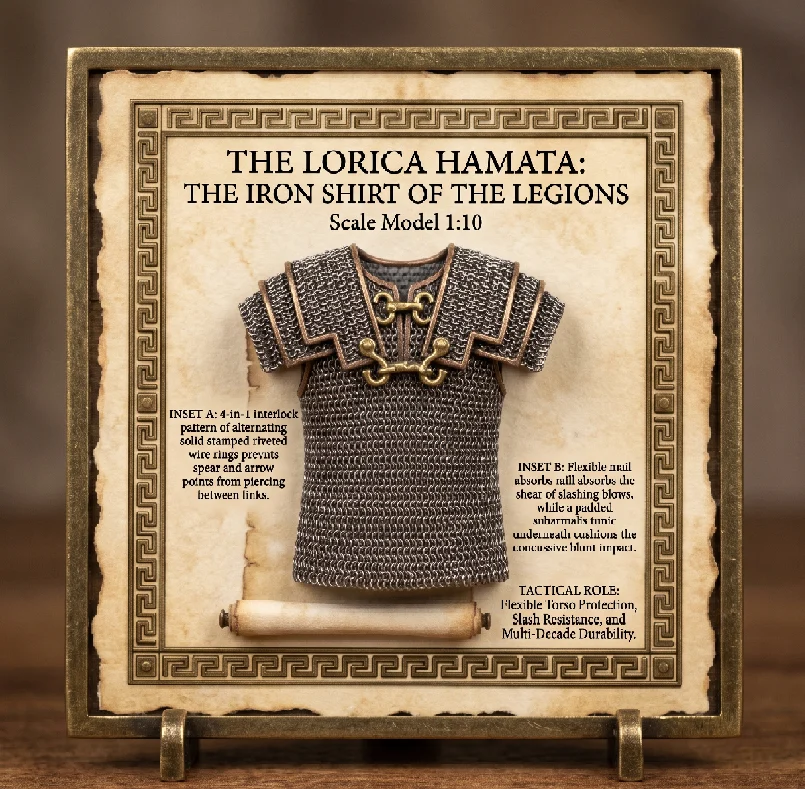
The Lorica Hamata: The Iron Shield That Forged the Roman Legions
Modern cinema routinely equips Roman soldiers in gleaming segmented plate armor, marching across sunlit provinces like clockwork automatons. Yet archaeology and classical literature present a far different picture of Roman military dominance. For over six hundred years, the true defensive foundation of the legionary was the Lorica Hamata.
Known simply as the iron shirt of the legions, the Lorica Hamata survived transitions from agrarian Republic to sprawling principate, outlasting every competing armor design in the Roman arsenal. It protected legionaries as they clashed with Celtic longswords, Parthian arrows, and Germanic battle-axes.
Celtic Origins and the Early Adoption of Mail Armor
Rome rarely invented its military equipment from scratch. The genius of Roman military doctrine lay in ruthless pragmatism: whenever the Republic faced an enemy weapon superior to its own, it adopted, refined, and mass-produced that weapon for its own legions.
During the fourth and third centuries BC, the Roman Republic engaged in brutal wars against Gallic tribes pushing south over the Alps. These Celtic warriors fielded a flexible, cut-resistant protective garment composed of interlocking iron rings.
Classical historian Polybius noted in Book VI of The Histories that wealthy Roman citizens in the Polybian levy opted for this Celtic-derived mail shirt instead of the small bronze pectoral heart-guard (pectorale). The Gallic heavy iron slashing sword was capable of cleaving bronze pectorals and splitting wooden shields.
Roman commanders quickly recognized that the interlocking weave of mail absorbed and redirected the slicing energy of heavy blades, keeping the soldier’s vital organs intact. By the end of the Punic Wars, the Lorica Hamata had evolved from an aristocratic luxury into the primary defensive armor issued across the heavy infantry.
       [ Celtic Mail Shirt ]
                 │
                 ▼  (Third-Century BC Gallic Wars)
     [ Republican Roman Adoption ]
                 │
                 ▼  (Marian Reforms: Standardized Mass Production)
     [ Lorica Hamata (Imperial Pattern) ]
                 │
                 ▼  (Worn through Republic, Empire, and Late Antiquity)
     [ Medieval European Hauberk ]
Metallurgy and the Anatomy of the Lorica Hamata
The manufacturing process of the Lorica Hamata was a triumph of ancient metallurgical engineering. Constructing a single mail shirt required between thirty thousand and fifty thousand individual iron rings, demanding up to two hundred hours of skilled labor from imperial fabricae (armories).
Rather than using open butt-jointed wire rings—which pull apart easily when struck by an arrow or spear—Roman armories used an alternating ring configuration that maximized tensile strength while keeping weight manageable.
(Solid Ring) ── (Riveted Ring) ── (Solid Ring)
     │                 │                │
     └─────────► [4-in-1 Weave] ◄───────┘
The construction system relied on two distinct ring types:
-
Stamped Solid Rings: Crafted by punching out washers from thin iron sheets or punching rings directly from cast iron blanks. These seamless rings had no weak points or joints, creating an unyielding anchor structure.
-
Riveted Wire Rings: Made by coiling wrought iron wire around an iron mandril, cutting the coils into individual open circles, flattening the overlapping ends, punching a microscopic hole through the overlap, and inserting a wedge-shaped iron or bronze rivet.
Roman armorers linked these rings using the standard European “4-in-1” weave, where each solid ring was linked into four adjoining riveted rings. Ring diameters typically varied between five and seven millimeters, with wire thicknesses hovering around one to 1.5 millimeters.
This tight weave created an iron fabric that was extraordinarily difficult to penetrate with cutting blades or broad arrowheads.
                  [Shoulder U-Doubling]
                   /                 \
        ┌─────────▼───────────────────▼─────────┐
        │  [Cast-Brass Pectoral S-Hooks / Studs]  │
        ├───────────────────────────────────────┤
        │                                       │
        │                                       │
        │           Mail Torso Body             │
        │       (30,000 to 50,000 Rings)        │
        │                                       │
        │                                       │
        ├───────────────────────────────────────┤
        │     Thigh-Length Skirt Hem Split      │
        └───────────────────────────────────────┘
The architecture of the shirt was tailored specifically for hand-to-hand combat:
Shoulder Doubling and the Pectoral Fasteners
The shoulder area received reinforcement through an additional U-shaped yoke of mail, directly inspired by Greek linothorax shoulder capes. This double layer draped over the trapezius muscles and clavicles, cushioning downward strikes from heavy two-handed axes or plunging cavalry swords.
The shoulder cape was fastened across the breastbone using cast-brass or bronze S-shaped hooks or breast studs, securing the heavy yoke during violent forward lunges.
Length and Cut
The Republican and early Imperial Lorica Hamata hung down to the mid-thigh, featuring short, capped sleeves or no sleeves at all. Slits along the hips allowed the legionary to march with an unhindered stride and ride horses without bunching the iron rings around the waist.
The Combat System: Mail, Subarmalis, and Shield
Mail armor is not a standalone defense; it is an outer layer within an integrated protective system. The Lorica Hamata was designed to resist slashing edges, shear forces, and surface punctures, but its flexibility meant it could not disperse blunt-force trauma on its own.
A heavy blow from a war club or a downward chop from a falcata could break ribs, fracture clavicles, or cause massive internal hemorrhaging even if the iron rings remained unbroken.
[ Incoming Blade / Weapon Impact ]
              │
              ▼
    ╔════════════════════════════════════════════╗
    ║  Lorica Hamata: Prevents Flesh Laceration  ║
    ╚════════════════════════════════════════════╝
              │
              ▼  (Transferred Kinetic Shock)
    ┌────────────────────────────────────────────┐
    │  Subarmalis (Padded Linen / Felt):         │
    │  Absorbs and Spreads Kinetic Impact        │
    └────────────────────────────────────────────┘
              │
              ▼
    [ Legionary's Torso: Undamaged ]
To solve this physical limitation, every Roman soldier wore a specialized padded garment known as the subarmalis beneath the mail:
-
Shock Absorption: Stuffed with layered linen, wool, or compressed animal felt, the subarmalis cushioned kinetic blows and distributed point impacts across the chest.
-
Chafing Prevention: An unpadded iron shirt weighing upwards of twenty-five pounds would rub bare shoulders raw within miles of marching; the subarmalis eliminated direct friction against skin or tunic.
-
Edge Softening: Leather or felt pteryges (hanging strips) often extended from the shoulders and hem of the subarmalis, providing extra protection to the upper arms and thighs without adding cumbersome iron weight.
The primary defensive tool remained the curved rectangular body shield, the scutum. Roman tactical doctrine required the soldier to deflect incoming missiles and heavy strikes with the plywood-and-iron shield first.
The Lorica Hamata functioned as the backup survival layer, catching wild flanking cuts, glancing spears, and fragmented debris that slipped past the rim of the scutum.
| Protective Layer | Construction Material | Primary Tactical Purpose |
| Scutum (Shield) | Layered birch/poplar, canvas, iron boss | Absorbs initial missile impacts and redirects heavy blows |
| Lorica Hamata | Alternating stamped and riveted iron rings | Halts blade penetration and prevents flesh slicing |
| Subarmalis | Quilted linen, wool, compressed felt | Dampens concussive shock and eliminates skin chafing |
| Balteus / Cingulum | Thick leather with brass plates | Cinches waist, transferring mail weight from shoulders to hips |
Tactical Mobility and Field Maintenance
A standard Lorica Hamata weighed between twenty and thirty-two pounds. While this sounds heavy on paper, the distribution of weight made it manageable on long marches.
When belted tightly at the waist with the military belt (cingulum militare), roughly half the shirt’s mass transferred directly to the pelvic girdle and hips. This relieved pressure on the shoulders and spine, allowing legionaries to march twenty Roman miles a day with full combat kit.
Flexible mail also moved with the torso. Unlike rigid plate armor, it allowed the soldier to bend, twist, reload artillery, and dig entrenchment ditches without removing his armor.
Its open weave provided superior air circulation in hot Mediterranean campaigns compared to solid bronze cuirasses, lowering the risk of heat exhaustion during extended sieges in Greece, Judea, and North Africa.
        [ Field Maintenance Routine ]
                      │
  ┌───────────────────┴───────────────────┐
  ▼                                       ▼
[ Minor Ring Breakage ]             [ Corrosion / Rust ]
  │                                       │
  ▼                                       ▼
• Extracted with pliers             • Placed in leather sack
• Cold-riveted with spare links     • Mixed with sand and oil
• Repaired immediately in tent      • Rolled back and forth to scour
Logistical maintenance was another significant advantage:
-
On-the-Spot Repairs: If four or five rings snapped under a hard blow, a soldier did not need a master armorer or forge to fix them. Carrying a small pouch of spare riveted rings and cold-crimping pliers, a legionary could patch his own armor inside his tent.
-
Corrosion Control: In damp frontier postings along the Rhine and Danube, iron rust was a constant issue. Roman troops cleaned their mail by placing the shirt into a heavy leather barrel or sack filled with dry sand and vinegar or oil, then rolling the sack back and forth. The tumbling sand polished away surface rust, leaving the iron rings bright and functional.
-
Generational Longevity: Because broken links could be replaced indefinitely, a single Lorica Hamata could remain in active service for decades, often passed down from father to son across generations of legionary service.
Lorica Hamata versus Lorica Segmentata
During the first century AD, imperial armories introduced the famous segmented plate armor (Lorica Segmentata). Modern media often treats this development as an outright replacement of chainmail, but archaeological finds reveal that the two systems served side by side for over two centuries.
                    [Roman Torso Armor Options]
                                 │
         ┌───────────────────────┴───────────────────────┐
         ▼                                               ▼
[ Lorica Hamata: Mail ]                         [ Lorica Segmentata: Plate ]
 ├── Universal troop issue                       ├── Legionary infantry exclusive
 ├── High flexibility & airflow                 ├── Superior deflection of blunt force
 ├── Easy field maintenance                      ├── Vulnerable internal leather straps
 └── Remains in service 600+ years               └── Disappears by late 3rd century AD
Segmented plate armor offered better resistance against high-energy missile weapons like the Dacian falx—a two-handed curved war blade capable of splitting helmets and crushing mail shirts. However, plate armor carried operational weaknesses.
The articulated steel hoops were bound together by delicate internal leather straps, brass hinges, and tie-loops that corroded quickly in wet climates or snapped under daily strain. Repairing broken plate required specialized blacksmithing, rivets, and matching sheet metal.
The Lorica Hamata, by contrast, remained the universal armor of the Roman military:
-
Auxiliary Troops: Auxilia infantry, archers, and allied levies wore mail almost exclusively throughout the Principate.
-
Cavalry Squadrons: Roman cavalry (alae) favored the flexibility of the hip-split mail shirt, which allowed uninhibited riding and spearmanship.
-
Centurions and Veterans: Senior field officers frequently chose ornate mail shirts fitted with silvered buckles and shoulder doubling, valuing reliability over brittle plate mechanics.
By the crisis of the third century AD, logistical collapses and shrinking treasuries made the delicate Lorica Segmentata unsustainable. The Roman military retired plate armor completely, reverting to the durable, easily maintained Lorica Hamata as the standard torso armor of the late imperial army.
The Long-Term Impact on Medieval European Warfare
When the Western Roman Empire collapsed in the late fifth century, the technical knowledge required to forge large, articulated plate cuirasses largely disappeared from Western Europe for centuries. The craft of manufacturing riveted iron mail, however, survived uninterrupted.
The Lorica Hamata served as the direct technological ancestor to the early medieval hauberk. From Byzantine cataphracts to Anglo-Saxon huscarls, Carolingian knights, and Norman conquerors depicted on the Bayeux Tapestry, European warriors wore mail shirts built with the same 4-in-1 alternating stamped-and-riveted technique perfected in Roman fabricae.
The design endured because it offered an optimal balance of protection, mobility, and structural durability. Through centuries of combat across three continents, the iron shirt of the Roman legions proved that battlefield survivability is measured not by rigidity, but by adaptability under pressure.
Frequently Asked Questions
What does Lorica Hamata mean in Latin?
The term Lorica Hamata translates directly to “hooked armor” or “mail cuirass.” It refers to the hook-shaped fasteners (hamata) used to secure the reinforced shoulder doubling across the chest, as well as the curved rings woven into its 4-in-1 design.
How heavy was the Lorica Hamata, and did it restrict movement?
A standard Roman mail shirt weighed between twenty and thirty-two pounds (roughly nine to fifteen kilograms). When cinched tightly at the waist with the military belt (cingulum militare), much of the weight rested on the hips rather than the shoulders. Because mail is flexible, it moved naturally with the body, allowing legionaries to swing weapons, sprint, and bend without restricting mobility.
Why did the Roman army use Lorica Hamata longer than Lorica Segmentata?
While Lorica Segmentata provided superior defense against heavy blunt weapons, it was difficult to maintain. Its internal leather straps rotted in damp climates, its brass fittings broke easily, and repairs required skilled blacksmiths. The Lorica Hamata was far more durable, easier to clean, and could be repaired in the field by soldiers using spare rings and pliers, remaining in service long after plate armor was abandoned