
Göbekli Tepe Mystery: The Megalithic Site That Rewrote History
The Göbekli Tepe mystery dismantled the foundational timeline of human civilization when its carved monoliths surfaced from the dust of southeastern Turkey. For generations, orthodox archaeology operated on an orderly sequence: humans developed agriculture, permanent farming communities formed, labor surpluses emerged, and settled societies constructed monumental stone temples. The staggering antiquity of this Anatolian hilltop proved that hunter-gatherers erected monumental architecture six millennia before Stonehenge and seven millennia before the Great Pyramid of Giza.
In the autumn of 1994, German archaeologist Klaus Schmidt visited a rounded limestone ridge fifteen kilometers northeast of the modern city of Şanlıurfa. A joint survey by Istanbul University and the University of Chicago had visited the hill in 1963, casually cataloging the scattered flint fragments and stone slabs as an abandoned medieval cemetery. Schmidt looked at the topography with seasoned eyes and recognized that the mound was artificial.
Scattered across the dry hillsides were tens of thousands of worked flint flakes, blades, and knapped cores. The sheer density of lithic debris signaled a massive, sustained manufacturing hub from the Pre-Pottery Neolithic era. When formal excavations commenced in 1995, Schmidt broke through topsoil to uncover a prehistoric complex that would transform our understanding of the ancient world into the profound Göbekli Tepe mystery.
The Rediscovery of Potbelly Hill and Early Excavations
The site name, Göbekli Tepe, translates colloquially from Turkish as “Potbelly Hill,” referencing the prominent knoll rising nearly eight hundred meters above sea level. Beneath this rounded silhouette lay an architectural complex spanning approximately nine hectares, completely invisible until modern spades exposed its limestone rings.
Schmidt coordinated a cooperative research expedition between the German Archaeological Institute and the Şanlıurfa Museum. The initial test trenches were expected to hit ordinary domestic walls or stone-lined hearths typical of early foraging camps. Instead, excavators struck smoothed limestone monoliths carved with sculptural precision.
The stratigraphy revealed multiple distinct occupational horizons. The oldest stratum, designated Layer III, preserved monumental circular and oval enclosures dating between 9500 and 8800 BCE. Concentric rings of megalithic pillars encircled central pairs of massive monoliths, embedded into bedrock floors polished smooth by prehistoric masons.
Above this layer, archaeologists documented Layer II, dating to the Pre-Pottery Neolithic B period between roughly 8800 and 8000 BCE. Here, the architectural form transitioned from sweeping circular sanctuaries to smaller, rectangular rooms with shorter pillars. The shift in layout added another layer to the emerging Göbekli Tepe mystery, demonstrating evolving architectural and religious traditions across more than a millennium.
[Chronological Horizons at Göbekli Tepe]
Layer III (ca. 9500–8800 BCE): Monumental circular enclosures (Enclosures A–D), 5.5-meter T-shaped pillars
Layer II (ca. 8800–8000 BCE): Rectangular multi-room architecture, smaller 2-meter megaliths
Layer I (ca. 8000 BCE onward): Systematic intentional backfill, surface plow zone, sediment wash
Monolithic Megaliths: Quarrying and Architecture in the Stone Age
The architectural engineering of Layer III required logistical mobilization on an unprecedented scale. Builders excavated T-shaped pillars directly from limestone plateaus situated mere hundreds of meters from the hilltop summit. Using only dense flint picks, basalt pounders, and wooden wedges soaked with water, stonecutters cleaved blocks weighing between ten and twenty tons from the bedrock.
In adjacent ancient quarries, archaeologists located several unfinished monoliths still attached to the bedrock floor. One partially extracted pillar measures over seven meters in length and weighs an estimated fifty tons. Moving these colossal stones uphill across rugged limestone terraces required hundreds of workers coordinating haulage ropes, wooden rollers, and levers.
The logistical reality of moving fifty-ton limestone slabs without wheels or draft animals deepens the Göbekli Tepe mystery. The builders created sophisticated enclosures with exceptional precision:
-
Central Monoliths: Twin T-shaped pillars erected at the geometric center of each enclosure, standing up to 5.5 meters tall and weighing between eight and ten tons.
-
Perimeter Colonnades: Ten to twelve peripheral pillars integrated into curved walls composed of unworked fieldstones and limestone rubble.
-
Terrazzo Flooring: Enclosures paved with an engineered mortar of crushed limestone, burnt lime, and gravel, ground smooth and rendered completely impermeable to water.
-
Socketed Bases: Central pillars seated in shallow bedrock pedestals scarcely twenty centimeters deep, kept stable through counterbalancing and timber-braced roof rafters.
The Carved Bestiary: Iconography and Anthropomorphic Pillars
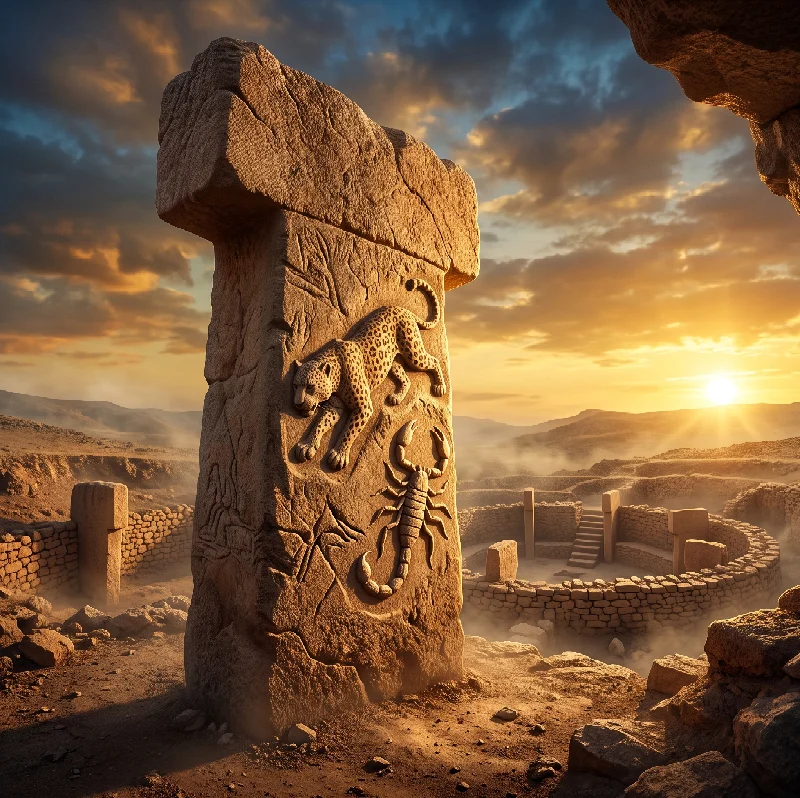
The monoliths were not merely structural supports; they served as narrative canvases depicting a formidable bestiary. The stonemasons carved their designs directly into the crystalline limestone using both bas-relief and high-relief sculpture. These carvings were executed with anatomical accuracy that presupposes an established artistic tradition.
The fauna represented on the pillars reflects a dangerous local ecosystem dominated by aggressive predators and venomous creatures. Snarling lions, bared-teeth boars, leaping foxes, coiled serpents, and scorpions cover the stone shafts. One exceptional high-relief carving depicts a predator crawling downward along the edge of a pillar, complete with individual ribs, shoulder blades, and extended claws.
[Iconographic Catalog Across Enclosures]
- Enclosure A (Snake Building): Dominance of interwoven serpents, net-like engravings
- Enclosure B (Fox Building): Prominent leaping foxes carved along the central shaft faces
- Enclosure C (Boar Building): Savage wild boars carved in high relief, multiple concentric rings
- Enclosure D (Vulture Building): High-relief vultures, scorpions, headless human silhouettes
The T-shape of the pillars carries deliberate anthropomorphic symbolism. Viewed in profile, the horizontal crossbar represents a stylized human head, while the vertical pillar shaft serves as an upright torso. Along the sides of the central pillars in Enclosure D, carvers sculpted human arms bending at the elbow, with long, delicate fingers meeting above an engraved loincloth made of animal pelt.
Facial features were intentionally omitted, suggesting that these towering figures represented ancestral spirits, supernatural deities, or mythological guardians. The symbolic presence of headless humans beneath soaring birds of prey aligns with the mortuary rituals of [Internal Link: Neolithic Skull Cult Practices], pointing toward complex funerary traditions.
Subsistence Without Farming: The Forager Reality
For over a century, scholars argued that monumental public works could only emerge from an agricultural surplus. Building large stone monuments was thought to require granaries of domesticated wheat, tax systems, and administrative bureaucracies. The economic evidence at Göbekli Tepe overturned this assumption.
Excavation teams have water-sieved hundreds of tons of soil across the site, recovering over one hundred thousand animal bone fragments. Zoological analysis carried out by the German Archaeological Institute revealed that every bone belonged to wild fauna:
-
Wild Gazelle (Gazella subgutturosa): Accounts for over sixty percent of the faunal assemblage, reflecting massive seasonal hunts.
-
Aurochs (Bos primigenius): Immense wild cattle that provided huge quantities of tallow, hide, and meat.
-
Asiatic Wild Ass (Equus hemionus): Swift steppe equids hunted with organized pit traps and ambush tactics.
-
Wild Boar (Sus scrofa): Aggressive forest and riverbed game providing calorie-dense meat and carving bone.
Botanical analysis corroborated the faunal evidence. Archaeobotanists recovered charred seeds of wild einkorn, wild barley, wild lentils, and wild almonds, but not a single domesticated crop strain was found within Layer III. The Göbekli Tepe mystery centers on this archaeological reality: the builders were pure hunter-gatherers operating centuries before the dawn of systematic agriculture.
[Faunal Profile: Bone Fragments Identified]
Wild Gazelle: ~60% (Migratory herds driven through seasonal valleys)
Wild Bovines (Aurochs): ~15% (Massive high-yield game animals)
Wild Equids / Wild Boar: ~15% (Steppe and riverbed game)
Wild Hare, Birds, Small Game: ~10% (Supplemental opportunistic foraging)
Domesticated Species: 0% in Layer III (No domesticated sheep, goats, or cattle)
The sheer volume of processed game points toward colossal communal feasts. Hunter-gatherer bands from across the northern Fertile Crescent gathered seasonally on this limestone ridge. They shared food resources, arranged marriages, settled tribal disputes, and quarried stone monuments to honor shared belief systems.
The Neolithic Revolution Upended
These discoveries inverted the established model of human civilization. Rather than agriculture providing the necessary foundation for religion, religious congregation likely drove the development of agriculture. Klaus Schmidt argued that the logistical necessity of feeding hundreds of laborers during seasonal building projects pushed ancient foragers toward systematic harvesting.
The nearby Karaca Dağ volcanic range, visible on the horizon north of the sanctuary, is the genetic birthplace of all modern domesticated einkorn wheat. The geographic proximity of early grain domestication to this site is not accidental. The communal rituals underlying the Göbekli Tepe mystery were likely the catalyst that led foraging societies to domesticate wild grasses, laying the foundations for [Internal Link: The Agricultural Revolution in the Fertile Crescent].
The Enigma of the Great Backfill
The physical construction of the monumental enclosures represents only one aspect of this archaeological puzzle. Around 8000 BCE, after centuries of continuous ritual use, the people who gathered at the site performed an unprecedented act. They did not abandon the stone circles to erode beneath the elements, nor were the pillars toppled by an invading army.
Instead, the ancient builders systematically entombed the monuments beneath massive amounts of backfill material. Millions of cubic feet of sediment, animal bone refuse, broken flint tools, and limestone rubble were shoveled into the enclosures by hand. The fill was poured over the pillars until the five-meter monoliths were buried beneath a flat-topped mound.
This deliberate burial created the artificial hill that preserved the site for ten millennia. Explanations for this burial remain among the most contested debates in archaeology:
-
Decommissioning of Sacred Ground: Ritual closure ceremonies intended to entomb the potency of worn-out sanctuaries when communities built new enclosures.
-
Protection Against Desecration: Deliberate preservation of ancestral shrines as cultural patterns shifted toward domestic life.
-
Shifting Ideology: A clean break from ancestral beliefs as early farming economies replaced migratory hunting lifeways.
-
Catastrophic Soil Erosion: Recent geoarchaeological theories proposing that heavy rain and hillside slippage washed debris into the sunken enclosures from the surrounding plateaus over long periods.
Regardless of the mechanism, this deliberate burial protected the carvings from weather, looters, and wind erosion, keeping the Göbekli Tepe mystery preserved until modern times.
Technical Specifications: Weapons, Tools, and Lithic Technology
Without bronze or iron, the masons constructed these monumental stone rings using sophisticated lithic toolkits. Excavations within the fill and surrounding quarry trenches yielded hundreds of thousands of specialized stone tools made from high-grade flint and imported volcanic glass:
-
Byblos Points: Slender, pressure-flaked flint projectile points measuring 60 to 90 millimeters in length, featuring tangs for secure hafting onto wooden arrow shafts.
-
Nemrik Points: Tanged flint hunting points with diamond-shaped cross-sections, used for taking down heavy game like aurochs and boars.
-
Basalt Hammerstones: Dense igneous cobbles weighing two to five kilograms, sourced from riverbeds to hammer and shape limestone blocks.
-
Flint Adzes and Picks: Heavy chipped stone implements with reinforced working bits, used to carve bedrock trenches and dress the faces of T-shaped pillars.
-
Obsidian Blades: Prismatic razor-sharp blades struck from prepared volcanic glass cores, imported from volcanic sources in Cappadocia and Lake Van hundreds of kilometers away.
The presence of imported obsidian highlights extensive exchange networks connecting communities across prehistoric western Asia. Long-distance trade routes moved luxury materials and ideas long before the emergence of urban city-states.
Global Significance of the Göbekli Tepe Mystery
Only a small fraction of the complex has been excavated so far. Ground-penetrating radar, geomagnetic surveys, and electrical resistivity scans indicate that at least sixteen additional monumental enclosures remain buried beneath the mound. The complex is not an isolated wonder; nearby sites across the Taş Tepeler region, such as Karahan Tepe and Sayburç, share identical T-shaped iconography and architectural designs.
The site proves that hunter-gatherers possessed rich, complex inner lives. They maintained sophisticated cosmologies, complex symbolic vocabularies, and social structures capable of organizing labor on a grand scale. The view that foraging humans were crude, struggling nomads has been erased by the architectural reality of this Anatolian summit.
The Göbekli Tepe mystery reminds us that the human story does not always follow a predictable path. Over eleven millennia ago, on an arid ridge above the Harran Plain, ancient people raised massive limestone monoliths toward the sky. Their stone sanctuary proved that the search for meaning, myth, and the sacred shaped the path of human civilization.
Frequently Asked Questions
What is the primary Göbekli Tepe mystery?
The primary mystery centers on how hunter-gatherers lacking metal tools, draft animals, or the wheel quarried, transported, and carved twenty-ton limestone pillars around 9500 BCE. Its extreme age challenged the established archaeological belief that monumental architecture could only be built by settled farming civilizations.
How old is Göbekli Tepe compared to other famous monuments?
Radiocarbon dating places the construction of Göbekli Tepe at approximately 9500 BCE, making it over 11,500 years old. It predates Stonehenge by roughly six thousand years, the Great Pyramid of Giza by seven thousand years, and the invention of writing by more than six millennia.
Why was Göbekli Tepe buried instead of abandoned?
Archaeological evidence indicates that around 8000 BCE, the ancient builders systematically backfilled the stone enclosures by hand with thousands of tons of earth, flint refuse, and animal bones. Scholars debate whether this was a ritual decommission, a move to protect sacred spaces, or the result of catastrophic slope wash from adjacent settlements.