
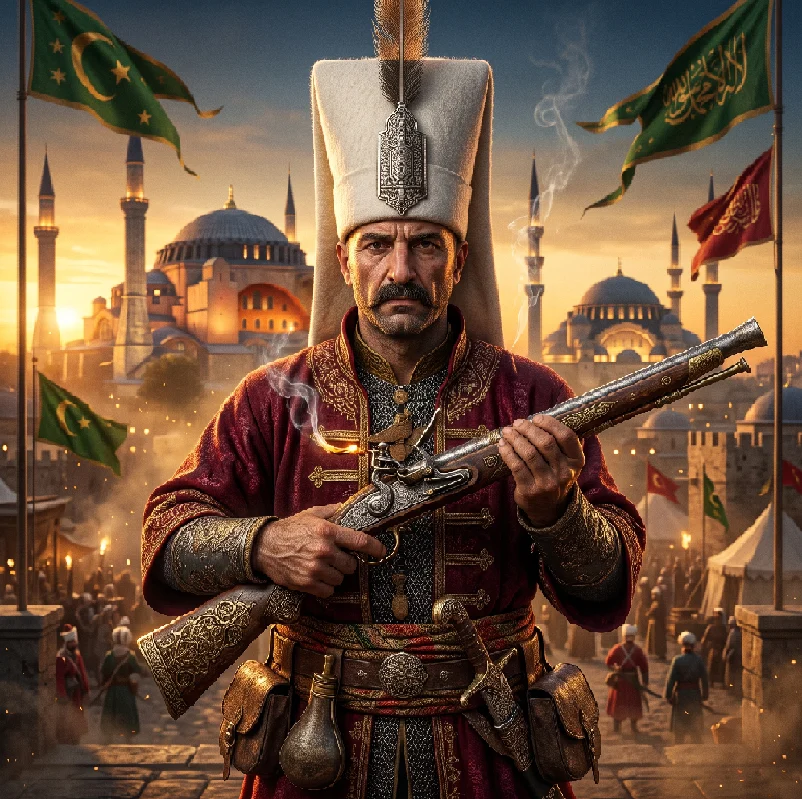
Ottoman Empire: The Gunpowder Machine That Remade Europe
In the spring of 1453, the Mediterranean world watched the collapse of an ancient order. Sultan Mehmed II brought down the colossal stone ramparts of Constantinople, using a calculated technological doctrine that announced the dawn of firearms in statecraft. That seismic victory established the Ottoman Empire as the foremost superpower spanning Southeast Europe, Western Asia, and North Africa.
The Ottoman Empire was not an arbitrary conqueror relying solely on manpower. It was an advanced administrative and logistical machine that bridged East and West, dictated global commerce, and commanded Mediterranean sea lanes. Over six centuries, its centralized institutions forced every rival European and Asian crown onto permanent defensive alert.
From Anatolian Borderland to Universal Hegemony
The political trajectory of the Ottoman Empire began around 1299 in the northwestern marches of Anatolia. Osman I, a leader of Turkmen pastoralists, carved out an autonomous principality (beylik) adjacent to a fractured Byzantine frontier. While rival Turkmen dynasties squabbled over the interior Anatolian plateau, Osman’s fighters directed their operational energy against the failing defenses of Bithynia.
This borderland position offered significant strategic advantages. It attracted thousands of dedicated frontier raiders (gazis), displaced artisans, and nomadic cavalrymen eager for campaign plunder. Rapid expansion across the Dardanelles into Thrace transformed what was an itinerant raiding band into a territorial power with its capital at Edirne.
Successive victories at Kosovo in 1389 and Nicopolis in 1396 shattered coordinated European crusades. The state demonstrated an extraordinary ability to absorb demographic shocks, rebounding quickly even after the catastrophic defeat against Timur at Ankara in 1402.
By the mid-fifteenth century, the Ottoman Empire was prepared to eliminate the final remnant of Eastern Rome. When Constantinople fell to Mehmed II, the Ottoman sovereign claimed the title of Kayser-i Rum (Caesar of Rome). The fledgling frontier emirate had completed its transformation into an imperial superpower.
The Imperial Standing Army: Janissaries and the Kapıkulu
At the foundation of early Ottoman supremacy stood the Kapıkulu (Slaves of the Sublime Porte). This corps represented Europe’s first permanent, professional standing military since the fall of Imperial Rome. Contemporary Western monarchs relied on unruly feudal levies or expensive, mutinous mercenary companies, while the Ottoman Empire fielded disciplined full-time soldiers paid directly in cash from the central treasury.
The core of this system was the elite Janissary infantry (Yeniçeri):
-
Recruits entered the service through the devshirme levy across Balkan rural communities, undergoing intensive physical, linguistic, and spiritual instruction.
-
Early institutional statutes barred Janissaries from marrying or conducting commercial trade, forging an insular subculture whose sole loyalty belonged to the reigning sultan.
-
Troops were housed in collective barracks (oda) structured around shared copper cooking cauldrons (kazan), which served as sacred regimental standards.
-
Soldiers drilled year-round in rapid marching, entrenchment engineering, and weapon maintenance.
The Janissaries embraced gunpowder long before Western forces integrated matchlocks on a large scale. By the late fifteenth century, the corps had traded traditional recurve bows for long-barreled matchlock muskets (tüfenk).
In open engagements, the Ottoman Empire deployed the Tabur Cengi (wagon fortress), derived from central European models. Heavy baggage carts were chained together to form an impenetrable perimeter studded with light swivel guns. From behind these palisades, Janissary companies maintained rolling volleys that broke mounted knightly charges with mechanical efficiency.
Ordnance, Weaponry, and Logistics of the Ottoman War Engine
Ottoman military superiority relied on advanced metallurgical engineering and institutional logistical planning. While European kingdoms scrambled to fund ad-hoc campaign supply trains, the Ottoman state maintained standardized depots, arms manufactories, and granaries across primary imperial roads.
The standard arsenal of the classical Ottoman soldier balanced personal agility with heavy shock protection:
-
Matchlock Musket (Tüfenk): Long, smoothbore firearms firing lead balls over distances up to two hundred yards, prioritizing armor penetration.
-
Yataghan: A forward-curving, single-edged short sword lacking a traditional crossguard, designed for devastating close-quarters thrusts and drawing cuts.
-
Kilij: A light, deeply curved cavalry saber featuring a flared false edge (yelman) optimized for slashing downward from horseback.
-
Krug Armor: Composite mirror armor featuring circular iron plates joined by riveted chainmail links, shielding vital organs while allowing mobility.
-
Chichak Helmet: A conical steel helmet fitted with an adjustable nasal bar, cheek guards, and a laminated neck guard to protect against downward blade strokes.
Ottoman industrial artillery was organized under the specialized Topçu corps. Ahead of the siege of Constantinople, imperial arsenals cast gigantic bronze bombards designed by the engineer Urban. The largest of these weapons, the Basilica bombard, hurled granite stones weighing half a ton against the Theodosian Walls.
Logistical efficiency was equally evident on the march. Armies moving through Thrace and the Danube valley relied on an imperial road system lined with menzil stations:
-
Staging hubs stored grain, hardtack, dried meat, and gunpowder months before the sultan departed Istanbul.
-
Thousands of camels and mules transported field bakeries, medical tents, and ammunition boxes along paved military routes.
-
Specialized pioneer corps (Lağımcılar) surveyed road conditions, drained marshes, and constructed timber bridges ahead of the main column.
This logistical prowess [Internal Link: Classical Siege Craft Innovations] allowed the Ottoman Empire to field armies exceeding one hundred thousand men deep within Central Europe without risking mass starvation.
Suleiman the Lawgiver: Administration, Law, and the Millet System
Under Sultan Suleiman I, who reigned from 1520 to 1566, the Ottoman Empire reached its territorial, economic, and institutional peak. Western chroniclers marveled at his wealth, naming him “the Magnificent,” yet his domestic subjects revered him as Kanuni (“the Lawgiver”).
Suleiman recognized that an empire spanning dozens of languages, ethnicities, and religious confessions could not be sustained through physical force alone. In collaboration with the Chief Mufti Ebussuud Efendi, Suleiman harmonized Islamic Sharia with secular dynastic law (kanun), creating the comprehensive legal corpus known as the Kanun-i Osmani.
This legal structure regulated property rights, marketplace taxation, land tenure, and administrative accountability. It protected peasant cultivators (reaya) from predatory aristocratic extortion, ensuring that tax revenues flowed straight into imperial treasuries rather than feudal pockets.
The governing structure relied on the Millet system, which granted institutional autonomy to religious minorities:
-
Christian Orthodox, Armenian Apostolic, and Jewish communities governed their internal civil disputes, family law, and primary schools under their own ecclesiastical leaders.
-
Communities settled legal disputes within their own courts, appealing to Ottoman judges (kadis) only when cases crossed interfaith boundaries.
-
In exchange for institutional protection and religious liberty, non-Muslim subjects paid a poll tax (jizya) and remained exempt from frontline military conscription.
Following the expulsion of Jews from Spain in 1492, Sultan Bayezid II dispatched Ottoman ships to bring thousands of Iberian refugees to Istanbul and Thessaloniki. These communities brought printing presses, metallurgical skills, and international trade networks that invigorated the economy of the Ottoman Empire.
The Battle of Mohács: Tactical Climax of the Ottoman Empire
The devastating effectiveness of this administrative and tactical system was demonstrated at the Battle of Mohács on August 29, 1526. The Hungarian kingdom assembled its noble cavalry on an open plain along the Danube, seeking to crush the Ottoman center in a single frontal charge.
Suleiman deployed his forces in three coordinated tiers:
-
Irregular cavalry (Akinji) and provincial horsemen (Sipahi) formed a fluid forward screen, drawing the armored Hungarian chivalry forward.
-
When the Hungarian knights charged, the Ottoman cavalry peeled away to the flanks, uncovering a fortified barrier of chained supply carts.
-
Behind the carts stood three hundred field guns backed by thousands of entrenched Janissary musketeers.
The Hungarian heavy cavalry charged directly into an interlocking kill zone. Concentrated canister shot and disciplined rolling musket volleys broke the forward charge within minutes, killing King Louis II and the bulk of the Hungarian aristocracy.
In a two-hour engagement, the Ottoman Empire extinguished the medieval Kingdom of Hungary, pushing its administrative border directly against the Austrian Habsburg domains.
Tactical Evolutions: The Shift to Provincial Cavalry
While the standing Janissary corps occupied the institutional center, the operational backbone of open-field campaigns rested upon the Timariot Sipahis. These cavalrymen held conditional revenue-producing estates (timar) granted directly by the sultan.
Unlike Western feudal lords, a sipahi did not own the land or the peasants who worked it. The land remained the property of the imperial treasury:
-
The cavalryman held rights only to collect a fixed agricultural tax in exchange for military service.
-
If a sipahi failed to report for a campaign with his armor, horses, and armed retainers (cebelu), his estate was revoked and reassigned.
-
Estates were non-hereditary by default, preventing the rise of entrenched provincial aristocracies that could challenge the authority of the throne.
This system provided the Ottoman Empire with an inexpensive standing force of tens of thousands of medium cavalry. Armed with recurve composite bows, steel maces, and lances, the Sipahis secured the flanks of the Janissary core, outmaneuvering slower Western European armored formations across open terrain.
Strategic coordination [Internal Link: Early Modern Combined Arms Doctrines] between flexible mounted wings and rigid gunpowder centerpieces gave Ottoman commanders an operational versatility unmatched by contemporary European armies.
Historical Misconceptions and Strategic Realities
Western historiography has often repeated caricatures regarding the internal dynamics of the Ottoman Empire. The most persistent myth frames the state as a religious monolith bent solely on forced conversion through holy war.
In historical reality, the empire was an exceptionally pragmatic fiscal entity. Ottoman administrators discouraged the mass conversion of Christian subjects because non-Muslims paid the jizya tax, which formed a foundational pillar of imperial revenue. Archival records in the Topkapi Palace demonstrate that Balkan peasants frequently chose Ottoman courts over local Christian feudal lords due to lower taxation rates and predictable judicial procedures.
Another persistent myth contends that the empire fell into irreversible military decay immediately following the failed Siege of Vienna in 1683. While external expansion stalled against modernized Austrian and Russian armies, the state displayed surprising adaptability for over two centuries.
The empire decentralized its administration, modernized its artillery schools under European military advisors, integrated into global diplomatic channels, and retained administrative control over its Middle Eastern heartland until the early twentieth century.
Archaeological Evidence and Archival Discoveries
The material reality of this imperial machine is preserved across modern excavations and archival collections throughout Southeastern Europe and the Middle East. Archaeological fieldwork at battle sites and border fortresses provides tangible proof of Ottoman operational standards.
Excavations at the fortress of Szigetvár in southern Hungary, where Suleiman died during the siege of 1566, have exposed extensive engineering works:
-
Deep mining galleries driven beneath stone ramparts, lined with charred timber revetments indicating subterranean gunpowder detonations.
-
Hundreds of solid iron cannonballs, lead musket shot, and bronze bombards bearing the distinct calligraphic royal monogram (tughra) of the reigning sultan.
-
Earthen assault ramps measuring hundreds of yards in length, constructed by thousands of camp laborers to roll heavy artillery batteries up to wall level.
The physical record matches the vast documentary archives preserved in Istanbul. The Ottoman archives contain over one hundred million documents, including tax registers (tahrir defterleri) that recorded every olive tree, watermill, and household across the empire.
These ledgers illustrate how logistical planning preceded field operations. Imperial scribes calculated grain yields down to the bushel months before troops marched, ensuring that the Ottoman Empire maintained its supply lines across thousands of miles of hostile terrain.
Geopolitical Aftermath: The Pax Ottomanica and the Modern Map
The long-term geopolitical outcomes of the Ottoman Empire permanently altered world history. By dominating the Levant, Egypt, and the Black Sea, the Ottomans controlled the traditional overland Silk Road trade routes connecting Europe with India and China.
This economic bottleneck altered the maritime priorities of Western Europe:
-
Portuguese and Spanish navigators were forced to seek alternative oceanic trade routes to Asia.
-
Vasco da Gama sailed around the Cape of Good Hope, while Christopher Columbus crossed the Atlantic Ocean.
-
The subsequent emergence of global maritime empires in the Atlantic directly resulted from the Ottoman land blockade across Eurasia.
Within its borders, the empire created a cultural and economic zone known as the Pax Ottomanica. For centuries, merchants traveled from Belgrade to Baghdad under a uniform legal code, using a single currency without crossing militarized internal borders.
When the Ottoman Empire finally dissolved following World War I, its partition left a political vacuum that continues to shape modern geopolitics. The borders of more than thirty modern sovereign states across the Balkans, the Middle East, and North Africa were drawn directly from former Ottoman provincial boundaries.
From the domed architecture of Sinan that defines Istanbul’s skyline to the multi-ethnic demographic composition of the Balkans, the institutional imprint of the Ottoman state remains etched into modern history. It stood as a formidable bridge between medieval feudalism and the modern bureaucratic state, demonstrating how administrative organization, religious tolerance, and gunpowder technology could sustain an empire across three continents.
Frequently Asked Questions
What was the Devshirme system in the Ottoman Empire?
The Devshirme was an imperial levy that conscripted young Christian boys from rural villages in the Balkans. Recruits converted to Islam, were educated in Istanbul in languages, governance, and combat, and were funneled into elite administrative positions or the Janissary military corps based on individual aptitude.
How did the Ottoman Empire view religious minorities?
The empire managed religious minorities through the Millet system. Non-Muslim communities, including Jews and Orthodox Christians, operated their own courts, schools, and charitable institutions under their respective religious authorities in exchange for paying an imperial poll tax (jizya).
Why was gunpowder technology so critical to Ottoman success?
Gunpowder technology was critical because the empire embraced it as a centralized industrial doctrine. Massive bronze siege bombards pulverized previously impregnable medieval stone fortifications, while disciplined Janissary musket companies firing behind wagon fortresses neutralized traditional heavy cavalry charges.